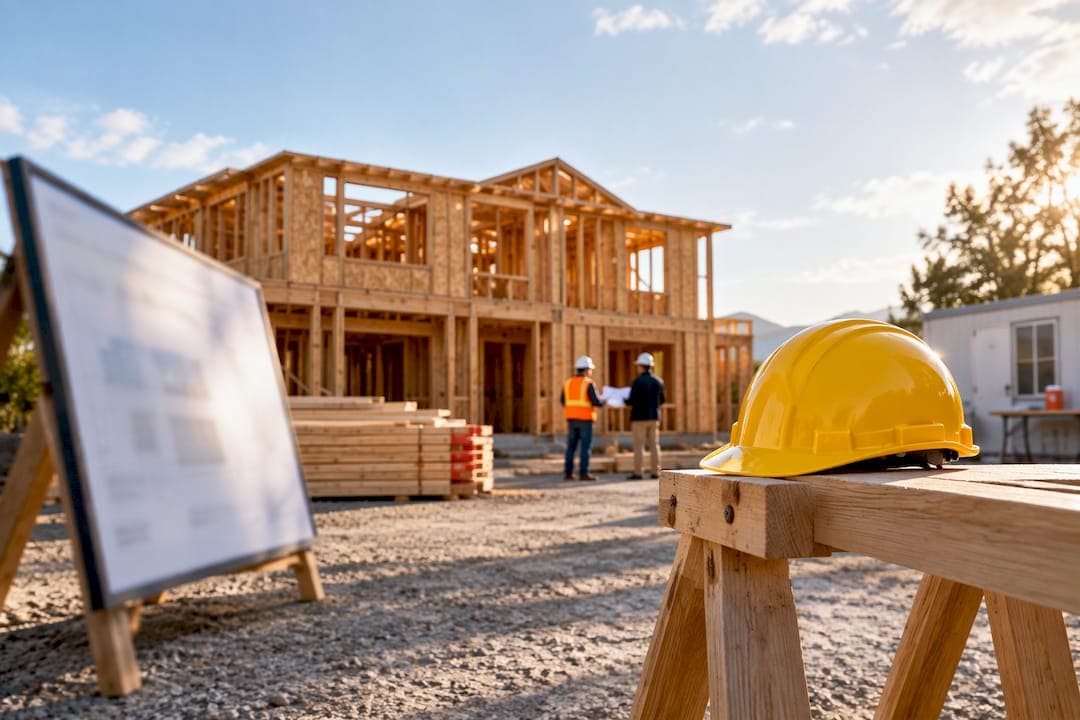
Lenders funding a construction loan typically require an issued building permit, plus any relevant trade and zoning approvals, before closing or releasing the first draw. Some lenders will accept a permit still in review if the borrower has paid intake fees and can show an approved plan review stamp, often paired with an escrow holdback for outstanding items. Final draws and loan closeout almost always depend on inspections and a certificate of occupancy.
TL;DR:
- Most lenders require that construction permits are issued or at least in review before closing, often with proof of fee payment and plan approval.
- Multiple permits, including trade and zoning permits, may be needed, and their approval times can range from weeks to several months depending on jurisdiction.
- Inspection and verification of work tied to permits are crucial for disbursement, with final loan closeout dependent on obtaining a certificate of occupancy.
- Preparing a complete permit package with plans, contractor documentation, and proof of land ownership streamlines underwriting and reduces delays.
- Confirming the local permit closeout document early prevents costly delays during the final draw and ensures project completion aligns with loan milestones.
Table of Contents
- What lenders expect: permits as loan conditions and common lender clauses
- Types of permits you may need and who issues them
- Typical timeline and fees: review durations and what drives permit costs
- How permits affect construction loan draws, inspections, and final closeout
- Lender-ready permit documentation checklist
- Common permit pitfalls, red flags lenders watch for, and how to fix them
- Jaken Finance Group perspective: how asset-based lenders evaluate permits to speed closings
- Authoritative municipal and standards links to check for local rules, fees, and timing
- What this checklist actually changes about how you plan a construction loan
- Sources
- FAQ
What lenders expect: permits as loan conditions and common lender clauses
Construction lenders treat permits as two separate checkpoints: a closing condition and a draw condition. A closing condition is what the lender needs before funding the loan at all, usually proof that the building permit has been issued or is far enough along in review to be low risk. A draw condition is narrower: it ties a specific disbursement to a specific inspection or trade permit tied to that phase of work.
Lenders verify permit status through several channels. Municipal permit portals let underwriters confirm intake dates, fee payments, and approval stamps directly. Loan files also often include copies of the plan review record and, in commercial deals, a check of the contractor's license standing. Financing commitments frequently list "Approvals and Permits" as a named closing condition, sometimes with an assignment of permits to the lender as added security.
When a permit is still in process, a lender may still move forward under conditions:
- A paid fee receipt showing intake has occurred and the review clock has started.
- An approved plan review stamp confirming the design has cleared the building department's technical check.
- An escrow holdback that reserves funds for outstanding permit items until they clear.
Pro Tip: Request your municipal intake record number as soon as you submit plans. Underwriters can verify status against that number without waiting on a phone call to the building department.
Types of permits you may need and who issues them
Most construction loans touch more than one permit. The building permit and its plan review are the anchor document: it covers structural design, and the local building department issues it after checking the submitted plans, specifications, and site plan against code.
Trade permits cover the systems layered on top of the structure:
- Electrical permits, required whenever wiring, panels, or service upgrades are part of the scope.
- Plumbing permits, required for water, sewer, and gas line work.
- Mechanical permits, required for HVAC installation or replacement.
Beyond the building itself, projects often need zoning or land-use approval, grading permits for site work, environmental clearances, demolition permits for teardowns, and sidewalk or right-of-way permits when construction affects public property. Each of these can involve a different department, which is why interagency coordination matters. Some cities offer combination permits or EZ permits that bundle simple residential scopes into one faster application. Requirements vary by city, so confirming the local list before applying saves a resubmission cycle later.
Typical timeline and fees: review durations and what drives permit costs
Review timelines vary sharply by scope and jurisdiction. Philadelphia offers expedited review options for an additional fee, while land-use approvals in some cities can run several months before a building permit can even be filed.
Permit fees are generally calculated based on project valuation rather than a flat rate. Many jurisdictions reference the International Code Council's Building Valuation Data to estimate construction value, then apply a local permit fee multiplier to that number. In Seattle, about 75% of the permit fee is often due at intake/construction-permit---new-building-multifamily-commercial-mixed-use%C2%A0or-industrial), with the remainder settled closer to issuance, and additional city or state surcharges can apply on top of the base fee.
Every extra week in permit review is a week of carry cost on a construction loan: interest accruing on drawn funds, plus holding costs on the property. Building a buffer into the project timeline for permit review, rather than assuming approval on the contractor's original schedule, keeps the loan's interest reserve from running short.
How permits affect construction loan draws, inspections, and final closeout
Draws are not just about work being done, they are about work being verified. A typical draw cycle looks like this:
- The contractor completes a phase of work tied to a specific permit or trade permit.
- The municipal inspector signs off on that phase during a scheduled inspection.
- The borrower or contractor submits the inspection report, a signed contractor statement, and lien waivers to the lender.
- The lender releases the draw for that phase, net of any retainage.
- The cycle repeats until the final phase, which ties to the certificate of occupancy or its local equivalent.
Temporary certificates play a role when a project needs partial occupancy before every item is closed out. Miami-Dade County's process for temporary certificates of completion or occupancy requires a notarized application and resolution of any completion holds before inspectors will sign off, and similar temporary documents exist in other jurisdictions under different names. A final certificate of occupancy is usually the trigger for the last draw and loan conversion or payoff. Lenders can structure draw schedules around these milestones so funding tracks actual project progress rather than the calendar.
Pro Tip: When an inspection fails, ask the lender about a partial release for the portions that passed rather than waiting for the entire phase to be redone.
Lender-ready permit documentation checklist
Assembling a clean permit package before applying for financing shortens both municipal intake and lender underwriting. The core items lenders and building departments both want to see include:
- Stamped architectural plans and full specifications.
- A site plan showing setbacks, utilities, and any grading work.
- Contractor license and insurance documentation.
- Signed bids and a project budget matching the scope of work.
- Proof of land ownership or a current title report.
Municipal submission produces its own paper trail: plan review receipts, paid fee receipts, and an intake record number, along with a pre-application site visit (PASV) or pre-application record (PAR) in cities that require one. Keeping these organized in a single file, cross-referenced by permit number, makes underwriting review faster and reduces back-and-forth requests.
| Step | What happens | Typical output |
|---|---|---|
| Pre-application or site visit | Department flags major issues before formal submission | PASV notes or screening report |
| Intake | Plans and fees submitted | Intake record number, fee receipt |
| Plan review | Department checks design against code | Approved plan review stamp |
| Fee settlement | Remaining balance paid near issuance | Final fee receipt |
| Inspection scheduling | Contractor requests inspections by phase | Inspection confirmation |
A contractor bid that already includes the documentation lenders expect, as outlined in what a contractor bid for loan approval must include, tends to move through this sequence with fewer stalls.
Common permit pitfalls, red flags lenders watch for, and how to fix them
Several recurring issues stall closings and draws. Incomplete plans trigger resubmission cycles. Missing trade permits, discovered mid-project, can halt an inspection entirely. Zoning conflicts, unpaid property taxes, and outstanding code violations on the parcel all raise flags a lender will want resolved before releasing funds.
Confusion between a Certificate of Occupancy and a local closeout document is common. Charleston, for example, uses a Certificate of Construction Completion to close out permits on certain dwelling types, and whether that document substitutes for or supplements a Certificate of Occupancy depends entirely on local practice. Confirming which document your jurisdiction actually requires, early, avoids a surprise at final draw.
Remediation options exist for most of these problems:
- Escrow holdbacks for outstanding permit items or unresolved violations.
- Conditional funding tied to a specific fix-by date.
- Expedited plan review, where the jurisdiction offers it, for an added fee.
- Contractor substitution when a licensing issue is the blocker.
When a permit issue looks likely to delay closing by more than a few weeks, raising it with the lender and the permit office at the same time, rather than after the fact, keeps options open on both sides. Reviewing how contractor draw management works in practice can also help borrowers anticipate where lien waivers and documentation gaps tend to surface.
Jaken Finance Group perspective: how asset-based lenders evaluate permits to speed closings
Asset-based underwriting weighs the property's value and the project's feasibility more heavily than the borrower's credit profile. In practice, that shifts the permit conversation toward proof the project can actually be completed as scoped: an approved plan review stamp, a licensed contractor with a matching bid, and a realistic budget tied to the permitted work.
For investors moving quickly, valuation-first documentation, paired with staged funding tied to inspection milestones, can support a closing without waiting on every final sign-off. Jaken Finance Group's New Construction Loans are structured around this asset-based approach, with underwriting focused on the deal rather than a credit score threshold.
Before applying, investors reduce friction by requesting the municipal intake number as soon as plans are submitted, confirming which trade permits the scope requires, and lining up contractor documentation described in the builder documentation lenders require ahead of the loan application rather than during underwriting.
Authoritative municipal and standards links to check for local rules, fees, and timing
Permit rules, fees, and review times are set locally, so a borrower's first stop should be their city or county building department portal. Search for "building permit," "plan review," and "certificate of occupancy" to find intake checklists and PASV or PAR requirements. For fee estimation, jurisdictions commonly reference the International Code Council's Building Valuation Data to convert project scope into an assessed construction value before applying the local fee multiplier.
What this checklist actually changes about how you plan a construction loan
Most borrowers treat permits as paperwork to clear before the loan process starts, rather than as an input the lender is actively underwriting against. That framing costs time. The permit timeline is not a side task, it is one of the two clocks (the other being the contractor's build schedule) that determines whether the draw schedule holds together.

The conventional advice to "get your permits early" is true but incomplete. What matters more is matching the permit sequence to the draw sequence: knowing which trade permit unlocks which inspection, and which inspection unlocks which disbursement. Borrowers who map that sequence before closing rarely get caught by a stalled draw. Those who treat permits as a single checkbox often do.
If there is one priority, it is this: confirm the local closeout document, whether that is a Certificate of Occupancy or a jurisdiction-specific equivalent, before construction starts, not when the final draw request goes in. That single confirmation prevents the most expensive kind of delay, the one that shows up after the work is already done.
— Jason Taken
This article is general information, not a substitute for advice from a qualified financial advisor. Consult a qualified financial professional about your own circumstances before acting on anything here.
Sources
- Get a building permit | City of Philadelphia
- Certificate of Construction Completion | Charleston, SC
- Building Valuation Data – AUGUST 2026 (ICC/BVD excerpt)
FAQ
What are the requirements for a construction loan?
Lenders typically require an issued or in-process building permit, a signed contractor bid, a project budget matching the scope of work, and proof of site control or ownership. Trade permits and zoning approvals are often required as the project reaches those phases, and final funding usually depends on a certificate of occupancy or local equivalent.
Is it difficult to get approved for a construction loan?
Approval difficulty depends more on the completeness of the permit and documentation package than on the loan type itself. Borrowers with stamped plans, a licensed contractor, and a realistic budget tend to move through underwriting faster than those submitting incomplete permit files.
What's the monthly payment on a $200,000 construction loan?
Construction loan payments vary by rate, draw schedule, and whether interest is charged only on funds drawn rather than the full commitment. Jaken Finance Group's New Construction Loans list rates from 8.99 to 13.5%, and an exact payment depends on how much of the loan has been drawn at any point in the project.
How much income do you need to be approved for a $400,000 mortgage?
Income requirements for a conventional mortgage depend on the lender's debt-to-income guidelines, credit profile, and the property's appraised value, and are not standardized nationally. Asset-based construction lenders, by contrast, focus underwriting on the property's value and project feasibility rather than a borrower's income documentation.