
A contractor bid for loan underwriting needs to be signed, itemized, and mapped to draw milestones before any hard-money or fix-and-flip lender will rely on it. Underwriters use the bid to verify that renovation costs support the projected after-repair value (ARV) within loan-to-value limits, so a vague or lump-sum estimate creates immediate friction.
A bid that passes underwriting review generally includes:
- Line-item labor and materials, broken out separately
- A written scope of work (SOW) by area or trade
- Exclusions and allowances stated explicitly
- A timeline with milestone dates
- Payment terms tied to draw stages
- Contractor license and current insurance information
- Signature and date on company letterhead
- Photos of existing condition and permit status
- A contingency line with a stated amount
Pro Tip: Write the bid so a third-party inspector who has never visited the property could read it and know exactly what work justifies each draw. If your loan officer has to call the contractor to clarify a line item, that bid needs revision before it goes into the file.
Key Takeaways
A lender-ready contractor bid must be itemized, signed, credentialed, and mapped to draw milestones, or it will slow underwriting and delay construction draws.
| Point | Details |
|---|---|
| Itemize labor and materials | Separate cost lines let underwriters verify scope instead of guessing at a lump sum. |
| Collect two to three bids | Multiple bids for major trades give lenders competitive pricing and cost verification. |
| Map bids to draw stages | Group line items into demo, shell, interiors, and final stages to avoid reimbursement disputes. |
| Include credentials and photos | License, insurance, and area photos are standard trust signals underwriters check first. |
| Work with a lender that reviews bids pre-close | Jaken Finance Group evaluates rehab budgets and contractor bids before closing to reduce draw friction. |
Table of Contents
- What Lenders Look for in a Contractor Bid for a Construction Loan
- How to Get Contractor Bids That Pass Underwriting
- Formatting a Loan-Ready Contractor Bid Template
- Submitting Bids to Your Lender Without Delays
- Contractor Financing Alternatives When Formal Bids Aren't Available
- Why Jaken Finance Group Stresses Lender-Ready Contractor Bids
- How Jaken Finance Group Works With Your Contractor Bids
- Sources
What Lenders Look for in a Contractor Bid for a Construction Loan
Underwriters read a contractor bid the way an auditor reads a ledger. They are checking whether the scope is complete, whether costs are reasonable for the local market, and whether the total renovation budget still leaves the loan within acceptable LTV once the ARV is applied. A bid that undercounts electrical work or omits permit fees throws off that entire calculation, and it usually surfaces during the loan approval process for contractors rather than before submission.
Specific documents and signals carry weight in this review:
- Bids signed and dated on contractor letterhead, not typed on plain paper
- Proof of active license and insurance for each contractor listed
- Photographic documentation of existing conditions, organized by room or area
- Permits obtained or permit applications already submitted to the local jurisdiction
- Material specifications or selections for finishes, not just allowances
- Two to three competitive bids for major categories like roofing, electrical, plumbing, or structural work
Lenders lean on multiple bids because obtaining two to three bids for significant trade categories improves pricing accuracy and gives underwriting a competitive benchmark rather than a single unverified number.
A bid that a third-party inspector can understand without a phone call to the contractor is the standard hard-money underwriters actually apply, and it prevents reimbursement disputes once construction starts.
Pro Tip: The single biggest driver of post-closing draw holds is a mismatch between what the bid describes and what the draw schedule requests. Confirm every draw request line traces back to a specific bid item before you submit it.
How to Get Contractor Bids That Pass Underwriting
Getting a contractor bid for loan approval right the first time saves weeks of back-and-forth with your loan officer. Follow this sequence:
- Define the scope of work by area or trade before contacting contractors, so every bidder prices the same job.
- Photograph existing conditions room by room and note any permit requirements you already know about.
- Solicit two to three bids for major categories rather than accepting the first quote.
- Require each contractor to itemize labor separately from materials, with exclusions and allowances stated in writing.
- Collect current license and insurance documentation from every contractor before submitting bids to your lender.
- Get written timelines and payment terms that align with your anticipated draw schedule.
When you meet with bidders, ask direct questions: Who pulls the permit, and is that cost included? Are there long-lead items like custom cabinetry or windows that could delay the timeline? What allowances are built in for flooring or fixtures, and what happens if you select something above that allowance? How are change orders priced and approved?
For most rehab work, a licensed general contractor bid covers the whole scope. For specialty trades like structural or major mechanical work, lenders often want trade-level bids from licensed subcontractors even when a GC is coordinating the project.
Pro Tip: If a contractor pushes back on separating labor from materials, explain that lump-sum bids slow down loan approval for contractors' clients industry-wide, not just at your lender. Most experienced contractors will comply once they understand it's a standard underwriting requirement, not a personal request.
Formatting a Loan-Ready Contractor Bid Template
A bid formatted for lender review looks different from a bid written for a homeowner. The header should show the contractor's company letterhead, license number, and the property address. Below that, the scope should be broken out by area or trade, with quantities, unit costs, and labor versus material lines shown separately. Allowances and exclusions belong in their own section, not buried in a footnote, and the signature block needs a date.
A simple fillable template can include these fields for each trade section: scope description, quantity or square footage, unit cost, labor cost, material cost, allowance amount if applicable, and estimated completion date. Ask contractors to fill in every field rather than submitting a single total.
Grouping line items into draw stages is what actually prevents reimbursement friction later. A typical draw-mapping structure looks like this:
| Draw Stage | Typical Line Items Included |
|---|---|
| Demo & structural | Demolition, structural repairs, framing, permits |
| Shell/rough-in | Roofing, windows, electrical rough, plumbing rough, HVAC rough |
| Interiors/finishes | Drywall, flooring, cabinetry, fixtures, paint |
| Final/punch list | Trim, final inspections, cleanup, landscaping |
This structure mirrors how lenders manage construction draw inspections, releasing funds as each stage completes rather than against a single lump total.
A few formatting mistakes reliably generate underwriter questions:
- Vague allowances like "flooring: $5,000" with no unit or material named
- Lump-sum totals with no labor/material breakdown
- Missing language about who pulls and pays for permits
- No stated contingency, or a contingency with no explanation for its size
Submitting Bids to Your Lender Without Delays
Your submission package should include signed bids, photos organized by area, current permit status, a stated contingency with justification, a timeline mapped to your draw schedule, and contractor license and insurance information with contact details. Missing any one of these typically triggers a follow-up request rather than a denial, but follow-up requests cost time you don't have on a fix-and-flip timeline.

Lenders verify bids in three ways: confirming the scope in the bid matches the scope in your loan application, checking contractor license and insurance status against public records, and confirming permit status with the local building department when required. Each check has a documentation answer, so anticipate them before your loan officer has to ask.
Common red flags that stall approval or hold up draws include:
- Lump-sum bids with no line-item detail
- Contractors who can't produce current license or insurance documentation
- Allowances stated without a specific dollar figure or material
- No mention of permit responsibility for work that legally requires one
- A bid that doesn't correspond to any draw stage in your construction schedule
Pro Tip: Before submitting, read your own bid file as if you were the underwriter seeing it cold. If you can't answer "what does this line cover and when does it get paid" for every item, your loan officer won't be able to either.
Contractor Financing Alternatives When Formal Bids Aren't Available
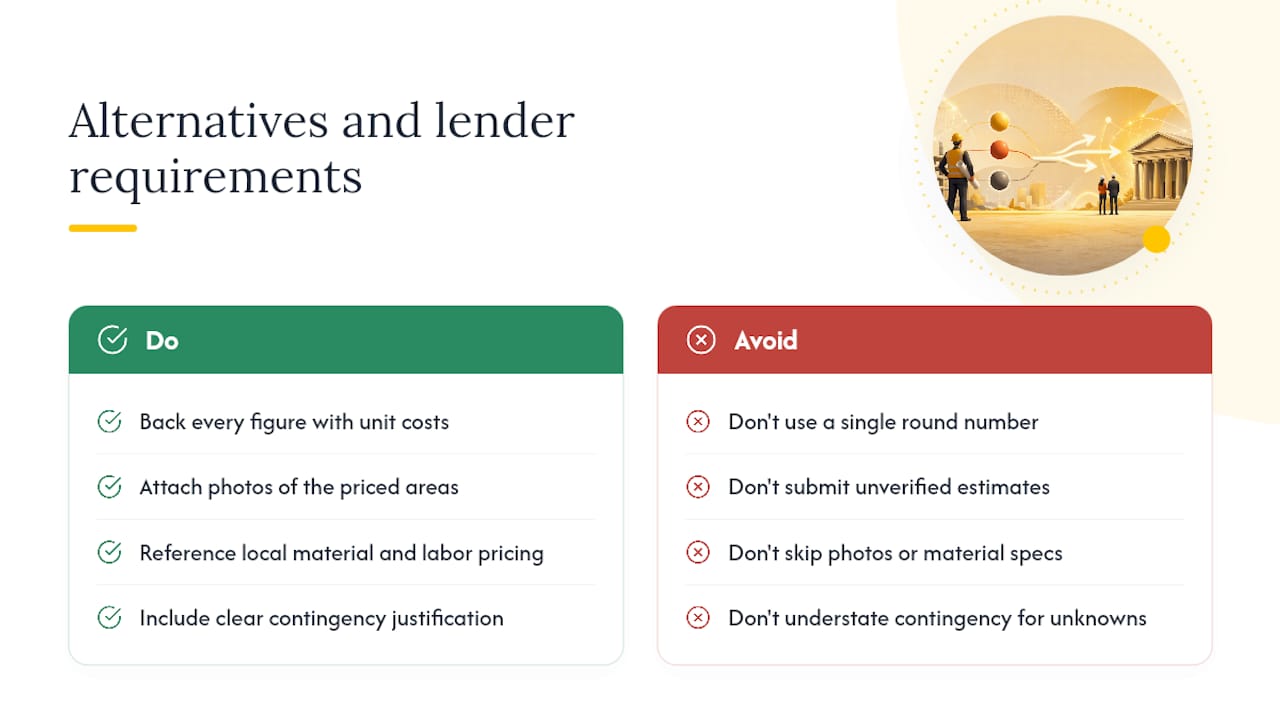
Not every project starts with signed contractor bids in hand, and lenders do accept defensible alternatives. A licensed general contractor's line-item proposal, even if not a final bid, often satisfies early-stage underwriting. Third-party cost opinions from licensed estimators, unit-cost takeoffs, and detailed owner-prepared rehab estimates tied to local pricing references are all accepted in many cases.
Lenders typically require more documentation to accept these substitutes: additional photos, material specifications, a higher contingency percentage, or more frequent draw inspections. Recommended contingency on hard costs generally includes a clear justification and may be higher if unknowns are expected, and unverified estimates often sit at the higher end of that range.
Pro Tip: To convert an owner estimate into something a lender will accept, back every number with a unit cost (per square foot, per fixture), attach photos of the areas being priced, and reference local material and labor pricing rather than a single round number.
Why Jaken Finance Group Stresses Lender-Ready Contractor Bids
Reviewing thousands of rehab budgets shows a consistent pattern: files with itemized, draw-mapped bids close faster and see fewer disputes during construction. Jaken Finance Group's underwriting approach centers on the property's value and a defensible budget, not just a borrower's credit profile, which places extra weight on getting the contractor bid right from the start. The firm's land contract refinance case study shows how documentation quality, not borrower profile alone, can move a nontraditional deal to approval.
How Jaken Finance Group Works With Your Contractor Bids
Jaken Finance Group reviews your rehab budget and contractor bids before close, not after, so draw disputes get resolved on paper instead of mid-construction. Because underwriting is asset-based rather than credit-driven, a well-documented bid carries real weight even for borrowers who wouldn't qualify with a conventional lender.
What that looks like in practice:
- Fast closings, often in as few as five days, once your loan file and bids are complete
- Asset-based underwriting focused on property value and ARV rather than FICO score alone
- Draw schedules built around your actual construction stages, not a generic template
If you're preparing a rehab or construction loan file, review Jaken Finance Group's 100% fix-and-flip financing requirements to see exactly which contractor documentation the program expects, then get your bids in order before you apply.
Sources
This article is general information, not a substitute for advice from a qualified financial advisor. Consult a qualified financial professional about your own circumstances before acting on anything here.