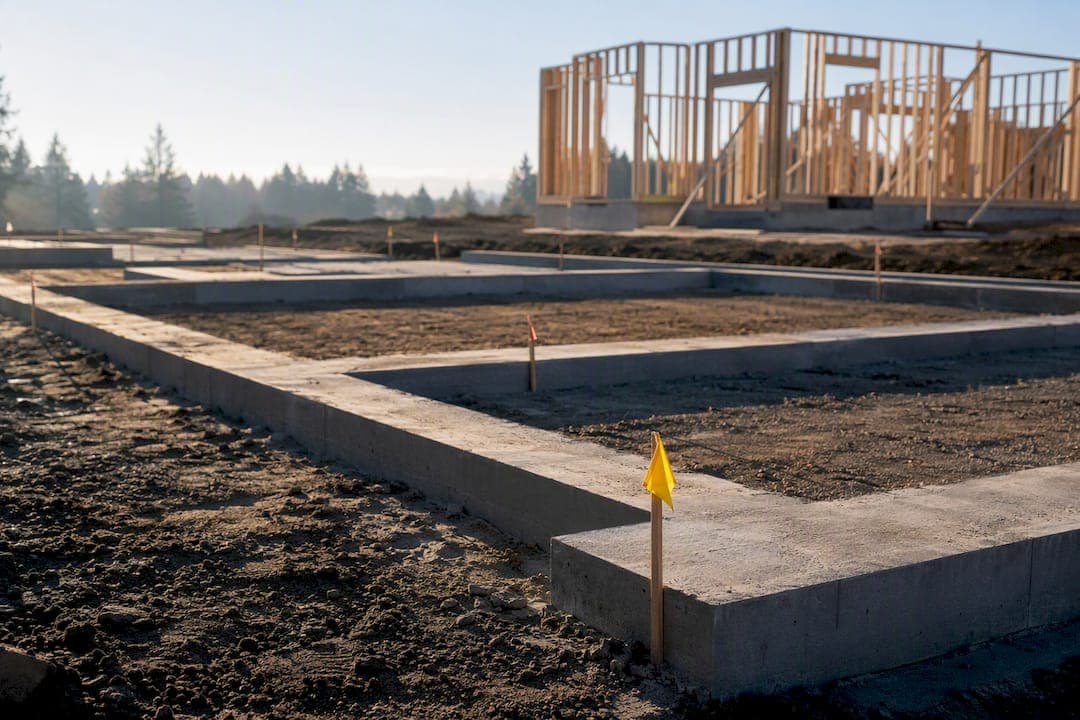
A ground up construction loan finances a build from raw land through a finished structure, releasing funds in milestone draws while the borrower pays interest-only on drawn amounts. It's the standard tool for investors and developers who need to bridge acquisition, site work, and vertical construction costs before a permanent mortgage or sale. Most investors favor construction-only financing over one-time-close products for speed and exit flexibility.
TL;DR:
- Construction-only loans typically have higher interest rates and offer maximum flexibility for exits but require a separate refinance or sale after construction.
- Draws are released in stages following inspections that verify progress, with interest paid only on disbursed amounts, not the full loan.
- Approval demands strong builder credentials, detailed project documentation, and a thorough appraisal based on the finished value, not current land worth.
- Rates often include a 100 to 150 basis point premium over permanent mortgages, with leverage typically capped at 85% of horizontal or vertical costs.
- Asset-based hard-money loans can close in as few as five days, suitable for experienced investors with a solid project plan and a clear exit strategy.
Table of Contents
- What Types of Ground Up Construction Loans Are Available?
- How Do Draws and Inspections Work During Construction?
- What Do Lenders Require for Approval?
- What Do Rates, Fees, and Leverage Look Like for Investors?
- How Long Does the Loan Process Take, Start to Finish?
- What Risks Come With Ground Up Construction Financing?
- When Does Asset-Based Hard Money Beat a Bank Construction Loan?
- Do Loan Requirements Differ for Single-Family, Multi-Family, and Commercial Builds?
- Why Does Builder Selection Matter So Much to Loan Approval?
- What Insurance Coverage Does a Construction Lender Require?
- How Do Market Conditions and Appraisals Affect Loan Sizing?
- A Practical Checklist for Evaluating a Ground-Up Deal
- Get Fast, Asset-Based Financing for Your Next Ground-Up Build
- Sources
What Types of Ground Up Construction Loans Are Available?
Two structures dominate the market, and choosing between them shapes everything from your closing costs to your exit strategy.
Construction-to-permanent (one-time-close) loans convert automatically into a permanent mortgage once the project is complete. Fannie Mae describes single-closing C2P transactions as affordable, convenient, and flexible because the borrower signs once, avoids a second round of closing costs, and can lock or float the permanent rate at conversion. This structure fits owner-occupants and buy-and-hold investors who know they're keeping the property long term.
Construction-only (two-time-close) loans fund the build alone, then require a separate refinance or sale to pay off the balance. Investors and developers generally prefer this route because it keeps the exit open. If a project turns into a sale instead of a refinance, or if the borrower wants to shop permanent financing separately, a two-close structure avoids being locked into one lender's long-term product.
- One-time-close: single closing, lower total closing costs, less exit flexibility
- Two-time-close: two closings, higher total fees, maximum flexibility for investors
- Specialty programs: VA, FHA 203(k), and USDA one-time-close options exist for qualifying owner-occupants, but they rarely apply to investment properties or spec builds
For a side-by-side breakdown of how construction-only financing compares to a rehab-focused facility, see this comparison of ground-up construction loans and fix-and-flip loans.
How Do Draws and Inspections Work During Construction?
Construction loans don't fund in a lump sum. Money moves in stages called draws, and each draw is tied to verified progress on the property. Bankrate's breakdown of construction lending confirms that borrowers typically pay interest only on the portion of funds actually disbursed, not on the full loan amount approved at closing. That keeps carrying costs manageable while the property isn't yet generating income.
A typical draw sequence looks like this:
- Land acquisition or payoff at closing, if the loan includes the lot
- Site work and foundation draw, released after a lender-ordered inspection confirms grading, utilities, and slab or footing completion
- Framing and rough mechanicals draw, tied to inspection of framing, plumbing rough-in, and electrical rough-in
- Drywall and interior finish draw, following inspection of insulation, drywall, and interior systems
- Final draw, released after a certificate of occupancy or final inspection, often triggering conversion to permanent financing or payoff
Interim rates on construction loans typically run higher than prevailing conforming mortgage rates by a notable margin, according to construction financing benchmarks. That premium reflects the added risk lenders take on when a property doesn't yet exist as collateral.
Inspections are usually ordered by the lender, not chosen by the builder, and third-party inspectors document percentage-of-completion before releasing each draw.
What Do Lenders Require for Approval?
Underwriting on a ground up construction loan is tighter than on a conventional purchase mortgage, largely because the collateral doesn't exist yet.
Typical benchmarks include minimum credit scores in the high 600s to low 700s, down payments roughly around one-fifth to one-quarter of project costs, and several months of reserves held in liquid assets
- Builder review: the general contractor's license, insurance, financial statements, and track record on comparable projects
- Documentation: signed plans and specs, a line-item budget, a fixed-price GC contract, and permits either in hand or in process
These figures come from lending guides on financing a home build, and they hold across most bank and credit union construction programs.
Appraisals on ground up deals use an "as-completed" valuation rather than current market value. Fannie Mae's construction products guidance sets the rules lenders follow for calculating loan-to-value against that projected finished value, not the raw land's worth today.
Pro Tip: Get your GC's license, insurance certificate, and three most recent completed projects into a single document before you apply. Lenders that see a clean builder package upfront move loans through underwriting noticeably faster than files where that information trickles in one request at a time.
For a full walkthrough of what to assemble before you submit a file, review this loan officer's guide to ground up construction loans.
What Do Rates, Fees, and Leverage Look Like for Investors?
Pricing on a ground up construction loan reflects both the elevated risk of an unbuilt asset and the extra servicing work draws require.
- Rate premium: roughly 100 to 150 basis points over comparable permanent mortgage rates during the build phase, per construction loan pricing data
- Leverage on acquisition: often 65% to 75% loan-to-cost for the land purchase
- Leverage on horizontal costs (site work, utilities, grading): commonly 75% to 85% of that budget line
- Leverage on vertical costs (framing through finishes): frequently the highest advance rate, sometimes 85% to 90%, since it drives the finished value
Most conforming construction-to-permanent programs cap total loan-to-cost under 90%, with the remainder covered by the borrower's cash or land equity.
Fee lines to expect: an origination fee (often 1 to 2 points), draw inspection fees charged per disbursement, a construction administration fee, and title or escrow fees that may apply twice under a two-close structure. Borrowers with strong FICO scores, substantial liquidity, and a builder with a documented completion history consistently see better pricing than first-time developers working with an unproven contractor.
Investors modeling returns across multiple builds should look at this investment property guide for new construction before locking in project assumptions.
How Long Does the Loan Process Take, Start to Finish?
Getting from application to funded draw involves more moving pieces than a standard purchase loan, and the paperwork has to be right before a lender will even quote terms.
- Prequalification: lender reviews credit, liquidity, and a preliminary project summary
- Document assembly: signed architectural plans, a detailed line-item budget, a fixed-price contract with your general contractor, permits, and a pro forma showing exit value
- Underwriting and appraisal: the lender orders an as-completed appraisal and reviews the builder's qualifications
- Closing and first draw: land acquisition or payoff funds, and the initial site-work draw is scheduled
- Construction phase draws: funds release on the inspection schedule until completion
- Conversion or payoff: the loan either converts to permanent financing or gets paid off through sale or refinance
Bank-based programs commonly take 30 to 60 days to close after a complete file is submitted. Non-bank and hard-money construction lenders can compress that considerably, since they underwrite around the asset and the deal rather than a full credit file. Detailed documentation requirements are covered in U.S. Bank's construction loan overview. If a mid-build shortfall hits, gap financing or a second-position loan against the partially completed structure is often the fastest fix, provided the first-position lender consents.
What Risks Come With Ground Up Construction Financing?
Cost overruns are the most common failure point. Material price swings, change orders, and unforeseen site conditions can blow through a budget fast, and a loan sized without a contingency leaves no cushion.
- Cost overruns: budget a 10% to 15% contingency line into the original draw schedule, not as an afterthought
- Schedule delays: weather, permitting backlogs, and subcontractor availability routinely push timelines past the original estimate
- Lien risk: unpaid subcontractors can file mechanic's liens against the property even after a draw was released to the GC
- Appraisal shortfall: if the as-completed appraisal comes in below projection, the lender may reduce the loan amount mid-project
Mitigate these with a vetted general contractor who has completed similar projects on budget, staged inspections tied strictly to verified progress, and a lender-held holdback on the final draw until a clean walkthrough. When a shortfall appears mid-build, gap or second-position financing can bridge the difference, but walk away from any funding gap that requires stripping your contingency to zero just to close it.
Pro Tip: Never release a draw to your GC based on a phone update. Require photo documentation and a written inspection report every time, even on projects with a contractor you've worked with before.
When Does Asset-Based Hard Money Beat a Bank Construction Loan?
Bank and GSE construction products underwrite the borrower's credit file first and the property second. Asset-based hard-money lending flips that order, weighing the property's projected value and the project's feasibility over FICO scores and years of tax returns. That structural difference is why non-bank lenders can close faster and fund investors that conventional underwriting would decline.
Certain lenders close loans in as few as five days by underwriting against the deal, not the borrower's credit profile. This model fits investors with a defined exit, an experienced contractor lined up, and a project that pencils on numbers rather than paperwork. It's a poor fit for borrowers who need the lowest possible rate and have time to wait 45 days for conventional approval. Review documented funding outcomes to see how the model applies to real projects. Learn more about how asset-based loans differ from ARV-only underwriting.
Do Loan Requirements Differ for Single-Family, Multi-Family, and Commercial Builds?
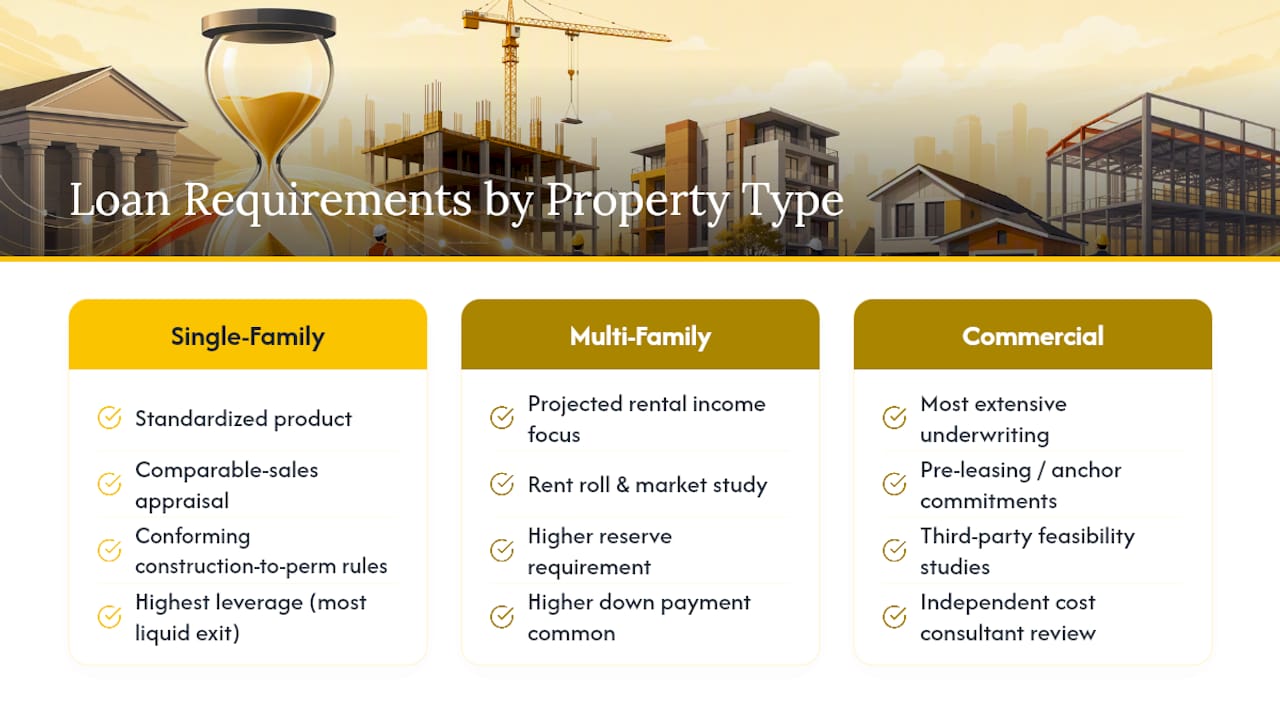
Loan structure and underwriting scrutiny both scale with project complexity, and lenders treat these three categories very differently.
Single-family spec or custom builds are the most standardized product. Conforming construction-to-permanent guidelines apply cleanly, appraisals rely on comparable finished homes in the immediate area, and most conventional lenders have a defined process for this exact loan type. Leverage tends to be highest here because the exit market (a retail buyer or a refinance into a 30-year mortgage) is the most liquid.
Multi-family projects (typically five or more units) shift underwriting toward projected rental income rather than comparable sales. Lenders want a rent roll projection, a market study supporting achievable rents, and often a higher reserve requirement since the exit depends on the property's income performance, not just a sale price. Down payment requirements commonly run higher than single-family, and the builder's experience with multi-unit projects specifically carries more weight than general construction experience.
Commercial ground-up construction (retail, office, industrial) usually requires the most extensive underwriting: a signed pre-leasing agreement or anchor tenant commitment in many cases, third-party market feasibility studies, and construction budgets reviewed by an independent cost consultant. Loan terms are typically shorter and leverage more conservative than residential products, reflecting the longer, less predictable path to stabilized income.
Across all three categories, the underlying draw and inspection mechanics stay similar. What changes is the depth of documentation and the metric lenders used to judge whether the finished project will support the loan.
Why Does Builder Selection Matter So Much to Loan Approval?
Lenders underwrite the general contractor almost as heavily as they underwrite the borrower, and for good reason: a stalled or failed build turns a performing loan into a distressed asset overnight.
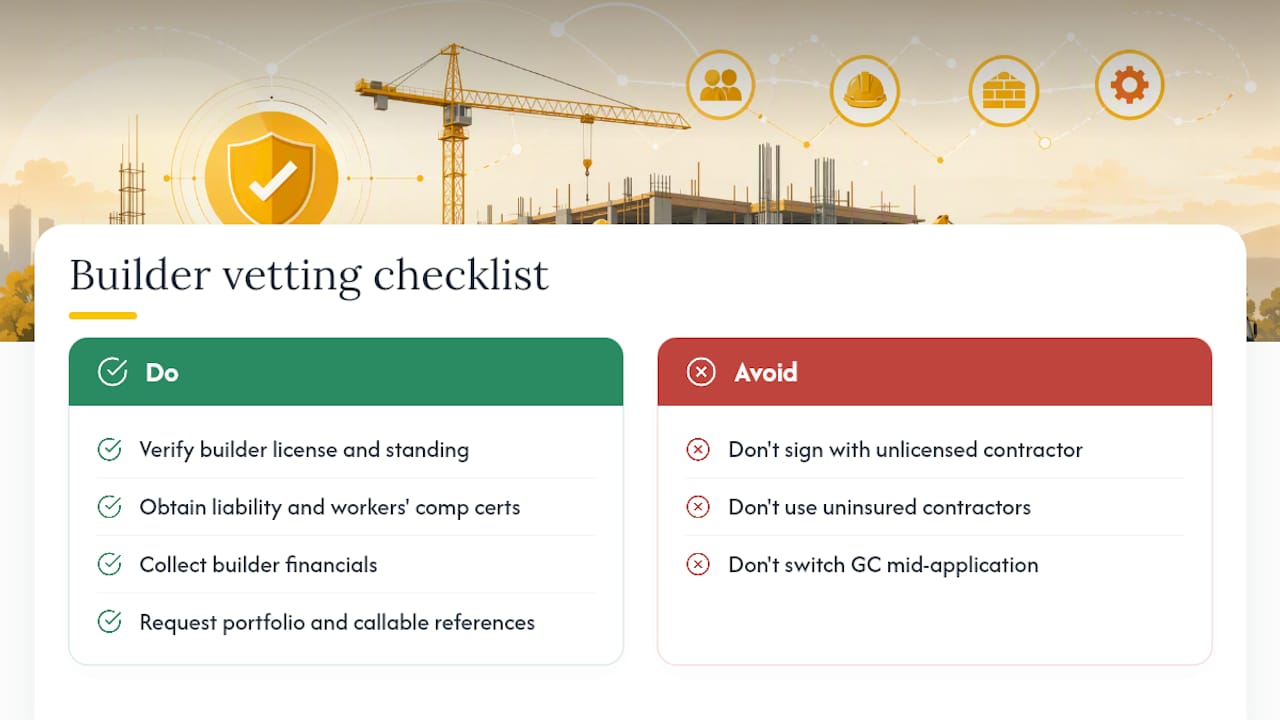
Builder review typically covers license status and standing in the state where the project sits, general liability and workers' compensation insurance certificates, financial statements or bank statements showing working capital, and a portfolio of comparable completed projects with references the lender can actually call. A first-time investor working with an unproven, unlicensed contractor will face more conditions, lower leverage, or an outright decline, even with strong personal credit.
U.S. Bank's construction lending guidance notes that complete, well-organized project documentation, which includes builder credentials, reduces underwriting friction and cuts down on conditional approvals that stall a file for weeks. That friction shows up most often when a borrower switches contractors mid-application or submits a budget that doesn't match the GC's actual scope of work.
The practical takeaway: vet your builder before you shop lenders, not after. A signed contract with an unlicensed or uninsured contractor is one of the fastest ways to get a construction loan file rejected outright, regardless of how strong the borrower's financial profile looks on paper.
What Insurance Coverage Does a Construction Lender Require?
Every ground up construction loan carries mandatory insurance conditions, and skipping this step delays closing more often than almost any other document gap.
Builder's risk insurance covers the structure itself against fire, theft, vandalism, and weather damage while it's under construction and has no other coverage in place. Lenders require this policy to name them as loss payee or additional insured, since the partially built structure is their collateral. Coverage typically needs to stay in force from the first draw through final completion, then transition to a standard homeowner's or landlord policy at conversion or sale.
General liability insurance, carried by the general contractor, protects against injury or property damage claims arising on the job site. Lenders verify this coverage as part of the builder review process, and most require a certificate naming the lender as an additional insured party.
Workers' compensation coverage for the GC's crew is a standard requirement in most states and gets checked alongside liability coverage during underwriting.
Gaps in any of these policies, or a lapse that occurs mid-build, can trigger a lender's right to halt draws until coverage is reinstated. Borrowers should confirm builder's risk coverage is bound before the first draw request, not after site work has already started.
How Do Market Conditions and Appraisals Affect Loan Sizing?
The as-completed appraisal is the single biggest lever on how much a construction loan will actually fund, and it moves with the broader market, not just the project's own merits.
Appraisers project the finished property's value using comparable recently sold homes or income projections for rental and commercial properties. When local comparable sales are thin, dated, or trending downward, the as-completed value can land below the borrower's own projection, which directly caps the loan amount under Fannie Mae's appraisal and LTV guidance.
Rising material and labor costs create a separate problem: a budget built six months before closing may no longer reflect current framing, roofing, or mechanical costs by the time the project breaks ground. Lenders in a tightening rate environment also tend to pull back on maximum loan-to-cost ratios across the board, regardless of an individual borrower's file strength.
The practical defense against both pressures is the same: build a contingency into the budget upfront, request an appraisal from someone with recent comparable experience in that specific submarket, and avoid locking a construction budget more than 60 to 90 days before closing when material costs are moving quickly.
A Practical Checklist for Evaluating a Ground-Up Deal
Before underwriting even starts, run through the same checks a loan officer runs internally. Confirm the budget includes a real contingency line, not padding disguised as one. Pull the GC's license, insurance, and three completed comparable projects, and call at least one reference directly. Stress-test the as-completed appraisal against the most recent comparable sales, not the ones from a year ago. Size your contingency to the project's actual complexity, since a custom build with site challenges needs more cushion than a straightforward spec home on a flat lot.
In practice, the deals that stall almost always trace back to one of these four checks being skipped, not to bad luck on the job site.
— Jason Taken
Get Fast, Asset-Based Financing for Your Next Ground-Up Build
Waiting 45 to 60 days for conventional construction underwriting can cost you the deal entirely if you're competing for land or a time-sensitive lot. Some lenders can close loans quickly by underwriting the project and the property's value rather than requiring a spotless credit file.
This approach fits investors and developers with a defined exit strategy, a vetted general contractor already under contract, and a project that pencils out on paper, even if their credit history doesn't check every box a bank requires. It's a strong match for spec builds, small multi-family projects, and experienced flippers moving into ground-up construction for the first time. Borrowers should have their site plans, budget, and GC agreement ready before reaching out, since asset-based underwriting still requires a real project file, just not years of tax returns.
If your next build fits that profile, review Jaken Finance Group's asset-based hard-money lending options and submit your project details to get a funding timeline back within days, not months.
This article is general information, not a substitute for advice from a qualified financial advisor. Consult a qualified financial professional about your own circumstances before acting on anything here.
Sources
- What Are Construction Loans And How Do They Work? | Bankrate
- Construction Products | Fannie Mae
- Construction Loan: How to Finance Building a Home | Opendoor