
Asset-based hard money loans, bridge loans, and transactional funding are the fastest reliable routes to close a loan, with documented timelines as short as five days for well-prepared files. Before contacting a lender, take these three steps immediately:
- Assemble your document packet: signed purchase contract, proof of funds, last two bank statements, and a preliminary title report.
- Prepare your lender questions: ask for the lender's typical clear-to-close timeline on similar loans, their appraisal process, and their daily wire cutoff.
- Stage your proof-of-funds and contract items: have a proof-of-funds letter ready before submitting an offer, particularly for auction or competitive purchases.
Speed typically costs more; investors looking to acquire or improve properties can explore rent-to-own metal buildings VA financing options available as alternative asset solutions. Expect higher interest rates, origination points, and expedited title and appraisal fees compared to conventional financing, and factor in how a short-term hard money loan may affect your refinance options post-closing.
Key Takeaways
Asset-based hard money and transactional funding are the fastest reliable loan types for real estate investors, with closings achievable in five to fourteen days when files are complete on submission.
| Point | Details |
|---|---|
| Fastest loan types | Hard money and transactional funding close in 5–14 days; bridge loans typically close in 7–21 days. |
| Top three documents to prepare | Signed purchase contract, proof-of-funds letter, and preliminary title report must be ready before application. |
| Best first question for any lender | Ask for the lender's average time from complete application to wire on a comparable loan. |
| Speed vs. cost trade-off | Faster closings carry higher rates (9%–14%) and 1–4 origination points; total cost is still lower when a deal would otherwise be lost. |
| Jaken Finance Group | Offers asset-based hard money and fix-and-flip loans with no minimum credit score and documented closings in as few as five days. |
Table of Contents
- What is a fast-closing loan and who actually needs one?
- Which loan types close fastest?
- What realistic timelines should you expect, and what controls them?
- What does speed cost? Rates, points, and a sample calculation
- What documents and title checks do you need ready to close fast?
- How do you choose a lender that actually closes fast?
- Why Jaken Finance Group delivers reliably fast closings
- The closing speed calculus most investors get wrong
- Jaken Finance Group: asset-based lending built for investor timelines
- Sources
What is a fast-closing loan and who actually needs one?
A fast-closing loan is any financing product structured to minimize conditional hold-ups and prioritize funding speed over the extended underwriting timelines common in conventional mortgage lending. The term covers several distinct product types, but the defining characteristic is that the lender's underwriting model, third-party relationships, and documentation requirements are all calibrated for rapid execution rather than exhaustive credit review.
Investors who rely on these products fall into predictable categories:
- Fix-and-flip operators who must close before a competing cash buyer or lose the deal.
- Auction buyers who face contractual funding deadlines of 10–30 days with no flexibility.
- Wholesalers executing double closes who need same-day transactional funding between the A-to-B and B-to-C legs of a deal.
- Cash-out refinancers pulling equity from a stabilized asset to fund a new acquisition.
- Commercial borrowers with time-sensitive purchase windows on distressed or off-market assets.
Conventional timing is acceptable when the seller is flexible, the deal is not competitive, and the borrower's credit and income profile qualifies for agency financing. When any of those conditions fails, a rapid-close product becomes the practical choice rather than a premium option.
Which loan types close fastest?
Hard money, bridge, and transactional funding each serve different deal structures, but all three can close significantly faster than bank financing. Hard money loans underwrite primarily on the asset's value rather than the borrower's credit profile, which removes the most time-consuming conventional conditions.
Transactional funding products approve based on the end buyer's proof of funds rather than the borrower's credit, enabling same-day wires for wholesale deals. Note that closing speed also varies by property type: single-family residential files typically move faster than commercial or mixed-use assets, and state-specific title practices can add one to five business days regardless of lender speed.
What realistic timelines should you expect, and what controls them?
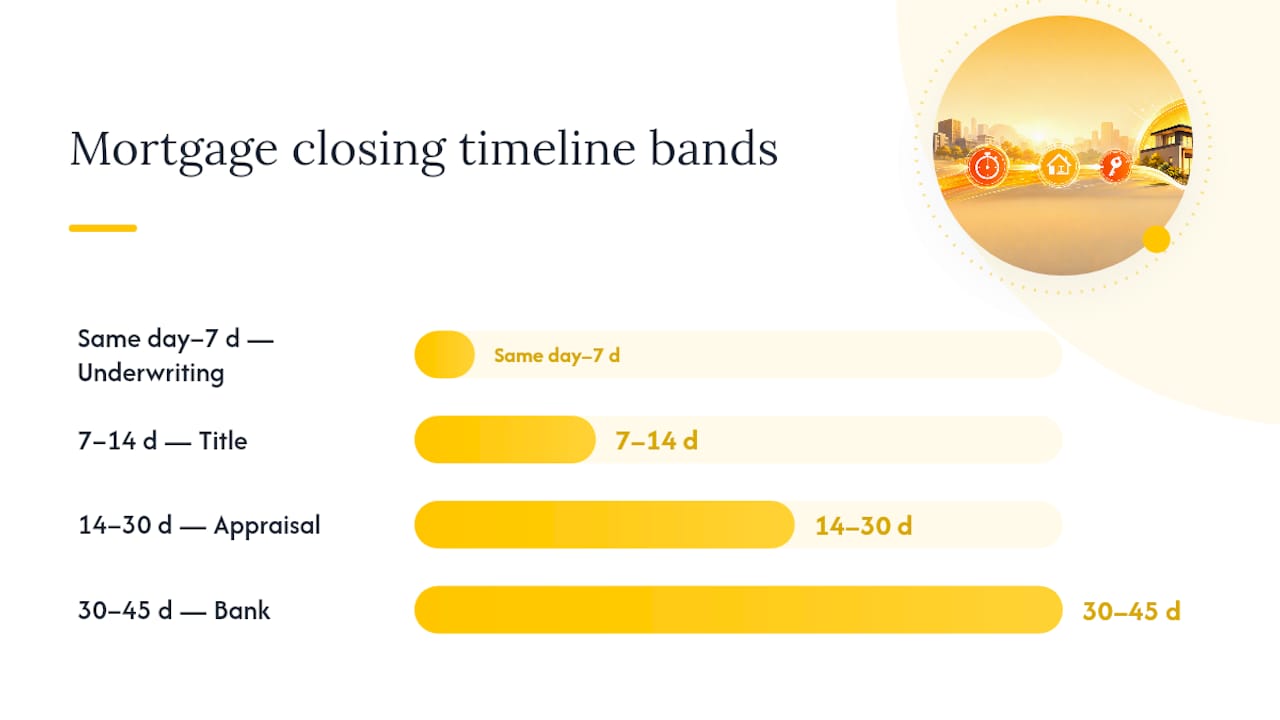
Mortgage closing timelines range from 10–21 days for very clean files with fast lenders, 21–30 days for well-prepared buyers using mortgage brokers, and 30–45 days for banks and more complex loans. Hard money and asset-based lenders operate outside that range on the fast end.
| Timeline Band | What Makes It Possible | Primary Gatekeeper |
|---|---|---|
| Same day to 7 days | Asset-based underwriting, in-house title, pre-ordered appraisal or desktop valuation, clean title | Lender underwriting and wire cutoff |
| 7–14 days | Clean file, cooperative title company, no lien issues, fast appraisal | Title company and appraiser |
| 14–30 days | Standard hard money or broker-assisted conventional file | Appraisal scheduling and condition clearing |
| 30+ days | Bank underwriting, complex income documentation, commercial credit review | Bank underwriting queue |

Lenders that maintain strong local relationships with appraisers and title companies can compress those windows significantly. Operational design matters: in-house underwriting, prioritized conditions clearing, and pre-vetted third-party vendors are the primary determinants of a seven-day close. Lenders with dedicated processes and adequate staffing can achieve clear-to-close within a week on simple files.
Cutoff times also govern same-day funding. Lenders with same-business-day disbursement capabilities typically require approval before a daily cutoff. For example, CashNetUSA funds same-business-day when applicants are approved before 1:30 p.m. CT on weekdays. Disbursement method matters too: Possible Finance reports that Most customers who choose debit-card disbursement receive funds in seconds, while ACH transfers take one to two business days.
Pro Tip: Pre-order a preliminary title report before submitting your loan application. Title issues are the single most common cause of delayed closings on otherwise clean hard money files, and a 48-hour head start on clearing liens can be the difference between a seven-day and a 21-day close.
What does speed cost? Rates, points, and a sample calculation
Speed shifts pricing in a predictable direction: shorter timelines require lenders to accept more process risk, and that risk is priced into the rate and fee structure. Asset-based underwriting also carries higher rates than credit-based conventional lending because the lender relies on collateral rather than income verification.
Common cost elements in a fast-closing loan:
- Origination points: typically 1–4 points on the loan amount, paid at closing.
- Interest rate: 9%–14% annualized for hard money; lower for bridge products with stronger borrower profiles.
- Expedited appraisal or desktop valuation fee: $300–$800 above standard appraisal cost.
- Title and settlement fees: standard closing costs plus any rush or same-day wire fees.
- Funding premium: some lenders charge an additional fee for closings under seven days.
The 14-day close costs less in total interest, but the expedited appraisal fee partially offsets that saving. For fix-and-flip financing, the more important calculation is opportunity cost: a deal lost to a slower competitor has no recoverable value.
What documents and title checks do you need ready to close fast?
Preparation on the borrower's side is the single largest controllable variable in closing speed. Lenders with in-house underwriting can move in days, but only if the file is complete on submission.
- Signed purchase contract with a clear closing date and no unresolved contingencies.
- Proof of funds letter covering the down payment and closing costs. A proof-of-funds letter guide is available for investors who need to prepare one for auction or competitive offers.
- Last two to three bank statements showing liquidity for reserves and closing costs.
- Project scope and rehab budget with line-item cost estimates from a licensed contractor.
- Preliminary title report ordered before or simultaneously with the loan application.
- Entity documentation if borrowing through an LLC or corporation: articles of organization, operating agreement, and EIN letter.
- Assignment or wholesale paperwork if the transaction involves a contract assignment.
Title red flags that commonly delay closings include unpaid mechanic's liens, chain-of-title gaps, open bankruptcy or probate proceedings, and delinquent property taxes. Identify these in the preliminary title report and engage a title company to begin clearing them before the lender's underwriting is complete. Digital document upload through the lender's portal, rather than email or fax, typically reduces processing time by one to two business days. Review the hard money loan application process for a step-by-step document checklist.
How do you choose a lender that actually closes fast?
Many lenders advertise fast closings; fewer deliver them consistently. The distinction lies in underwriting model, third-party relationships, and operational infrastructure.
Selection criteria to evaluate:
- In-house underwriting vs. brokered file: direct portfolio lenders underwrite internally, eliminating the file-hand-off delays that slow brokered submissions.
- Asset-based vs. credit-based underwriting: asset-based lenders skip income verification and focus on LTV and ARV, which removes the most time-consuming conventional conditions.
- Appraisal and title relationships: lenders with preferred appraiser and title company networks can schedule and complete third-party work faster than lenders who rely on borrower-selected vendors.
- Documented funding SLAs: ask for the lender's average time from application to wire on loans similar to yours.
- NMLS licensing: verify any mortgage loan originator or lender through NMLS Consumer Access, the public registry for state licensing and registration.
Red flags that signal a slow or unreliable lender:
- Vague timeline commitments ("we close fast" with no specific day range).
- No clear list of required documents provided upfront.
- Unwillingness to name the conditions that typically delay closing on their files.
- Undisclosed fees that appear at or after commitment.
Questions to ask on the first call:
- What is your typical time from complete application to clear-to-close on a file like mine?
- Do you underwrite in-house or broker the file to another lender?
- Who handles your appraisals and title work, and how do you coordinate their timelines?
- What is your daily wire cutoff, and what happens if we miss it?
- What conditions most commonly delay your closings?
NetCredit's rapid decisioning model illustrates how automated underwriting shortens decision time for consumer products; the same principle applies to asset-based real estate lenders that have built proprietary decisioning systems around property valuation rather than income analysis.
Why Jaken Finance Group delivers reliably fast closings
Jaken Finance Group operates as a direct asset-based lender, underwriting on property value rather than borrower credit scores, with no minimum FICO requirement on qualifying products. That underwriting model eliminates the income verification and credit-condition loops that extend conventional timelines. Funded deals can close in as few as five days on clean files.
The product range covers hard money, fix-and-flip, bridge, new construction, DSCR rental, gap, second-position, and commercial real estate loans, giving investors a single lender relationship across multiple deal types.
Funded deal case studies on the Jaken Finance Group website document specific funding timelines and loan-to-value ratios across residential and commercial transactions. Investors can review verified funded deals to assess whether the lender's documented performance matches their deal profile before applying.
The application path is straightforward:
- Precheck: submit the property address, purchase price, and estimated ARV for a preliminary terms review.
- Submit your document packet: upload the signed contract, proof of funds, title report, and rehab budget through the lender's portal.
- Clear to close and wire: once underwriting confirms conditions are met, the wire is scheduled to meet the closing date.
The closing speed calculus most investors get wrong
Speed in real estate lending is not a product feature. It is an operational output, and it depends as much on what the borrower does before the application as on what the lender does after receiving it.
Most investors focus on finding the fastest lender. The more productive question is whether their own file is fast-close ready. A lender with a five-day funding capability cannot execute that timeline against a file missing a title report, an incomplete rehab budget, or an unsigned purchase contract. The lender's speed ceiling is only reachable when the borrower's preparation matches it.
The second underappreciated variable is post-closing planning. A hard money loan closes fast, but it carries a balloon payoff and a short term, typically six to twenty-four months. Investors who close fast without a clear exit strategy, whether that is a sale, a DSCR refinance, or a conventional takeout, create a different kind of risk. Speed at entry and discipline at exit are not separable decisions.
Jaken Finance Group: asset-based lending built for investor timelines
Investors who need to close in days, not weeks, have a direct path through Jaken Finance Group's asset-based lending programs. The lender's no-minimum-credit-score underwriting and high-leverage structures are built specifically for fix-and-flip operators, auction buyers, and commercial borrowers who cannot wait for bank approval queues.
The 100% fix-and-flip financing program covers acquisition and rehab costs for qualified investors, removing the capital constraint that delays many deals. For investors evaluating asset-based hard money options without a credit score minimum, Jaken Finance Group's program page outlines exactly what the underwriting process requires. Start with a precheck submission at Jakenfinancegroup, upload your document packet, and receive terms before committing to a closing date.
Sources
- Nmlsconsumeraccess
- How Fast Can A Mortgage Close?
- Quick Loans | CashNetUSA Fast Cash Loans
- NetCredit quick loans
- Instant Cash ▪︎ Possible Finance
This article is general information, not a substitute for advice from a qualified financial advisor. Consult a qualified financial professional about your own circumstances before acting on anything here.