
For U.S. real estate investors who need speed and flexibility, the most effective approach to new construction financing is short-term asset-based construction lending for speculative or investor-led builds, and single-close construction-to-permanent financing when the exit is a long-term hold. Construction phases typically run 12–18 months, with funds disbursed in stages through a draw schedule and interest-only payments due on amounts drawn.
The two paths that matter for investors: Single-close construction-to-perm locks your rate and eliminates a second closing — ideal for build-to-hold. Short-term asset-based construction loans prioritize ARV and builder track record over income documentation — ideal for speculative builds, ground-up flips, or projects requiring fast approval. Jaken Finance Group closes deals in as few as five days on asset-based programs.
When to choose each path:
- Single-close construction-to-perm: Long-term hold, rate certainty needed, conventional or agency-eligible project
- Short-term asset-based construction loan: Speculative build, fast approval required, income documentation is limited, or project doesn't fit agency guidelines
- Bridge-to-DSCR: Build-to-rent projects where rental yield will qualify the permanent loan
Table of Contents
- What is new construction financing and how does it work?
- What types of construction loans do investors use?
- How does a construction loan operate from application through draws?
- What do lenders underwrite for new construction projects?
- What rates, fees, and loan terms should investors expect?
- What documents do you need to apply for a construction loan?
- How do you choose the right construction lender?
- Worked example: 12-month ground-up construction project
- Tax implications and benefits of new construction financing
- Key Takeaways
- Why asset-based construction lenders have become the default for serious investors
- Jaken Finance Group funds new construction projects fast
- Useful sources and further reading
What is new construction financing and how does it work?
New construction financing is a loan structure that funds the building of a property from the ground up, using the project itself as collateral rather than an existing structure. Unlike a standard acquisition mortgage, the lender does not disburse the full loan amount at closing. Instead, funds are released in stages called draws, tied to verified construction milestones.
During the construction phase, borrowers pay interest only on the outstanding balance drawn to date. This keeps carrying costs lower while the project is underway. Once construction is complete, the loan either converts to permanent financing or is paid off through a sale or refinance.
Investors choose construction financing for three primary reasons:
- Leverage: Fund a ground-up project without tying up full capital
- Project control: Draw-based disbursements align funding with verified progress
- Speed to market: Asset-based programs can close faster than conventional mortgages
For a deeper breakdown of documentation and project submissions, Jaken Finance Group's construction loan guide covers the full process.
What types of construction loans do investors use?
Choosing the right loan structure depends on your exit strategy, project timeline, and documentation profile.
- Construction-to-permanent (single-close): One closing covers both the build and the long-term mortgage. Single-closing transactions allow underwriting and closing for construction and permanent financing with one set of documents, eliminating a second closing and providing rate certainty. Fannie Mae's single-closing enhancements extend credit document age up to 18 months, supporting longer timelines.
- Construction-only (two-close): Separate loans for the build and permanent financing. Useful when investors plan to sell at completion or want to shop permanent financing independently. Two closings mean two sets of closing costs.
- Short-term asset-based / hard-money construction loans: Underwriting centers on ARV, project viability, and builder track record rather than borrower income. Approval is faster and more flexible. Best for speculative builds, investors with non-traditional income, or projects that need to close quickly.
- DSCR construction-to-rental programs: When the exit is a rental hold, DSCR underwriting qualifies the loan on projected rental income rather than personal income documentation. See Jaken Finance Group's build-to-rent programs for developer-focused structures.
- Lot loans and phased financing: Raw land purchases before construction begins. Typically shorter terms and higher rates; often rolled into a construction loan at the build phase.
For investors weighing asset-based programs against conventional options, the differences between private money and conventional loans are worth reviewing before selecting a structure.
How does a construction loan operate from application through draws?
The operational flow follows a defined sequence. Understanding each step prevents cash flow surprises and keeps the project on schedule.
- Pre-qualification: Lender reviews project scope, ARV estimate, builder credentials, and borrower profile.
- Underwriting: Plans, itemized budget, builder contract, and timeline are submitted. Lender orders an appraisal based on plans and comps.
- Closing: Single-close programs close once; two-close programs close on the construction loan only.
- Draw administration: Funds are released in stages as milestones are completed and inspections are passed. Bankrate notes that lenders typically require four to six inspections over the project.
- Conversion or payoff: At completion, a single-close loan converts automatically to permanent financing. A two-close loan requires a second closing or is paid off through a sale.
Draw counts vary by project size. Fairway's draw schedule data indicates that the number of draws varies by project size, increasing as project costs rise. Larger projects above $1 million vary by lender.
Lenders watch for operational red flags including change orders that expand scope without budget adjustments, missed inspection windows, and contractor substitutions not pre-approved in the GC contract.

What do lenders underwrite for new construction projects?
Construction loans are underwritten more strictly than conventional mortgages because there is no completed collateral. Lenders evaluate four core questions: Does the borrower qualify? Can the builder complete the project? Is the budget realistic? What will the finished property be worth?
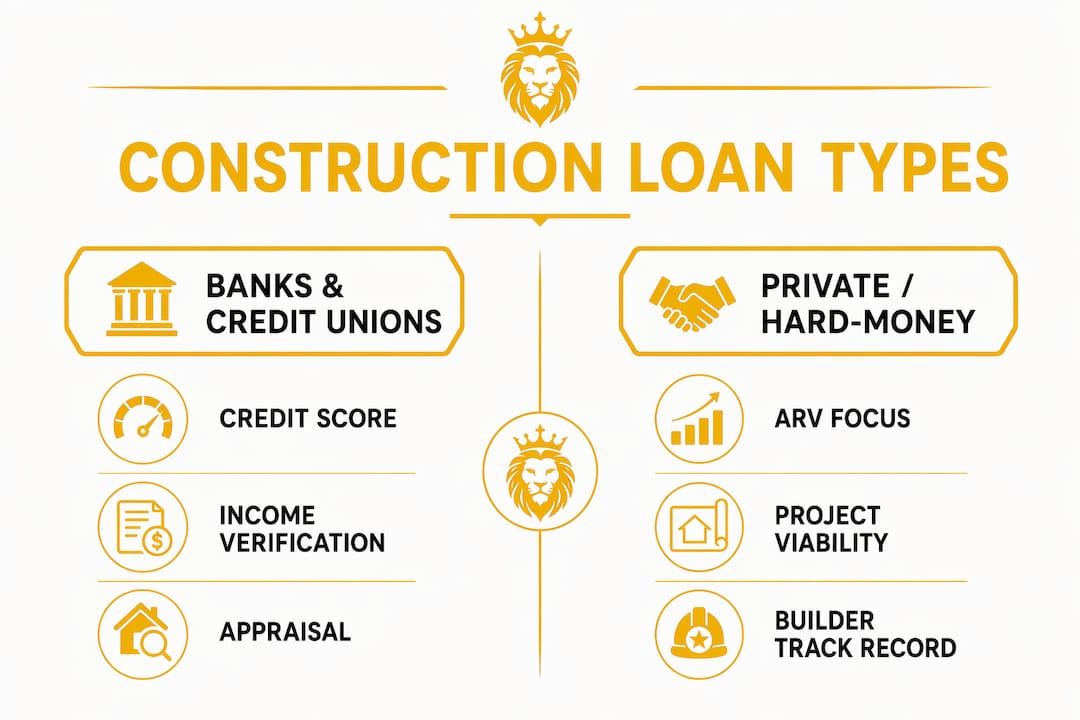
Asset-based lenders weight ARV and project viability heavily, with less emphasis on borrower income and FICO scores. Traditional banks and credit unions apply standard income and credit thresholds alongside project review.
| Underwriting Factor | Banks / Credit Unions | Private / Hard-Money Lenders |
|---|---|---|
| Credit score requirements tend to be higher for banks and credit unions but can be more flexible or waived entirely by private or hard-money lenders. | ||
| Income documentation | Full W-2s, tax returns, DTI | Reduced or asset-based |
| ARV / project viability weight | Secondary | Primary |
| Builder track record review | Required | Required |
| Approval speed varies from about one to two months with banks or credit unions to several days with private or hard-money lenders. | ||
| LTC flexibility | Conservative | Higher leverage available |
Core underwriting items every lender requires include architectural plans and specs, an itemized construction budget with contingency, a builder/GC license and portfolio, a signed construction contract, and a project timeline. Private lenders prioritize the builder's track record and ARV comps; banks add income verification and debt-to-income analysis.
What rates, fees, and loan terms should investors expect?
Construction loan rates run higher than permanent mortgage rates. Variable rates that fluctuate with the prime rate are common on construction-only products. Single-close programs can lock the permanent rate at origination, protecting against rate increases during the build. For a current view of market rate ranges, this construction loan interest rate guide covers the 2026 environment in detail.
Typical loan economics for investor construction programs:
- Loan-to-cost (LTC): Commonly 80%–90% for asset-based programs; more conservative at banks
- Down payment / equity: Banks often require 20%–25% of total project cost; asset-based lenders vary
- Origination points: Typically 1–3 points depending on lender and loan size
- Draw / inspection fees: Per-draw fees apply at most lenders; factor these into your budget
- Interest calculation: Interest accrues only on amounts drawn, not the full commitment
Pro Tip: On a single-close program, negotiate the rate lock period to cover your full construction timeline plus a buffer. A lock that expires before the certificate of occupancy forces a costly extension or re-lock.
What documents do you need to apply for a construction loan?
Lenders require a rigorous vetting package before approving a construction loan. Preparing these materials in advance reduces back-and-forth and accelerates approval.
Project documents:
- Detailed construction budget with line-item costs and a contingency reserve (typically 10%–15%)
- Architectural plans and specifications
- Builder/GC license, insurance certificate, and project portfolio
- Signed construction contract with fixed or GMP pricing
- Project timeline with milestone dates
Borrower documents:
- Proof of assets and reserves
- Prior project case studies or references (especially for asset-based lenders)
- Entity documents for SPVs or LLCs
- Title commitment and property insurance binder
Appraisal and comps: Lenders order a "subject to completion" appraisal based on plans, specs, and comparable sales to validate ARV and lot value.
Pro Tip: Assemble your builder's resume, license, and two to three completed-project references before your first lender conversation. Builder credibility is one of the fastest ways to accelerate underwriting.
How do you choose the right construction lender?
Speed-to-close, LTC, draw administration, and lender experience with investor projects are the four criteria that separate a workable lender from a problematic one.
Essential questions to ask any lender:
- What is your typical time from application to first draw?
- How many draws do you allow, and who orders inspections?
- What is your change-order policy, and how quickly are they processed?
- Do you offer rate lock or float-down options on single-close programs?
- What reserves do you require at closing?
Red flags to watch for:
- Vague or undisclosed retainage policies
- Inability to pre-approve a builder before closing
- No defined inspection cadence or draw timeline
- Pressure to close before plans are finalized
- Opaque fee structures disclosed only at closing
| Criteria | Banks / Credit Unions | Private / Hard-Money Lenders |
|---|---|---|
| Speed to close | — | 5–15 days |
| LTC flexibility | Conservative | Higher leverage |
| Income documentation | Full | Reduced / asset-based |
| Single-close availability | Select programs | Program-dependent |
| Investor experience | Varies | Specialized |
Worked example: 12-month ground-up construction project
Project profile: Single-family spec build; $400,000 total project cost ($320,000 hard costs, $40,000 soft costs, $40,000 contingency); ARV $550,000; LTC 80% ($320,000 loan).
Sample draw schedule (8 draws for a $400,000 project):
- Site work and foundation
- Framing complete
- Roof and exterior sheathing
- Mechanical, electrical, plumbing rough-in
- Insulation and drywall
- Interior finishes (cabinets, flooring)
- Fixtures, trim, and exterior completion
- Final inspection and certificate of occupancy
| Month | Draw Amount | Outstanding Balance | Interest-Only Payment (10% rate) |
|---|---|---|---|
| 1 | — | — | $400 |
| 12 | — | $320,000 | — |
Rate used for illustration only; actual rates vary by lender and market conditions.
Pro Tip: Build a 10%–15% contingency into your budget before submitting to any lender. Projects that arrive at underwriting without a contingency line signal inexperience and often require a budget revision that delays closing.
Use a builder loan calculator to model your specific draw schedule and cumulative interest cost before committing to a loan structure.
Tax implications and benefits of new construction financing
New construction projects carry several tax considerations that can meaningfully affect net returns. Interest paid on a construction loan is generally deductible as a business expense for investors holding the property in an LLC or other business entity, subject to IRS rules on capitalization during the construction period. Under IRC Section 263A, interest and certain other costs incurred during construction may need to be capitalized into the property's basis rather than expensed immediately.
Once the property is placed in service, investors can pursue cost segregation studies to accelerate depreciation on components with shorter useful lives, such as land improvements, fixtures, and certain mechanical systems. Bonus depreciation rules allow a portion of those costs to be deducted in the year the property is placed in service, improving near-term cash flow. For a detailed breakdown of these strategies, Jaken Finance Group's resource on bonus depreciation and cost segregation covers current rules for real estate investors.
Investors who sell a newly constructed property may face ordinary income tax treatment if the property is classified as dealer property rather than a capital asset. Holding period and intent at the time of construction are key factors the IRS evaluates. Consult a qualified tax professional to confirm the treatment applicable to your specific project and entity structure.
This article is general information, not tax or legal advice. Confirm current rules with a qualified tax professional for your situation.
Key Takeaways
Asset-based construction lenders that prioritize ARV and builder track record over income documentation offer the fastest path to closing for U.S. real estate investors, with programs like those at Jaken Finance Group closing in as few as five days.
| Point | Details |
|---|---|
| Choose the right structure | Single-close suits long-term holds; short-term asset-based loans suit speculative builds needing fast approval. |
| Prepare a complete project package | Submit an itemized budget with 10%–15% contingency, architectural plans, and a builder resume before applying. |
| Understand draw mechanics | Interest accrues only on amounts drawn; construction phases typically run 12–18 months. |
| Vet lenders on speed and transparency | Ask about draw timelines, inspection cadence, change-order policy, and retainage before committing. |
| Jaken Finance Group | Offers asset-based construction loans with closings in as few as five days and no minimum credit score requirement. |
Why asset-based construction lenders have become the default for serious investors
The conventional wisdom says investors should shop banks first and treat private lenders as a last resort. That framing is outdated. For ground-up construction, the variables that determine project success — builder quality, ARV accuracy, budget discipline — are exactly what asset-based lenders underwrite. A bank's 45-day approval process adds no analytical value to those questions; it just adds time.
Professional investors have figured this out. The speed advantage of asset-based lending is not just a convenience. On a speculative build in a competitive market, a 10-day close versus a 45-day close can be the difference between securing a lot and losing it. The focus on ARV and builder track record also creates a natural alignment: lenders who underwrite on project viability have a direct incentive to approve projects that will actually succeed.
Jaken Finance Group's ability to close in as few as five days, combined with flexible underwriting that doesn't require a minimum credit score, reflects exactly this model. Their funded deal case studies show the practical results across multiple project types.
Jaken Finance Group funds new construction projects fast
Investors who need to move quickly on a ground-up project don't have to choose between speed and leverage. Jaken Finance Group provides asset-based construction loans with no minimum credit score requirement, closings in as few as five days, and underwriting centered on ARV and builder track record.
Programs cover new construction, fix-and-flip, bridge-to-DSCR, and build-to-rent structures across the United States. Draw administration is centralized, fee structures are disclosed upfront, and the approval process is built for investors who have their project package ready. Review the Bridgeport two-flat case study to see how the process works on a funded deal from hard money through DSCR conversion.
To start an application or discuss your project, visit Jaken Finance Group and submit your project details. Have your construction budget, builder credentials, and ARV comps ready to accelerate the review.
Useful sources and further reading
- Bankrate: Construction loans explained — Overview of loan types, qualifying criteria, and rate mechanics
- Fannie Mae: Construction products and single-closing transactions — Agency guidelines for single-close programs and credit document age extensions
- U.S. Bank: Construction loans and one-time close options — Interest-only mechanics and conversion to permanent financing
- TVFCU: Construction loan draw system — Draw-based disbursement and construction-phase payment structure
- Fairway: Single-close construction loan features — Draw counts by project size and single-close operational benefits
- Jaken Finance Group: Construction loan guide — Documentation requirements and project submission guidance
- Jaken Finance Group: Build-to-rent financing programs — Developer-focused DSCR and rental construction structures
- Jaken Finance Group: Bonus depreciation and cost segregation — Tax strategy resource for investors placing new construction in service