
Contractor draw management is the process of preparing, verifying, and submitting documentation so a lender releases construction funds on schedule. Handled correctly, it moves money in days instead of weeks. Automating this process can cut turnaround times by 50% to 80%, with some borrowers reporting draw-to-fund cycles as fast as 1.4 days against a traditional two to three week wait. This guide, from Jaken Finance Group, breaks down what a lender-ready package requires and which software features close the gap.
- Faster funding means less strain on contingency reserves and subcontractor relationships.
- The core standard documents are the AIA G702 and G703 forms.
- Software with AI-assisted review is now the fastest route to a clean draw.
Key Takeaways
Contractor draw management works best when documentation is collected continuously, reconciled with a three-way match, and reviewed with AI audit tools before it ever reaches a lender.
| Point | Details |
|---|---|
| Reconcile before submitting | Match G702 line 4 to G703 totals exactly to avoid automatic rejection. |
| Collect waivers continuously | Set subcontractor deadlines 7 to 14 days before submission, not on it. |
| Automate the audit step | AI-assisted review can cut draw-to-fund time by up to 80%. |
| Book inspections early | Confirmed inspection windows, not paperwork, often set the funding date. |
| Bridge gaps with fast financing | Jaken Finance Group closes asset-based construction loans in as few as five days when a draw stalls. |
Table of Contents
- What Is a Contractor Draw and Who Owns Each Step?
- What Documents Belong in a Complete Draw Package?
- Which Software Features Actually Speed Up Draw Turnaround?
- What Causes Draws to Get Delayed, and How Do You Fix It?
- How Should You Evaluate and Choose Draw Management Software?
- What Kinds of Draw Management Tools Are Available?
- What Does Draw Management Software Cost, and How Fast Should a Clean Draw Move?
- What Does the Research Say About Time Savings, and Why?
- How Do Inspections Affect Draw Timing and Cost?
- How Do You Actually Prepare and Submit a Lender-Ready Draw?
- How Do Different Vendor Approaches Play Out in Practice?
- Sources
What Is a Contractor Draw and Who Owns Each Step?
A draw is a partial disbursement of construction loan funds tied to completed work, distinct from a pay application, which is the contractor's internal request to the general contractor for payment on that work. A draw becomes the lender-facing version of that request, bundled with proof and sign-offs. Responsibility moves through a chain, and a break anywhere in that chain stalls the whole cycle.
- Subcontractors submit invoices and sign lien waivers for completed work.
- The general contractor compiles the package, reconciles totals, and certifies accuracy.
- The owner or developer reviews and approves the request before it reaches the lender.
- The lender or construction loan administrator verifies documentation and authorizes funding.
- An inspector or architect confirms physical progress matches what's billed.
Most construction loans set draw cadence in the loan agreement itself, often monthly, sometimes biweekly on faster builds, and frequently capped at a fixed number of draws over the loan term. Reviewing that schedule against your loan-to-cost ratio before the first draw prevents surprises about how much can be requested at each stage.
What Documents Belong in a Complete Draw Package?
Lenders expect a specific bundle of paperwork, and missing even one piece is the single most common reason a draw comes back unfunded. At minimum, a compliant package needs an AIA G702 and G703, plus lien waivers, proof of stored materials, and current inspection reports.
- AIA G702 (Application and Certificate for Payment), the summary cover sheet.
- AIA G703, the continuation sheet itemizing costs by line item.
- Subcontractor invoices matching the amounts claimed on the G703.
- Conditional and unconditional lien waivers for every paid party.
- Inspection reports confirming completed percentage of work.
- Stored materials documentation for anything purchased but not yet installed.
- Change orders approved and reflected in the current schedule of values.
- Insurance certificates showing active, unexpired coverage.
- Progress photos dated and tied to the billing period.
The reconciliation rule that matters most: the total on G702 line 4 must match the sum of the G703 continuation sheet exactly. Even a rounding error triggers a manual review or outright rejection.
Pro Tip: Collect lien waivers and stored-materials receipts continuously throughout the month instead of chasing subcontractors during the final 48 hours before submission. That single habit change eliminates the most common source of last-minute delay.
Which Software Features Actually Speed Up Draw Turnaround?
The dominant shift in construction finance right now is AI-assisted draw review, and it's the feature most directly responsible for compressing weeks into days. Software built for contractor payment plans and draw schedule management typically includes eight core modules, though not every platform executes all of them equally well.
- Draw package prep and export, generating G702/G703 forms without manual re-entry.
- AI document audit, flagging arithmetic errors and schedule-of-values mismatches before submission.
- Lien-waiver collection and tracking, with automated reminders to subcontractors.
- Mobile sub portal, letting subcontractors upload invoices and waivers from a job site phone.
- Inspection scheduling, coordinating third-party inspectors directly inside the platform.
- Approval workflows, routing packages through owner and lender sign-off in sequence.
- Payments integration, tracking fund disbursement once a draw clears.
- ERP and accounting integrations, syncing with Sage, Procore, Yardi, or QuickBooks.
Each module solves a distinct bottleneck. AI audits catch the arithmetic mismatches that cause automatic rejection, described in Buildertrend's breakdown of the draw process. Mobile sub portals fix the "subs late with paperwork" problem by moving waiver collection off spreadsheets and email threads entirely. Inspection scheduling removes the calendar-coordination lag that otherwise adds days to every cycle.
| Best For | Key Features | Integrations | Pricing / Trial | Mobile Support | Speed Claims |
|---|---|---|---|---|---|
| General contractors | Draw prep, sub portal, waiver tracking | Sage, QuickBooks | Per-project or tiered, trials common | Full mobile sub submission | Days, not weeks |
| Lenders / loan admins | AI audit, inspection ordering, compliance | Core banking, ERP | Per-active-loan pricing | Portal access, limited mobile | 1.4-day claims published |
| Owner-developers | Fund tracking, payments, reporting | Procore, Yardi | Flat SaaS fee, demo available | Dashboard-first, light mobile | Varies by lender cooperation |
What Causes Draws to Get Delayed, and How Do You Fix It?
Rejected packages are rarely about disputed workmanship. They're almost always paperwork problems, and a rejected draw commonly adds one to two weeks to the payment cycle, with some contractors reporting delays stretching to six weeks when corrections drag on.
- Missing or incorrect lien waivers. Fix: set subcontractor waiver deadlines 7 to 14 days before your submission date, not on it.
- G702/G703 mismatches. Fix: run a three-way match between the invoice, the schedule of values, and the continuation sheet before you submit.
- Expired insurance certificates. Fix: track expiration dates in a shared calendar tied to your draw schedule.
- Math errors on totals. Fix: pre-run an AI audit through your draw software before the package leaves your desk.
- Unverified stored materials. Fix: photograph and receipt every stored-materials purchase the day it happens.
- Inspection scheduling conflicts. Fix: book the inspector as soon as the work phase nears completion, not after.
Pro Tip: Build a weekly, not monthly, compliance rhythm. Collecting waivers, insurance updates, and photos in small weekly batches prevents the end-of-period scramble that causes most last-minute rejections.
How Should You Evaluate and Choose Draw Management Software?
Nine criteria separate a platform that genuinely reduces your workload from one that just digitizes the same paperwork. Run through this list during any demo.
- Onboarding speed. How long until your team can prep a real draw without support tickets?
- AI audit quality. Does it catch schedule-of-values mismatches, or just spellcheck totals?
- Lender-portal support. Can your lender review and approve inside the same system?
- Mobile sub submission. Can a subcontractor upload a waiver from a phone on-site?
- Accounting and ERP integration. Does it sync with Sage, Procore, Yardi, or your existing system?
- Lien-waiver workflow. Are reminders automated, or still manual follow-up?
- Inspection ordering. Can you schedule and track inspectors from inside the platform?
- Payment and fund-control support. Does it track disbursement after the draw clears?
- Pricing model and trial length. Is there a free trial or demo before you commit?
During a 30-day trial, track three numbers: how long draw prep actually takes, your rejection rate on submitted packages, and days from submission to funded payment. Those three metrics tell you more than any sales pitch, and they line up directly with the operational fixes covered in common loan mistakes to avoid.
What Kinds of Draw Management Tools Are Available?
The vendor landscape breaks into four rough categories, and matching your role to the right one matters more than chasing the longest feature list. Built, DrawStack, Land Gorilla, Northspyre, Plymouth, and GCPay each anchor a slightly different niche within construction draw management.
- Mobile-first sub portals prioritize subcontractor invoice and waiver submission from job sites, best for GCs juggling many small subs.
- Lender-focused portals emphasize audit trails and approval workflows, best for construction loan administrators managing multiple active loans.
- AI-audit platforms lead with automated document review to catch errors before lender submission, best for teams chasing faster funding cycles.
- Full construction finance suites bundle draw management with broader project accounting, best for owner-developers running larger, multi-phase builds.
Before committing, export one completed draw as a test PDF through the trial account, run its AI audit on a real package, and time your prep steps before and after adoption.
What Does Draw Management Software Cost, and How Fast Should a Clean Draw Move?
Pricing generally falls into per-project fees, per-active-project tiers, per-user seats, or a flat SaaS subscription, and most vendors offer a free trial or live demo before you commit to a contract. Third-party inspections, a frequent gating item in the schedule, typically run $250 to $500 each and often set the earliest possible funding date more than any paperwork issue does.
- A clean, complete draw package typically funds in 5 to 10 business days through traditional review.
- AI-assisted platforms report funding as fast as 1.4 days when the lender cooperates on inspection timing.
- Inspection windows, not document review, are frequently the true bottleneck.
Statistic Callout: When negotiating with a vendor or lender, cite this: automation shrinks draw-to-fund timelines by 50% to 80% compared to manual, paper-based cycles.
What Does the Research Say About Time Savings, and Why?
The core finding holds across multiple sources: automated draw workflows cut turnaround by roughly half to four-fifths, with the fastest documented cases funding in 1.4 days. AI audits catch the arithmetic and schedule-of-values errors that otherwise trigger manual review, described in the Labarna. Automated waiver collection and proactive inspection coordination close the remaining gap. Results still vary by project size and how quickly your lender responds.
| Driver | Typical Impact |
|---|---|
| AI document audit | Catches G702/G703 mismatches pre-submission |
| Automated waiver collection | Removes missing-paperwork delays |
| Proactive inspection scheduling | Cuts calendar-coordination lag |
How Do Inspections Affect Draw Timing and Cost?
Third-party inspections verify that the work claimed on a draw actually exists in the field, and they're frequently the single item holding up funding. Effective draw processes tie payment to milestone or percentage-of-completion triggers that a third-party inspector confirms before funds move, which means the inspector's calendar, not your paperwork, often sets the pace.
Inspection costs commonly land in the $250 to $500 range per visit, though larger commercial projects can push higher depending on scope and travel. The bigger cost isn't the inspection fee itself. It's the scheduling delay. Many lenders won't release funds until a confirmed inspection report is attached to the package, and inspectors booked reactively, after the work is already done, add days or even a full week to the cycle.

The fix is straightforward: book the inspection proactively as the work phase nears completion, not after your subcontractors report it finished. Include the confirmed inspection window directly in your draw package submission rather than noting that one is "pending." This single change removes one of the most common reasons a lender-ready package still sits unfunded for days after every other document is correct.
Loan administrators managing multiple active construction loans benefit from batching inspection requests by geography or project phase, reducing the per-visit coordination overhead. Contractors on tighter draw schedules, biweekly cycles especially, should treat inspection booking as a standing calendar item tied to the draw cadence itself, not a one-off task triggered by a completed phase.
How Do You Actually Prepare and Submit a Lender-Ready Draw?
The process breaks into six sequential steps, and skipping the order usually creates the rework that slows everything down.
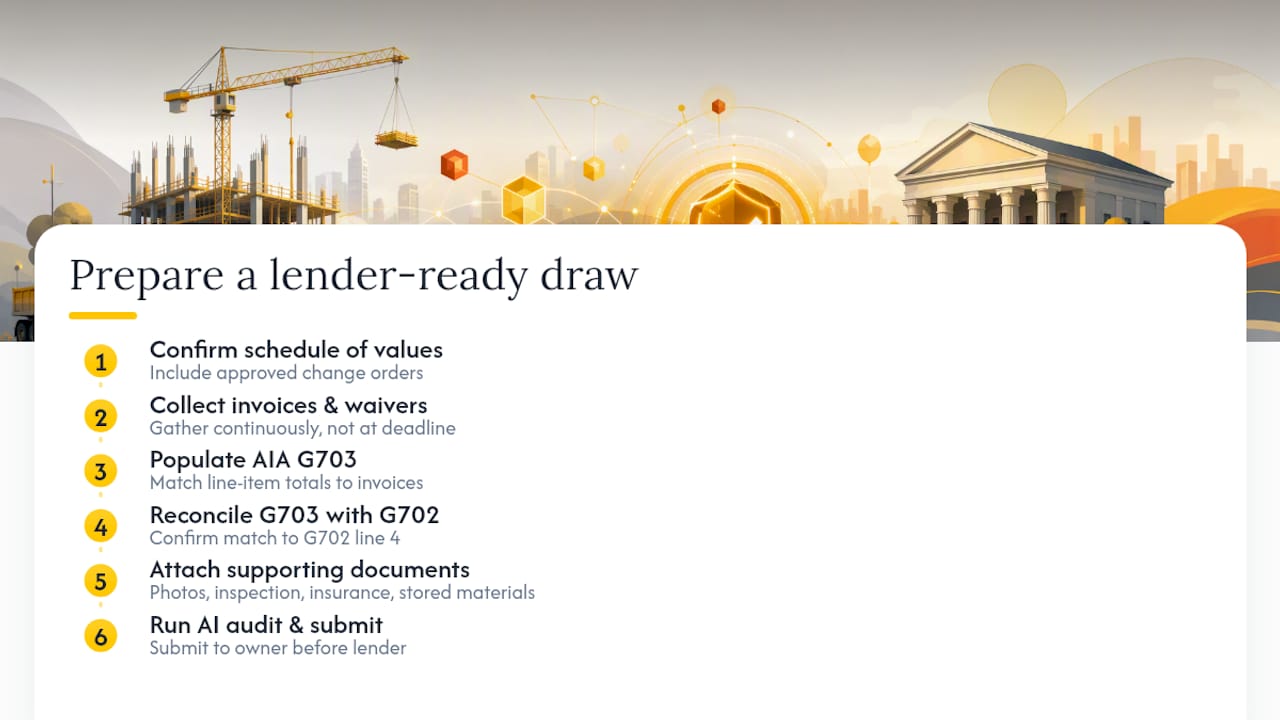
Step one: Confirm the current schedule of values reflects any approved change orders before you start compiling anything else.
Step two: Collect subcontractor invoices and lien waivers for the billing period, ideally from documentation gathered continuously rather than chased at the deadline.
Step three: Populate the AIA G703 continuation sheet with line-item totals matching those invoices exactly.
Step four: Total the G703 and confirm it matches the amount entered on G702 line 4. This is the reconciliation step most rejections trace back to.
Step five: Attach supporting documents: stored materials proof, insurance certificates, dated progress photos, and the inspection report confirming physical progress.
Step six: Run the completed package through an AI audit if your software supports it, then submit to the owner for approval before it reaches the lender.
A draw request often runs 20 to 500-plus pages once every supporting document is attached, and every dollar requested has to trace back to verifiable work. Treating each draw as an audit-ready bundle, rather than a quick invoice, is what separates contractors who fund in days from those stuck in weeks-long back-and-forth. If a project stalls mid-build while waiting on a slow draw, a mid-construction refinance can bridge the gap without derailing the schedule.
How Do Different Vendor Approaches Play Out in Practice?
Picture two general contractors running similar mid-size residential builds. One relies on spreadsheets and email to collect subcontractor waivers, then manually re-types totals into a G703 template before every submission. The other runs a mobile-first sub portal that lets subcontractors upload invoices and waivers directly from their phones as work finishes.
The spreadsheet-based GC typically spends two to three days each cycle just chasing signatures and re-checking totals by hand, and any single missing waiver pushes the whole submission back a week. The GC using a mobile portal has waivers arriving continuously through the month, so draw day becomes an export-and-review task rather than a scramble.
A construction loan administrator overseeing a dozen active loans faces a different problem: volume, not collection. A lender-focused portal that centralizes approval workflows and inspection ordering across every loan in the portfolio cuts the administrative overhead of chasing twelve separate contractors through twelve separate processes. Consolidating pay-app workflows and automating three-way matching between pay apps, schedule of values, and waivers is what actually improves working capital across a loan book, not just faster paperwork on any single loan.
Owner-developers running multi-phase commercial builds tend to lean toward full finance suites that bundle draw management with broader project accounting, since their concern is portfolio-level cash flow rather than any single draw's turnaround.
Publisher Perspective: What Jaken Finance Group Sees Most Often
The most common issue isn't disputed workmanship. It's slow, last-minute documentation and inspection scheduling failures. Prepare lender-ready packages continuously, and let software catch errors before your lender does.
Funding That Moves at the Speed of Your Draw Schedule
A tighter draw process only solves half the equation. When a draw still stalls, or your project needs a capital bridge while paperwork clears, Jaken Finance Group closes hard money and fix-and-flip loans in as few as five days, underwritten against the asset rather than a credit score.
Whether you're managing construction payment plans across a portfolio or need a second-position loan to cover a gap while a draw clears, Jaken Finance Group's loan programs accommodate the leverage and speed that traditional lenders typically can't match. Use the free loan-to-cost calculator and investor guides to see how much a project qualifies for before you apply, then request a quote directly through the site to get a fast-closing option in motion.
Sources
- How Construction Draw Management Technology Can Improve Inspection Turn Times
- Construction Draw Process Explained | DrawCheck
- Draw request — Procore