
Lenders accept borrower experience when you have a track record of paid-off flips or ground-up builds of comparable scope. Without that, most hard-money and construction lenders will underwrite the loan against your general contractor's credentials instead. Expect lower leverage, a higher rate, or a conditional approval until GC documentation clears. Start by pulling your contractor's license, insurance certificates, and three references before you apply.
TL;DR:
- Lenders mainly evaluate the builder's project history for scope relevance, such as similar size and type, rather than just the number of completed projects.
- Strong credentials include an active license, adequate insurance, bonding capacity, and financial vetting through tax returns and supplier credit references.
- Borrowers acting as owner-builders face additional scrutiny and documentation requirements, making it harder to secure favorable loan terms.
- Using an experienced, approved general contractor on the loan can significantly improve approval speed and leverage; building a track record with the same GC and lender is beneficial.
- Common underwriting issues like missing references, incomplete contracts, or insurance gaps are easily fixable before submission to avoid delays.
Table of Contents
- What Underwriters Look For: Builder Experience Requirements Explained
- Borrower Experience vs. GC Experience: Which One Counts?
- Builder Documentation Checklist: What Lenders Require
- How to Overcome Limited Builder Experience
- Common Underwriting Red Flags and How to Fix Them
- How Jaken Finance Group Evaluates Builder Experience
- Get Your Project Underwritten on Property Value, Not Just Your Resume
- Sources
What Underwriters Look For: Builder Experience Requirements Explained
Underwriters do not treat "experience" as a single checkbox. They break it into components, and each one carries different weight depending on the loan type and the size of the project.
The first thing an underwriter checks is whether the builder's project history actually matches the deal in front of them. A GC who has finished a dozen kitchen rehabs looks strong on paper but thin if the file is a ground-up build. Lenders want to see comparable scope: similar square footage, similar budget size, similar construction type. A loan officer's guide to ground-up construction loans walks through how this comparison plays out in practice for first-time ground-up borrowers.
Beyond project history, underwriters weigh a specific set of credentials:
- Active state contractor license in good standing, verified directly with the licensing board
- General liability insurance and workers' compensation coverage at levels the lender sets as a minimum
- Bonding capacity, required on larger or municipally permitted projects
- Financial vetting through supplier credit references, lien history searches, and either tax returns or CPA-prepared financial statements
That last item matters more than most borrowers expect. Financial vetting, including CPA-prepared tax returns and supplier credit checks, tends to predict completion risk far better than a stack of glowing reference letters. A GC who is overextended on three other jobs can still produce polished references while quietly running short on cash for yours.
Experience level directly changes your loan terms. Developers with a relevant project history and a strong team commonly secure higher leverage, faster approvals, and better pricing than first-timers presenting an identical property. A thin experience file does not necessarily kill the deal, but it usually means a lower loan-to-cost ratio, a larger reserve requirement, or an interest rate a point or two above what an experienced sponsor would get on the same asset.
Borrower Experience vs. GC Experience: Which One Counts?
Your personal track record is not always the deciding factor. Lenders regularly substitute your contractor's experience for your own, but the rules around that substitution depend on how you're structured on the deal.
If you're acting as an owner-builder, meaning you're both borrower and de facto contractor, lenders apply extra scrutiny. They commonly demand additional documentation: your own licensing (if applicable), a detailed self-managed budget, and sometimes a requirement that a licensed GC still sign off on major trade work. Owner-builder files also tend to draw more conditional approval items because there's no independent party vouching for execution risk.
The far more common workaround looks different:
- An experienced, lender-approved GC signs onto the loan, or in some cases co-borrows
- The lender relies primarily on the GC's completed-project history rather than yours
- You build a payoff history with the same lender and the same GC across smaller deals first, which strengthens future approvals and loosens terms over time
That last path is underrated. A borrower with zero ground-up experience who closes two or three smaller flips successfully, with the same lender and same GC, often gets treated like a repeat client on their fourth or fifth deal. The relationship itself becomes collateral against experience gaps. A ground-up construction loan vs. fix-and-flip comparison is worth reviewing if you're deciding which structure fits your current experience level.
Builder Documentation Checklist: What Lenders Require
Assembling the right file before your loan officer asks for it is the single fastest way to shorten underwriting. Here's the order most lenders expect it in.
- Licenses and insurance certificates. Confirm your GC's license is active with the state board, and pull certificates showing general liability and workers' comp coverage. Republic Bank & Trust Company's builder qualification packet sets minimums at one million dollars in general liability and five hundred thousand dollars in workers' comp, figures that align closely with what most private construction lenders expect.
- Three references from property owners or suppliers. Republic Bank's packet also asks for supplier accounts open at least two years, alongside completed-project references. Reach out early since suppliers are often slower to respond than former clients.
- Signed construction contract with cost itemization. A vague one-page agreement will not pass. Lenders want a fixed-price or guaranteed-maximum-price contract broken down by line item.
- AIA-style draw schedule (G702/G703). This format ties each draw request to a percentage of completed work, and it's become close to a standard requirement across private lenders, per Homestead Capital Partners' builder loan checklist.
- Builder financials, lien searches, and subcontractor agreements. A clean lien search matters as much as the contract itself; open liens on prior jobs are one of the fastest ways to stall a file.
A contractor bid checklist for loan approval breaks down exactly what a compliant bid document should include line by line.
Pro Tip: Ask your GC for supplier references before you submit the loan application, not after. Suppliers take days to confirm credit history, and that delay is one of the most common reasons files sit in underwriting longer than borrowers expect.
How to Overcome Limited Builder Experience
A thin track record does not have to sink your deal. Several accepted paths let lenders say yes even when your personal history is short.
- Bring an approved GC and let them sign or co-borrow. This is the most direct fix, and it's the same workaround underwriters point to most often for first-time ground-up borrowers.
- Accept a lower LTC or hold higher reserves. Offering a bigger cash cushion signals to the lender that you've priced in the execution risk they're worried about, which often unlocks approval even at a slightly worse rate.
- Build payoff history on smaller deals first. Two or three completed flips with the same lender and GC combination turn you into a known quantity by your fourth project.
- Get your GC on the lender's approved builder list before you submit the file. Once a contractor clears vetting, they can be reused on future projects without full re-vetting, provided licensure and insurance stay current.
Pro Tip: If you know which lender you want to work with long term, ask them directly whether your GC is already on their approved list. It can save you weeks on your first deal and every deal after it.
Reserve requirements tied to inexperience are worth planning for early. A construction contingency budget primer explains how much buffer to build in before a lender asks for it.
Common Underwriting Red Flags and How to Fix Them
Most stalled construction files trace back to the same handful of problems, and most of them are fixable in days, not weeks.
- GC refuses to provide references or financials. Underwriters commonly treat this as a de facto disqualification. If your contractor won't cooperate, switch GCs before it costs you the deal.
- Missing or inconsistent bids, no draw schedule, incomplete contract. Fix this by insisting on a proper AIA-formatted draw schedule and a fixed-price or GMP contract before submission.
- Insurance gaps or open liens. Pull certificates and run a lien search before you apply, not after underwriting flags it.
- Ask your loan officer directly: "What conditions typically get attached to a file like mine?" Getting that answer up front surfaces hidden requirements before they slow your closing.
Conditional approvals are normal, not a rejection. Underwriters routinely list specific missing items rather than declining outright, and treating that list as a roadmap gets you to funding faster than treating it as a setback.
How Jaken Finance Group Evaluates Builder Experience
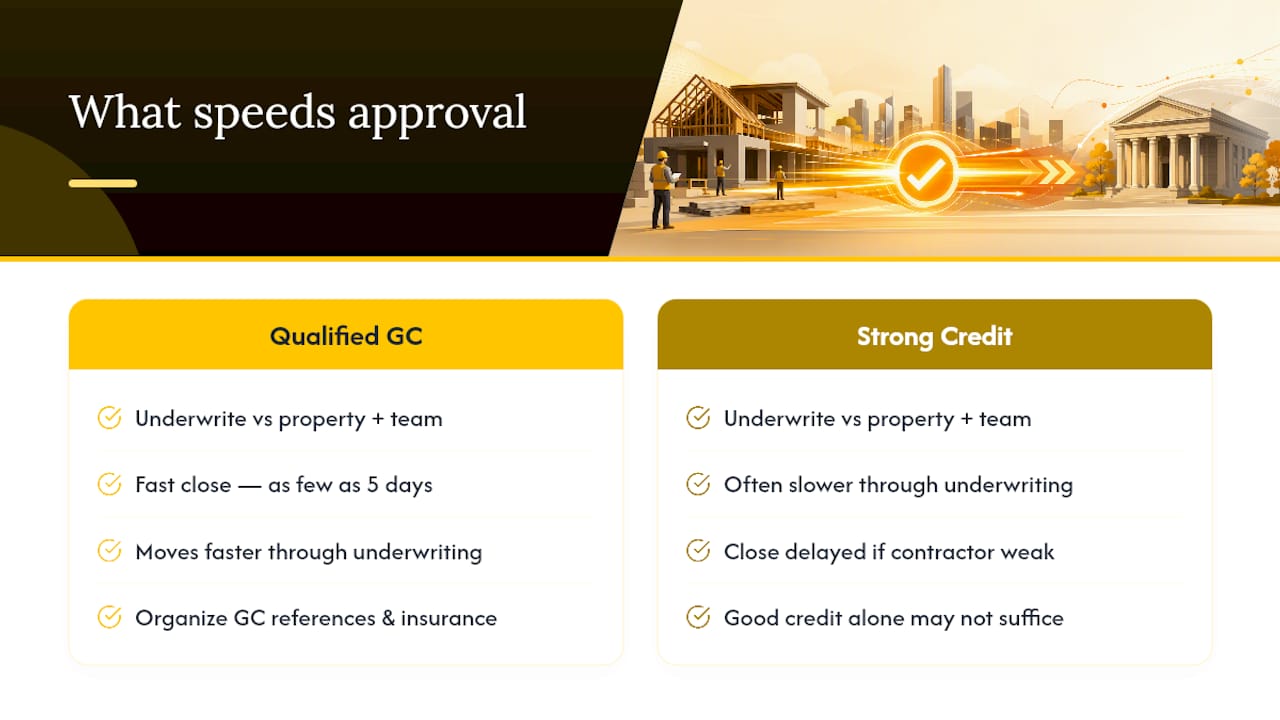
At Jaken Finance Group, we underwrite construction and fix-and-flip loans against the property and the team, not just a credit score. That means an investor with a thin personal track record but a genuinely qualified, insured GC still has a real path to a fast close, often in as few as five days once documentation is complete.
We've seen enough files to know the pattern: strong GC documentation moves faster through underwriting than a spotless credit profile with a weak contractor behind it. Our funded deal case studies show how that plays out across different experience levels. If you're preparing to apply, get your GC's references and insurance certificates organized first. That single step does more to speed your approval than anything else on the checklist.
— Jason Taken
Get Your Project Underwritten on Property Value, Not Just Your Resume
Jaken Finance Group underwrites hard-money and construction loans on asset value and team strength, not a rigid personal experience threshold. If your GC has active licensing, insurance, and a track record that matches your project scope, that credibility can carry the file even when your own borrower history is short.
Our asset-based hard-money lending evaluates the property and the people executing the build rather than leaning on a minimum credit score, which means investors with an approved, well-documented GC can move through underwriting faster than they would with a traditional construction lender. To see how the evaluation works before you commit to a rate lock or a full application, review what an asset-based loan actually assesses. If you have your GC's documentation ready, start a loan inquiry with Jaken Finance Group today and get a real answer on terms within days, not weeks.
Sources
- Republic Bank & Trust Company — Builder/Contractor Qualification Statement (rev 3.20.26)
- First-Time Builder Loans | Homestead Capital Partners
- How to Choose a Hard Money Lender: 8 Questions to Ask First - InvestorFuel