
Most U.S. residential bridge loans fund in 2–4 weeks from application to closing. For straightforward investor deals with clean title and an asset-based lender, that window can compress to 5–10 business days. Owner-occupied, regulated transactions are a different story: mandatory disclosure periods under CFPB Regulation Z routinely push those timelines to 30–45 days or longer. The single biggest variable is not your credit score or even your equity position. It is whether your loan falls under consumer mortgage regulations or operates as a commercial investment product.
Here is what that means in practical terms:
- Best-case (investor/hard-money): 5–10 business days, assuming clean title, in-house or waived appraisal, and complete documentation
- Typical (most residential bridge loans): 2–4 weeks, covering standard appraisal, title search, and underwriting cycles
- Slower (owner-occupied, regulated): 30–45+ days, driven by mandatory waiting periods and additional disclosure requirements
- Lender type matters: Private and hard-money lenders commonly close in 5–14 days; banks and regulated lenders typically run 30–45 days or more
Jaken Finance Group, which specializes in asset-based hard money and bridge lending, offers closings in as few as five days for qualifying investor transactions — a benchmark that reflects what is achievable when regulatory friction is removed and underwriting centers on property value rather than borrower credit files.
Key Takeaways
A residential bridge loan funds in 2–4 weeks for most borrowers, but investor deals with clean title and an asset-based lender can close in 5–10 business days while owner-occupied regulated loans typically require 30–45 days or more.
| Point | Details |
|---|---|
| Typical funding window | Most bridge loans close in 2–4 weeks; best-case investor deals fund in 5–10 business days. |
| Owner-occupied loans take longer | Mandatory CFPB disclosure periods under Regulation Z add statutory waiting time that lenders cannot waive. |
| Top borrower action | Submit a complete document package on day one and ask the lender to pre-order appraisal and title simultaneously. |
| Repayment term planning | Most bridge loans run 6–12 months; build in a 30–45 day buffer for your sale escrow or refinance process. |
| Jaken Finance Group | Offers asset-based bridge loans with closings in as few as five days for qualifying investor transactions, no minimum credit score required. |
Table of Contents
- Bridge loan timeline: stage by stage from application to funding
- How long does a bridge loan last, and how is repayment structured?
- What factors affect the bridge loan timeline most?
- How to shorten your bridge loan approval and closing timeline
- Costs and fees that affect your closing schedule
- When can a bridge loan realistically close in 5–10 business days?
- How bridge loans compare to alternatives on timing
- The tradeoff most borrowers get wrong
- Jaken Finance Group closes bridge loans when timing is critical
- Sources
Bridge loan timeline: stage by stage from application to funding
Every bridge loan moves through the same core stages. What separates a 7-day close from a 45-day close is how long each stage takes and whether tasks overlap or run sequentially.
Three scenario snapshots:
Scenario A — Expedited investor close (7–10 business days). The borrower submits a complete package on day one: signed purchase contract, two years of tax returns, bank statements, and a clear exit strategy. The lender pre-orders appraisal and title simultaneously. An in-house or desktop appraisal returns in 24–48 hours. Title comes back clean. Underwriting approves in two days. Wire transfers on day 8.

Scenario B — Standard residential close (2–4 weeks). A licensed appraiser schedules an on-site visit 5–7 days out. Title search uncovers a minor lien that takes three days to resolve. Underwriting requests one additional document. Total elapsed time: 18 days.
Scenario C — Regulated owner-occupied close (30–45+ days). The loan triggers consumer mortgage disclosure requirements under Regulation Z. Mandatory waiting periods apply between disclosure delivery and closing. A full licensed appraisal is required. Title reveals a boundary dispute that takes two weeks to clear. Total: 42 days.
According to Shawbrook Capital's bridge loan closing guide, realistic closing windows range from roughly 7 days for expedited deals to 6 weeks for standard transactions, with the primary driver being how quickly appraisal and title are ordered.
The tasks most likely to create delays: appraisal scheduling backlogs, title defects requiring legal resolution, incomplete borrower documentation submitted in multiple rounds, and lender underwriting queues during high-volume periods.
How long does a bridge loan last, and how is repayment structured?
Bridge loan terms typically run 6–12 months, though some lenders offer terms as short as 3 months or as long as 24 months depending on the project scope and exit strategy. Most borrowers use the loan to cover the gap between purchasing a new property and either selling an existing one or completing a refinance into permanent financing.
Common repayment structures:
- Interest-only with balloon payment: The borrower pays only accrued interest monthly, then repays the full principal at maturity — the most common structure for investor bridge loans
- Lump-sum at sale: No monthly payments; all interest and principal are due when the property sells, often used for fix-and-flip projects
- Refinance payoff: The bridge loan is retired when the borrower closes on a longer-term mortgage, typically a DSCR rental loan or conventional product
- Payment deferral: Some hard-money lenders allow deferred payments, rolling interest into the payoff balance — useful for rehab projects with no rental income during construction
As Investopedia notes, bridge loans are short-term interim financing secured by real property and designed to be retired through sale or refinance, not carried to full amortization.
The repayment timeline interacts directly with your exit strategy's own calendar. If you plan to sell, account for a typical 30–45 day escrow period after a purchase contract is signed. If you plan to refinance, add 3–6 weeks for a conventional or DSCR loan to process. Building that buffer into your term selection prevents a maturity default — one of the most avoidable and costly outcomes in bridge lending. For a deeper look at bridge loan terms and repayment structures, the mechanics of each structure are worth reviewing before you commit to a term length.
What factors affect the bridge loan timeline most?
Not all delays are equal. Some add a day or two; others add weeks. Knowing which factors carry the most calendar risk lets you focus preparation where it actually moves the needle.
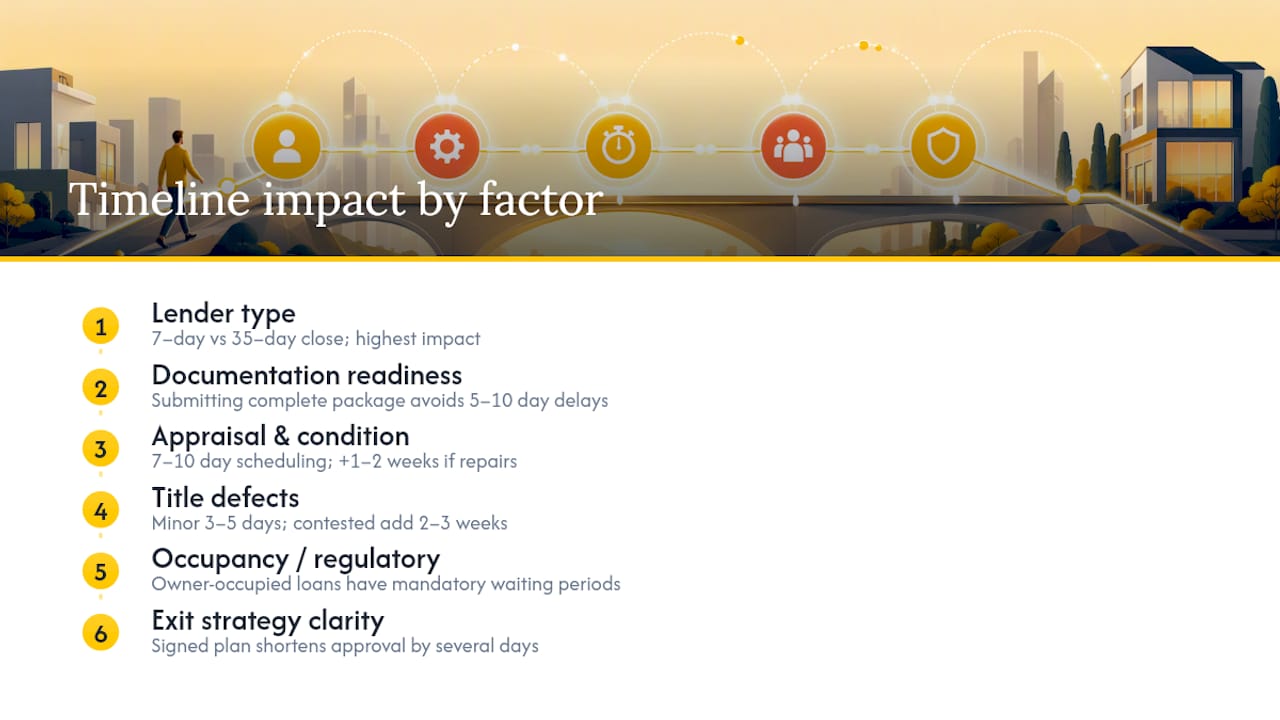
1. Lender type is the highest-impact variable. Private and hard-money lenders underwrite primarily on property value and equity, which means they can approve and fund in days. Banks and regulated lenders layer in income verification, debt-to-income analysis, and mandatory disclosures. The difference between a 7-day close and a 35-day close often starts here. For a direct comparison of how bridge loans and hard-money loans differ in speed and underwriting, the structural distinctions are worth understanding before you choose a lender.
2. Documentation readiness is the factor borrowers control most directly. Submitting a complete package on day one — tax returns, bank statements, purchase contract, payoff statements, and HOA documents — eliminates the back-and-forth that commonly adds 5–10 days to underwriting.
3. Appraisal availability and property condition are frequently underestimated. A licensed appraiser in a busy market may not schedule an on-site visit for 7–10 days. Properties with deferred maintenance, unpermitted additions, or access issues can trigger a second appraisal visit or a required-repairs condition, adding another 1–2 weeks. Fully disclosing property defects upfront and having a repair escrow plan ready prevents the most common appraisal-related delays.

4. Title defects can halt a close entirely until resolved. Common issues include outstanding liens, boundary disputes, estate-related ownership questions, and recording errors. Minor defects resolve in 3–5 days; contested title issues can add 2–3 weeks or more.
5. Occupancy and regulatory status is the factor most borrowers do not anticipate. Owner-occupied loans subject to consumer mortgage regulations carry mandatory disclosure waiting periods that lenders cannot waive. These are not processing delays — they are statutory minimums. Investment property loans avoid most of these requirements, which is a primary reason investor-focused bridge products close so much faster.
6. Exit strategy clarity drives underwriting speed. A vague exit plan ("sell when the market improves") is frequently rejected or flagged for additional review. A signed purchase contract or a documented refinance commitment gives the underwriter a clear, verifiable path to repayment and typically shortens approval time by several days.
How to shorten your bridge loan approval and closing timeline
Speed in bridge lending is largely a preparation problem. Most delays trace back to missing documents, late-ordered third-party services, or unclear exit strategies — all of which borrowers can address before submitting an application.
Borrower document checklist:
- Two years of federal tax returns (personal and business if applicable)
- Two to three months of bank statements
- Signed purchase contract with all addenda
- Current mortgage statement and payoff quote on the property being sold or refinanced
- HOA documents and current dues statement (if applicable)
- Property insurance declarations page
- Clear, written exit strategy: signed sale contract or refinance commitment letter
Tactical steps to accelerate closing:
- Choose an asset-based or hard-money lender that underwrites on property value, not credit score
- Use electronic signatures on all documents to eliminate courier and mail delays
- Designate a single point of contact on your side who can respond to lender requests within hours, not days
- Verify the lender's state licensing through NMLS Consumer Access before submitting — unlicensed or improperly licensed lenders create legal complications that can delay or void a closing
Pro Tip: If an appraisal comes back with required repairs or a lower-than-expected value, have a set of recent comparable sales ready to submit immediately. A well-documented comp package can support a reconsideration of value within 24–48 hours rather than the 1–2 weeks a full re-appraisal would require. Similarly, if title uncovers a lien, offer to escrow funds for its payoff at closing rather than waiting for it to be cleared beforehand — many title companies will accept this approach for straightforward monetary liens.
Costs and fees that affect your closing schedule
Fees in bridge lending are not just a cost question — several of them directly affect how fast you can close. Paying for expedited services compresses timelines; underfunding closing costs delays the wire.
Typical fee items and ranges:
- Origination points: Bridge loans commonly carry 2–4 origination points, paid at closing. On a $300,000 loan, that is $6,000–$12,000 due at the closing table
- Appraisal fee: Standard residential appraisals run $400–$700; rush or expedited appraisals from lenders with in-house capacity can reduce turnaround to 24–48 hours, sometimes at a premium
- Title and escrow fees: Typically $800–$2,000 depending on loan size and state; expedited title searches are available in most markets for an additional $150–$300
- Interest reserve: Some lenders require 1–3 months of prepaid interest held in escrow, which must be funded at closing
- Legal and recording fees: $200–$600 depending on state and county; county recording timelines vary and can add 1–3 days to the post-closing process
Wire timing is a practical constraint that catches borrowers off guard. Most lenders require incoming wires to be confirmed before releasing funds. If closing falls on a Friday or the day before a federal holiday, a wire submitted after the bank's cutoff (typically 3:00–4:00 PM ET) will not settle until the next business day. That single oversight can push a Thursday close to Monday.
Lenders reference the Federal Reserve H.15 daily rate releases when setting short-term product pricing, so bridge loan interest rates tend to move with broader market benchmarks. Reviewing current H.15 data gives borrowers a reasonable baseline for evaluating quoted rates before committing.
For a complete breakdown of what to expect at the closing table, the bridge loan closing costs guide covers each line item in detail.
When can a bridge loan realistically close in 5–10 business days?
A 5–10 business day close is achievable, but it requires a specific set of conditions to align. Missing any one of them typically pushes the timeline into the 2–4 week range.
Prerequisites for an expedited close:
- Clean title with no outstanding liens, disputes, or ownership gaps
- In-house appraiser, desktop appraisal, or appraisal waiver from the lender
- Complete borrower documentation submitted on day one
- Clear, documented exit strategy (signed sale contract or refinance commitment)
- Substantial equity in the subject property (lenders generally cap residential LTVs at around 80%)
- Lender capacity to pre-order title and appraisal simultaneously on application day
The fastest closings share one characteristic: every third-party service is ordered on day one, not after conditional approval. Lenders who wait until underwriting is complete to order appraisal and title are structurally incapable of closing in under two weeks, regardless of how efficient their internal process is. When evaluating lenders for a time-sensitive deal, ask directly: "Do you order appraisal and title on the day of application?" The answer tells you more about realistic closing speed than any advertised timeline.
Jaken Finance Group's funded deal case studies document real investor closings, including transactions where asset-based underwriting and simultaneous third-party ordering produced funding timelines well within the 5–10 business day window.
The regulatory caveat for owner-occupied loans: Consumer mortgage products subject to Regulation Z carry mandatory disclosure waiting periods that cannot be waived by the lender or the borrower. These statutory minimums exist to protect consumers and are enforced by the CFPB. Any lender claiming they can close an owner-occupied, regulated mortgage in 5–7 days should be asked specifically how they handle the required disclosure timing — because the answer will either reveal a misclassification of the loan or a compliance risk the borrower would inherit.
How bridge loans compare to alternatives on timing
If your primary constraint is speed, bridge loans from private or hard-money lenders are typically the fastest path to funding for real estate transactions. The alternatives each carry their own timeline and cost profile.
- HELOC (Home Equity Line of Credit): Approval typically takes 2–6 weeks, and draw availability may require an additional 3–5 business days after approval. HELOCs are cheaper than bridge loans in most rate environments but require an existing property with sufficient equity and a lender willing to subordinate or hold the first lien.
- Conventional mortgage: Standard purchase mortgages run 30–45 days minimum, with jumbo or non-QM products sometimes extending to 60 days. Not a viable option for time-sensitive acquisitions or properties that do not meet agency condition standards.
- Personal loan: Funding can occur in 1–5 business days for well-qualified borrowers, but loan amounts are typically capped at $50,000–$100,000 — far below what most real estate transactions require. Interest rates are also substantially higher than secured bridge products.
- Seller financing (seller carry): Timeline depends entirely on negotiation and the seller's attorney, but deals can close in 1–2 weeks when both parties are motivated and title is clean. The tradeoff is that seller financing is uncommon, terms vary widely, and the seller must be willing to carry the note.
A bridge loan makes the most sense when the transaction requires speed, the property does not qualify for conventional financing (condition, occupancy, or timing), and the borrower has a clear, near-term exit. When cost is the primary concern and timing is flexible, a HELOC or conventional product may produce a lower all-in cost despite the longer timeline. For situations where a construction phase follows the acquisition, the construction loan vs. bridge loan comparison clarifies which product fits which project stage.
The tradeoff most borrowers get wrong
Speed in bridge lending has a real cost, and the borrowers who manage it best are the ones who decide early which constraint they are actually optimizing for.
The conventional framing is: pay more to close faster. That is true as far as it goes. Expedited appraisals, rush title searches, and the origination points that come with hard-money products all add to the cost of a fast close. But the more important question is what the alternative actually costs. Carrying two mortgages for an extra 30 days while waiting for a cheaper loan to process is not free. Missing a purchase contract deadline because a bank's underwriting queue ran long is not free. The cost of a missed deal or a double-carry month frequently exceeds the premium charged for a 10-day hard-money close.
What borrowers underestimate is the value of a lender with documented fast-close experience, not just an advertised timeline. Any lender can claim a 7-day close. The ones who consistently deliver it have in-house appraisal capacity, established title relationships, and underwriting teams that do not require committee approval for asset-based decisions. Before committing to a lender on a time-sensitive deal, ask for specific funded examples and verify their licensing through NMLS Consumer Access. A lender who cannot point to real closed transactions at the speed they advertise is telling you something important.
Jaken Finance Group closes bridge loans when timing is critical
Real estate investors who need capital fast do not benefit from a 45-day underwriting process. Jaken Finance Group underwrites on asset value, not credit score, which means approval decisions are made on the property's equity position and the borrower's exit strategy — not a FICO file. That approach removes the documentation layers that slow conventional lenders and makes closings in as few as five days a realistic target for qualifying transactions.
For investors evaluating a time-sensitive acquisition, Jaken Finance Group offers asset-based hard money products with flexible terms, high leverage, and no minimum credit score requirement. The firm's bridge loan program for investors covers residential and commercial acquisitions, fix-and-flip projects, and gap financing situations where speed is the deciding factor. To move forward, submit a loan inquiry directly through the Jaken Finance Group website and have your purchase contract, property details, and exit strategy ready — those three items are what the underwriting team needs to issue a same-day prequalification decision.
Sources
The following sources cover U.S. regulatory requirements, market-rate benchmarks, and industry guidance on bridge loan timelines.
Regulatory sources:
- Howlongfor
- Bridge loan - Bankrate
- Consumer Financial Protection Bureau — Regulation Z (12 CFR 1026), sec. 1026.43
- Federal Reserve — H.15 Selected Interest Rates
Market-rate data:
Industry timing guides:
This article is general information, not a substitute for advice from a qualified financial advisor. Consult a qualified financial professional about your own circumstances before acting on anything here.