
Most U.S. bridge loans typically run for short to medium terms and use interest-only monthly payments with a balloon principal payoff at maturity. Commercial bridge rates and origination points vary depending on loan type, and most lenders require a documented exit strategy — either a property sale or a permanent refinance — before they will commit. LTV limits generally depend on current or as-stabilized value. Bridge financing is appropriate for short-term gaps, not long-term holds; borrowers who carry bridge debt past their planned exit often overpay compared to permanent debt. Terms vary by lender, asset type, and state, so treat every figure here as a starting range, not a guarantee.
Table of Contents
- At-a-glance numbers: the facts you need right now
- What loan durations actually look like — and why lenders set them that way
- Repayment options: interest-only, balloon payoffs, and overlapping mortgages
- Example: how much would a $100,000 bridge loan cost?
- Rates, fees, and the total cost drivers for bridge loans
- Lender requirements and underwriting: what lenders check
- When a bridge loan makes sense — common use cases and red flags
- Alternatives to bridge loans and when to choose them
- How to shop for a bridge loan: questions to ask and red flags
- How Jaken Finance Group structures bridge loans for investors
- Key risks, pros/cons, and how to mitigate them
- Key Takeaways
- What borrowers consistently get wrong about bridge financing
- Jaken Finance Group's bridge and hard-money programs for U.S. investors
- Sources and further reading
At-a-glance numbers: the facts you need right now
- Term ranges by use case: Acquisition or buy-before-you-sell: 3–12 months. Value-add repositioning or lease-up: 12–24 months. Construction or heavy-lift with extensions: up to 36 months total.
- Rate ranges by bridge type: Senior/institutional bridge: 9–11% + 1–2 points. Value-add: 10–12% + 2–3 points. Heavy-lift: 11–14% + 2–4 points. Private/hard-money: 10–14% + 2–5 points.
- LTV: 65–80% depending on lender type and asset quality; hard-money lenders may go higher on strong assets.
- Speed to close: Institutional lenders: 30–60 days. Private and hard-money lenders: 7–21 days. Jaken Finance Group closes in as few as five days on qualifying deals.
- Common exit paths: Sale of the property, refinance to permanent debt (agency, CMBS, or bank), cash-out refinance, or HELOC on a stabilized asset.
- Market context: Bridge rates have fallen roughly 150–200 basis points from 2024 peaks, improving refinance economics for borrowers with credible exits.
What loan durations actually look like — and why lenders set them that way
Initial CRE bridge terms most commonly run 12–24 months, with one or two extension options of 6–12 months each, bringing total potential duration to 24–36 months on complex repositioning deals. Shorter acquisition bridges for residential buy-before-you-sell transactions often close with 3–6 month terms. Construction and heavy-lift deals typically need the longest runway.

Lenders cap term length for a straightforward reason: the longer a bridge loan runs, the greater the refinancing risk and the higher the capital cost to the lender. If a borrower misses maturity without a negotiated extension, the loan is technically in default — which can trigger default interest rates, acceleration clauses, and in recourse structures, personal liability. Negotiating extension mechanics before closing is not optional.
Extensions are not automatic. Most lenders require the borrower to meet performance conditions — a minimum as-stabilized DSCR, a maximum LTV test, or a leasing milestone — before granting an extension. Failing to negotiate those thresholds in writing at origination can leave a borrower with no path forward at maturity.
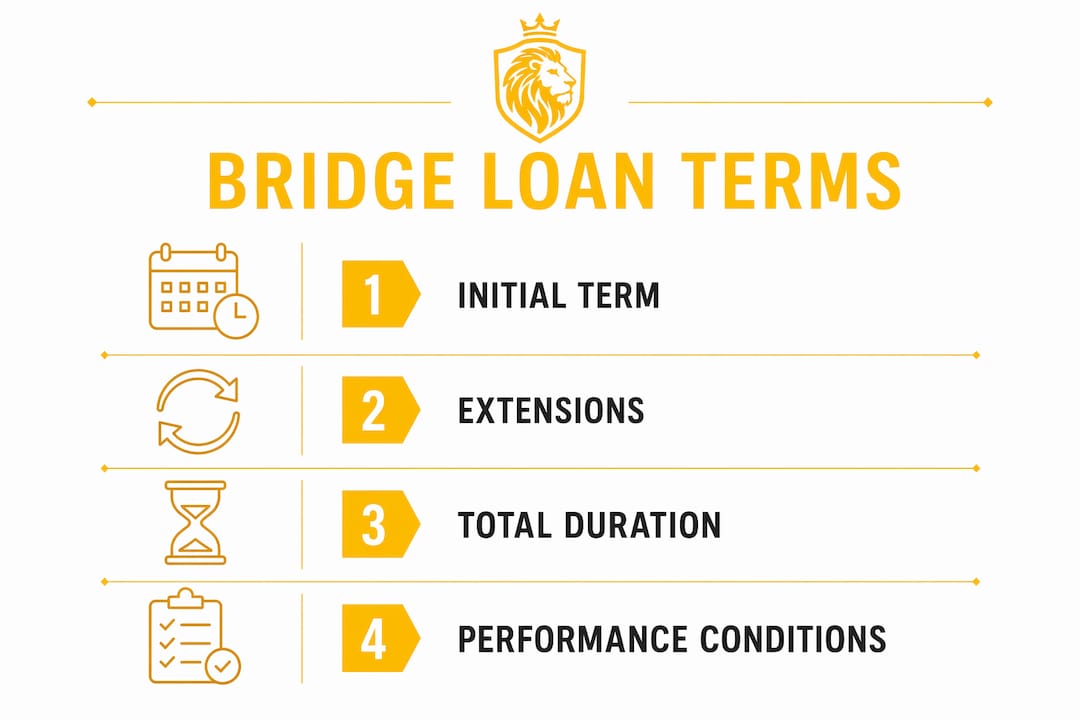
| Bridge Type | Typical Initial Term | Common Extension Length | Total Potential Duration |
|---|---|---|---|
| Acquisition / buy-before-you-sell | 3–6 months | 3–6 months (1 option) | 6–12 months |
| Value-add / lease-up | 12–18 months | 6 months (1–2 options) | 18–30 months |
| Heavy-lift / construction | 18–24 months | 6–12 months (1–2 options) | 24–36 months |
| Hard-money / fix-and-flip | 6–12 months | 3–6 months (1 option) | 9–18 months |
Pro Tip: Begin the permanent-refinance process at least six months before bridge maturity. Permanent lenders typically require 3–6 months of stabilized NOI to underwrite the takeout — starting late is one of the most common and costly borrower mistakes.
Repayment options: interest-only, balloon payoffs, and overlapping mortgages
Bridge loans use interest-only monthly payments with a balloon principal repayment at maturity as the dominant structure. The borrower pays only the interest accrued each month, then repays the full principal in a single lump sum when the loan matures or the property sells. This structure preserves cash flow during the hold period, which is particularly valuable when a property is being repositioned and not yet generating full income.

Two less common variants exist. Deferred interest structures roll accrued interest into the balloon payoff rather than requiring monthly payments — useful for heavy-lift deals where cash flow is minimal during construction. Some lenders offer monthly principal-and-interest amortization, though this is rare in bridge products and typically appears only in shorter-term residential programs.
Overlapping mortgage payments are a real cash-flow risk for residential borrowers who carry an existing mortgage while the bridge loan is outstanding. Both obligations run simultaneously until the original property sells. Borrowers should model both payment streams before committing.
- Interest-only monthly + balloon at maturity: Most common; preserves cash flow during repositioning.
- Deferred interest roll-up: Interest accrues and is added to the balloon; reduces monthly obligation but increases payoff amount.
- Monthly P&I: Rare; reduces balloon size but increases monthly cash burden.
- Overlapping mortgage: Applies when the borrower's existing home or property mortgage continues during the bridge term.
Pro Tip: Negotiate an interest reserve at closing — typically 6–12 months of debt service held back by the lender — so monthly payments are funded from the reserve rather than out-of-pocket. Ask whether the lender requires a principal paydown before granting an extension, as this can materially affect your liquidity at the 12-month mark.
Example: how much would a $100,000 bridge loan cost?
The example below uses a representative hard-money rate of 12% and 3 origination points on a 12-month term.
| Cost Component | Amount |
|---|---|
| Gross loan amount | $100,000 |
| Net proceeds to borrower | $97,000 |
| Monthly interest-only payment (12% / 12) | $1,000/month |
| Balloon payoff at maturity | $100,000 |
| Total cost of capital (points + interest) | $15,000 |
Sensitivity: what changes if the term extends or rates shift?
- 6-month extension at same rate: Additional $6,000 in interest + an extension fee of roughly $250–$500 (0.25–0.50% of the loan balance), bringing total cost to approximately $21,250–$21,500.
- Rate moves +200 bps to 14%: Monthly payment rises to $1,167; total 12-month interest cost increases to $14,000, raising all-in cost to $17,000.
- Rate moves –200 bps to 10%: Monthly payment drops to $833; total 12-month interest cost falls to $10,000, reducing all-in cost to $13,000.
Interest reserves affect net proceeds directly. If the lender holds back six months of debt service ($6,000) at closing, net proceeds to the borrower drop from $97,000 to $91,000. Exit fees of 0–1% add another $0–$1,000 at payoff. Use a bridge loan calculator to model your specific scenario before committing to a term sheet.
Rates, fees, and the total cost drivers for bridge loans
All-in cost on a bridge loan is rarely just the quoted interest rate. Every line item below can materially change what you actually pay.
- Quoted interest rate: 9–14% depending on bridge type and lender; hard-money products often sit at the higher end.
- Origination points: 1–5 points deducted from loan proceeds at closing; higher-risk or lower-LTV deals attract more points.
- Exit fees: 0–1% of the loan balance paid at payoff; not universal but common in institutional bridge products.
- Extension fees: 0.25–0.50% per 6-month extension; confirm whether these are paid upfront or added to the balance.
- Interest reserves: 6–24 months of debt service held at closing; reduces net proceeds but eliminates monthly payment risk during lease-up.
- Legal and due-diligence fees: $15,000–$75,000 depending on deal size and complexity; paid regardless of whether the loan closes.
- Appraisal and environmental costs: Typically $2,500–$10,000 for standard appraisals; Phase I environmental reports add $1,500–$3,500.
- Closing costs: Title insurance, recording fees, and escrow charges vary by state and deal size.
APR is a poor measure of true cost on short-term bridge loans. When origination points and reserves are large relative to the loan amount, the effective cost of capital can be significantly higher than the stated rate. Model total dollars out of pocket over the expected hold period, not the annualized rate.
Lender type, LTV/LTC, and perceived exit risk all move spreads and points. A clean acquisition bridge at 65% LTV on a stabilized asset will price tighter than a heavy-lift deal at 80% LTC with a speculative lease-up assumption.
Lender requirements and underwriting: what lenders check
Bridge underwriting centers on the asset and the exit plan, not the borrower's FICO score. Institutional bridge lenders assess asset value, business plan credibility, and sponsor experience alongside the numbers. Hard-money lenders move faster and accept weaker sponsor credit, but they price that risk into higher rates and points.
Core underwriting factors:
- Asset value and appraisal: Current as-is value and as-stabilized or ARV appraisal; lenders size the loan against the lower of cost or appraised value.
- LTV/LTC limits: Typically 65–80% of as-is value or 75–85% of total cost depending on lender type and deal risk.
- Sponsor experience: Track record with similar asset types and project complexity; more experience typically means better pricing.
- DSCR at stabilized basis: Lenders model the property's projected debt-service coverage ratio at stabilization to confirm the exit refinance is achievable.
- Business plan credibility: Renovation budgets, contractor bids, lease-up timelines, and comparable rent data must support the pro forma.
- Environmental and title due diligence: Phase I environmental reports and clean title are standard requirements.
- Recourse and guarantees: Most bridge loans require personal guarantees with standard carve-outs for fraud and environmental liability; non-recourse structures are available at lower LTVs.
- Reserves and escrows: Interest reserves, tax and insurance escrows, and completion reserves are common on value-add and construction deals.
Before applying, prepare a short business plan with a pro forma stabilization schedule, recent rent rolls or comparable lease data, contractor bids for any renovation work, and a documented exit path — either a signed purchase agreement or a preliminary permanent-financing term sheet.
When a bridge loan makes sense — common use cases and red flags
Bridge financing fits a specific set of circumstances. Applying it outside those circumstances is where borrowers get into trouble.
Common use cases:
- Buy-before-you-sell (residential): Purchase a new property before the existing home closes; term typically 3–6 months.
- Value-add repositioning: Acquire an underperforming asset, execute a renovation or re-tenanting plan, then refinance to permanent debt; term typically 12–24 months.
- Lease-up financing: Fund a newly constructed or recently renovated property through stabilization; term 12–18 months.
- Construction shortfalls: Cover gaps between a construction loan and permanent takeout when the project timeline slips.
- Time-gap working capital: Short-term liquidity while a sale or refinance closes; term 3–6 months.
For fix-and-flip investors, bridge and hard-money products are often interchangeable — the key variable is whether the exit is a sale or a refinance.
Red flags — situations where bridge financing is likely a poor fit:
- No credible exit plan or a permanent-debt assumption that requires market conditions to improve significantly.
- Pro forma stabilization that depends on above-market rents or aggressive lease-up timelines with no comparable support.
- Sponsor liquidity insufficient to cover interest payments if reserves run out before stabilization.
- Reliance on a permanent lender who has not pre-qualified the deal or indicated interest.
- Using bridge financing as a substitute for permanent debt with no defined payoff horizon.
Alternatives to bridge loans and when to choose them
| Alternative | Speed to Fund | Typical Cost | Underwriting Focus | Best Use Case |
|---|---|---|---|---|
| HELOC | 2–6 weeks | SOFR-indexed floating-rate | Credit + equity | Residential gap financing with strong credit |
| Cash-out refinance | 3–6 weeks | 6–8% (30-yr fixed) | Full income/credit | Stabilized asset with equity; long hold intended |
| Permanent refinance | 4–8 weeks | 9–14% | DSCR + income | Stabilized CRE; replaces bridge at maturity |
| Private hard-money | 5–21 days | 10–14% + 2–5 pts | Asset value only | Speed-critical deals; weak credit; nonconforming |
| Bridge loan | 7–60 days | 9–14% + 1–4 pts | Asset + business plan | Short-term gap; value-add; pre-stabilization |
A HELOC is cheaper than a bridge loan when the borrower has strong credit and sufficient home equity, but it requires a stabilized primary residence as collateral and takes weeks to set up — too slow for competitive acquisition timelines. A cash-out refinance offers the lowest long-term cost but replaces the existing mortgage and resets amortization, which may not be desirable. Permanent refinancing is the correct exit from a bridge loan, not an alternative to one.
Private hard-money is the closest substitute for bridge financing. The key difference between bridge and hard-money is underwriting depth: institutional bridge lenders assess the full business plan; hard-money lenders focus primarily on asset value and move faster. For investors who need funds in under two weeks on a nonconforming asset, hard-money is typically the right tool.
How to shop for a bridge loan: questions to ask and red flags
Numbered checklist for evaluating term sheets and lender calls:
- Is the rate fixed or floating? If floating, what is the index (SOFR, Prime), what is the spread, and how often does it reset?
- How many origination points are charged, and are they deducted from proceeds or paid at closing?
- What are the exact extension mechanics — what performance conditions must be met, what is the extension fee, and must it be requested in writing by a specific date?
- How is the interest reserve sized, and does it reduce net proceeds at closing or get funded separately?
- Are there prepayment penalties or yield-maintenance provisions, and at what point do they expire?
- Is the loan recourse or non-recourse? What are the standard carve-outs?
- What is the lender's realistic timeline from application to funding?
- What due-diligence and legal fees are non-refundable if the deal does not close?
Red flags to watch for:
- Vague extension clauses that give the lender sole discretion to approve or deny without defined criteria.
- High non-refundable fees collected before a term sheet is signed or a credit approval is issued.
- Lenders unwilling to document their exit assumptions or pro forma underwriting in writing.
- Unclear default remedies or acceleration language buried in the loan agreement.
To compare two term sheets numerically, calculate total dollars out of pocket over the expected hold period: points paid at close + monthly interest × expected months + extension fees (if applicable) + exit fees. The lower all-in cost wins, not the lower stated rate. Negotiating levers include reducing origination points in exchange for a slightly higher rate, shortening or eliminating exit fees, and specifying the interest reserve amount in the term sheet rather than leaving it to lender discretion.
For construction-adjacent deals, reviewing 2026 construction loan rate ranges alongside bridge pricing helps confirm whether a bridge-to-perm or construction-to-perm structure is more cost-effective for your timeline.
How Jaken Finance Group structures bridge loans for investors
Asset-based underwriting is the core of how Jaken Finance Group approaches bridge financing. The lender sizes loans against property value and the investor's business plan rather than personal credit scores, which means investors with strong deals but non-traditional credit profiles can still access capital quickly.
A representative Jaken Finance Group bridge scenario: an investor acquires a value-add multifamily property at 70% LTV, structured as a 12-month interest-only loan with a 6-month extension option. The interest reserve covers the first six months of debt service, funded at close. The exit is a DSCR rental loan at stabilization. The lender underwrites the as-stabilized rent roll and confirms the permanent-debt assumption is achievable before committing.
Pro Tip: Jaken Finance Group's asset-based underwriting means no minimum credit score requirement. Prepare your property appraisal, renovation scope, and exit plan before the first call — not after — and closings can happen in as few as five days. Review funded deal case studies to see how similar transactions were structured.
Key risks, pros/cons, and how to mitigate them
Pros:
- Fast access to capital — days to weeks versus months for conventional financing.
- Asset-based underwriting accommodates nonconforming assets and sponsors.
- Interest-only payments preserve cash flow during repositioning.
- Flexible structures (reserves, deferred interest, extension options) can be tailored to the business plan.
Cons:
- Higher cost of capital than permanent debt — typically 2–4% more annually.
- Short maturity creates refinancing risk if the business plan slips.
- Points and reserves reduce net proceeds at closing.
- Personal recourse is common; default consequences are significant.
Mitigation strategies:
- Build conservative permanent-refinance assumptions — underwrite the exit at a rate 100–150 bps above current market to stress-test the payoff.
- Fund a full 12-month interest reserve at closing if the property will not generate income during renovation.
- Negotiate extension terms, conditions, and fees in writing at origination — never assume extensions are automatic.
- Maintain contingency liquidity equal to at least 3–6 months of debt service outside the reserve.
- Start the permanent-refinance process six months before maturity; do not wait for the extension clock to run.
Key Takeaways
Most U.S. bridge loans run 12–24 months initially, with total potential duration reaching 24–36 months for complex deals when extensions are negotiated. These loans feature interest-only payments and a balloon payoff, priced at 9–14% plus 1–4 origination points depending on loan type and lender.
| Point | Details |
|---|---|
| Typical term and structure | Bridge loans most commonly run 12–24 months initially, with extension options often allowing for 24–36 months in total duration. Interest-only payments and a balloon payment at maturity are standard. |
| Rate and cost range | Commercial bridge rates run 9–14% plus 1–4 origination points; hard-money sits at the higher end. |
| Exit plan is mandatory | Lenders underwrite the exit as much as the asset; no credible exit means no approval. |
| Start perm-refi early | Begin permanent-refinance underwriting six months before bridge maturity; perm lenders need 3–6 months of stabilized NOI. |
| Jaken Finance Group | Offers asset-based bridge financing with no minimum credit score, fast closings, and flexible reserve structures for U.S. investors. |
What borrowers consistently get wrong about bridge financing
The three errors that appear most often in bridge loan defaults are predictable and preventable. First, borrowers enter the loan without a documented exit — they assume the property will sell or refinance on schedule without confirming that assumption with a lender or buyer. Second, they undercapitalize reserves, leaving no buffer when renovation timelines slip or lease-up takes longer than projected. Third, they build pro formas on aggressive rent ramps that have no comparable support in the local market, which means the stabilized DSCR never materializes and the permanent refinance falls apart.
Bridge financing is a precision instrument. It works when the business plan is tight, the exit is confirmed, and the borrower has liquidity to absorb delays. Jaken Finance Group's funded deal case studies and investor guides show how well-structured bridge transactions are executed from origination through exit.
Jaken Finance Group's bridge and hard-money programs for U.S. investors
Real estate investors who need fast, flexible capital without the credit constraints of conventional lending have a direct path through Jaken Finance Group's asset-based lending programs. The concrete advantages over institutional bridge lenders are speed and underwriting flexibility: no minimum credit score, closings in as few as five days, and loan structures built around the property's value and the investor's business plan.
Eligible borrower profiles and program parameters:
- Property types: residential investment, multifamily, mixed-use, commercial, fix-and-flip, new construction.
- Typical LTV/LTC: up to 80% depending on asset type and deal structure.
- Loan sizes: available for a range of deal sizes across the United States.
- Underwriting basis: asset value and business plan; no minimum FICO requirement.
- Closing timeline: as few as five days on qualifying transactions.
Investors ready to move on a deal can start the process at jakenfinancegroup.com — submit deal details and receive a preliminary term sheet without a lengthy application process.
This article is general information, not professional financial or legal advice. Bridge loan terms vary by lender, asset type, and state. Verify current rates, fees, and eligibility requirements directly with your lender or a qualified financial professional before committing to any financing.
Sources and further reading
The rate ranges, term structures, and underwriting criteria cited in this guide draw from the following sources. Terms vary by lender, market, and asset type — always verify current figures directly with your lender before making financing decisions.
- Typical Commercial Bridge Loan Rates in 2026 — Axiant Partners: Rate tables by bridge type (senior, value-add, heavy-lift, hard-money), origination points, extension fees, and interest reserve guidance.
- Commercial Bridge Loans: The Complete 2026 Borrower's Guide — Avana Capital: Underwriting criteria, exit-timing guidance, cost-of-capital comparisons, and business-plan requirements.
- What Are Common CRE Bridge Loan Terms? — H Equities: Initial term ranges, extension mechanics, and DSCR-based extension conditions.
- Bridge Loans: How They Work and Key Benefits Explained — Investopedia: Repayment structures, interest-only mechanics, and residential bridge loan examples.
- Bridge Loans for Real Estate Investors — Deal Run: Investor-focused term ranges, rate bands, and LTV parameters.