
What do bridge loan closing costs typically run?
Bridge loan closing costs in the U.S. typically range from 1% to 5% of the total loan amount as of mid-2026. On a $1 million loan, that translates to $10,000–$50,000 in upfront expenses before a single draw is made. The range is wide because fee structures vary significantly by lender type, asset class, and deal complexity.
The main fee categories investors encounter:
- Origination fees (points): 1% to 4% of the loan amount, reaching up to 5% on hard money or complex transactions
- Appraisal fees: Property-dependent, typically $500–$1,200 for standard residential assets
- Title insurance and title search: Approximately 0.2%–0.5% of the loan amount
- Recording fees: Charged by local county or municipal agencies; vary by jurisdiction
- Settlement or escrow fees: Generally $250–$750 per transaction
- Processing, underwriting, and document preparation fees: Lender-specific; add to cumulative total
Jaken Finance Group specializes in asset-based bridge lending with transparent fee structures, giving investors a clear picture of total costs before commitment.
Table of Contents
- Breaking down each closing cost component
- Why the stated interest rate alone does not tell the full story
- What extension terms actually cost you
- Private credit funds vs. hard money lenders: how costs differ
- How to budget and negotiate bridge loan closing costs
- When fees are due: the bridge loan closing timeline
- Key Takeaways
- Fast, transparent bridge financing from Jaken Finance Group
Breaking down each closing cost component
Understanding each line item prevents budget shortfalls at the closing table. Here is what each fee covers and what drives its size.
- Origination points are the largest single cost. At 1%–4% of the loan amount, they compensate the lender for underwriting and capital deployment. On hard money deals or transactions with thin documentation, origination fees can reach 5%. Critically, these fees are typically deducted from loan proceeds at closing, meaning the net disbursement is lower than the face value of the loan. A $500,000 loan with a 2% origination fee nets $490,000 to the borrower.
- Appraisal fees cover the independent valuation of the collateral property. Fees range from $500 to $1,200 depending on property type, size, and geographic market. Complex mixed-use or commercial assets push toward the upper end.
- Title insurance and title search fees protect both lender and borrower against ownership disputes or liens. These run 0.2% to 0.5% of the loan amount, with variation by state and title company.
- Recording fees are set by the county recorder's office and cover the cost of registering the deed of trust or mortgage lien. They are non-negotiable and jurisdiction-specific, typically modest but worth confirming in advance.
- Settlement or escrow fees cover the neutral third party managing fund disbursement at closing. These fees generally fall between $250 and $750 per transaction.
- Additional lender fees may include underwriting fees, document preparation charges, and wire transfer costs. These vary widely by lender and are often disclosed only in the loan commitment letter.
Cumulative total closing costs across these categories typically range from 1% to 5% of the loan amount for most U.S. bridge transactions.
Why the stated interest rate alone does not tell the full story
The coupon rate on a bridge loan is the headline number, but it rarely reflects what investors actually pay. Effective cost evaluation requires accounting for origination points, exit fees, interest reserves, extension fees, and the actual hold period to arrive at a true annualized cost of capital.

Consider a practical example: a $2 million bridge loan at 9.5% with 1.5 origination points, a 0.75% exit fee, and a 12-month hold. The origination cost adds 150 basis points to the effective annual rate. The exit fee adds another 75 basis points. The actual all-in cost is closer to 11.75% annualized, not 9.5%. Two term sheets with identical coupons can differ by a full percentage point in total cost once fee and term structure are priced honestly.
Interest reserves compound this further. When a lender requires the borrower to fund an interest reserve account at closing, that capital is no longer available for the project, affecting cash flow even though it is technically the borrower's own money.
Pro Tip: Calculate the effective annualized cost (EAC) for every bridge loan offer by adding origination points and exit fees to the stated rate, then dividing by the expected hold period in years. This single metric makes apples-to-apples comparison possible across lenders with different fee structures.
Some bridge loans also carry minimum interest guarantees, requiring payment of interest for a set number of months even if the loan is repaid early. Most bridge products do not include prepayment penalties, but minimum interest clauses function similarly and must be identified before signing.
What extension terms actually cost you
Extension clauses are among the most overlooked provisions in bridge loan commitment letters, and among the most consequential when project timelines slip.
- Extension fees typically run 0.25% to 0.50% per extension period, charged on the outstanding loan balance
- Interest rate increases often accompany extensions, adding 25–100 basis points to the coupon for the extended term
- Cumulative cost impact on a $1 million loan: a single 6-month extension at 0.5% adds $5,000 in fees, plus higher interest on the extended balance
- Project delays are common in renovation and construction scenarios; underestimating timeline risk directly reduces profit margins
- Negotiation leverage exists before signing: investors can negotiate the extension fee percentage, the number of permitted extensions, and whether rate increases are capped
Review every commitment letter for the specific extension conditions, including any performance tests the lender requires before granting an extension. Some lenders require the project to meet a leasing or construction milestone before approving the extension request.
Private credit funds vs. hard money lenders: how costs differ
The lender type chosen has a direct and material impact on bridge financing expenses. The two primary categories in the private lending market operate with distinct cost structures.
- Private credit funds and debt funds target institutional-quality assets with experienced sponsors. They typically offer lower origination fees (1–2 points), competitive interest rates, and non-recourse structures. Closings run 2–4 weeks. The trade-off is tighter underwriting criteria: stabilized or near-stabilized assets, documented exit strategies, and often a minimum loan size.
- Hard money lenders serve deals that fall outside institutional parameters: heavy value-add, thin documentation, urgent timelines, or borrowers with credit challenges. Origination fees reach 3–5 points, and interest rates run higher. The advantage is speed and flexibility. Closings in 5–10 business days are achievable, and asset value drives approval more than borrower FICO.
Choosing between these lender profiles depends on three variables: asset condition, borrower credit profile, and project urgency. A stabilized multifamily asset with a strong sponsor belongs in the debt fund market. A distressed single-family flip with a 90-day close deadline fits the hard money lending profile. Jaken Finance Group operates in the hard money and asset-based lending space, offering fast closings and flexible underwriting for investors who need capital deployed quickly regardless of credit score.
How to budget and negotiate bridge loan closing costs
Accurate budgeting starts before the lender conversation, not after the term sheet arrives.
- Request an itemized fee schedule from every lender at the initial inquiry stage, not just at commitment. Compare line by line, not total to total.
- Verify third-party fees independently. Appraisal, title, and recording fees are set by third parties. Confirm local filing rates and get competing title quotes before accepting the lender's estimate.
- Negotiate origination fees directly. On larger loan amounts or repeat borrower relationships, origination fees are frequently negotiable. A 0.5-point reduction on a $2 million loan saves $10,000.
- Address exit fees and extension terms before signing. These are negotiable at the commitment stage and non-negotiable after.
- Factor in your credit profile. Stronger borrower credit and documented track records reduce perceived lender risk, which translates to lower pricing on both rate and fees.
Pro Tip: Build a simple cost comparison spreadsheet with columns for origination fee, exit fee, interest rate, expected hold period, and extension fee. Calculate total cost of capital for each offer. This framework surfaces the true cost differences that coupon-only comparisons obscure.
Jaken Finance Group provides transparent fee disclosure and works with investors to structure loans that fit both the asset and the budget. Investors can also use bridge loan calculators to model total costs before committing to a term sheet.
When fees are due: the bridge loan closing timeline
Understanding when each cost hits the ledger helps investors manage cash flow through the closing process.
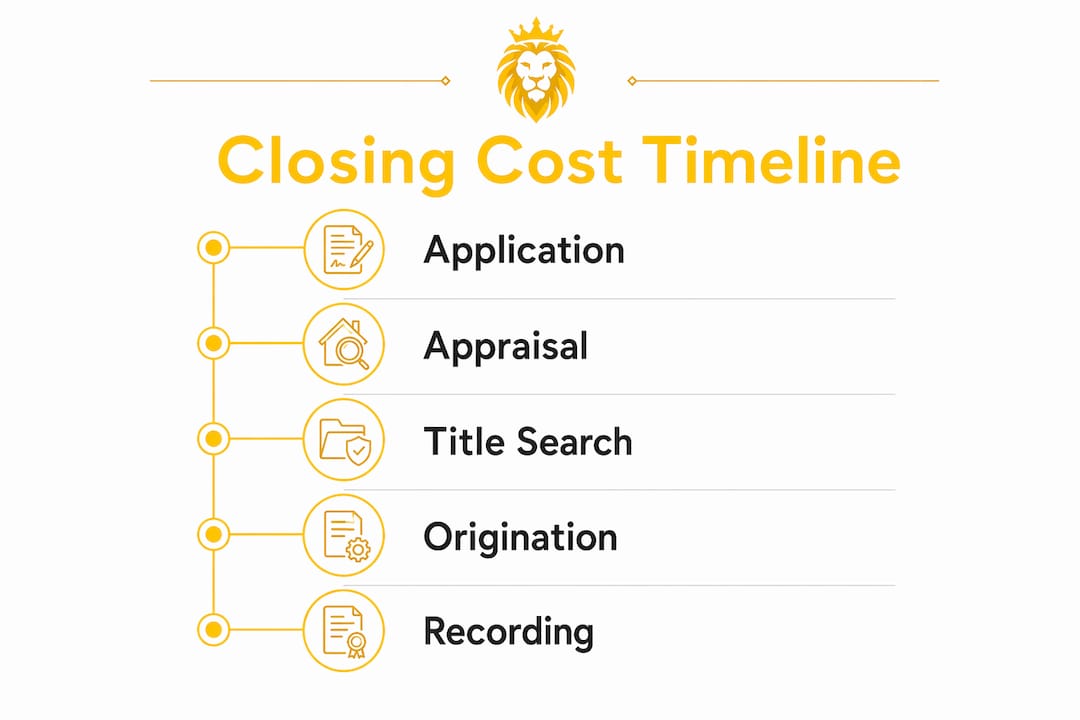
Application to term sheet (Days 1–5): Some lenders charge an application or due diligence deposit at this stage, ranging from $500 to $2,500. This amount may or may not apply toward closing costs.
Term sheet to commitment (Days 5–15): The appraisal is ordered and paid by the borrower, typically $500–$1,200. Environmental reports, if required, are also ordered during this window.
Commitment to closing (Days 15–30): Title search is initiated, title insurance is bound, and the settlement agent is engaged. Title and escrow fees are confirmed during this phase.
Closing day: Origination fees are deducted from loan proceeds. Recording fees are paid to the county. Settlement fees are paid to the escrow agent. The borrower receives net proceeds after all deductions.
Post-closing: Interest accrues from the funding date. If an interest reserve was required, it was funded at closing and draws down monthly. Extension fees and any rate adjustments apply only if the loan term is extended beyond the original maturity date.
Hard money lenders like Jaken Finance Group can compress this timeline significantly. Closings in as few as five business days are achievable on straightforward asset-based transactions, which also compresses the window during which third-party fees accumulate.
Key Takeaways
Bridge loan closing costs in the U.S. run 1%–5% of the loan amount, and evaluating the all-in cost including origination points, exit fees, and extension terms is the only reliable way to compare lender offers accurately.
| Point | Details |
|---|---|
| Total cost range | Closing costs run 1%–5% of the loan amount when all fees are included. |
| Origination fee impact | Origination fees of 1%–4% are deducted from proceeds, reducing net disbursement below the face loan amount. |
| All-in cost evaluation | Effective annualized cost includes rate, origination points, exit fees, and hold period — not the coupon alone. |
| Extension fee risk | Extension fees of 0.25%–0.50% per period, plus potential rate increases, materially raise total loan cost when timelines slip. |
| Jaken Finance Group | Offers asset-based bridge loans with fast closings and transparent fee structures for investors across the U.S. |
Fast, transparent bridge financing from Jaken Finance Group
Real estate investors who have read this far know that the coupon rate is only part of the equation. The origination structure, extension terms, and net proceeds after fee deductions determine whether a bridge loan actually works for the deal.
Jaken Finance Group funds hard money and bridge loans nationwide with closings in as few as five business days. Underwriting is asset-based, meaning property value drives approval, not credit score. Fee structures are disclosed upfront, so investors can model total cost of capital before committing. Whether the project is a fix-and-flip, a value-add acquisition, or a new construction, Jaken Finance Group structures loans around the asset and the business plan.
Ready to see what your deal qualifies for? Apply for bridge financing at Jaken Finance Group and get a clear, itemized cost picture before you sign anything.