
A construction contingency budget is a reserved percentage of project cost set aside to absorb unforeseeable conditions and necessary change orders, not scope upgrades or estimating errors. The best practice for sizing one is risk-based, not arbitrary: tie every percentage point to a specific risk driver, and keep owner and general contractor (GC) contingencies in separate, separately governed lines from the start.
TL;DR:
- Owner contingency typically ranges from 5% to 15%, depending on project complexity, site conditions, and design maturity, with renovation projects often higher.
- Contingency should always be managed separately from allowances and retainage, and justified through a detailed risk-based worksheet rather than a flat percentage.
- The contingency budget must be governed by the owner or their representative, with approval authority scaled to the size of the change order or risk event.
- Leftover contingency funds should revert to the owner unless otherwise specified, and only spent on documented, qualifying risk events like unforeseen site conditions.
- Maintaining separate, detailed tracking and monthly reforecasting of contingency depletion helps prevent funding gaps and supports lender approval.
Table of Contents
- What Is a Construction Contingency Budget and How Does It Differ From Allowances?
- What Contingency Percentage Should You Budget by Project Type?
- How Do You Calculate a Risk-Based Contingency Budget?
- Who Manages the Contingency Budget and What Do Lenders Expect?
- When Can You Actually Spend Contingency Funds?
- How Should You Track and Reforecast Contingency Mid-Construction?
- What Lenders See That Project Teams Often Miss
- What Happens When Contingency Runs Short Mid-Build?
- Sources
What Is a Construction Contingency Budget and How Does It Differ From Allowances?
Owner contingency is capital held and controlled by the project owner or developer, released only for events outside the contractor's control, such as differing site conditions or code-driven design changes. GC contingency, sometimes called contractor's contingency, sits inside a guaranteed maximum price (GMP) and covers the contractor's own estimating risk on self-performed and subcontracted work. Design contingency is a separate reserve carried during early design phases to absorb cost growth as drawings develop; the American Institute of Architects recommends this typically ranges from 5% to 10% and stresses that contracts must state clearly who controls it.
Custodianship matters more than most budgets admit. Owner contingency should never sit inside the GC's contract sum, where it becomes negotiable rather than reserved. Allowances and retainage are frequently confused with contingency, but they serve different functions entirely:
- Allowances are pre-budgeted amounts for scope not yet fully specified, like finish selections, and get spent down as decisions are made.
- Retainage is money withheld from contractor payments, typically 5% to 10%, released at substantial completion; it belongs to the contractor and is not a risk reserve.
- Contingency, according to Procore's construction contingency guidance, is not money owed to anyone. It only gets spent when a qualifying risk event occurs.
Mixing these three into one line item is the single most common budgeting error project teams make.
What Contingency Percentage Should You Budget by Project Type?
Contingency benchmarks vary sharply by project type, site complexity, and how far design has progressed. Practitioner data from 2026 shows owner contingency commonly running 5% to 15% of hard cost depending on those factors, while GC contingency inside a GMP typically lands in the 2% to 5% range.
Owner contingency commonly runs higher than most first-time developers assume, especially on renovation work where existing conditions are unknown until walls come open.
| Project Type | Typical Owner Contingency | Key Driver |
|---|---|---|
| Tenant improvement (existing shell) | 8% to 15% | Concealed conditions, MEP surprises |
| Ground-up commercial/multifamily | 5% to 10% | Site, weather, market volatility |
| Healthcare renovation | 10% to 15% | Regulatory complexity, phased occupancy |
| Cold storage / data center | 5% to 8% | Specialized trades, but well-documented systems |
| Residential remodel/renovation | 10% to 15% | Building age, scope discovery |
Design maturity moves these ranges more than project type alone. AACE International's estimate classes tie cost accuracy to how complete the design documents are: a Class 5 estimate built on a concept sketch carries far more uncertainty than a Class 1 estimate built on finished construction documents. As design progresses toward roughly 75% completion, contingency can typically tighten; earlier-stage projects need materially larger reserves to cover what the drawings haven't resolved yet.
Lenders have their own norms layered on top of these ranges. Institutional underwriting increasingly requires a separately identified owner contingency line rather than a lump-sum buffer folded into hard costs, and generic "10% contingency" entries without supporting justification get flagged during loan review. Renovation and design-build practitioners echo this, recommending contingency sized to the level of uncertainty, often 8% to 15%, held apart from the contractor's control. Reviewing current commercial construction cost per square foot benchmarks before applying a percentage helps anchor the hard-cost base you're sizing against.
How Do You Calculate a Risk-Based Contingency Budget?
Skip the flat percentage pulled from a past project and build the number from actual risk inputs. That's the difference between a contingency figure a lender accepts and one they send back for justification.
Start by gathering six inputs: project type, known or suspected site unknowns (soil, utilities, hazardous materials), delivery method (design-bid-build versus design-build versus GMP), specialty scope exposure (structural steel, curtain wall, complex MEP), current market volatility for materials and labor, and design completeness measured against AACE estimate class.
- Baseline the design maturity. Identify your AACE estimate class. A Class 4 or 5 estimate (conceptual to schematic design) starts with a wider band than a Class 1 or 2 estimate near full construction documents.
- Quantify each risk category separately. Assign a percentage to site unknowns, specialty scope, and market volatility individually rather than guessing one blended number.
- Apply the design-completion modifier. Practitioner rules of thumb link earlier design stages to noticeably larger reserves, tightening as drawings approach full completion.
- Aggregate and cross-check against benchmarks for your project type from the table above.
- Document the buildup so it survives a lender's underwriting review.
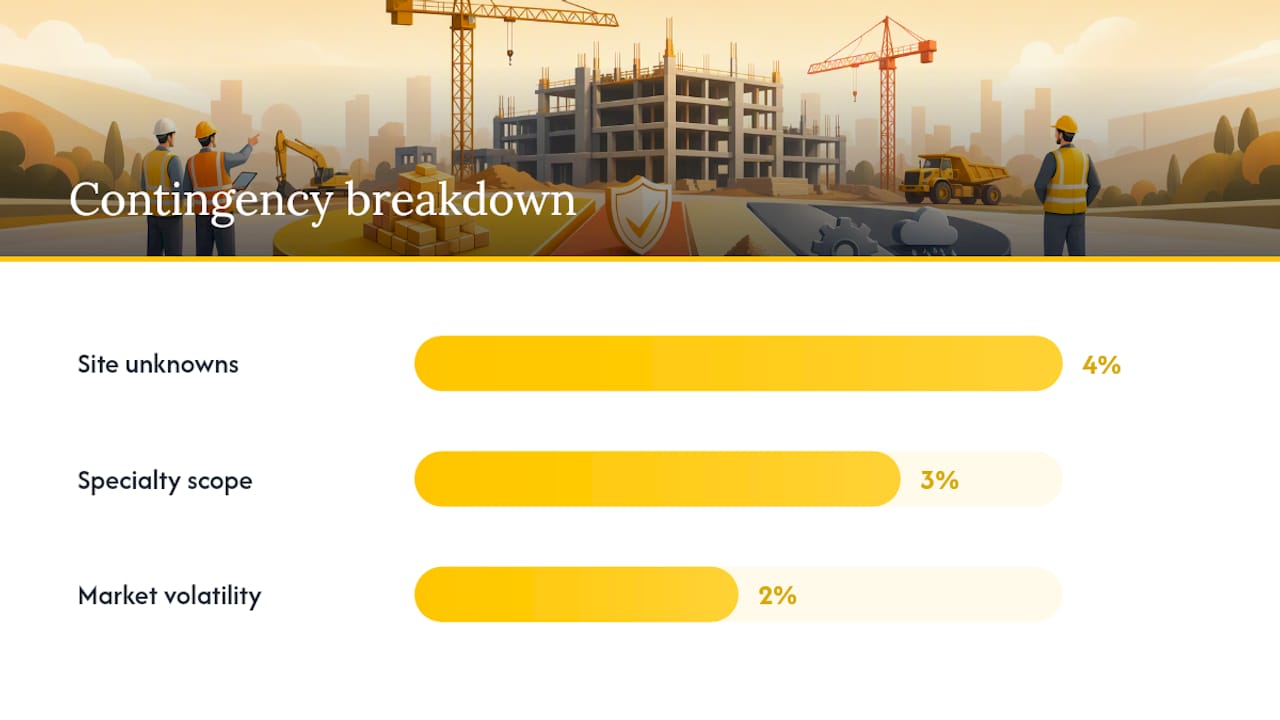
A quick example: a $4 million tenant improvement at 60% design development, with moderate MEP complexity and known asbestos abatement risk, might land at 4% for site unknowns, 3% for specialty scope, and 2% for market volatility, aggregating to roughly 9%, or $360,000 in owner contingency.
Pro Tip: Build your contingency justification as a line-item worksheet, not a single percentage. When a lender or finance committee asks "why 9% and not 6%," you want an answer tied to specific risks, not a gut feeling.
Who Manages the Contingency Budget and What Do Lenders Expect?

Governance determines whether contingency protects the project or quietly disappears into scope creep. The owner or their designated representative should hold ultimate authority over owner contingency, with the project manager or owner's representative reviewing draw requests before approval and construction controls staff logging every transaction against the risk register.
A workable approval matrix scales authority to dollar amount:
- Change orders under $10,000: PM approval alone.
- $10,000 to $50,000: PM plus owner's representative sign-off.
- Above $50,000: owner or investment committee approval required.
Lenders bring their own requirements to this structure. Most now require contingency to appear as a separately identified draw line rather than folded into hard costs, funded only against approved draws with supporting documentation, such as revised change-order logs or field condition reports. Reserve requirements tied to draws often mirror the documentation standards seen in DSCR loan reserve guidelines, and a solid draw management playbook keeps a project's paperwork lender-ready throughout construction. At closeout, unused contingency typically reverts to the owner or, depending on the contract, gets split under an incentive clause with the GC.
When Can You Actually Spend Contingency Funds?
Contingency exists for qualifying events, not convenience. A qualifying event is something outside the contractor's reasonable control: differing subsurface conditions, code changes mandated mid-construction, or design errors discovered in the field. An owner deciding to upgrade finishes or add square footage is a scope change, not a contingency event, and belongs in a separate change order funded from a different budget line.
- Document the triggering condition with photos, field reports, or inspection findings.
- Issue a formal change order referencing the specific contingency category it draws against.
- Route it through the approval matrix before any work proceeds.
- Log the draw against the risk register, not just the general ledger.
Renovation practitioners are consistent on one point: leftover contingency should revert to the owner unless the contract specifies a shared-savings arrangement. Treating unspent reserve as free money for upgrades erodes the entire purpose of holding it.
How Should You Track and Reforecast Contingency Mid-Construction?
Track committed amounts separately from paid amounts, and categorize every draw by risk type so the reserve stays linked to your original risk register rather than becoming a generic slush fund. Procore's construction budget guidance recommends this separation specifically to preserve transparency when owners or lenders audit spend later.
Reforecast monthly at minimum, and immediately after any milestone that changes design certainty, such as completing structural drawings or finishing abatement work.
- Track the remaining reserve ratio: contingency left divided by original contingency.
- Monitor burn rate: how fast contingency depletes relative to percent complete.
- Report committed exposure: contingency tied up in pending change orders but not yet paid.
A reserve ratio that falls well below the project's percent-complete curve is an early warning sign worth escalating before it becomes a funding gap.
What Lenders See That Project Teams Often Miss
Underwriting a construction loan means underwriting the contingency line as closely as the hard costs. A thin or undocumented reserve is often the first thing that stalls approval, and it's a pattern we see repeatedly at Jaken Finance Group when reviewing incoming construction deals. Adequate contingency, sized against real risk drivers rather than a round number, tends to correlate with faster closings and fewer mid-construction funding gaps, as reflected in the 12-Unit Garden Multifamily Construction Stack case study. None of that replaces disciplined estimating. Contingency covers the unforeseeable; it was never designed to paper over a bad take-off.
— Jason Taken
What Happens When Contingency Runs Short Mid-Build?
Even a well-sized contingency budget can run thin when a lender's draw approval lags behind an urgent site condition, or when discovered conditions exceed what the reserve was built to absorb. That gap is exactly where short-term financing earns its keep instead of forcing a project to stall. Jaken Finance Group's asset-based lending underwrites against the property's value and completed work in place rather than a borrower's credit profile, which matters when a contingency shortfall shows up mid-construction and there's no time for a traditional bank's timeline.
A mid-construction refinance can free up capital when hard costs outpace the original budget, and down payment funding covers gaps before a draw schedule catches up.
| Scenario | Product Fit |
|---|---|
| Contingency depleted by discovered site conditions | Mid-construction refinance |
| Lender draw approval delayed, cash flow gap | Asset-based hard money loan |
| Insufficient upfront capital for owner contingency | Down payment funding |
Owners facing a contingency squeeze can request a quote from Jaken Finance Group to explore fast-closing options before a shortfall turns into a stalled job site.
Sources
- Managing the contingency allowance | AIA
- What is Construction Contingency? | Procore
- Commercial construction contingency by project type | Terrapincg
- Budgeting for contingency: why every construction budget needs reserve | Timber Design + Build