Spec home financing comes down to three practical routes: a bank or builder-lender spec construction loan, a spec builder line of credit, or a hard-money and asset-based bridge loan. Bank programs cost less but move slower and demand more documentation; asset-based loans close faster with fewer hoops but carry higher rates. Hard-money and asset-based bridge loans fit best when speed, flexible underwriting, or an unconventional credit profile rules out a traditional bank timeline.
TL;DR:
- Asset-based bridge loans are ideal when speed, unconventional credit profiles, or project complexity prevent traditional bank financing.
- Lenders typically size spec loans based on cost or after-repair value, with leverage decreasing as financing shifts from project cost to ARV.
- Specification of draws, inspection requirements, and closing timelines vary by lender, with speed-focused lenders offering same-day disbursement options.
- Rates range from near 8 percent for asset-based loans to lower bank rates, with interest typically accruing or being paid monthly depending on the structure.
- Strong builder experience, detailed project plans, and land control documentation significantly improve qualification chances and leverage limits.
Table of Contents
- What Are the Main Types of Spec Construction Loans?
- How Do Lenders Size and Structure Spec Loans?
- Who Qualifies for Spec Home Loans?
- What Do Spec Loans Cost, and How Does Cash Flow Compare?
- How Do Draws, Inspections, and Closing Timelines Work?
- What Exit Strategies Work Best for Spec Builds?
- How Jaken Finance Group Structures Spec Financing
- A Builder's Quick Checklist Before Choosing a Lender
- Get a Fast Quote on Your Next Spec Build
- Where to Verify Lenders and Rules
- Sources
What Are the Main Types of Spec Construction Loans?
Every spec loan product solves the same problem differently: funding a home built without a signed buyer. A spec construction loan from a bank or dedicated construction lender finances the build itself, sized against cost or projected resale value, and is distinct from a construction-to-permanent loan because there's no long-term amortizing mortgage waiting at the end. A spec builder line of credit works more like a revolving facility for builders running multiple projects at once, drawing and repaying as homes sell. A hard-money or asset-based bridge loan underwrites the deal, not the borrower's tax returns, trading a higher rate for underwriting decisions measured in days rather than weeks.
- Spec construction loans: best for single builds with clean comps and time to spare on paperwork.
- Spec builder lines of credit: best for repeat builders juggling several lots at once.
- Hard-money/asset-based bridge loans: best when timing, credit history, or project complexity rules out conventional financing.
How Do Lenders Size and Structure Spec Loans?
Lenders size spec loans against either total project cost or after-repair value (ARV), and the gap between those two numbers often decides how much leverage a builder actually gets. Loans sized on cost tend to favor builders with disciplined budgets, while ARV-based caps protect the lender when comparable sales are thin or unreliable.
Pay-rate structure is where spec loans diverge sharply from a standard mortgage. Two models dominate:
- Monthly interest-only payments on funds actually disbursed, calculated as draws go out.
- A 0% pay-rate structure, where interest accrues and is paid in full at maturity or sale, keeping monthly cash flow untouched during the build.
Some programs advertise up to 90% loan-to-cost paired with a $0 monthly pay-rate, which explains why builders juggling several projects gravitate toward this structure. Terms typically run short, with extension options available for a fee if a sale takes longer than planned. Points are usually charged at closing or rolled into the payoff, and personal guaranties are standard on nearly every spec deal regardless of entity structure.
Who Qualifies for Spec Home Loans?
Builder track record drives leverage more than almost any other factor. Lenders typically sort borrowers into experience tiers, and builders with several completed ground-up projects in recent years often unlock higher LTC caps than first-time spec builders working their first lot.
Expect to provide:
- Construction plans and a line-item cost budget
- Comparable sales or an appraisal supporting ARV
- Entity formation documents and personal financial statements for guarantors
- Proof of site control or land ownership
Subordinating land equity or adding a stronger co-guarantor can materially shift the deal math, sometimes pushing leverage several points higher or shaving fees off the quote.
Pro Tip: If your track record is thin, bring a co-guarantor with completed projects to the table before you apply. Lenders weigh combined experience, not just the primary borrower's history, and it can move you into a better leverage tier immediately.

What Do Spec Loans Cost, and How Does Cash Flow Compare?
Rates on spec construction loans vary by lender type and borrower profile, with some asset-based programs start with rates near 8% paired with a 0% pay rate, while bank and credit-union programs often run lower but require interest-only payments on outstanding draws. Points, typically 1 to 3, are usually due at closing or deferred to payoff depending on the program. Third-party costs (appraisal, title, inspections) add several thousand dollars regardless of lender type.
The pay-rate structure changes monthly cash needs dramatically. Here's how a spec build compares under two common structures during construction and at sale:
| Structure | Monthly Payment Obligation | Total Interest Due at Sale |
|---|---|---|
| Monthly interest-only | Increases as draws go out, peaking near completion | Paid incrementally; smaller lump sum at payoff |
| 0% pay-rate (accrues to maturity) | $0 during construction | Full accrued interest due at sale or maturity |
Builders running multiple projects tend to favor the second model because it frees operating cash for the next lot instead of tying it up in monthly interest.
How Do Draws, Inspections, and Closing Timelines Work?
Spec loans fund in stages, not lump sums. Draws are released at defined milestones, typically foundation, framing, mechanicals, and final completion, and each draw usually requires a third-party inspection confirming the work is done before money moves.
- Lenders that emphasize speed often promise same-day draws once an inspection clears.
- Underwriting decisions on straightforward deals can happen within days rather than weeks.
- Closing timelines depend heavily on title work and appraisal turnaround, not just lender approval.
- Budget for a float between completing work and receiving reimbursement, and keep a contingency reserve for unexpected delays or cost overruns.
Builders who plan for that float, rather than assuming instant reimbursement, avoid the cash crunches that stall projects mid-build.
What Exit Strategies Work Best for Spec Builds?
Every spec loan needs a repayment plan before it needs a buyer. The primary exit, selling the finished home, repays the loan directly from closing proceeds, and lenders generally underwrite the deal expecting this outcome first.
- Sale at completion: straightforward payoff, most common exit, and the assumption baked into most spec underwriting.
- DSCR refinance or rental conversion: lenders will want to see market rent projections and a debt-service coverage ratio that supports the new loan before approving this pivot. A mid-construction refinance can also bridge a build to completion if costs run over.
- Bridge-to-stabilization: useful when a market softens; extension provisions built into the original loan give breathing room instead of forcing a fire sale.
Lenders view a documented plan B far more favorably than a plan that only works if the home sells fast.
How Jaken Finance Group Structures Spec Financing
Some lenders underwrite spec deals around the asset and the builder's plan, not a credit score threshold. Closings can happen in as few as five days, which matters most for investors competing for lots, builders mid-construction who need a fast refinance, or borrowers whose credit profile would slow down a bank timeline. Products can span hard money, bridge, and new construction financing, all structured for short-term use and repayment at sale or refinance.
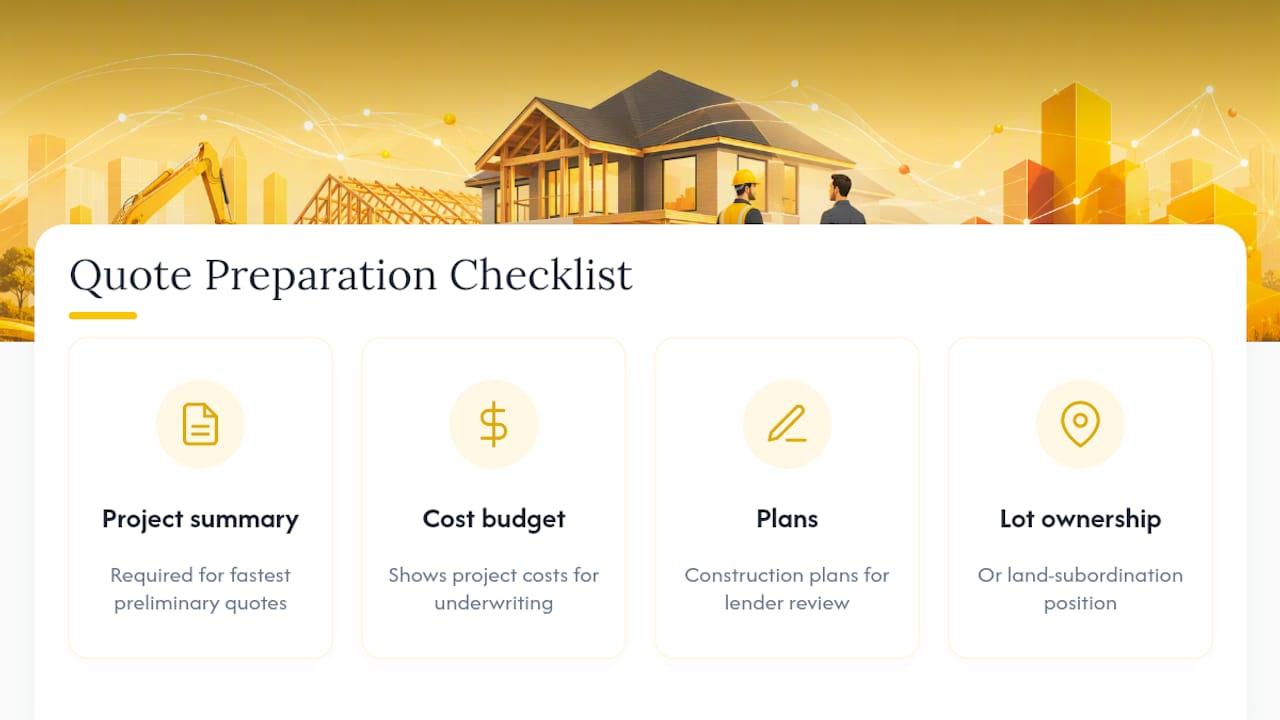
Builders getting the fastest preliminary quotes usually come prepared with a project summary, cost budget, plans, and proof of lot ownership or a land-subordination position already lined up.
A Builder's Quick Checklist Before Choosing a Lender
Three questions decide the right fit: Does this deal match your pipeline speed? Can you carry the cost structure to sale? How much equity are you willing to tie up? Speed pressure points toward asset-based lending; cost sensitivity points toward a bank builder program.
— Jason Taken
Get a Fast Quote on Your Next Spec Build
Some lenders underwrite spec projects on the strength of the asset and the plan, not a credit score cutoff, which can put builders facing tight closing windows or unconventional credit histories in a stronger position than a bank timeline allows. Learn more about how this works on the asset-based loan overview before you apply.
To move quickly on a preliminary quote, have your project summary, line-item cost budget, plans, and proof of lot ownership or land-subordination interest ready to submit. Builders without a clean credit history can review asset-based hard-money programs built specifically for that gap, and investors bridging equity shortfalls can look at down-payment funding options designed for short-term spec deals. Start your quote request today and get terms back before your next lot slips to another buyer.
Where to Verify Lenders and Rules
- Confirm any lender's licensing status through NMLS Consumer Access before signing a term sheet.
- Review HUD's fair housing guidance for compliance issues tied to sales and financing.
- Check NCUA resources if considering a credit-union-backed spec program.
- Research lender reputation through public profiles like BBB's construction-lending listings before committing.
Sources
- Spec Construction Loans for Builders — 90% LTC, $0 Monthly Payments
- Spec Construction Loans Oregon & California | Up to 85% LTC
- NMLS Consumer Access
- Fair Housing | HUD