
Most hard-money loans fund in 5–14 business days; repeat borrowers with clean files and straightforward collateral can close in as few as 1–3 business days. That speed comes directly from how private lenders underwrite: they evaluate the property's value and your exit plan, not two years of tax returns and a 45-day income verification queue.
Three factors determine where your deal lands in that range:
- Property-based underwriting: Lenders set leverage using LTV and ARV rather than borrower income, which cuts the documentation burden and compresses approval time.
- Valuation method: A broker price opinion (BPO) or drive-by valuation takes 1–3 days; a full appraisal can take 5–10 days. Choosing the right method for your deal type is one of the fastest ways to control the hard money closing timeline.
- Title work: Title search and clearance routinely take 3–14 days and represent the most common source of unexpected delays on otherwise clean deals.
Key Takeaways
Most hard-money loans close in 5–14 business days, with title work and valuation method being the two factors that most reliably determine where a deal lands in that range.
| Point | Details |
|---|---|
| Typical closing window | Most hard-money deals fund in 5–14 business days; best-case repeat-borrower deals close in 1–3 business days. |
| Title work is the top bottleneck | Title search and clearance take 3–14 days; problematic titles can add 1–3 weeks to any closing. |
| Valuation method matters | A BPO or drive-by takes 1–3 days; a full appraisal takes 5–10 days — choosing correctly controls the timeline. |
| Loan type changes the timeline | Fix-and-flip and bridge loans close fastest (5–14 days); new construction can take 14–45 days due to draw schedules. |
| Jaken Finance Group | Direct hard-money lender closing qualifying deals in as few as 5 business days, with asset-based underwriting and no minimum credit score. |
Table of Contents
- What does the hard money closing timeline look like stage by stage?
- Why does hard-money financing close faster than a bank mortgage?
- What happens at each stage of the hard-money closing process?
- What speeds up a hard-money closing, and what causes delays?
- How does the loan type affect your hard-money funding timeline?
- Borrower checklist: what documents and actions control your timeline?
- How does a hard-money timeline compare to a conventional mortgage?
- How does Jaken Finance Group close fast?
- What experienced investors know about planning a fast close
- Jaken Finance Group: fast hard-money closings for real estate investors
- Sources
What does the hard money closing timeline look like stage by stage?
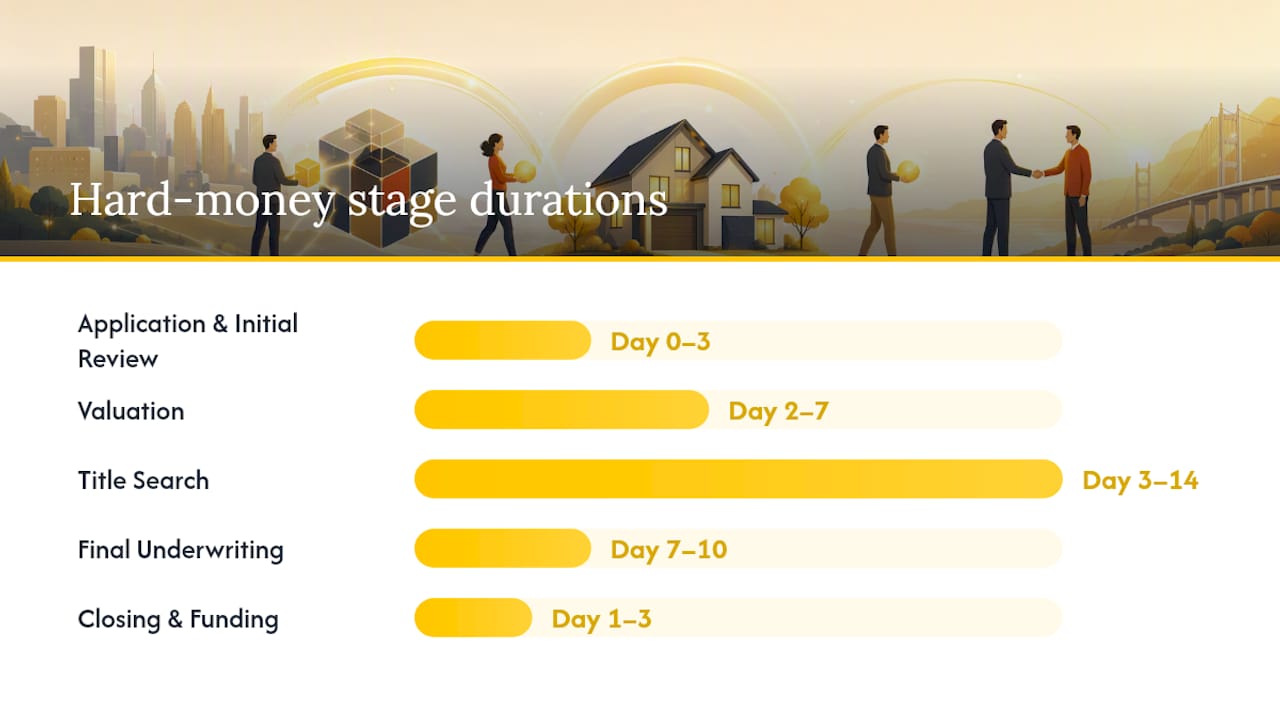
The table below reflects conservative day ranges based on industry-standard hard money loan process benchmarks. Best-case figures assume a pre-packaged file, BPO valuation, and clean title.
| Stage | Best Case | Typical | Problem Case |
|---|---|---|---|
| Application & submission | Day 0–1 | Day 0–1 | Day 0–2 |
| Initial review & conditional approval | Day 1–2 | Day 1–3 | Day 2–5 |
| Valuation (BPO or appraisal) | Day 1–3 | Day 3–7 | Day 5–10 |
| Title search & insurance commitment | Day 2–5 | Day 3–14 | Day 7–21 |
| Final underwriting / clear-to-close | Day 5–7 | Day 7–10 | Day 10–14 |
| Closing & funding | Day 1–2 | Day 1–3 | Day 2–5 |
Stage-by-stage summary:
- Application: Day 0–1 (borrower submits full packet)
- Initial review: Day 1–3 (lender issues term sheet or conditional approval)
- Valuation: Day 2–7 (BPO is faster; full appraisal takes longer)
- Title search: Day 3–14 (clean title moves fast; encumbrances add weeks)
- Clear-to-close: Day 7–10 typical
- Funding: Day 1–3 after clear-to-close
Best case: 5 business days total, with a pre-packaged file, BPO valuation, and no title issues. Typical: 7–14 business days. Problem case: 3–5 weeks when title defects, appraisal disputes, or missing documents arise.
Why does hard-money financing close faster than a bank mortgage?
Hard-money loans are short-term, asset-based loans secured by real property. The lender's primary underwriting question is whether the collateral's value supports the loan amount and whether the borrower has a credible exit strategy, not whether the borrower's W-2s meet a debt-to-income threshold. That structural difference is what compresses the hard money funding timeline.
Three speed levers separate private lending from conventional mortgage pipelines:
- LTV/ARV-focused underwriting: Because approval hinges on property value rather than income verification, lenders can issue a term sheet within 24 hours of receiving a complete file.
- Flexible valuation options: Private lenders can accept a BPO or drive-by inspection instead of a full URAR appraisal, shaving 3–7 days off the valuation stage.
- Reduced borrower documentation: No 4506-C tax transcripts, no 60-day asset seasoning requirements, no employer verification calls. The file is lighter, and review is faster.
Pro Tip: Speed comes at a cost. Hard-money rates typically run higher than conventional mortgage rates, and origination points add to the upfront cost. For a deal where timing is the constraint — a competitive purchase, an auction, a distressed property — that premium is often the correct tradeoff. For a long-hold rental with no time pressure, a conventional loan's lower rate may outweigh the speed advantage.
What happens at each stage of the hard-money closing process?
Stage 1: Application and deal submission (Day 0–1)
Submit a complete file on Day 0. Lenders who receive a pre-packaged application can issue a term sheet the same day or the next morning. A complete file includes the signed purchase contract, a government-issued ID, recent bank statements or proof of funds, a property address and description, and a preliminary scope of work with contractor bids if the deal involves rehab. Submitting an incomplete file is the single most common reason a 5-day close becomes a 14-day close.
The hard money loan application process at most private lenders is a one-page or online form, not a multi-week intake. Pre-packaging your file before you sign the purchase contract puts you in a position to submit on Day 0.
Stage 2: Initial review and conditional approval (Day 1–3)
The underwriter reviews the deal structure: purchase price, requested loan amount, LTV relative to current value, ARV if rehab is involved, and the borrower's exit plan (sale, refinance, or rental). Conditional approval typically arrives within 1–3 business days. Common conditions include a satisfactory valuation, clear title, and proof of insurance.
Stage 3: Valuation (Day 2–7)
The lender orders a BPO, drive-by inspection, or full appraisal depending on loan size, property type, and internal policy. BPOs and drive-bys are completed in 1–3 days. Full appraisals, required on larger or more complex assets, take 5–10 days and sometimes longer in rural markets with limited comparable sales. Selecting a lender who accepts BPO valuation for your property type can cut this stage nearly in half.
Stage 4: Title search and insurance commitment (Day 3–14)
The title company searches public records for liens, judgments, unpaid taxes, and ownership gaps. Clean title on a property with a straightforward chain of ownership resolves in 3–5 days. Problematic titles — mechanic's liens, IRS liens, probate issues, or breaks in the chain — can add 1–3 weeks. The CFPB notes that recording and legal transfer steps are fixed administrative requirements that affect all loan types, including private hard-money deals. Title insurance commitment follows clearance and is required before closing.

Stage 5: Final underwriting and clear-to-close (Day 7–10)
Once valuation and title are complete, the underwriter issues final approval. This stage involves payoff calculations, confirming insurance binders, verifying down payment funds, and issuing the closing disclosure. Experienced lenders complete this in 1–2 business days once all conditions are satisfied.
Stage 6: Closing and funding (Day 1–3 after clear-to-close)
Closing occurs at the title company or escrow office. Borrowers sign loan documents, the lender wires funds, and the title company records the deed and mortgage with the county. Wire cutoff times matter: most title companies require wires by 2:00 PM local time to record same-day, as detailed in the Terms & Conditions | Lending Gurus. A wire submitted after cutoff delays recording by one business day. Post-closing, the lender places a lien on the property, and the borrower receives confirmation of funding.
What speeds up a hard-money closing, and what causes delays?
Actions that accelerate closing
- Submit a complete, pre-packaged file at application, including the purchase contract, ID, proof of funds, and contractor bids.
- Order a preliminary title report before submitting the loan application to identify encumbrances early.
- Request a BPO or drive-by valuation if the lender and property type allow it.
- Designate an experienced title company or closing attorney familiar with investment property transactions.
- Confirm wiring instructions and escrow contact information before clear-to-close.
- Respond to lender conditions within hours, not days. Delayed responses to document requests are a leading cause of timeline extension.
Common delays and how to mitigate them
- Title defects: Mechanic's liens, unpaid property taxes, or probate issues can add 1–3 weeks. Pull a preliminary title report before signing the purchase contract.
- Appraisal disputes: If the appraised value comes in below the purchase price, the loan amount may need to be restructured. Request a BPO first on properties where value is straightforward.
- Missing borrower funds: Lenders verify down payment and closing cost funds at the time of clear-to-close. Have funds in a single, accessible account before applying.
- Contract amendments: Any change to the purchase price, closing date, or property condition after underwriting begins requires re-review. Avoid contract modifications once the loan is in process.
- Escrow and wire cutoffs: Missing a daily wire cutoff delays funding by one full business day. Confirm cutoff times with the title company at the start of the closing stage.
Pro Tip: Build a 3-business-day contingency buffer into every purchase contract closing date. Even a clean deal can hit a one-day wire delay or a 48-hour title exception. Negotiating a 3-day extension option upfront costs nothing and protects the deal.
How does the loan type affect your hard-money funding timeline?
Different hard-money products carry different timelines, primarily because of valuation complexity, draw schedules, and documentation requirements.
- Fix-and-flip loans (5–14 business days): Typically the fastest hard-money product. Valuation is straightforward on residential properties, and lenders are experienced with the deal structure. Fix-and-flip financing with a BPO can close in 5–7 business days on a clean file.
- Bridge loans (3–14 business days): Used to bridge a purchase gap or cover a transition period. Simple bridge deals on stabilized properties can close in 3–5 days. Bridge loans on properties requiring significant documentation take longer.
- DSCR rental loans (7–21 business days): Debt-service coverage ratio loans require a rent schedule, lease documentation, and sometimes a full appraisal. The additional paperwork adds 5–7 days compared to a fix-and-flip on the same property.
- New construction loans (14–45 business days): The most time-intensive hard-money product. Lenders require a detailed construction budget, draw schedule, contractor vetting, and often a full appraisal of the completed value. Draw inspections during the construction period add ongoing timeline considerations beyond initial closing.
- Commercial real estate loans (14–30 business days): Commercial property loans involve additional due diligence: environmental assessments, rent rolls, operating statements, and asset-class-specific valuation. Timeline varies significantly by property type and loan size.
When timing is the primary constraint, fix-and-flip and simple bridge loans offer the fastest path to funding. DSCR and construction products are appropriate when the deal structure requires them, with the understanding that additional days are built into the process.
Borrower checklist: what documents and actions control your timeline?
Submitting a complete file at application is the single highest-leverage action a borrower can take to shorten the closing timeline. The following checklist items materially reduce lender review time when delivered upfront.
Core documents:
- Signed purchase contract (all pages, including addenda)
- Government-issued photo ID (driver's license or passport)
- Recent bank statements (last 60 days) or proof of funds letter
- Rehab scope of work and contractor bids (for fix-and-flip or construction deals)
- Property photos (exterior, interior, and any visible damage)
- Property access instructions for the valuation inspector
- Prior title report, if available from a previous transaction on the same property
Where to obtain each item:
- Bank statements: download directly from your bank's online portal in PDF format.
- Contractor bids: request itemized written bids, not verbal estimates.
- Property photos: take a minimum of 20 photos covering all rooms, the exterior, roof, and mechanical systems.
- Prior title report: request from the seller's closing attorney or the title company used in the last transaction.
Pro Tip: Organize all documents into a single labeled PDF or shared folder before submitting. Lenders who receive a disorganized file spend time sorting before they can review. A clean, labeled submission signals a professional borrower and often moves to the top of the review queue.
Title troubleshooting: If you suspect title issues — the property has been through foreclosure, has multiple prior owners, or is being purchased from an estate — contact a title company before signing the purchase contract. A preliminary title search costs $150–$300 and can identify encumbrances before they become a closing emergency.
How does a hard-money timeline compare to a conventional mortgage?
The difference between the two financing paths is not marginal. It is structural.
- Hard-money closing timeline: 5–14 business days typical; 1–3 days best case for repeat borrowers.
- Conventional mortgage timeline: 30–60 days typical, with some transactions extending to 90 days when appraisal, income verification, or underwriting backlogs arise. OCC mortgage metrics confirm that institutional mortgage pipelines operate on substantially longer timelines than private lending channels.
Key differences by category:
- Underwriting focus: Hard-money lenders evaluate LTV/ARV and exit plan. Conventional lenders evaluate debt-to-income ratio, credit score, employment history, and asset seasoning.
- Valuation: Hard-money accepts BPO or drive-by on many deals. Conventional requires a full URAR appraisal ordered through an appraisal management company (AMC), which adds time and removes lender control over scheduling.
- Borrower documentation: Hard-money requires a lighter document set. Conventional requires tax returns, W-2s, pay stubs, 4506-C transcripts, and 60-day asset statements.
- Cost: Hard-money rates and origination points are higher. Conventional rates are lower, with longer amortization and no balloon payoff.
- Recording and legal steps: Both loan types are subject to the same state recording requirements and escrow procedures. These steps are fixed regardless of lender type.
For a detailed breakdown of when each financing type fits the deal, the hard money vs. conventional financing comparison covers the decision criteria investors use most frequently.
When to choose hard-money: Competitive purchase with a short inspection period, auction purchase, distressed property ineligible for conventional financing, or any deal where a 30-day close would cost you the contract.
When to accept the conventional timeline: Long-hold rental with no time pressure, primary residence purchase, or any deal where the rate differential over a multi-year hold period outweighs the speed premium.
How does Jaken Finance Group close fast?
Jaken Finance Group operates as a direct hard-money lender, which means no broker intermediary, no correspondent pipeline, and no committee approval queue. The lender's internal workflow is structured to move from application to funding in as few as 5 business days on qualifying deals.
The workflow prioritizes:
- Rapid initial review: A complete file receives a term sheet within 24 hours of submission.
- Flexible valuation options: Jaken Finance Group accepts BPO and drive-by valuations on eligible residential deals, reducing the valuation stage to 1–3 days.
- Title coordination: The lending team works directly with the borrower's chosen title company or escrow officer to align on closing dates and wiring logistics.
- No minimum credit score requirement: Underwriting is asset-based, so borrowers with non-traditional credit profiles are evaluated on property value and deal structure rather than FICO.
Borrower actions that align with Jaken Finance Group's fast-close process:
- Prequalify before signing the purchase contract.
- Deliver a complete document packet at the time of application.
- Designate a title company experienced with investment property closings.
- Confirm wiring instructions and escrow contact information before clear-to-close.
Jaken Finance Group is transparent about the exceptions that lengthen timelines. Title defects, complex construction draw schedules, and state-specific recording delays can extend closing beyond the typical 5–14 business day window. When those conditions arise, the lending team communicates the revised timeline to the borrower directly and works to resolve conditions as quickly as the title and recording process allows. Readers can verify Jaken Finance Group's licensing and registration status through NMLS Consumer Access.
What experienced investors know about planning a fast close
The investors who consistently close hard-money deals in 5–7 business days are not doing anything extraordinary. They assemble the file before they sign the purchase contract. They have a title company on speed dial. They know their lender's valuation policy before they make an offer.
The most common mistake is treating the loan application as something that happens after the contract is signed. By the time a borrower submits a complete file, 2–3 business days have already elapsed. On a 10-day closing window, that margin is gone before the lender issues a term sheet.
One actionable checklist reminder: Assemble the file before you sign the purchase contract. That means having your ID, bank statements, contractor relationships, and preferred title company identified before you are under contract. The hard money loan approval process rewards preparation, not urgency after the fact.
Build contingency days into every purchase contract. A 3-business-day buffer costs nothing to negotiate and protects the deal from a single-day wire delay or a 48-hour title exception. Prequalifying with a lender before you are under contract eliminates the first 24–48 hours of the review stage entirely.
Jaken Finance Group: fast hard-money closings for real estate investors
Investors who need to close in days, not months, have a direct path through Jaken Finance Group. The lender's asset-based underwriting means no minimum credit score requirement and no income verification queue standing between your deal and funding.
Jaken Finance Group closes qualifying deals in as few as 5 business days. Fix-and-flip, bridge, DSCR, new construction, and commercial loans are all available nationwide. The 100% fix-and-flip program covers purchase and rehab costs for investors who need maximum leverage without tying up capital. For borrowers with non-traditional credit profiles, the no-credit-check asset-based lending option evaluates the deal on property value and exit plan alone.
To start an application or speak with the lending team, visit Jaken Finance Group. Confirm all loan terms, rates, points, and closing timelines in writing before proceeding. Actual closing times vary based on property type, title conditions, and state recording requirements.
This article provides general information about hard-money lending timelines and is not a substitute for professional legal, financial, or lending advice. Confirm current loan terms and eligibility with a qualified lender before making financing decisions.
Sources
The following sources provide official definitions, stage-by-stage timelines, and lender context referenced throughout this article.
- Howlongfor
- What is a mortgage closing? What happens at the closing? | Consumer Financial Protection Bureau