
Hard money fees typically stack into an all-in cost of roughly 3% to 5% of the loan amount in closing costs, plus 1.5 to 3 origination points and interest that usually falls between 9.5% and 13% on first-position rehab loans. The real cost, though, depends on your hold period and how draws are structured. Origination points, interest, third-party closing costs, draw and inspection fees, servicing charges, and prepayment or extension clauses all factor into the final number.
TL;DR:
- Hard money loan costs typically total 3 to 5 percent of the loan amount, plus origination points often ranging from 1.5 to 3, and interest rates between 9.5 and 13 percent.
- Fixed costs like points and closing fees have a greater impact on shorter hold periods, making daily or monthly interest and fees more significant in overall costs.
- Negotiating factors include borrower track record, down payment size, draw schedule, and documented exit strategies, which can lower points and rates.
- Key details to confirm in the term sheet are interest accrual basis, all line-item fees, draw inspection costs, and prepayment or extension clauses, to accurately compare offers.
- Asset-based lenders typically focus on project value and exit strategy rather than credit score, but credit history can still influence small margins of the fee structure.
Table of Contents
- What Are Hard Money Fees, Line by Line?
- What Do Real Loans Cost? Two Worked Examples
- What Drives Your Fee Level, and How Do You Negotiate It?
- What Should Be on Your Term Sheet Before You Sign?
- How Direct Lenders Like Jaken Finance Group Approach Fee Structure
- Does Your Credit Score Affect Hard Money Fees?
- When Are Hard Money Fees Worth Paying?
- Ready to Compare Real Fee Numbers on Your Deal?
- Sources
What Are Hard Money Fees, Line by Line?
Hard money fees are not a single number quoted by a lender. They're a stack of separate charges, and each one behaves differently depending on the deal, the lender, and how long you hold the loan.
Origination points are the lender's upfront fee for funding the loan, charged as a percentage of the loan amount. One point equals 1% of the principal. Most investors pay 1.5 to 3 points on a rehab loan, though repeat borrowers with a strong track record sometimes negotiate lower points on subsequent deals with the same lender. Points are usually non-negotiable on a first-time deal but become a real bargaining chip once a lender trusts your exit history.
Interest rates on hard money loans commonly land between 9.5% and 13% for first-position rehab financing, with the broader market stretching from 7% to 15% depending on property type and lender risk appetite. Most hard money loans are interest-only, and here's the detail investors often miss: whether interest accrues on the full loan commitment or only on funds actually drawn changes your carry cost substantially on a rehab project with a slow draw schedule.
Beyond points and rate, expect these line items:
- Underwriting and processing fees covering the lender's file review, usually a flat few hundred to a couple thousand dollars. Watch for duplicated charges disguised as separate "document prep" and "processing" fees for the same task.
- Appraisal or BPO fees, typically $300 to $600 for a broker price opinion or $400 to $700 for a full appraisal, paid to a third-party valuation firm rather than the lender directly.
- Title and escrow fees, generally $500 to $1,500 depending on the state and the title company handling the closing.
- Draw and inspection fees, charged per disbursement request on rehab loans, commonly $100 to $300 per inspection event.
- Servicing fees, either a flat monthly charge or built into the rate spread, covering payment processing and loan administration for the life of the loan.
- Prepayment penalties or minimum interest clauses, which guarantee the lender a set number of months of interest even if you pay off early.
- Extension fees, charged when a loan runs past its original maturity date, often structured as a partial point plus a short extension of the maturity date.
What Do Real Loans Cost? Two Worked Examples
Numbers matter more than ranges when you're comparing offers, so here's how the math actually plays out on two common deal sizes.
-
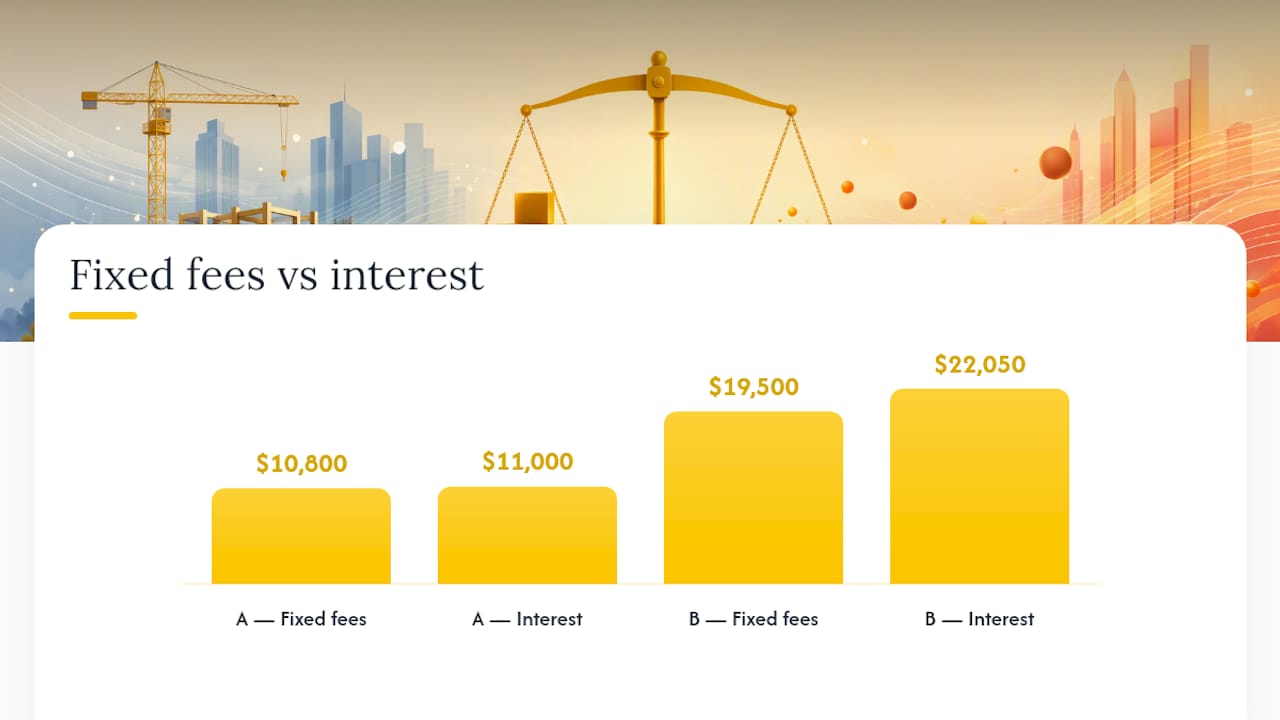
Points: $200,000 × 2% = $4,000
-
Interest (interest-only, 6 months): $200,000 × 11% ÷ 12 × 6 = $11,000
-
Closing costs (appraisal, title, escrow, underwriting): roughly $6,000
-
Draw/inspection fees (assume 4 draws at $200 each): $800
-
Total cost: $4,000 + $11,000 + $6,000 + $800 = $21,800
-
Annualized all-in rate: $21,800 ÷ $200,000 ÷ 0.5 years = 21.8% annualized
-
Points: $400,000 × 2% = $8,000
-
Interest, assuming only 70% of the commitment is drawn on average across the 9 months (common on new-construction or heavy-rehab draws): $400,000 × 0.70 × 10.5% ÷ 12 × 9 = $22,050
-
Closing costs: roughly $10,000
-
Draw/inspection fees (assume 6 draws at $250 each): $1,500
-
Total cost: $8,000 + $22,050 + $10,000 + $1,500 = $41,550
-
Annualized all-in rate: $41,550 ÷ $400,000 ÷ 0.75 years = 13.85% annualized
| Deal | Loan amount | Points cost | Interest cost | Closing + draw fees | Total cost | Annualized all-in rate |
|---|---|---|---|---|---|---|
| Example A | $200,000 | $4,000 | $11,000 | $6,000 | $21,800 | 21.8% |
| Example B | $400,000 | $8,000 | $22,050 | $10,000 | $41,550 | 13.85% |
The gap between those two annualized rates is not a coincidence. Points and closing costs are fixed dollar charges, so the shorter your hold, the smaller the denominator dividing that fixed cost. A 6-month flip absorbs the same $4,000 in points as a 12-month project, but the shorter timeline concentrates that cost into half the time, which drives the annualized figure higher even though the actual dollars spent are lower.
Before you can rerun this math on a real quote, ask the lender for these exact inputs: the point count, the note rate, whether interest accrues on the full commitment or drawn balance only, the expected draw schedule, per-draw inspection cost, and every closing line item in writing. A free hard money loan calculator can reproduce both scenarios above once you have those figures.
What Drives Your Fee Level, and How Do You Negotiate It?
Pricing on a hard money loan isn't arbitrary. It reflects the lender's actual risk and operating cost on your specific deal, and understanding the drivers gives you real leverage at the negotiating table.
Underwriting drivers carry the most weight. Loan-to-value and after-repair-value ratios set the baseline risk the lender is pricing for. Property condition and rehab complexity matter almost as much: a cosmetic flip prices differently than a full gut renovation with structural work, because the lender's downside risk on an unfinished project is higher. Your track record as a borrower, and whether this is a repeat relationship with the lender, often moves the rate more than any other single factor.
Operational drivers show up in the fine print. Draw frequency, third-party inspection requirements, insurance and reserve rules, and how fast you need to close all add cost on the lender's side, and that cost gets passed through in fees.
You have more room to negotiate than most borrowers assume:
- Stronger appraisal evidence or a documented ARV comp package can shave points off an initial quote.
- A larger down payment reduces lender risk and often reduces rate or points in response.
- A shorter, simpler draw schedule with fewer inspection events cuts your per-draw fee total directly.
- A documented history of on-time payoffs with the same lender is the single strongest lever for repeat borrowers.
Pro Tip: Ask every lender for their minimum-interest clause language in writing before you sign. A 3 to 6 month interest floor can turn a fast, profitable flip into a break-even deal if you pay off in month two and still owe interest through month five.
Red flags worth walking away from: undisclosed minimum-interest language buried in the note, two separate line items charging for the same administrative task, and any lender who won't give you a written draw and inspection turnaround timeline before closing.
What Should Be on Your Term Sheet Before You Sign?
A term sheet or written loan estimate is the only reliable way to compare two hard money offers apples to apples. Confirm every one of these items in writing before you commit to a lender:
- Points and note rate, stated as exact numbers, not ranges.
- Interest accrual basis: full commitment versus drawn balance only.
- Prepaid interest days required at closing.
- Underwriting, processing, and document fees, itemized separately.
- Appraisal or BPO cost and who orders it.
- Title and escrow fees and which company handles closing.
- Draw inspection fee per event and expected inspection turnaround time.
- Monthly or annual servicing fee.
- Extension fee structure and prepayment or minimum-interest clause language.
- Wire fees or other funding charges deducted at closing.
Once you have this in writing from two or three lenders, calculate total cash-to-close and total carry cost for your expected hold period, then annualize each offer the way the worked examples above do. Ask specifically whether fees get deducted from loan proceeds or paid separately out of pocket. Rolling fees into the loan reduces your cash-to-close but increases your loan balance and total interest paid over the hold.
How Direct Lenders Like Jaken Finance Group Approach Fee Structure
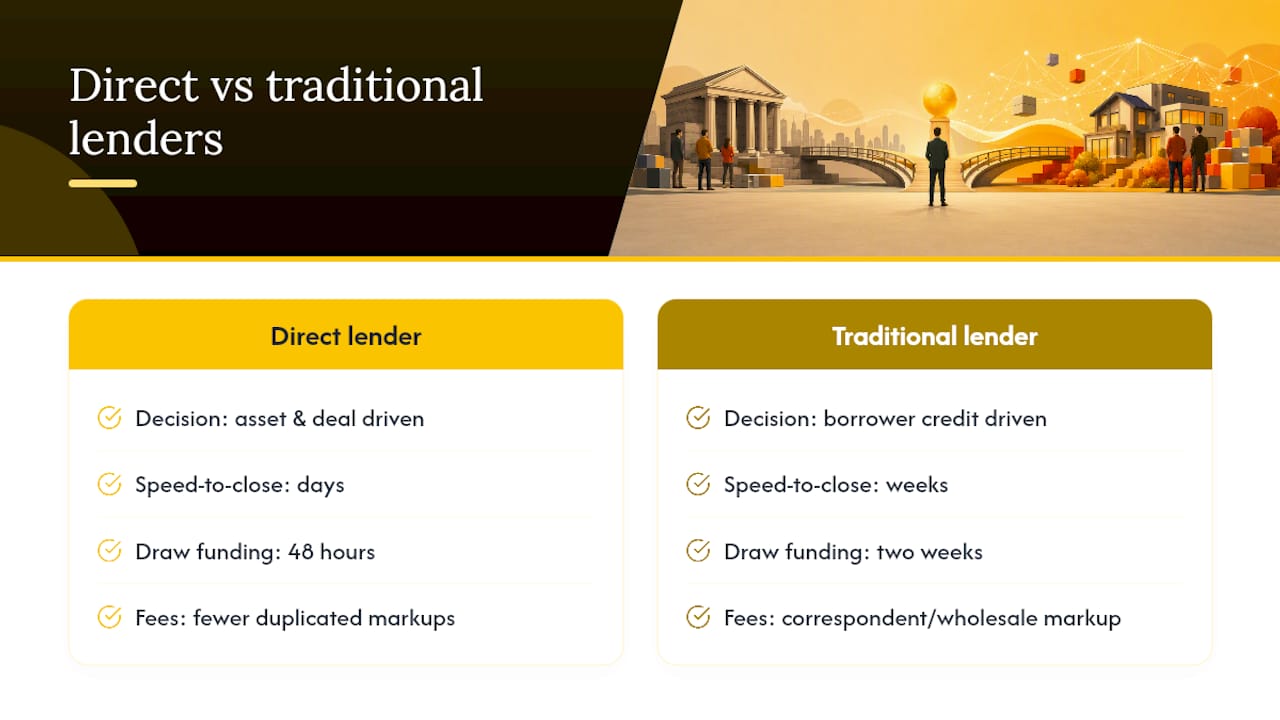
A direct lender changes the fee equation in ways that matter to your bottom line. When a direct lender underwrites a fix-and-flip or new-construction loan, the asset's value and the deal's numbers drive the decision, not the borrower's credit score, which can speed approval and remove additional underwriting steps that add time and cost at traditional lenders.
Speed-to-close matters because carry cost accrues from day one. A lender that can fund in days rather than weeks shortens the period where you're paying interest without productive use of the capital, which directly improves your annualized all-in cost on a flip. Cutting out layers of correspondent or wholesale markup that many broker-sourced hard money loans carry is another place where a direct-lender structure can mean fewer duplicated fees on your closing disclosure.
Draw turnaround speed deserves particular attention on rehab deals, since a lender who inspects and funds draws in 48 hours versus two weeks materially changes how fast your contractors can keep moving, which affects your total project timeline and therefore your total interest cost.
Does Your Credit Score Affect Hard Money Fees?
Credit history plays a smaller role in hard money pricing than it does in conventional lending, but it isn't irrelevant. Hard money lenders underwrite primarily against the property's value and the deal's exit strategy, which is why borrowers with low or thin credit files can often still qualify when a bank would decline them outright.
That said, credit and financial history still influence pricing at the margins for most lenders. A borrower with a documented history of missed payments, recent bankruptcies, or unresolved liens may see slightly higher points or rate as the lender prices in added risk, even on an asset-based loan. Conversely, a strong track record of successful flips and on-time payoffs, regardless of FICO score, tends to matter more to a hard money underwriter than the three-digit number itself.
The practical takeaway: don't assume a low credit score automatically means the highest fee tier. Asset-based underwriting means your deal's LTV, the property's condition, and your exit plan usually carry more weight than your credit report. If your score is a concern, lead the conversation with your track record and the strength of your numbers rather than waiting for the lender to ask.
When Are Hard Money Fees Worth Paying?
Hard money makes sense when speed and flexibility solve a problem a bank can't. A distressed property that won't qualify for conventional financing, a closing timeline measured in days rather than months, or a borrower whose tax returns don't reflect true cash flow are all scenarios where the fee premium buys something real. It stops making sense on long-hold rental acquisitions where a conventional or DSCR loan's lower rate wins over a 12-month-plus horizon, since the fixed points get diluted less by a longer term but the higher rate compounds instead.
Before you sign anything, request a written fee worksheet, run your expected hold period through the worked examples above, and ask directly about minimum-interest clauses and extension pricing. Get the draw schedule and inspection turnaround times documented in writing, not promised verbally. A lender who hesitates to put any of this on paper is telling you something about how the rest of the deal will go.
— Jason Taken
Ready to Compare Real Fee Numbers on Your Deal?
Some direct lenders fund hard money and fix-and-flip loans nationwide using asset-based underwriting, meaning the deal's numbers, not the borrower's credit score, drive the approval decision, and closings may happen quickly.
When you request a quote, ask for the same things this guide walks through: a written fee worksheet, a sample term sheet showing points and rate, the expected draw cadence, and inspection turnaround times. That paper trail is what lets you compare a Jaken Finance Group quote against any other offer using the exact math in the worked examples above. Start by reviewing the asset-based hard money loan options available with no minimum credit score, and request your fee worksheet before your next deal deadline arrives.
Sources
For borrowers who want to verify lender registration or dig deeper into fee mechanics, these sources back the figures throughout this guide:
- Hardmoneyhome
- Hard Money Loan Costs in 2026: Points, Interest, and Fees • Aspire Mortgage
- Consumerfinance
- Hard Money Loan Calculator