
Most hard money lenders require a down payment, and the typical range usually covers a significant portion of the purchase price, though some programs require a larger percentage depending on property type, deal structure, and lender policy. The exact amount is not driven by credit score or W-2 income. It is driven by deal math: the loan-to-value (LTV) ratio, the after-repair value (ARV), and how comfortably the total loan fits within the lender's risk threshold. Jaken Finance Group, for example, structures asset-based loans nationwide with underwriting centered on property fundamentals rather than borrower credit profiles, making down payment requirements a function of the deal itself.
Exceptions to the cash-down requirement do exist. Experienced investors with a documented track record and deals showing a wide spread between total project cost and ARV can sometimes access 100% fix-and-flip financing, though these programs carry tighter conditions and are not the standard.
Table of Contents
- How does hard money underwriting treat down payments differently?
- What are the typical down payment ranges for hard money loans?
- What lender criteria actually change your down payment requirement?
- What options exist when you lack cash for a down payment?
- When will a hard money lender finance 100% of a deal?
- How do you calculate the cash required at close?
- What fees and costs add to the cash required beyond the down payment?
- What does the application checklist look like for proving your down payment?
- Key Takeaways
- The deal is the down payment
- Jaken Finance Group funds deals where the numbers work
- Useful sources and further reading
How does hard money underwriting treat down payments differently?
Hard money underwriting is asset-based lending, which means the property's value and the investor's exit strategy carry far more weight than credit score or debt-to-income ratio. That structural difference is precisely why down payment requirements look so different from conventional mortgages.
Conventional lenders price risk through borrower creditworthiness. A 3%–3.5% down payment is achievable on FHA or conforming products because the lender is underwriting the borrower's long-term repayment capacity. Hard money lenders price risk through collateral. If the borrower defaults, the lender's recovery depends on the property's liquidation value, so they require the investor to hold enough equity from day one to cover that exposure.
The key metrics hard money lenders use:
- LTV (Loan-to-Value): The loan amount as a percentage of the current as-is property value. A 70% LTV on a $200,000 property means a $140,000 loan and $60,000 in equity.
- ARV (After-Repair Value): The projected value after renovations are complete. Most lenders cap total exposure at 65%–75% of ARV, which is the single most important ceiling in fix-and-flip lending.
- LTC (Loan-to-Cost): The loan amount as a percentage of total project cost (purchase plus rehab). Some lenders offer high-LTC programs that fund both acquisition and renovation, reducing the cash an investor must bring to close.
Hard money underwriting emphasizes exit-strategy viability over income verification. A lender wants to know how the loan gets repaid: sale, refinance, or rental cash flow. The clearer and more credible that exit, the more leverage a lender is willing to extend, and the lower the effective down payment requirement.
Pro Tip: Investors who want to reduce their required down payment should lead with the exit strategy in their application, not their credit score. A well-documented sale timeline or refinance plan backed by comparable sales data carries more weight in hard money underwriting than a 720 FICO.
What are the typical down payment ranges for hard money loans?
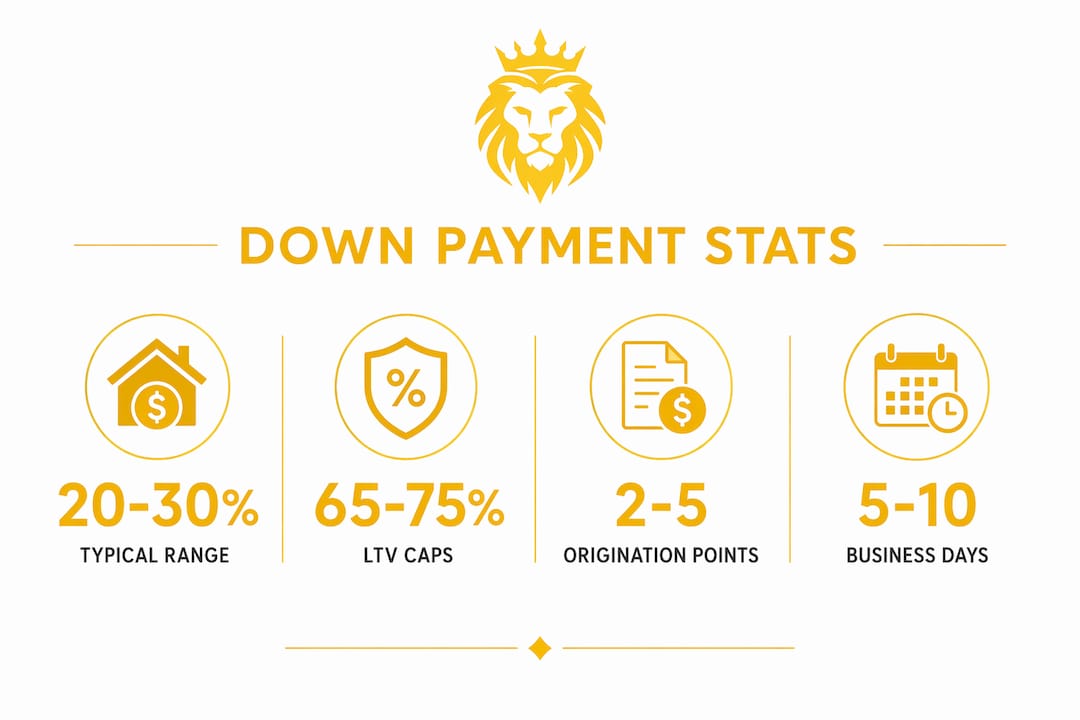
Market data shows that hard money down payments vary widely, with most standard programs requiring a moderate to substantial portion of the purchase price. The wide range reflects how differently lenders structure their programs and how much deal quality can shift the requirement.

| Metric | Common Cap | Notes |
|---|---|---|
| LTV (as-is value) | 65%–75% | Based on current appraised value; drives minimum equity at purchase |
| ARV cap | 65%–75% | Most lenders will not exceed 70%–75% of post-rehab value |
| LTC (purchase + rehab) | — | High-LTC programs exist but require strong deal fundamentals |
| Down payment (purchase price) | Typically a sizable portion | Varies by lender, property type, and borrower experience |
A note on reading these percentages: "25% down" and "75% LTV" describe the same equity position from opposite directions. Investors sometimes conflate ARV-based caps with purchase-price-based down payments, which leads to miscalculating cash needed at close. The ARV cap limits the total loan, while the down payment percentage refers specifically to the gap between the purchase price and the loan amount.
Conventional mortgages allow down payments as low as 3%–3.5% through FHA programs, which makes hard money's 20%–30% requirement look steep. The trade-off is speed, flexibility, and access: hard money closes in days rather than weeks, requires no income documentation in most cases, and funds properties that conventional lenders will not touch.
What lender criteria actually change your down payment requirement?
Down payment requirements are not fixed. Four factors move them meaningfully, and investors who understand each one can negotiate better terms or target lenders whose programs align with their deal profile.
Property quality and market conditions
Lenders assess location, comparable sales, condition, and ARV certainty. A property in a liquid market with strong comps and a conservative ARV estimate presents lower risk, which can support higher leverage. A rural property or one with a speculative ARV will face a larger required equity cushion.
Exit strategy credibility
The cleaner and more documented the exit, the more leverage a lender will extend. A fix-and-flip with signed contractor bids, a realistic sale timeline, and three comparable recent sales within a half-mile radius is a fundamentally different risk profile than a deal with vague renovation plans and no comparable data.
Borrower experience and track record
Experienced investors with completed projects on record often qualify for higher LTC programs and lower down payment requirements. First-time borrowers typically face more conservative terms because the lender is pricing in execution risk alongside deal risk.
Proof of funds and reserves
- Lenders require documented proof that the down payment funds exist and are accessible.
- Bank statements covering 60–90 days are standard.
- Some lenders accept borrowed funds for the down payment, but this raises scrutiny. The CFPB notes that borrowing for a down payment increases total debt load and carries tax and penalty risk if retirement accounts are involved.
- Reserves beyond the down payment, typically covering 3–6 months of carrying costs, strengthen the application and can improve offered terms.
- Gifts and partner contributions are sometimes acceptable; lender policies vary and must be confirmed in advance.
Pro Tip: Prepare a one-page deal summary before submitting an application: purchase price, rehab budget, ARV with comps, exit plan, and projected timeline. Lenders who receive this upfront move faster and are more likely to offer favorable terms.
What options exist when you lack cash for a down payment?
Several strategies allow investors to meet or replace a traditional cash down payment. Each carries different cost, risk, and lender acceptability profiles.
- Seller financing (carryback): The seller holds a second-position note for part of the purchase price, reducing the cash the buyer must bring. Not all hard money lenders allow a seller carryback in second position; confirm lender policy before structuring the deal this way.
- Equity partners: A private partner contributes the down payment in exchange for a share of the profit or equity. This is widely accepted by lenders because the funds are not debt on the borrower's balance sheet.
- Second-position loans: Some lenders or private investors will fund a second-position loan to cover the down payment gap. Lender acceptance varies significantly; many first-position hard money lenders prohibit undisclosed seconds.
- Business lines of credit: A business line of credit can fund the down payment if the lender accepts business-sourced funds. This is a debt instrument, so lenders will factor the payment obligation into their risk assessment.
- Whole life insurance cash value: Investors who hold whole life policies can borrow against the cash value to fund a down payment. Because it is a policy loan rather than a conventional debt, it does not appear on a credit report and is generally viewed favorably by lenders. A broader overview of whole life insurance in a real estate portfolio outlines how investors structure this approach.
- LTC programs (roll-in rehab): High-LTC lenders fund both acquisition and renovation costs, which reduces or eliminates the need for a separate cash down payment on the rehab portion. The down payment still applies to the purchase price, but the total cash required at close drops significantly.
- Down payment assistance programs: These are primarily designed for owner-occupied conventional mortgages. Bankrate's guidance confirms that most assistance programs are not structured for investor-funded hard money deals and are rarely applicable here.
| Strategy | Lender Acceptability | Cost | Risk Level |
|---|---|---|---|
| Equity partner | High | Profit share | Low (no added debt) |
| Seller carryback | Moderate (lender-dependent) | Negotiated interest | Moderate |
| Whole life policy loan | High | Policy loan rate | Low |
| Business line of credit | Moderate | Interest on draw | Moderate |
| Second-position loan | Low to moderate | Higher rate | High |
| LTC program (rehab roll-in) | Built into lender program | Higher rate/fees | Moderate |
Risk note: Using borrowed funds for a down payment increases total leverage on the deal. If the exit fails or the timeline extends, the investor carries debt service on both the hard money loan and the down payment source simultaneously. Lenders that accept borrowed down payments typically require documented reserves and a conservative ARV spread to offset this added risk.
When will a hard money lender finance 100% of a deal?
100% financing in hard money is rare and typically reserved for experienced investors with strong deal fundamentals. It is not a standard product; it is a program exception that lenders extend when the risk profile justifies it.
The deal profile that typically qualifies:
- ARV spread is wide: total project cost (purchase plus rehab) is well below 65%–70% of ARV, leaving the lender protected even at 100% LTC.
- The borrower has completed multiple similar projects with documented outcomes.
- The exit strategy is clearly defined and supported by recent comparable sales.
- The property is in a liquid market with predictable resale timelines.
Even when a lender funds 100% of acquisition and rehab costs, several cash items remain uncovered:
- Origination fees and points (typically 2–5 points)
- Appraisal and inspection fees
- Title insurance and closing costs
- Prepaid interest and escrow
- Carrying cost reserves (taxes, insurance, utilities during the hold period)
Some industry reporting suggests a minority of borrowers qualify for very high-leverage programs, and those that do often face higher rates and stricter exit requirements as a trade-off. Investors should treat 100% LTC advertising as a starting point for conversation, not a guaranteed outcome.
How do you calculate the cash required at close?
The following worked examples show how LTV, LTC, and ARV caps translate into actual cash requirements. All figures are illustrative.
| Scenario | Purchase Price | Rehab Budget | ARV | Lender Cap | Loan Amount | Cash at Close |
|---|---|---|---|---|---|---|
| Fix-and-flip (25% down) | $200,000 | — | — | — | $200,000 (75% of purchase) | — |
| BRRRR (70% ARV cap) | — | $60,000 | — | 70% ARV = $196,000 | $196,000 | $14,000 gap + fees |
How to read these calculations:
- Start with the ARV or as-is value and apply the lender's cap percentage to find the maximum loan amount.
- Subtract the loan amount from the total project cost (purchase plus rehab) to find the cash gap.
- Add lender fees, closing costs, and required reserves to the cash gap to arrive at total cash needed at close.
- Confirm the resulting LTV on the as-is value does not exceed the lender's separate LTV ceiling.
In the BRRRR example, the lender's 70% ARV cap produces a $196,000 loan against a $210,000 total project cost, leaving a $14,000 gap before fees. That gap is the effective down payment in an LTC-structured deal.
Worksheet columns to track per deal: purchase price, rehab budget, total project cost, ARV, lender cap (%), maximum loan amount, cash gap, estimated fees and points, reserves required, and total cash needed.
What fees and costs add to the cash required beyond the down payment?
Hard money loans carry higher rates, fees, and shorter terms than conventional financing, and those costs increase total cash requirements at close beyond the down payment alone.
Common fee items:
- Origination points: Typically 2–5 points (each point equals 1% of the loan amount). On a $200,000 loan, 3 points equals $6,000 due at closing.
- Appraisal fee: $400–$700 for a standard residential appraisal; more for complex or commercial properties.
- Inspection fee: $300–$500 for a general inspection; additional for specialized inspections.
- Underwriting and processing fees: Lender-specific; ranges vary and are not always publicly listed.
- Title insurance and closing costs: Typically 1%–2% of the loan amount, depending on state and transaction complexity.
- Prepaid interest: Many hard money lenders collect interest for the first month or two at closing.
- Reserves: Some lenders require 3–6 months of carrying costs held in reserve, covering taxes, insurance, and debt service.
| Fee Item | Typical Range | Notes |
|---|---|---|
| Origination points | 2–5 points | Paid at close; negotiable based on deal and relationship |
| Appraisal | $400–$700 | Required before funding |
| Title and closing costs | 1%–2% of loan | State-dependent |
| Prepaid interest | 1–2 months | Collected at close |
| Reserves | 3–6 months carrying costs | Lender-dependent; not always required |
Timeline: Hard money lenders can close in as few as 5–10 business days when documentation is complete. Delays typically stem from incomplete title work, missing contractor bids, or unresolved property condition issues. Investors who pre-assemble their documentation package before identifying a deal can compress the timeline further.
What does the application checklist look like for proving your down payment?
A complete application package reduces underwriting time and signals borrower preparedness, which can directly influence offered terms.
- Execute the purchase contract. The signed contract establishes the purchase price and timeline the lender underwrites against.
- Prepare a rehab scope and budget. Itemized contractor bids or a detailed scope of work with cost estimates. Vague budgets slow underwriting.
- Compile proof of funds. Bank statements (60–90 days), brokerage statements, or documentation of the funding source for the down payment. If using a policy loan or partner funds, provide supporting documentation.
- Document the exit strategy. A written exit plan with comparable sales data for a flip, or a rental analysis with projected cash flow for a hold.
- Gather property comps. Three to five recent comparable sales within a half-mile radius and 90–180 days. The lender's appraiser will verify these, but providing them upfront speeds the process.
- Provide title information. Preliminary title report or existing title insurance policy if available.
- Submit contractor agreements. Signed contractor agreements or letters of intent strengthen the rehab budget's credibility.
- Complete the lender's application. Entity documentation (LLC operating agreement, EIN) if borrowing in a business name.
Acceptable proof of funds includes personal bank statements, business account statements, brokerage accounts, and documented policy loan proceeds. Borrowed funds are acceptable with many lenders but must be disclosed; undisclosed debt is grounds for denial or loan recall.
Pro Tip: Attach a one-page executive summary to the application: property address, purchase price, rehab budget, ARV with three comps, exit plan, and projected timeline. Underwriters who receive this move faster because they do not have to extract the deal thesis from scattered documents.
Key Takeaways
Hard money down payments are determined by deal math, not borrower credit, and investors who understand LTV, ARV, and LTC mechanics can structure deals to minimize required cash at close.
| Point | Details |
|---|---|
| Typical down payment range | Most hard money programs require 10%–40% of the purchase price depending on lender and deal type. |
| ARV cap drives the number | Lenders cap total loans at 65%–75% of ARV; the gap between that cap and project cost is the effective down payment. |
| Three levers to reduce cash needed | Strong ARV spread, documented borrower experience, and a credible exit strategy each reduce lender-required equity. |
| Alternatives to cash down | Equity partners, whole life policy loans, and LTC programs are the most lender-accepted substitutes for a cash down payment. |
| Jaken Finance Group | Offers asset-based hard money and fix-and-flip loans nationwide with no minimum credit score requirement and closings in as few as five days. |
The deal is the down payment
Most investors focus on their credit score when approaching a hard money lender. That is the wrong variable. The down payment requirement in hard money lending is almost entirely a function of deal quality: how wide the spread is between total project cost and ARV, how credible the exit strategy is, and how much execution risk the lender is absorbing. A borrower with a 580 FICO and a deal showing 40% equity cushion to ARV will often get better terms than a borrower with a 720 FICO and a thin-margin flip.
The mistake most investors make is treating the down payment as a fixed cost rather than a negotiable output of deal structure. It is not fixed. Lenders who advertise 100% LTC are not giving money away; they are pricing the risk differently because the deal math justifies it. Investors who understand this shift their preparation from "how do I qualify?" to "how do I make this deal undeniable?" That reframe changes everything about how they approach lenders, structure offers, and present applications.
One underappreciated point: the documentation package is itself a negotiating tool. A clean, complete application with contractor bids, comps, and a written exit plan signals execution competence. Lenders extend better leverage to borrowers who demonstrate they have done this before, even if the track record is short, because the documentation itself is evidence of process discipline.
Jaken Finance Group funds deals where the numbers work
Real estate investors who need fast, flexible capital without conventional income documentation have a direct path through Jaken Finance Group. The firm offers hard money, fix-and-flip, bridge, and asset-based loans nationwide with no minimum credit score requirement and closings in as few as five days. Underwriting centers on the property's value and the investor's exit strategy, not W-2s or debt-to-income ratios.
For investors working through down payment structure, Jaken Finance Group's loan programs include high-LTC options designed to reduce cash at close on qualifying fix-and-flip and rehab deals. Whether the deal is a single-family flip, a BRRRR acquisition, or a new construction project, the underwriting process starts with the asset. Investors with a deal in hand can get a quote, discuss program options, and move toward funding without the delays of conventional underwriting. Visit Jaken Finance Group to submit a deal for review or speak with a lending specialist about your next project.
Useful sources and further reading
- Jaken Finance Group — Hard Money & Fix-and-Flip Loans Nationwide: Primary landing page covering loan products, speed-to-close details, and the application process. Start here for program specifics and to submit a deal.
- 100% Fix-and-Flip Financing Requirements — Jaken Finance Group: In-depth guidance on the qualifications and deal structure required for 100% LTC programs.
- 500 Credit Score Hard Money Lender — Jaken Finance Group: Explains how asset-first underwriting works for borrowers with lower credit scores.
- Hard Money Loans — Experian: Authoritative overview of hard money underwriting, rates, fees, and risk factors.
- Hard Money Loans — LendingTree: Covers typical down payment ranges, rate comparisons with conventional mortgages, and program structures.
- 100% Financing for Real Estate Investors — Nav: Research-backed analysis of when 100% LTC is possible and what lenders require for high-leverage programs.
- Down Payment Assistance for Homebuyers — Bankrate: Clarifies which assistance programs apply to conventional buyers versus investor-funded hard money deals.
- Borrowing for a Down Payment — CFPB: Federal guidance on the risks and tax consequences of using borrowed funds for a down payment.
- Bridgeport Two-Flat BRRRR Case Study — Jaken Finance Group: Real-world example of a BRRRR project funded through Jaken Finance Group, useful for investors modeling similar acquisitions.
- Borrowing Against Whole Life Cash Value — The Infinite Banker: Detailed mechanics of using whole life policy cash value as a down payment source and how lenders view this funding method.
This article is general information for real estate investors and does not constitute financial, legal, or tax advice. Confirm current loan terms, program availability, and applicable regulations with a qualified professional before making financing decisions.