
Yes, hard money lenders routinely approve deals based primarily on property value rather than FICO scores, but expect higher costs and a short repayment window. Hard money moves fast, but it is expensive, so plan to refinance or sell before the term ends.
TL;DR:
- Hard money lenders focus on property value and collateral rather than FICO scores, but expect higher interest rates and shorter loan terms.
- Approval heavily depends on the property's after-repair value, condition, location, and a clear exit strategy, not just credit history.
- Borrowers with bad credit must offer larger down payments, detailed rehab plans, and proof of cash reserves to strengthen their application.
- Typical hard money costs include interest rates from 8% to over 18%, origination points, and loan-to-value caps around 60% to 75% of ARV.
- Hard money suits quick, profitable fix-and-flip projects or auction deals, but is inefficient for long-term financing due to high costs and short durations.
Table of Contents
- What Does "No Credit Check" Actually Mean for Hard Money Loans?
- What Are Typical Terms and Costs for Bad-Credit Borrowers?
- How Can Borrowers with Bad Credit Qualify for Hard Money?
- How Do Lenders Calculate ARV and Spot Red Flags?
- When Does Hard Money with Bad Credit Actually Make Sense?
- How Does a Direct Lender Actually Process a Bad-Credit Application?
- When Would I Recommend Hard Money for a Bad-Credit Borrower?
- How Jaken Finance Group Can Fund Your Next Deal
- Sources
What Does "No Credit Check" Actually Mean for Hard Money Loans?
Hard money underwriting revolves around two numbers: the after-repair value (ARV) and the loan-to-value (LTV) ratio. ARV is what the property will be worth once renovations are complete, based on comparable sales in the area. LTV measures the loan amount against either the current value or the ARV, depending on the lender's structure. Because the property itself secures the loan, a borrower's credit score matters far less than the collateral's strength.
That said, "no credit check" is often marketing shorthand rather than a literal promise. Many lenders advertising no-credit-check hard money still underwrite around the property but run a soft credit pull or ask basic questions about your financial history. A soft pull doesn't affect your score, unlike the hard inquiries traditional mortgage lenders perform, but it still gives the lender a general sense of your risk profile before they commit capital.
What lenders actually scrutinize instead of a FICO number includes:
- Real estate experience — completed flips or rental purchases carry weight, even without a long track record.
- Exit strategy — a documented plan to sell or refinance within the loan term.
- Bank statements — proof you can cover holding costs, interest reserves, and unexpected overruns.
- Property condition and location — properties in stable or appreciating markets get more favorable terms.
- Down payment or existing equity — skin in the game reduces the lender's exposure if the project stalls.
This is why hard money approval leans on ARV and property value far more than on the borrower's repayment history with other creditors.
What Are Typical Terms and Costs for Bad-Credit Borrowers?
Hard money isn't cheap, and borrowers with damaged credit should expect to land on the higher end of the pricing spectrum rather than the lower end. Here's what the market generally looks like:
- Interest rates: typically 8% to 18% or higher annually, with bad-credit borrowers often paying above 12%.
- Origination points: 1 to 6 points (a point equals 1% of the loan amount), charged upfront at closing.
- Loan term: usually 6 to 24 months, structured as interest-only with a balloon payoff.
- LTV/ARV cap: commonly 60% to 75% of ARV, known in the industry as the 70% rule once repair costs and lender margin are factored in.
Quick math: A lender applying the 70% ARV rule on a property worth $300,000 after repairs will cap the loan near $210,000 minus your estimated rehab costs, meaning the purchase price plus renovation budget needs to fit comfortably under that ceiling.
Here's a worked example. Monthly interest alone runs $1,800. The 3 points cost $5,400, due at closing. Over 9 months, total interest reaches $16,200, and total borrowing cost including points climbs to $21,600. If your renovation and resale timeline stretches to 12 months instead of 9, you're now paying $21,600 in interest plus the same $5,400 in points, for a total north of $27,000. This is exactly why LendingTree's breakdown of hard money costs stresses that speed comes at a real price, and every extra month on the clock erodes your margin.
How Can Borrowers with Bad Credit Qualify for Hard Money?
Bad credit doesn't automatically disqualify you, but it does mean you need to compensate with other strengths in your application. Lenders weigh several factors that offset a low score, and the more of these you can demonstrate, the stronger your position at the negotiating table.
Compensating factors that carry real weight include:
- A larger down payment, often significant enough to lower the lender's risk exposure.
- A documented exit strategy with realistic timelines for sale or refinance.
- A detailed, itemized rehab budget backed by licensed contractor bids.
- Proof of cash reserves covering several months of interest payments.
- Prior experience with flips or rental acquisitions, even on a small scale.
Before you apply, assemble a document packet that answers a lender's questions before they're asked. That packet should include the signed purchase contract, a line-item rehab budget, contractor bids or estimates, two to three months of bank statements, current property photos, and a preliminary title report. Lenders processing an incomplete file will come back with questions, and every round of questions adds days to your timeline.
Pro Tip: Package your rehab budget and contractor bids as a single PDF with a cover summary. Underwriters move faster when they don't have to hunt through five separate email attachments to piece together your project scope.
Borrowers who submit a clean, complete file often get a term sheet within 24 to 48 hours of application, while incomplete submissions can drag into a second week before a lender even issues preliminary terms.
How Do Lenders Calculate ARV and Spot Red Flags?
ARV calculation starts with comparable sales, known as comps, pulled from properties that sold recently within a half-mile to one mile radius and share similar square footage, bedroom count, and condition after renovation. Conservative appraisers and lenders will discount comps that are more than six months old or that sit in a different school district or micro-market, even if the straight-line distance looks close on a map.
A credible rehab budget breaks costs into categories such as roofing, electrical, plumbing, flooring, and cosmetic finishes, with dollar figures tied to actual contractor quotes rather than rough estimates.
Several red flags routinely stop hard money approvals in their tracks:
- Inflated ARV estimates that rely on cherry-picked comps or ignore recent price corrections in the neighborhood.
- Missing permits for structural, electrical, or plumbing work already completed by a previous owner.
- Existing liens or title issues that surface during a preliminary title search.
- Unrealistic exit timing, such as assuming a full gut renovation and resale within 60 days.
- No contingency budget, which signals the borrower hasn't accounted for the unexpected costs every rehab project encounters.
Catching these issues yourself before submitting an application saves time and avoids the frustration of a denial that could have been prevented with better preparation.
When Does Hard Money with Bad Credit Actually Make Sense?
Hard money fits best in scenarios where speed and flexibility outweigh cost. Auction purchases with tight closing windows, fix-and-flip projects with strong profit margins, and bridge situations where a refinance is already lined up are the classic use cases.
It makes far less sense as a long-term financing strategy. Experian's guidance on hard money treats it explicitly as bridge financing, not a substitute for a conventional mortgage, because carrying costs compound quickly if your sale or refinance takes longer than planned.
Before committing, weigh these alternatives:
- FHA or VA loans for owner-occupied purchases, which may accept lower scores with a larger down payment.
- Non-QM loans, which use alternative documentation but still typically require a formal credit review.
- Credit repair first, if your timeline allows months rather than weeks before you need financing.
More than 45 million American adults have limited or no credit history, and rebuilding credit takes months to years, which is exactly why so many investors turn to asset-based lending instead of waiting.
The main risks with hard money remain consistent across every scenario: high carry costs if the project stalls, foreclosure exposure if you can't refinance or sell on schedule, and the danger of assuming a refinance will go smoothly when market conditions shift underneath you.
How Does a Direct Lender Actually Process a Bad-Credit Application?
A typical direct-lender workflow moves through a handful of predictable steps, and understanding that sequence helps you know what to prepare and when.
- Initial inquiry: you submit basic deal details, purchase price, and ARV estimate.
- Document collection: contract, rehab budget, bank statements, and property photos go to underwriting.
- Property review: the lender orders or reviews comps and confirms the ARV independently.
- Term sheet: preliminary terms arrive, often within 24 to 48 hours of a complete file.
- Closing: funding can occur in as few as five business days once title and insurance clear.
Some direct lenders structure their evaluation around asset-based underwriting, meaning the property's value and your exit plan carry more weight than a credit report. Repair funding may be built into the loan structure rather than requiring a separate draw process, and exit planning is often discussed upfront rather than left as an afterthought once the clock is already running.
When Would I Recommend Hard Money for a Bad-Credit Borrower?
Hard money earns its cost when the math clearly works: a profit margin large enough to absorb double-digit interest and points, a contingency reserve covering at least three extra months of holding costs, and a realistic timeline that accounts for permit delays and contractor scheduling slips. If those three boxes aren't checked, the deal is speculation dressed up as a plan.
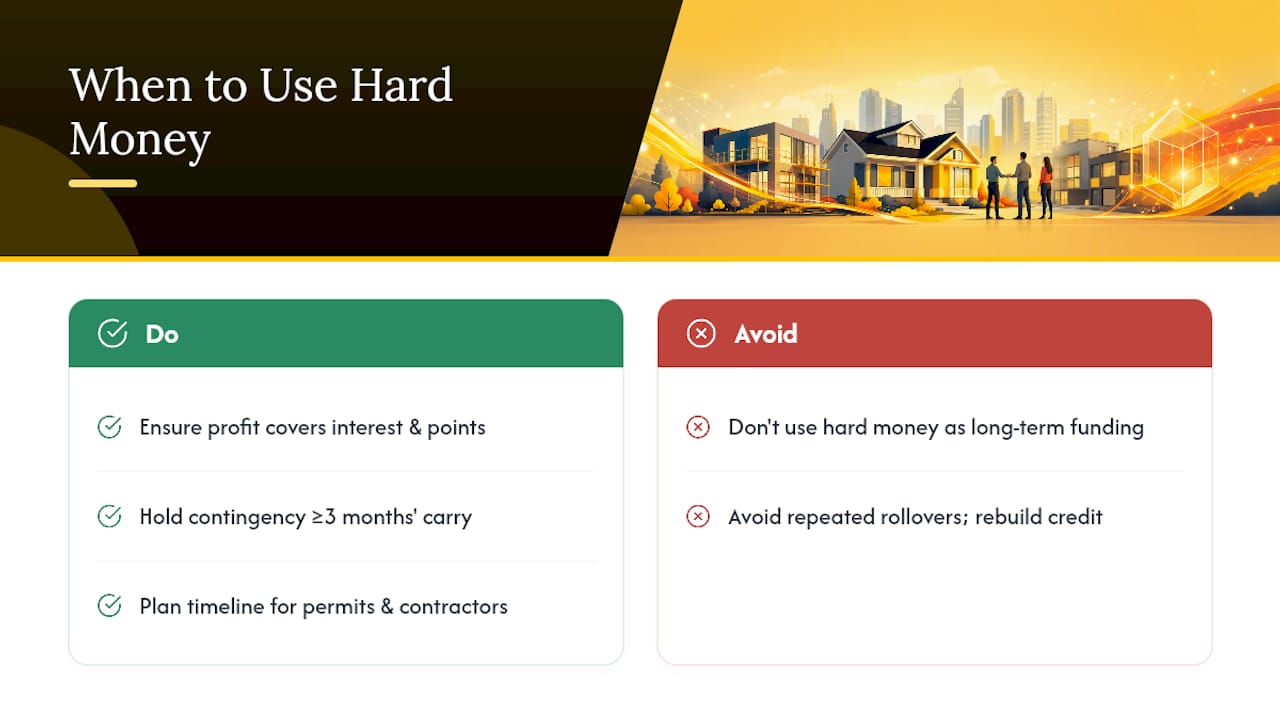
My one caution is this: hard money is a bridge, not a foundation. Borrowers who keep rolling into new hard money loans instead of rebuilding credit and transitioning to conventional or Non-QM financing eventually get squeezed by compounding costs.
— Jason Taken
How Jaken Finance Group Can Fund Your Next Deal
Some lenders underwrite around your property, not your credit score, with closings possible in as few as five business days once your file is complete. That speed matters when competing against cash buyers at auction or racing a seller's closing deadline, and it means a low FICO score doesn't automatically knock you out of contention the way it would with a bank.
Start by pulling together your purchase contract, rehab budget, and recent bank statements, since a complete packet is what moves you from inquiry to term sheet fastest. If you want to see how asset-based underwriting works before you apply, the asset-based loan explainer breaks down how ARV drives your loan amount. When you're ready to move forward, the hard money lender no credit check page is where to request terms on your specific deal. Investors curious about funded outcomes on similar projects can also review funded deal case studies to see how the numbers played out for other borrowers in comparable situations.
Sources
For deeper context on the topics covered here, these resources are worth a look: the CFPB's guide to buying a home with bad credit for consumer protections, Experian's explanation of hard money mechanics for cost framing, LendingTree's hard money overview for rate benchmarks, and Rocket Mortgage's guidance on buying with bad credit for traditional-lending comparisons. Jaken Finance Group's hard money loan guides round out the picture with investor-specific scenarios.
- Hard Money Loans: How They Work and When to Use Them
- What Is a Hard Money Loan and How Does It Work? | LendingTree
- How do hard money loans work? | Experian
- How to deal with 'bad credit'—or no credit—when you want to buy a home | CFPB