
Most hard money loan declines trace back to one of four issues: insufficient equity or loan-to-value shortfall, a weak or missing exit strategy, property or title defects, or thin borrower reserves combined with recent credit events. The first move after a hard money loan declined notice is to call the lender directly and ask exactly which factor triggered the denial and what documentation would reverse it.
TL;DR:
- A hard money loan decline often results from insufficient borrower contribution, a weak exit strategy, property issues, or title defects, not just one vague reason.
- Ensuring a substantial, verifiable cash reserve and a clear, detailed exit plan significantly improves approval chances, especially when supported by firm bids and comps.
- Addressing title issues early and providing a concise, organized deal memo can speed up underwriting and reduce rejection risks.
- Fixing credit-related concerns sometimes involves providing stronger collateral documentation, as many asset-based lenders prioritize property fundamentals over credit scores.
- Alternative financing options like private money, seller financing, or short-term bridge loans may be faster solutions if a quick approval is needed beyond traditional lenders.
Table of Contents
- Top Reasons a Hard Money Loan Gets Declined
- What Underwriters Check: A Self-Audit Checklist
- Step-by-Step Fixes to Improve Your Approval Odds
- Alternatives if You Can't Fix the Application Quickly
- Why Asset-Based Underwriting Rewards Prepared Investors
- Get a Deal Review Before You Reapply
- Sources
Top Reasons a Hard Money Loan Gets Declined
Lenders rarely decline a deal for one vague reason. They point to specific numbers or documents that failed to clear underwriting. Here are the most common causes, in the order underwriters tend to hit them.
-
Insufficient borrower contribution or LTV shortfall. Hard money lenders typically cap financing at 65% to 75% of after-repair value (ARV), expecting the borrower to bring roughly 25% to 35% of total project cost. If your purchase price plus rehab budget pushes past that ceiling, the loan math simply fails before underwriting even looks at your credit.
-
No credible exit strategy. Lenders want a believable plan to sell, refinance, or stabilize the property as a rental within the loan term. A one-line statement like "I'll sell it" without comps, a listing timeline, or refinance pre-qualification reads as speculation, not a plan.
-
Property-specific problems. Weak comparable sales, a declining neighborhood, an underestimated repair scope, or code violations that make the property uninsurable all undercut the collateral value the loan depends on.
-
Title defects and legal encumbrances. Undisclosed liens, unpaid property taxes, probate complications, or ownership disputes can halt funding even when the deal numbers look solid. Title and lien issues are among the most common lender deal-stoppers, and they often surface late in the process because borrowers assume a clean title until a search proves otherwise.
-
Deal types lenders won't touch. Some requests are structurally outside what asset-based lenders fund. Loans secured by soft assets like stocks or receivables, or purely speculative equity requests, are routinely declined because there's no hard collateral to foreclose on if the deal fails.
-
Personal financial red flags. Hard money underwriting is asset-based, but lenders still review reserves, recent credit events, and borrower experience. A recent bankruptcy, thin cash reserves, or bank statements that don't match your stated income can raise enough doubt to stall approval.
What Underwriters Check: A Self-Audit Checklist
Before you reapply, walk through the same checklist an underwriter uses. Most declines trace back to one item on this list.
- ARV and comps: Is your ARV based on recent, truly comparable sales, or on optimistic assumptions?
- Borrower contribution: Can you document a substantial portion of project cost in verifiable funds?
- Reserves: Do you have cash reserves beyond the down payment to cover carrying costs and overruns?
- Title and liens: Has a title search confirmed no outstanding mortgages, tax liens, or ownership disputes?
- Insurability: Can the property be insured in its current condition?
- Proof of funds and contractor bids: Do you have firm bids and a documented rehab scope, not rough estimates?
- Credit history: Are there recent bankruptcies or foreclosures, and how recent are they?
Pro Tip: Interest rates on hard money loans in 2026 often run 8% to 15%, with origination points around 1% to 3percent. Run your numbers at the higher end of that range before submitting, so a conservative underwriter's math doesn't blow up your deal.
Step-by-Step Fixes to Improve Your Approval Odds
Match your fix to the reason behind the decline rather than resubmitting the same file and hoping for a different result.
-
Close the equity gap. Document proof of funds, bring in a joint venture partner for additional capital, or use a short-term bridge to cover the shortfall between your available cash and the lender's required contribution.
-
Build a real exit strategy. Put a timeline on paper: refinance pre-approval, rent-up assumptions with market rent comps, or a staged sale plan with a realistic days-on-market estimate for your area.
-
Tighten the property numbers. Get firm, written contractor bids instead of verbal estimates, use a defensible ARV backed by three to five recent comps, and add a 10% to 20% contingency to your rehab budget so a cost overrun doesn't sink the exit plan.
-
Clear title issues fast. Order a title search early, resolve any liens or unpaid taxes before submitting, and consult a real estate attorney if probate or ownership disputes are involved.
-
Present a stronger file. Build a one-page deal memo covering purchase price, ARV, rehab budget with contingency, exit plan, and proof of funds. A tighter fix-and-flip underwriting file organized around these five points moves through underwriting faster than a scattered folder of documents.
If credit history is part of the problem, understand how lower credit scores affect hard money terms before you assume a decline is permanent. Many asset-based lenders will work around credit issues when the collateral and reserves are strong.
Alternatives if You Can't Fix the Application Quickly
Sometimes the fastest path forward isn't reapplying with the same lender. Consider these options while you rebuild the file:
- Private money or joint venture equity closes faster than a bank loan but usually costs more or requires giving up a share of ownership.
- Seller financing or subject-to deals can work when the seller is motivated and willing to carry part of the balance.
- Short bridge or mezzanine financing covers a temporary equity gap without restructuring the entire deal.
- Pausing to re-scope the project or bringing on a co-investor may beat forcing a deal that doesn't pencil out as originally structured.
Understanding how repayment and exit mechanics actually work helps you evaluate whether any of these alternatives genuinely solve your timing problem or just delay it.
Why Asset-Based Underwriting Rewards Prepared Investors
Jaken Finance Group underwrites primarily against ARV and property fundamentals, which is why prepared investors with firm contractor bids and a clear deal memo can close in as few as five days. Conservative ARV estimates and documented numbers aren't bureaucratic hurdles. They're the fastest route through underwriting for borrowers who've done the homework a declined applicant often hasn't.
— Jason Taken
Get a Deal Review Before You Reapply
Jaken Finance Group underwrites primarily against the property, not a credit score, which means a declined deal at another lender often still qualifies once the numbers and documentation are tightened up. Its fix-and-flip, bridge, and hard money loans are built around ARV-based leverage and fast closings, so a well-documented file can move from application to funding in days rather than weeks.
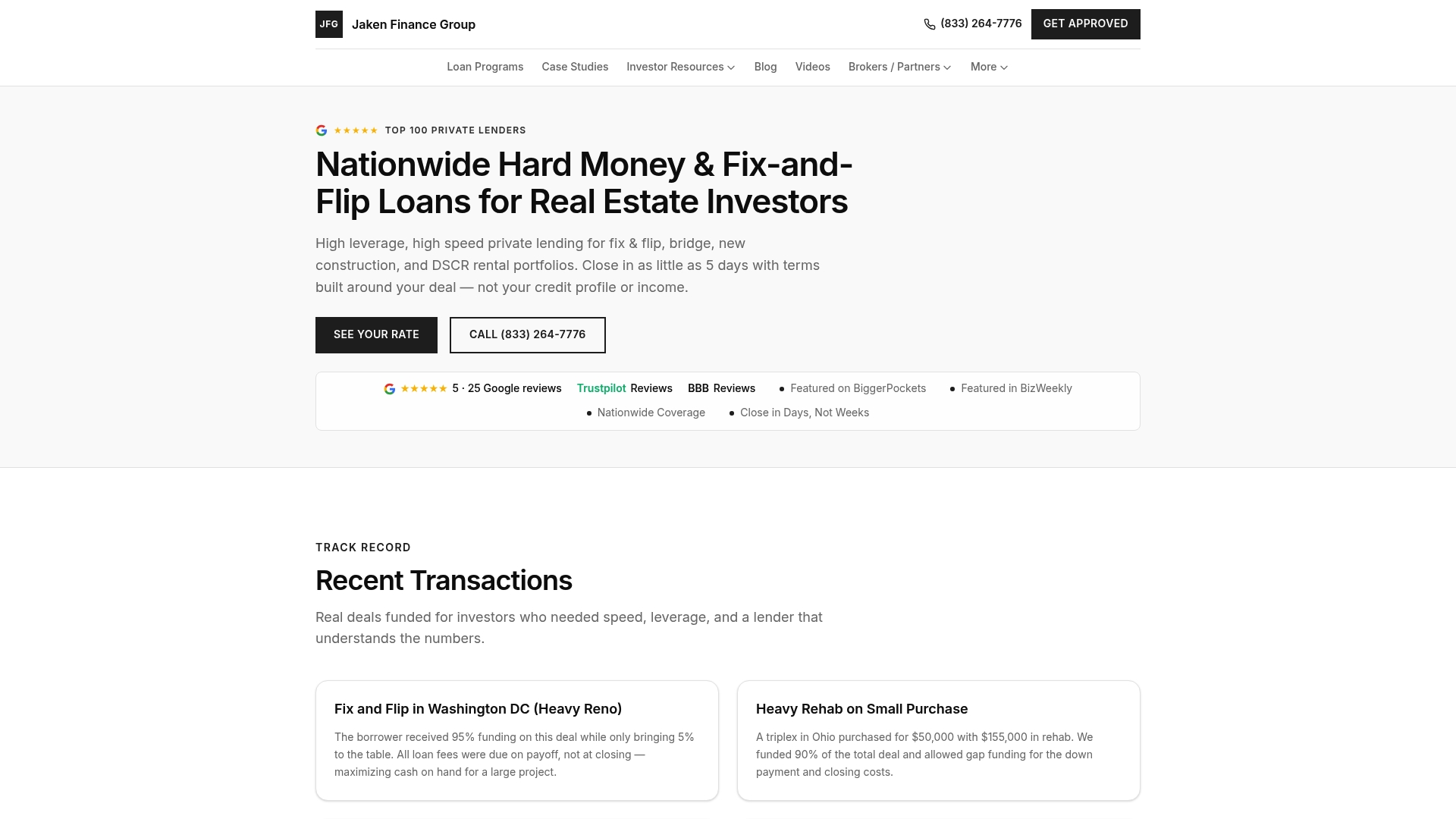
If credit history was the sticking point on your last application, asset-based lending without a hard credit-score cutoff may resolve it outright. Otherwise, the fastest next step is a free deal review: submit your ARV, rehab budget, and exit plan through Jaken Finance Group's loan application and get direct feedback on what would move your file from declined to funded.
Sources
Figures on LTV, rates, and underwriting standards above come from The Close, Experian, Lender Tribune, and Rocket Mortgage.
This article is general information, not a substitute for advice from a qualified financial advisor. Consult a qualified financial professional about your own circumstances before acting on anything here.
- The Close — Best hard money lenders
- Experian — Pros and cons of hard money loans
- Lender Tribune — How to qualify for a hard money loan in 2026