Most fix-and-flip lenders in the United States will finance a large majority of the total project cost, but the after-repair value usually sets the real ceiling, capping loans at a moderate to high percentage of ARV. Borrower experience, cash reserves, and carry costs then adjust that number up or down. The sections below break down the formulas, the market ranges, worked math, and a checklist to apply before you make an offer.
TL;DR:
- Leverage is often limited more by the after-repair value cap than by the loan-to-cost ratio, especially in deals with thinner rehab margins or inflated ARV estimates.
- Typical loan caps hover around 70-90% LTC but vary based on borrower experience, property type, and lender tier, with more experienced investors accessing higher leverage.
- The actual cash needed at closing can exceed the headline leverage percentage by tens of thousands due to origination points, closing costs, unfunded project costs, and reserves.
- Asset-based underwriting focuses on property value and scope of work, allowing faster approvals and higher leverage for well-documented deals, especially for first-time flipters.
- Asking detailed questions about interest accrual and aligning draw schedules with project milestones can significantly improve usable leverage and reduce carrying costs.
Table of Contents
- What LTC, LTV, and LTARV Actually Measure
- Typical Leverage Caps by Loan Type and Borrower Track Record
- How Leverage Changes Your Return and Your Downside
- Comparing Financing Options for Fix-and-Flip Leverage
- What Lenders Look at Before Approving Higher Leverage
- Negotiating Leverage and Structuring Your Draws
- Reconciling Your Loan Amount With the Cash You'll Actually Need
- Jaken Finance Group Case Study: Second Look Fix-and-Flip Leverage Rescue
- Your Pre-Offer Leverage Checklist
- What I've Learned Underwriting Leverage for Flippers at Scale
- Get Fast, Asset-Based Leverage on Your Next Flip
- Sources
What LTC, LTV, and LTARV Actually Measure
Lenders rarely rely on a single ratio to size a fix-and-flip loan. They run three, then apply whichever produces the smallest, most conservative number. That practice, common across fix-and-flip lenders, is the single most misunderstood part of flip loan leverage for new investors.
- Loan-to-Cost (LTC): Loan amount ÷ total project cost (purchase price plus rehab budget). This is the ratio most lenders quote in marketing.
- Loan-to-Value (LTV): Loan amount ÷ current as-is value of the property, before any renovation work happens.
- Loan-to-ARV (LTARV): Loan amount ÷ projected after-repair value, based on comparable sales once the rehab is complete.
Here's how the binding ratio gets identified in practice. Say you're buying a property for $200,000 with a $50,000 rehab budget, for a total project cost of $250,000. The ARV comes in at $320,000. A lender offering 90% LTC would calculate a maximum loan of $225,000. But that same lender caps LTARV at 70%, which caps the loan at $224,000. In this case the two numbers land close together, but flip the math on a deal with a thinner rehab margin or an inflated ARV estimate, and the LTARV cap will bind hard, sometimes forcing you to bring tens of thousands more cash to closing than the headline LTC number implied.
Typical Leverage Caps by Loan Type and Borrower Track Record
Advertised leverage varies more by lender tier and borrower history than by property type. Some platforms market aggressive numbers on LTC or renovation costs in certain products, but those offers typically come bundled with tighter LTARV caps, higher points, or stricter draw conditions, according to CNBC Select's review of investment property lenders.
Realistic ranges most investors will encounter vary by lender and borrower profile. LTC is often in the moderate to high range of total project cost, with repeat borrowers typically accessing higher leverage. LTARV commonly stays below industry ceilings established by most private lenders. LTV on as-is properties is usually lower, especially for harder-to-value distressed properties. First-time flippers tend to be at the conservative end of these ranges or face additional reserve requirements, while experienced borrowers with multiple completed flips can often negotiate more favorable terms.
Some lenders also advertise closing timelines of 5 to 21 days alongside leverage up to 92.5% LTC, according to LendingOne's market comparison. Though marketed maximums and what a specific deal actually qualifies for can differ substantially once a lender underwrites the ARV.
How Leverage Changes Your Return and Your Downside
Leverage cuts both ways, and the math makes that obvious once you run two scenarios against the same property.
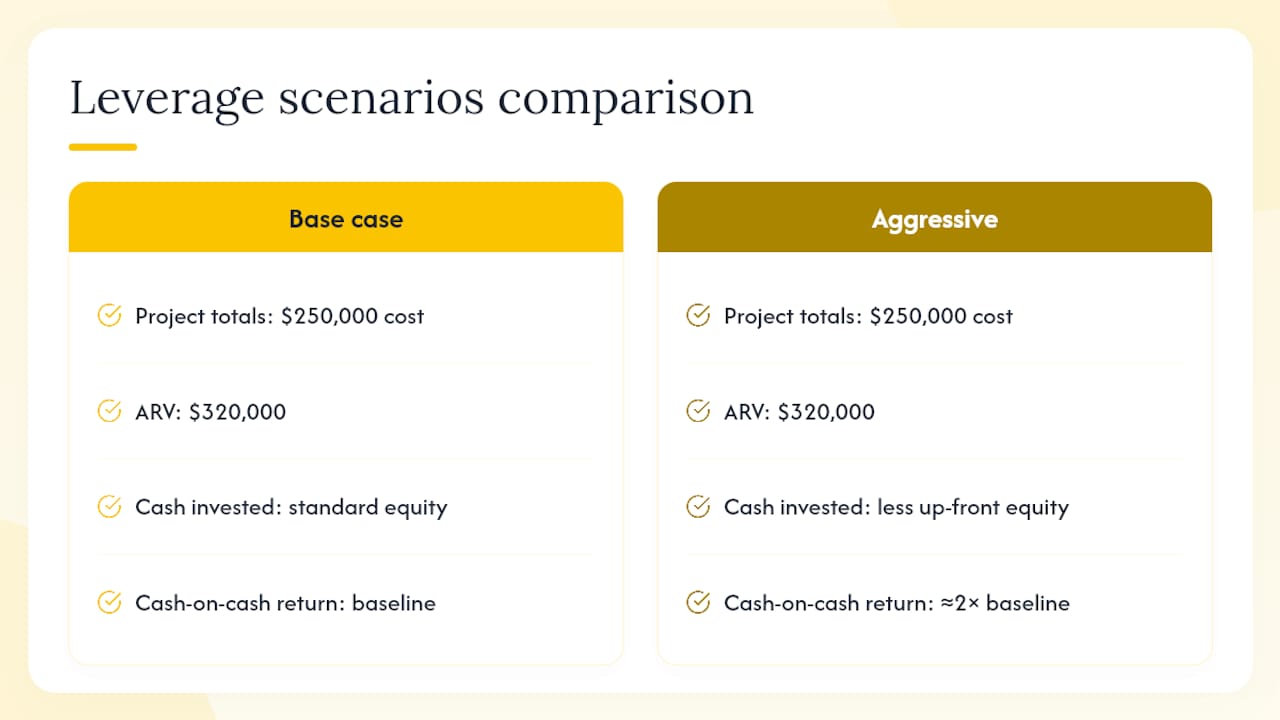
Assume a purchase price of $200,000, a $50,000 rehab budget, and an ARV of $320,000. Total project cost: $250,000.
The aggressive scenario roughly doubles the cash-on-cash return under the base case. That's the appeal of leverage.
On short flips, origination points and minimum interest holds often matter more than the quoted rate. A loan with 2 points and a 90 day minimum interest period can carry a higher effective annualized cost than a loan with a slightly higher rate but no minimum hold, particularly if you sell in under four months, a dynamic detailed in DealForge's breakdown of fix-and-flip financing costs.
Comparing Financing Options for Fix-and-Flip Leverage
The vehicle you choose determines how much leverage you can realistically pull, and how fast.
- Hard money and fix-and-flip loans: Built specifically for this use case, with rehab funded through draws rather than upfront. Leverage typically runs 70% to 90% LTC, capped by ARV, with closings possible in a matter of days rather than weeks.
- Bridge loans: Useful when you're acquiring a property that needs light work or when you need to close before a longer-term loan is arranged. Leverage tends to mirror hard money ranges but with more flexible use of proceeds; bridge loan structures can also cover gaps between a sale and a new acquisition.
- HELOCs and home-equity strategies: Can fund a down payment or rehab costs on a flip, but leverage depends entirely on equity in your primary residence or another property, and most banks are slow to underwrite compared to asset-based lenders.
- DSCR loans: Built for rental cash flow, not renovation and resale, so they generally don't fit a true flip; DSCR products become relevant only once you decide to hold and refinance instead, a shift worth understanding through DSCR loan rate mechanics.
- Cash and seller financing: Removes leverage caps entirely but ties up capital; seller financing can sometimes fill the gap between what a lender will fund and what the deal needs, effectively raising your blended leverage without a second lender in the mix.
What Lenders Look at Before Approving Higher Leverage
ARV drives the loan amount, but lenders don't take a borrower's number at face value. They stress-test it against comparable sales, broker price opinions, or full appraisals, and an inflated ARV estimate is one of the most common reasons a flip loses money, a pattern outlined in Baseline's fix-and-flip lending guide.
- ARV justification: Expect the lender to require at least three comparable sales within a reasonable radius and timeframe, sometimes backed by a third-party BPO or full appraisal on larger loans.
- Scope of work and contractor bids: A detailed, line-item rehab budget with signed contractor bids reduces perceived risk and can unlock a few extra points of leverage compared to a rough estimate.
- Draw schedule realism: Lenders want a timeline that matches the actual scope. An unrealistic six-week gut renovation timeline raises red flags before underwriting even finishes.
- Experience tier and documentation: Completed flips in the last 24 to 36 months, proof of funds for reserves, and a clean track record on prior draws all factor into where you land within the leverage bands, an underwriting rhythm most lenders apply consistently, as noted in Baseline's underwriting overview.
Pro Tip: Bring your contractor bids and a comp set to your first conversation with a lender, not after a term sheet is issued. Underwriters move faster, and often stretch leverage further, when the file is already backed by third-party documentation instead of your own estimate.
Negotiating Leverage and Structuring Your Draws
A few tactical moves can improve the real, usable leverage on a deal without changing the headline terms at all.
- Ask how interest accrues. Some lenders charge interest on the full committed loan balance from day one (a Dutch structure); others charge only on funds actually disbursed. That difference alone can shift your carry costs by thousands of dollars over a six-month hold.
- Align your draw schedule with real milestones. Framing, rough mechanicals, and final inspection are natural draw points that most lenders recognize, and clean milestone alignment speeds up disbursement.
- Use documented reserves to bridge an experience gap. If you're a first-time flipper stuck at a lower leverage tier, showing six months of proven reserves can sometimes convince a lender to move you up a bracket rather than deny the extra leverage outright.
Pro Tip: Always ask explicitly whether interest is calculated on disbursed funds only. It's one of the highest-leverage negotiating points in the entire loan conversation, and most borrowers never ask.
Reconciling Your Loan Amount With the Cash You'll Actually Need
The loan amount on your term sheet is not the cash you'll have in hand. Several deductions happen before and after closing.
- Unfunded portion of the purchase and rehab: Whatever percentage the LTC or LTARV cap doesn't cover, you bring at closing.
- Origination points: Commonly 1% to 3% of the loan amount, due upfront and reducing your net proceeds immediately, per DealForge's cost breakdown.
- Closing costs, title, and insurance: Standard transactional costs that stack on top of the loan-related fees.
- Minimum interest holds: Many lenders require a minimum interest period (often 3 to 6 months) even if you sell sooner, meaning you pay for time you didn't use.
- Contractor deposits and post-close reserves: Draws fund rehab in stages, but most contractors expect a deposit before the first draw arrives.
On the $250,000 total-project-cost example above, an 80% LTC loan of $200,000 sounds like plenty of leverage. After 2 points ($4,000), closing costs (roughly $2,500), a rehab deposit ($3,000), and the unfunded $50,000 in project cost, actual cash needed at close and shortly after can exceed $60,000, well beyond what the headline "80% financed" figure suggests.
Jaken Finance Group Case Study: Second Look Fix-and-Flip Leverage Rescue
An investor came to Jaken Finance Group after a traditional lender pulled back financing mid-deal over documentation gaps, leaving a signed purchase contract at risk. Using asset-based underwriting, focused on the property's ARV and the scope of work rather than a rigid credit file, the loan was restructured and funded on a fast timeline, preserving the deal and the investor's earnest money.
The gap wasn't the deal's fundamentals. The property had strong comps and a realistic rehab budget. The gap was a lender that underwrote the borrower's paperwork instead of the asset. Asset-based underwriting closed that gap in days, not weeks.
Three lessons apply broadly: complete contractor bids and a solid comp set mattered more than a perfect credit file; speed came from evaluating the property first and the borrower's documentation second; and the borrower's willingness to negotiate draw structure upfront avoided delays later. More examples like this appear in Jaken Finance Group's funded deal case studies.
Your Pre-Offer Leverage Checklist
Run these checks before submitting an offer, not after.
- Build a conservative ARV buffer of at least 5% to 10% below your top comp estimate.
- Confirm you have reserves covering at least three to six months of carry costs beyond the loan term.
- Match your draw schedule to real, inspectable milestones your contractor can hit.
- Ask upfront whether interest accrues on committed or disbursed funds.
- Document experience or compensating reserves if you're outside the top leverage tier.
Red flags that call for lower leverage: an ARV based on a single aggressive comp, a contractor bid that's a rough verbal estimate, or a market showing rising days-on-market for comparable resales.
| Decision Point | Choose Higher Leverage When | Choose Lower Leverage When |
|---|---|---|
| ARV confidence | Three or more tight comps support the number | ARV rests on one comp or a stale sale |
| Track record | Three or more completed flips in 24 to 36 months | First or second flip with limited reserves |
| Market trend | Inventory is tight and days-on-market are falling | Days-on-market are rising in your submarket |
| Rehab scope | Cosmetic work with signed contractor bids | Structural or unknown-scope work |
What I've Learned Underwriting Leverage for Flippers at Scale
The biggest misconception among newer flippers is that leverage is a fixed number a lender assigns to a property. It isn't. Leverage is a negotiation between your documentation, your ARV defense, and the lender's confidence in your execution. The investors who consistently land at the top of the leverage bands aren't the ones with the best credit scores. They're the ones who show up with a comp set, a signed contractor bid, and a draw schedule that matches reality. Speed matters too. Asset-based underwriting exists because a property's value and a realistic scope of work tell a lender more than a stack of tax returns ever will, and that shift in evaluation is what lets a well-documented deal close in days instead of a month of back-and-forth.
— Jason Taken
Get Fast, Asset-Based Leverage on Your Next Flip
Jaken Finance Group underwrites against the property, not a rigid credit profile, which means investors with strong deals but imperfect paperwork can still access competitive leverage without waiting weeks for a decision. That's the practical difference against a traditional bank underwriting process: speed, flexibility on documentation, and loan terms built around your project's ARV and scope of work rather than a credit score threshold.
If your deal has a solid comp set and a realistic rehab budget but a traditional lender is dragging its feet, or you're a first-time flipper trying to figure out how much leverage you can realistically access, Jaken Finance Group's asset-based hard money loans are built for exactly that scenario. Closings in as few as five days are possible when the file is documented well. Explore your options and request a leverage quote on your next deal today.
Sources
- Fix-and-Flip Financing: Loans, Costs & Draws (2026) | DealForge
- Best Investment Property Lenders of 2026 | CNBC Select
This article is general information, not a substitute for advice from a qualified financial advisor. Consult a qualified financial professional about your own circumstances before acting on anything here.