
A fix-and-flip extension is a formal agreement between a borrower and lender that pushes the loan's maturity date forward by a defined period, typically 1–12 months, in exchange for fees and adjusted interest carry. If your project will miss its original exit date, the single most important action is to notify your lender before the maturity date, not after.
Immediate action checklist (first 24–72 hours):
- Contact your lender by phone and follow up in writing the same day
- Pull your current draw report and document completed work with dated photographs
- Collect all active permits, contractor invoices, and any change orders
- Estimate remaining scope, realistic completion date, and revised exit timeline
- Confirm your interest payment status and resolve any arrears immediately
- Prepare updated comparable sales (MLS comps) to support your revised ARV
Pro Tip: Request your lender's extension policy in writing at loan origination, before you need it. Knowing the fee structure and documentation requirements in advance lets you prepare a clean request package in hours, not days.
Key Takeaways
A fix-and-flip extension preserves deal viability when timelines slip, but each additional month of carry directly reduces net profit, making early lender communication and documented exit planning the two most valuable tools an investor has.
| Point | Details |
|---|---|
| Notify lender early | Contact your lender at the first sign of a 2-week-plus delay, ideally 30–45 days before maturity. |
| Document progress thoroughly | Submit photos, draw reports, updated comps, and a contractor schedule with every extension request. |
| Calculate the full cost | A one-month extension on a $250,000 loan at 12% plus a $1,000 fee costs approximately $3,500 in incremental carry. |
| Evaluate alternatives first | Refinancing to DSCR, selling as-is, or bridge financing may preserve more profit than a multi-month extension on a thin-margin deal. |
| Jaken Finance Group | Asset-based underwriting and fast closings give investors a flexible path for extensions, pivots, and contingency scenarios. |
Table of Contents
- How are fix-and-flip loan extensions structured?
- What do lenders require to approve an extension?
- How much does a fix-and-flip extension cost?
- When and how should you request a loan extension?
- What are the alternatives to requesting an extension?
- Worked example: how a 3-month extension changes the numbers
- What experienced asset-based lenders actually prioritize
- Jaken Finance Group handles extensions and fast closings for active investors
- Sources
How are fix-and-flip loan extensions structured?
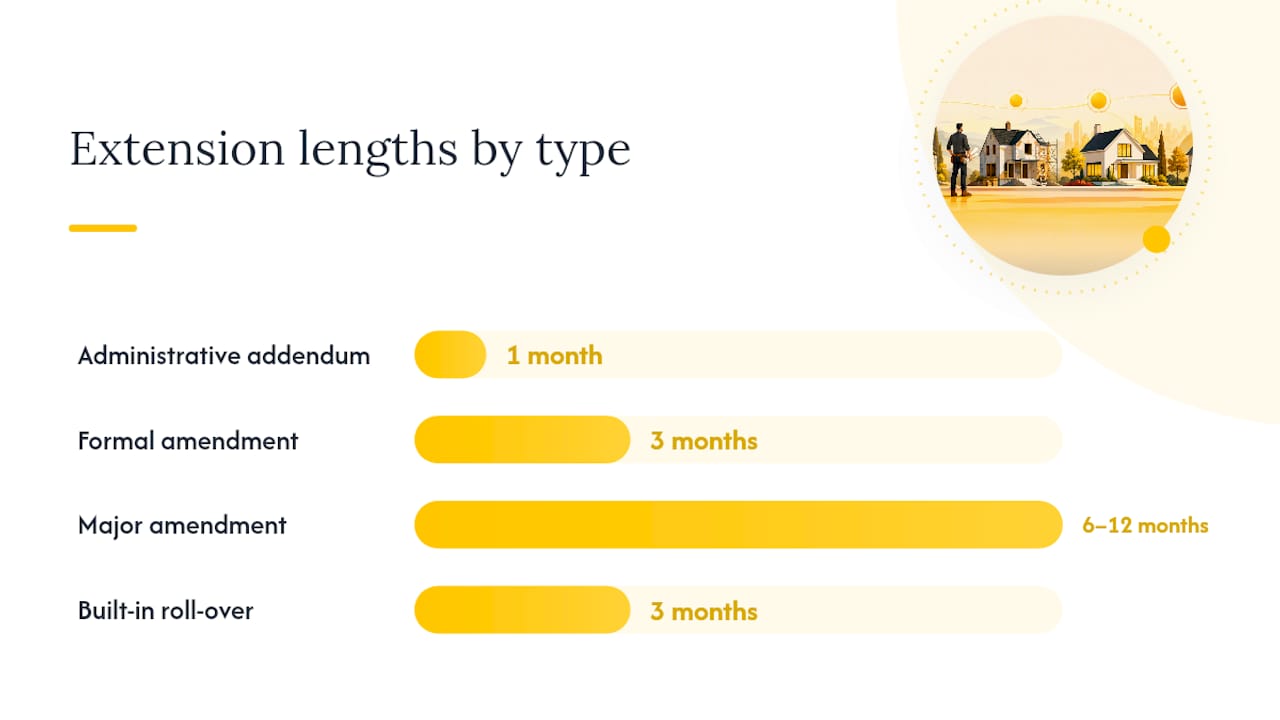
Fix-and-flip loans typically run up to 12 months, and most private lenders offer fee-based extensions when a project timeline slips. Extensions take three common forms depending on the lender's process and the loan documents.
Administrative month-to-month addenda are the lightest form. The lender issues a one-page addendum that shifts the maturity date by 30 days, collects a flat fee, and requires no full re-underwrite. These are common for minor permit delays or final punch-list work.
Formal loan amendments involve a new maturity date written into the loan agreement, often with updated interest rate terms or additional origination points. Lenders use these for 3–6 month extensions where the project scope has changed materially.
Built-in roll-over options are negotiated at origination. Some lenders include a contractual right to one 3-month extension, subject to payment history and project progress conditions. This is the cleanest path because the terms are pre-agreed.
| Extension Type | Typical Length | Common Trigger | Lender Process |
|---|---|---|---|
| Administrative addendum | 1 month | Permit delay, final inspections | Flat fee, minimal docs |
| Formal amendment | 3 months | Scope creep, contractor delays | Full doc package, re-underwrite |
| Major amendment | 6–12 months | Market shift, major scope overrun | Full re-underwrite, possible rate adjustment |
| Built-in roll-over | 3 months | Any qualifying delay | Pre-agreed conditions at origination |
Extensions also interact directly with draw schedules. Most lenders will not approve an extension if outstanding draws have not been inspected and closed. Holdbacks tied to completion milestones remain frozen until the lender's inspector signs off, so clearing open draws before submitting an extension request materially speeds up approval. For a deeper look at how draw schedules and lender inspections work within fix-and-flip financing structures, the mechanics are worth reviewing before your first extension request.
What do lenders require to approve an extension?
Lender approval is not automatic. Underwriters evaluate five primary criteria before granting a term extension on a fix-and-flip loan.
- Project progress relative to schedule. Lenders want to see that work is advancing, not stalled. Photographic evidence, updated contractor schedules, and a milestone completion log carry more weight than verbal assurances.
- Draws completed and inspected. All previously funded draw requests must be closed and inspected. An open, uninspected draw is a red flag.
- Borrower payment history. Missed or late interest payments are the fastest path to a denied extension. Lenders treat payment history as a proxy for borrower reliability.
- Credible revised exit strategy. A sale plan backed by current MLS comps or a refinance plan with a qualifying DSCR rental product is required. Vague exit plans are rejected.
- Borrower liquidity and reserves. Lenders want confirmation that the borrower can carry the additional months of interest and fees without defaulting.
JPMorgan's real estate investing guidance notes that lenders favor borrowers who present a clear exit plan and maintain a strong relationship, and that borrower transparency materially increases the likelihood of an extension being approved. Lenders that understand a borrower's full strategy are more likely to work through delays constructively.
Practical steps to improve approval odds:
- Stay current on all interest payments through the extension request date
- Submit dated photographs showing progress at each completed phase
- Provide an updated contractor schedule with specific milestone dates
- Share current MLS comps within a 0.5-mile radius and 90-day sale window
- Be transparent about what caused the delay and what has changed
Document checklist lenders commonly request:
- Updated permits and any change orders
- Contractor invoices and lien waivers
- Draw reports from all funded disbursements
- Bank statements showing 3–6 months of reserves
- MLS comparable sales supporting revised ARV
- Written timeline with remaining milestones and completion date
Pro Tip: Lenders reviewing extension requests are looking for one thing: evidence that the deal still works. A one-page project summary with photos, updated comps, and a clear exit date does more to secure approval than a lengthy explanation of what went wrong.
Investors who maintain consistent communication throughout the loan term, not just at the extension request stage, report fewer friction points during the approval process. The underwriting primer from Jaken Finance Group outlines what asset-based lenders validate during both origination and extension reviews.
How much does a fix-and-flip extension cost?
Extension costs have three components: the flat extension fee, additional interest carry, and in some cases a rate adjustment or additional origination points.
Common fee types:
- Flat extension fee: Typically a few hundred to a few thousand dollars per month, charged at the time the amendment is executed. Some lenders set a minimum regardless of loan size.
- Additional interest carry: The borrower continues paying interest on the unpaid principal balance at the existing rate for each extended month. At rates commonly in the 11%–13% range for fix-and-flip products, this is often the largest cost component.
- Rate adjustment: Some lenders step up the interest rate by 1–2 points for extensions beyond 3 months, particularly on formal amendments.
- Additional origination points: Rare on short extensions but possible on major amendments; typically 0.5–1 point.
- Late fees: Charged separately if any interest payment was missed before or during the extension period.
Sample one-month extension cost calculation:
That cost represents the floor cost for a single additional month on a mid-six-figure loan at a typical fix-and-flip interest rate. On a deal with a thin profit margin, one extension month can consume a significant portion of the margin before accounting for property taxes, insurance, and utilities.
Holding costs including mortgage interest, property taxes, and insurance are critical drivers of flip profitability and compound quickly as delays extend. Fees are typically billed as a one-time payment at amendment signing, while interest carry continues to accrue monthly.

When and how should you request a loan extension?
Timing is the single most controllable variable in the extension process. Notify your lender as soon as you identify a risk of more than two weeks to your exit date. For formal amendments, start the request 30–45 days before the loan maturity date. Waiting until the final week limits your options and signals poor project management to the underwriter.
Step-by-step request process:
- Initial call. Contact your loan servicer or originating loan officer by phone. State the issue, estimated delay, and your revised exit date. This call starts the clock on lender review.
- Formal written request. Follow up the same day with a written request via email. Include the loan number, current maturity date, requested new maturity date, and a one-paragraph summary of the reason for the delay.
- Submit the document package. Attach the full document checklist: photos, draw report, updated comps, contractor schedule, bank statements, and permits.
- Lender underwriting review. The lender reviews the package, may order a property inspection, and issues a decision. Simple administrative extensions can clear in 3–5 business days. Formal amendments with re-underwriting typically take 1–3 weeks.
- Amendment signing and fee payment. Once approved, both parties sign the amendment. The flat extension fee is due at signing. Interest carry resumes under the new maturity date.
Sample extension request email (attachments listed below):
Subject: Extension Request — Loan #[XXXX], Maturity [Date]
Please see our formal request to extend the maturity date on the above loan by 90 days to [New Date]. Renovation is approximately 75% complete; remaining scope is [brief description]. Updated comps support an ARV of $[X]. We are current on all interest payments. Attached: draw report, photos, contractor schedule, MLS comps, and bank statements. Please confirm receipt and advise on next steps.
Attachments checklist:
- Dated property photographs (interior and exterior)
- Most recent draw report
- Updated MLS comps (within 90 days)
- Contractor schedule with milestone dates
- Bank statements (most recent 2–3 months)
- Active permits and any change orders
Lender response timelines range from 3 business days for administrative addenda to 3 weeks for complex formal amendments. Building contingency time into your request window protects against lender processing delays.
What are the alternatives to requesting an extension?
An extension is not always the right path. Four alternatives are worth evaluating based on the project's remaining timeline and profit margin.
- Refinance to a rental or DSCR product. If the property generates or will generate rental income, refinancing into a DSCR rental loan removes the hard maturity pressure and converts the asset to a hold. This works when the rental yield supports the debt service and the investor is willing to shift the exit strategy.
- Short-term bridge loan. A second short-term loan can pay off the maturing fix-and-flip loan and provide additional runway. Bridge financing carries its own fees and interest, so the math must confirm the deal still pencils after the additional carry cost.
- Sell as-is. When scope overruns are severe and margins are thin, selling the property in its current condition to another investor or through a wholesale channel cuts losses faster than extending. House flips are commonly short holds of 3–4 months, and an extended hold on a thin-margin deal can eliminate profit entirely.
- Forbearance. Some lenders will negotiate a short forbearance period, deferring interest payments temporarily without formally extending the maturity date. This is rare and typically reserved for borrowers with strong payment histories and documented hardship.
Decision framework:
| Scenario | Preferred Path |
|---|---|
| Minor delay (under 30 days), strong comps, payments current | Administrative extension |
| 90 day delay, scope creep, viable exit plan | Formal 3-month amendment |
| Major overrun, thin margin, no clear exit | Sell as-is or wholesale |
| Property cash-flows as rental, long-term hold viable | Refinance to DSCR |
| Temporary cash-flow disruption, strong borrower history | Forbearance (lender discretion) |
Reviewing your fix-and-flip financing options before committing to an extension ensures you are choosing the path that preserves the most profit, not simply the path of least resistance.
Worked example: how a 3-month extension changes the numbers
Initial assumptions:
- Purchase price: $180,000
- Rehab budget: $45,000
- ARV: $290,000
- Loan amount: $200,000 at 12% per annum
- Original term: 9 months
- Origination points: 2% ($4,000)
Step 1: Monthly holding cost components (original term)
- Monthly interest: $200,000 × 12% ÷ 12 = $2,000
- Property taxes: approximately $250/month
- Insurance: approximately $150/month
- Utilities: approximately $100/month
- Total monthly carry: $2,500
Step 2: Original projected profit
- Sale price at ARV: $290,000
- Less purchase: $180,000
- Less rehab: $45,000
- Less origination points: $4,000
- Less 9 months of carry ($2,500 × 9): $22,500
- Less closing/selling costs (6%): $17,400
- Projected net profit: $21,100
Step 3: Add a 3-month extension
- Additional interest carry (3 months × $2,000): $6,000
- Additional holding costs (taxes, insurance, utilities × 3): $1,500
- Flat extension fee: $1,000
- Total extension cost: $8,500
- Revised net profit: $12,600
That is a material hit, but it is recoverable if the ARV holds.
Step 4: Sensitivity check
- If the sale price drops 2% ($290,000 → $284,200): profit falls an additional $5,800, leaving approximately $6,800 net.
- If the lender steps up the rate by 2 points (12% → 14%) on the extension: the 3-month interest carry rises from $6,000 to $7,000, reducing profit by another $1,000.
On a $45,000 rehab, that is $4,500–$6,750 in reserve. Investors who fund that contingency at origination rarely need to request extensions at all.*
Funded deal examples published by private-lender aggregators show interest rates commonly in the 11%–13% range with origination points of 1.25%–3%, which aligns with the assumptions used above. Verify your own loan file for the exact unpaid principal balance and rate before running this calculation.
What experienced asset-based lenders actually prioritize
Most articles on fix-and-flip extensions focus on the borrower's checklist. The more useful frame is understanding what a lender is actually trying to protect when they review an extension request.
An asset-based lender's primary concern is not the borrower's credit score or income statement. It is whether the property's current and projected value still supports the loan balance, and whether the borrower has a credible, documented path to exit. A borrower who communicates early, keeps payments current, and submits a clean package with updated comps is demonstrating exactly the behaviors a lender needs to see to approve the request. A borrower who goes silent until the maturity date and then calls in a panic is demonstrating the opposite.

Two rules of thumb that hold across most extension scenarios: first, schedule a contingency extension into every flip timeline at origination, even if you never use it. Knowing the fee and documentation requirements before you need them removes the friction entirely. Second, treat the lender relationship as a long-term asset. Investors who have funded multiple deals with the same lender and maintained clean payment histories consistently receive more flexibility on extensions, better pricing, and faster turnaround on amendment approvals.
Repeated extensions on the same loan, or extensions across multiple loans simultaneously, will affect future pricing and leverage. Lenders track borrower performance across their portfolio. A pattern of late exits signals execution risk and typically results in tighter LTV, higher points, or shorter initial terms on future loans.
Jaken Finance Group handles extensions and fast closings for active investors
When a project timeline slips, the lender's response speed and flexibility matter as much as the fee structure. Jaken Finance Group's asset-based underwriting evaluates deals on property value rather than borrower credit scores, which means extension reviews focus on the asset and the exit plan, not a FICO threshold. Closings in as few as five days mean investors can also pivot to a bridge or refinance structure quickly if an extension is not the right path.
For investors approaching a maturity date, Jaken Finance Group's team reviews extension requests and contingency scenarios directly. The 100% LTC fix-and-flip program includes built-in flexibility for qualifying borrowers, and the funded deal case studies show realistic interest, points, and term structures investors can use to model their own extension costs. Contact Jaken Finance Group with your loan details, current project status, and revised exit timeline to start the extension review process.
Sources
Verifying lender credentials and deepening your understanding of fix-and-flip financing mechanics reduces risk at every stage of a project.
- Fix and Flip Loans
- Real Estate Investing Tips to Consider
- A Beginner's Guide to Real Estate Investing: Key Strategies & Tips
- 5 types of real estate investment strategies | Ameriprise Financial
For state-specific permit timelines and filing requirements, check your local building department and state contractor licensing board directly. Permit delays are one of the most common triggers for extension requests, and processing times vary significantly by jurisdiction.
This article is general information, not a substitute for advice from a qualified financial advisor. Consult a qualified financial professional about your own circumstances before acting on anything here.