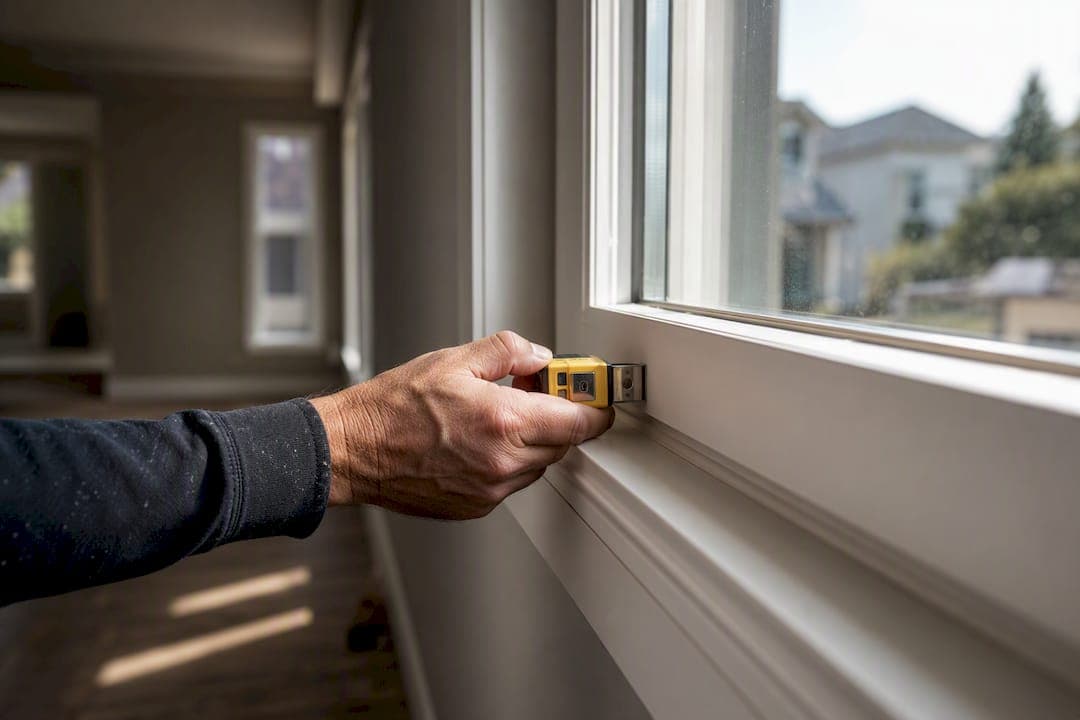
An escrow holdback for repairs lets closing proceed now by setting aside agreed funds in escrow to pay for specified repairs after the deed transfers. It only works if the lender approves the arrangement and the underlying agreement spells out scope, deadline, and release conditions. Lenders typically limit holdbacks to non-safety, exterior, or weather-delayed repairs, which keeps the closing date intact while protecting the collateral and giving the buyer a documented path to completion.
TL;DR:
- Most loan programs require a contingency multiplier of at least 120% to 150% of repair costs, which can significantly inflate the holdback amount and reduce seller proceeds.
- Repair scope should be clearly outlined in the agreement, focusing only on minor exterior, landscaping, or non-habitable repairs, as major structural or safety issues must be completed before closing.
- The seller typically funds the holdback from sale proceeds, with escrow managed by a neutral third party like the title company or closing attorney to ensure fair disbursement.
- Verification of repair completion usually involves a formal inspection, appraisal update, or lien waivers, with costs around 150 to 200 dollars, and must meet specific documentation standards.
- When repair costs exceed acceptable holdback limits or programs restrict the scope, investor buyers can use fix and flip or bridge loans to close on time without relying on seller funding or holdbacks.
Table of Contents
- What Is an Escrow Holdback for Repairs and When Does It Apply?
- Who Funds the Holdback and How Does the Escrow Account Get Set Up?
- How Do Lenders and Loan Programs Affect Holdback Rules?
- How Is the Holdback Amount Calculated?
- Step-by-Step: Drafting the Agreement and Getting to Closing
- Verifying Completion and Releasing Holdback Funds
- Risks, Remedies, and Negotiation Tips for Buyers and Sellers
- An Expert Perspective From Jaken Finance Group
- What the Standard Playbook Gets Wrong
- When Financing Beats Waiting on a Holdback
- Official Guidance and Documents to Consult
- Sources
- FAQ
What Is an Escrow Holdback for Repairs and When Does It Apply?
A repair holdback escrow lets a sale close before repairs are finished. The money sits with a neutral third party, usually the title company or closing attorney, and gets released only after the repairs are verified. Lender and loan program rules determine which items qualify, how much gets set aside, and what deadline applies, according to LegalClarity.
The trigger is almost always something found late in the process: an inspection report that flags a cosmetic issue, an appraisal that requires "subject to completion" language, or a contractor who can't finish before the closing date because of weather or scheduling backlogs. Rather than push the closing date, buyer, seller, and lender agree to close on schedule and finish the work afterward.
Not every repair qualifies. Holdbacks work best for items that don't affect habitability or structural integrity right now. That's a distinction worth understanding before you negotiate one.
Repairs that commonly qualify for a holdback:
- Exterior paint, siding repair, or minor trim work
- Landscaping, grading, or drainage fixes flagged by inspection
- Fence repair or replacement
- Minor roof patches (not full roof replacement in most cases)
- Driveway or walkway repairs that don't affect access safety
Repairs that almost always must be completed before closing:
- Structural deficiencies (foundation cracks, load-bearing issues)
- Major electrical or plumbing system failures
- Roof replacement where active leaks threaten interior damage
- Any issue an appraiser flags as affecting habitability
A common misconception is that a holdback exists to squeeze concessions out of the seller. It isn't a negotiating chip. It's a risk-management tool the lender uses to make sure the collateral retains its value and stays livable after the deed transfers. If the repair is severe enough to threaten either of those, expect the underwriter to insist it is done before closing, not after.
When a holdback isn't approved or the gap is too large, buyers usually choose between a seller credit at closing (cash instead of a completion promise) or a short delay to closing. Credits move faster but leave the repair entirely in the buyer's hands after they own the problem.
Who Funds the Holdback and How Does the Escrow Account Get Set Up?
The seller funds the holdback in the overwhelming majority of transactions, drawn directly from sale proceeds at closing. That's the default assumption in most purchase contracts, and it's what underwriters expect to see documented.
Buyer-funded holdbacks happen, but they're rare and usually tied to a specific negotiating position, such as a buyer who wants a repair done a certain way and is willing to pay for it themselves after closing. Some transactions split the difference with a partial contribution from each side, though that adds complexity to the release terms.
The account itself is controlled by a neutral party, not by either the buyer or seller directly:
- Title company or closing attorney holds the funds in most residential transactions and manages disbursement according to the signed agreement.
- Lender-controlled escrow applies in some loan programs, particularly where the loan servicer wants direct oversight of repair completion before releasing its own risk exposure.
- Real estate brokerage trust accounts occasionally hold smaller holdbacks, though this is less common on financed transactions.
Lenders insist on a neutral escrow agent because neither party has an incentive to act fairly once money changes hands. The agent's fiduciary role means it can't release funds until the documented conditions are met, regardless of pressure from either side. That structure is what makes the whole arrangement enforceable rather than just a handshake promise.
How Do Lenders and Loan Programs Affect Holdback Rules?
This is where most buyers get surprised. The rules aren't universal. Each loan program sets its own ceiling on repair cost, its own completion window, and its own verification standard, and the lender's underwriter has final say regardless of what the purchase contract says.
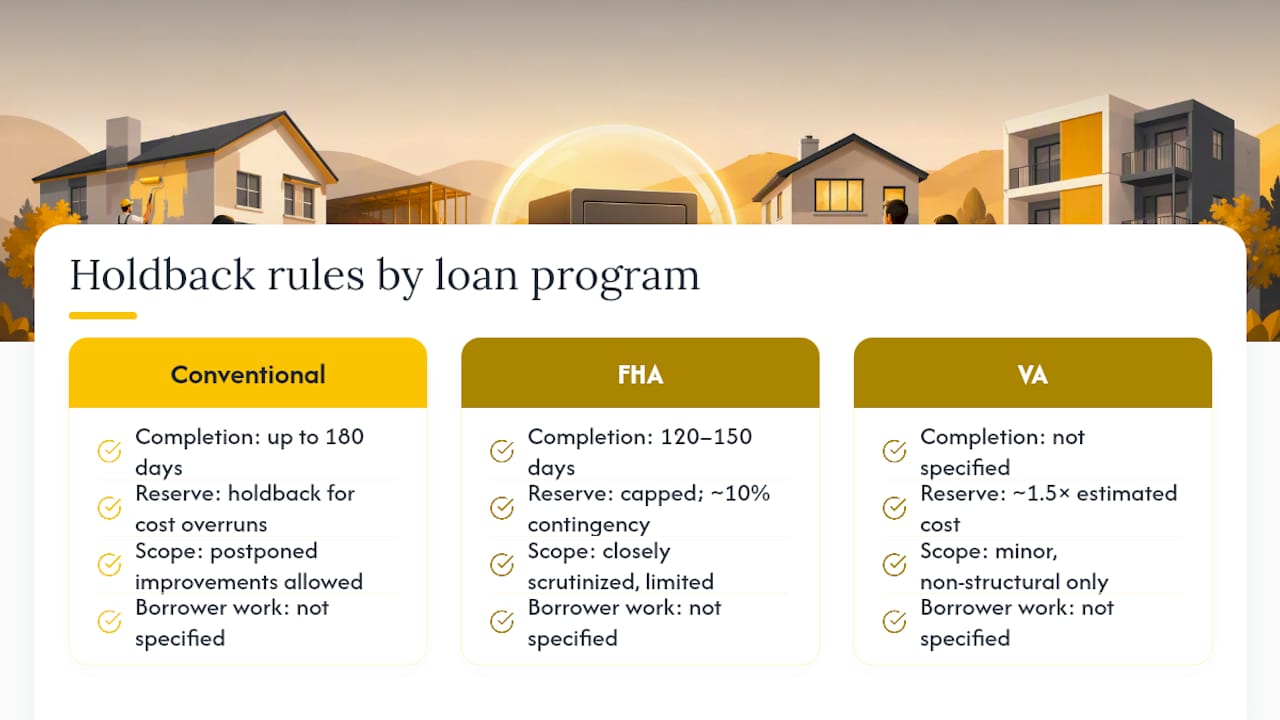
Fannie Mae and Freddie Mac conventional loans generally allow postponed improvements when the appraisal is completed "subject to" repairs, with the lender collecting a holdback that reserves for cost overruns. Fannie Mae's Selling Guide requires formal verification of completion, typically an appraiser's Form 1004D (Appraisal Update and/or Completion Report), before the servicer releases the funds. Completion windows commonly run up to 180 days, though individual lenders can set tighter internal deadlines.
FHA loans are more restrictive. The 203(b) repair escrow typically caps usage at fairly low dollar amounts and layers in a contingency buffer, often around 10 percent, on top of the contractor's bid. Completion windows generally fall in the 120 to 150 day range, and FHA underwriters scrutinize the scope closely since the program insures loans for buyers with thinner financial cushions.
VA loans take the most conservative stance of the major programs. Repairs eligible for a holdback are usually limited to minor, non-structural items, and VA guidance commonly requires holding roughly 1.5 times the estimated repair cost to cover overruns, according to LegalClarity's review of program rules. VA appraisers use their own inspection and completion documentation, separate from Form 1004D in many cases.
USDA loans cap holdback amounts as a percentage tied to the total loan amount and generally prohibit the borrower from doing the repair work themselves, even if they're qualified. USDA also tends to hold to a 180-day completion window similar to conventional guidelines.
Conventional lender overlays matter more than most buyers expect. Even within Fannie Mae or Freddie Mac guidelines, individual lenders add their own stricter rules, called overlays, on top of the baseline program requirements. The underwriter reviewing your file has final authority to reject a holdback proposal even when the loan program technically permits it.
How Is the Holdback Amount Calculated?
The starting point is always a repair estimate, either a contractor's bid or, better, a fixed-price contract. Lenders strongly prefer the fixed-price version because a bid can change once work starts, while a signed contract locks the number. A fixed-price contractor agreement also tends to speed up lender approval since it limits change-order risk that could blow past the escrowed amount.
On top of that base estimate, lenders add a contingency multiplier. This is the single detail buyers underestimate most.
Pro Tip: Ask your lender which multiplier applies before you negotiate the repair scope with the seller. A 150% holdback on a $12,000 roof patch ties up $18,000 of the seller's proceeds, not $12,000, and that number can blow up a deal if the seller didn't budget for it.
Common contingency benchmarks include:
- 120% on some conventional and Fannie Mae approaches
- 150% frequently applied under FHA and VA guidance
- 1.5x to 2x the base bid in stricter lender overlay practice
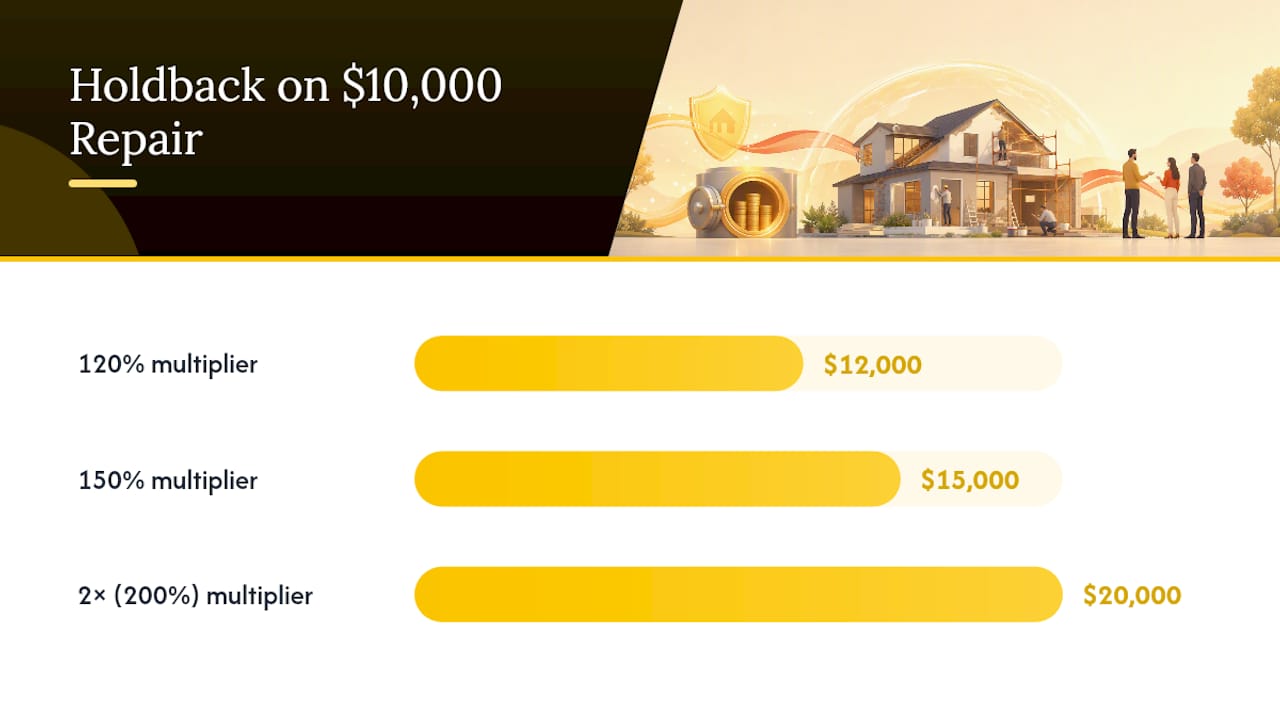
Here's the math in practice. A contractor bids $10,000 for exterior siding repair. At a 120% multiplier, the escrow holds $12,000. At 150%, it holds $15,000. At a stricter lender's 2x standard, it holds $20,000, double the actual repair cost. That gap comes straight out of the seller's proceeds at the closing table, which is exactly why sellers push back on high multipliers and why a fixed-price contract that limits perceived risk can bring the number down.
When the repair finishes under budget, the surplus typically returns to the seller once the escrow agent verifies completion. Shortfalls work the other direction: if the actual cost exceeds the holdback, the contract's remedy clause determines who covers the difference, which is exactly why that clause needs to be specific before anyone signs.
Step-by-Step: Drafting the Agreement and Getting to Closing
Getting from "we found a problem in the inspection" to "we're funding an escrow at the closing table" follows a fairly consistent sequence, even though the paperwork varies by lender and title company.
- Negotiate the purchase addendum. Buyer and seller agree on exact scope of work, which contractor performs it, the total cost, the completion deadline, and what happens if the seller doesn't deliver. Vague language here causes almost every dispute that follows.
- Submit the addendum to the lender's underwriter. The lender decides whether the holdback is permitted under the loan program and may require contractor bids or a signed fixed-price contract before approving the amount.
- Title company or closing attorney drafts the formal escrow agreement. To initiate a holdback, both parties sign this document, often provided by the title company or lender, detailing scope, contractor, deadline, and disbursement procedure, per LTGC's explanation of the process.
- Escrow gets funded at closing. The seller's proceeds are reduced by the holdback amount, or the seller deposits cash directly, depending on how the agreement is structured.
- Release conditions get documented in writing. The agreement should specify exactly what triggers release, who orders re-inspection or a completion report, and who pays for it.
A well-drafted agreement, according to a sample escrow agreement form used by real estate professionals, should name the escrow agent, the deadline, the exact release conditions such as invoices and lien waivers, how any surplus gets distributed, and what happens if the seller defaults on the repair entirely. Skipping any one of those items is how a routine holdback turns into a legal dispute months after closing.
Before hiring anyone to do the work, it's worth running the contractor through a basic verification process. A contractor verification checklist covering licensing, insurance, and prior work history can prevent a bigger problem than the original repair.
Verifying Completion and Releasing Holdback Funds
Getting the money released isn't as simple as texting a photo of the finished siding. Most lenders require formal, documented verification, and the standard varies by loan type and by how much money is on the line.
The most common verification method on conventional loans is an appraiser's Form 1004D, the Appraisal Update and/or Completion Report. The appraiser who initially flagged the repair returns to confirm it's done and matches the original scope. Third-party inspector reports serve a similar function when a full appraiser re-visit isn't required, and some lenders accept authenticated photos or a pre-arranged digital evidence process, though Fannie Mae's guidance makes clear that arrangement has to be agreed to in advance.
Beyond the inspection itself, release typically requires a documentation package:
- Paid contractor invoices showing the work is fully compensated
- Signed lien waivers from the contractor and any subcontractors
- Permits and municipal inspection sign-offs where required
- A completion affidavit signed by the party who did the work
Expect the re-inspection or completion report to cost somewhere in the range of $150 to $200, and the agreement should specify upfront who pays it, according to Fannie Mae's selling guide. Leaving that detail out is a small oversight that causes real friction when the repair is done and everyone's waiting on a $175 invoice to get resolved.
The most common release pitfall isn't the repair quality. It's a missing lien waiver. Buyers should insist on lien waivers and final paid invoices as non-negotiable release conditions, because an unpaid subcontractor can file a mechanic's lien against the property months later, long after the buyer assumed the matter was closed.
Risks, Remedies, and Negotiation Tips for Buyers and Sellers
The contract language decided before closing determines whether a holdback protects you or leaves you exposed. Buyers who skip this step often discover the gap only after something goes wrong.
Buyer protections worth insisting on:
- A liquidated damages clause specifying a dollar penalty if the seller misses the deadline
- A remedy clause letting the buyer hire a replacement contractor and pay from escrow if the seller stalls
- Explicit lien waiver requirements before any funds release
A robust escrow agreement should include remedy language allowing the buyer to hire a contractor directly and pay from the escrowed funds if the seller defaults, rather than leaving the buyer to chase the seller through small claims court after the fact.
Pro Tip: If the seller resists a strong remedy clause, that resistance itself tells you something. A seller confident in getting the work done on time rarely objects to a clause that only triggers if they fail to deliver.
Sellers have leverage too, and using it correctly reduces how much cash gets tied up unnecessarily. Getting a guaranteed fixed-price contract from a licensed contractor, rather than a rough bid, lowers the lender's required buffer and frees up more proceeds at closing. Requesting staged releases tied to itemized work, rather than one lump payment on full completion, can also make the arrangement easier for both sides to track.
The best negotiations set a realistic deadline from the start, document exactly what triggers an extension if weather or supply delays hit, and give the escrow agent explicit authority to disburse funds if both parties later disagree about whether the work meets the agreed scope.
An Expert Perspective From Jaken Finance Group
Escrow holdbacks work well when the seller has enough proceeds to absorb the withheld amount and the repair is genuinely minor. They break down fast when the numbers don't line up, when a seller is already stretched thin on proceeds, or when the repair scope turns out to be larger than the original bid suggested.
That's where financing built for speed becomes relevant, particularly for investor-buyers. When a seller can't or won't fund a holdback, or when a repair exceeds what an FHA or VA program will allow, an investor still has a path to close and handle the rehab independently through products like fix and flip loans or a bridge loan. Asset-based underwriting looks at the property's value rather than requiring a minimum credit score, which matters when a deal is time-sensitive and a seller's proceeds simply won't cover a large contingency buffer.
Before approaching any lender on a repair-heavy purchase, gather contractor bids, a clear scope of work, and photos of the current condition. Underwriters evaluate repair risk primarily on documentation quality, not on the size of the problem itself. Propose a timeline you can actually defend with a signed contractor agreement, not a verbal estimate.
What the Standard Playbook Gets Wrong
Most guidance on escrow holdbacks treats the mechanics as the whole story: sign the addendum, fund the escrow, get the 1004D, collect the check. That's accurate as far as it goes, but it undersells how much the outcome depends on choices made before anyone drafts an agreement.
The biggest gap in conventional advice is treating the contingency multiplier as a formality. It isn't. The difference between a 120% and a 2x holdback can determine whether a seller has enough proceeds left to close at all, and buyers rarely negotiate that number even though it's often more flexible than the loan program's ceiling suggests.
The second gap is assuming a holdback is always the right tool. When the repair is large, the seller's proceeds are thin, or the loan program's caps don't fit the actual cost, forcing a holdback often just delays a problem that financing built for exactly this kind of speed and flexibility can solve more cleanly. Prioritize the fixed-price contract and the remedy clause before anything else. Everything downstream, the multiplier, the deadline, the lender's approval, gets easier once those two pieces are solid.
— Jason Taken
When Financing Beats Waiting on a Holdback
Sometimes the seller won't agree to a holdback, the repair scope blows past what FHA or VA guidelines allow, or an investor simply can't afford to wait for a contractor's schedule to line up with a closing date. Jaken Finance Group's asset-based loan programs give buyers, particularly investors, a way to close on schedule and fund the rehab independently instead of depending on a seller's cooperation and proceeds.
Fix and flip loans and bridge loans both close in as few as five to ten days and underwrite against the property's value rather than a credit score threshold, which matters when a repair-heavy deal doesn't fit neatly into a conventional program's caps. Gap lending covers the space between what a primary loan provides and what a deal actually needs, useful when a large repair budget exceeds a lender's holdback ceiling entirely. If you're evaluating a purchase where the seller won't fund a holdback, or the numbers on a fixed-price contract are running higher than a loan program allows, visit the loan options page and talk with a loan officer about structuring the deal around financing instead of a stalled negotiation.
Official Guidance and Documents to Consult
Verifying program-specific rules directly with the source prevents surprises at underwriting. A few starting points:
- Fannie Mae's Selling Guide on verifying completion and postponed improvements
- LegalClarity's overview of how repair and holdback escrows work across loan programs
- A sample escrow agreement for repairs for reviewing standard clauses before signing
FHA, VA, and USDA each publish their own program handbooks with specific caps and timelines; a loan officer or the title company handling closing can confirm the current version that applies to your file.
Sources
- Repair and holdback escrows at closing: how they work | LegalClarity
- Requirements for Verifying Completion and Postponed Improvements | Fannie Mae Selling Guide
FAQ
How Does an Escrow Holdback Work for Repairs?
Funds equal to the repair cost, plus a contingency multiplier, get deposited into a neutral escrow account at closing. The money releases to the contractor or seller once the repair is verified, typically through an appraiser's Form 1004D or a lender-approved inspection.
Who Pays for an Escrow Holdback?
The seller funds the holdback from sale proceeds in most transactions. Buyer-funded or split-funded arrangements happen occasionally but are far less common.
What Is the Difference Between Escrow and a Holdback?
Escrow is the general mechanism, a neutral third party holding funds or documents until agreed conditions are met. A holdback is a specific application of escrow: money set aside at closing specifically to guarantee that repairs get completed afterward.
Are Escrow Holdbacks Common?
They're common enough that most title companies and lenders have standard procedures for them, but they're generally reserved for minor, non-safety repairs. Major structural or system failures almost always require completion before closing rather than a holdback afterward.