
As-is value tells a lender what your collateral is worth today; purchase price only tells you what a seller accepted. When those two numbers disagree, the appraisal usually wins for financing purposes, while purchase price remains a negotiated outcome you can still adjust. If appraisal comes in under purchase price, expect financing terms or your down payment to shift. If purchase price lands below as-is value, you have captured a discount worth defending with contingencies and investor math.
TL;DR:
- Appraisal values usually determine loan limits and financing terms when there is a discrepancy between appraisal and purchase price.
- Buyers often negotiate discounts or cover gaps in cash when appraisals come in below purchase prices, especially in slower markets.
- The 70% rule for flippers caps bids at 70% of ARV minus repair costs, accounting for project risk and profit margins.
- Conducting thorough inspections and obtaining written contractor bids are essential before closing an as-is property to avoid hidden costs and surprises.
- Asset-based loans facilitate faster closings without waiting for a perfect appraisal, especially useful for fix-and-flip or urgent purchase scenarios.
Table of Contents
- As-Is Value vs Purchase Price: The Core Definitions
- Why As-Is Value and Purchase Price Often Diverge
- How Appraisals Set Financing: LTV, Gaps, and Your Options
- Investor Math: ARV, Repair Costs, and the 70% Rule
- Due Diligence Checklist Before You Close on an As-Is Property
- Prioritizing Appraisal Certainty Over Speed
- Funding As-Is Purchases Without Waiting on a Perfect Appraisal
- Sources
As-Is Value vs Purchase Price: The Core Definitions
Five terms get used loosely in real estate conversations, and mixing them up leads to bad offers. Each one answers a different question, for a different audience.
- As-is value: what a property is worth right now, in its current physical condition, based on comparable sales of similarly distressed or dated properties. Sellers and buyers reference this when negotiating a purchase price.
- Appraised value: a licensed appraiser's opinion of worth at a specific point in time, produced under USPAP-guided methodology and ordered by the lender. This is the number that controls loan sizing.
- Market value: the price a property should command under normal market conditions with a willing buyer and seller. It's close to as-is value but not identical, since market value can reflect broader demand trends rather than one specific comp set.
- After-repair value (ARV): what the property will be worth once renovations are complete, calculated from comps of already-renovated homes in the same neighborhood.
- Purchase price: the actual negotiated number in the contract. It can sit above, below, or right at any of the figures above.
Flippers rely on ARV to size their renovation budget. Lenders rely on appraised value to size the loan. Sellers and buyers negotiate around as-is and market value. All four numbers can legitimately differ on the same house.
Why As-Is Value and Purchase Price Often Diverge
The gap between as-is value and purchase price rarely comes from one cause. It's usually a stack of smaller factors pushing in the same direction.
- Repair uncertainty: initial repair estimates are guesses until a contractor walks the property; actual bids frequently run higher, which pushes buyers to negotiate price down after inspection.
- Buyer pool limitations: as-is properties often can't qualify for conventional financing due to condition issues, shrinking the pool to cash buyers and investors, which tends to suppress offers.
- Market dynamics: in low-inventory markets, bidding wars can push purchase price above as-is value even on a distressed property; in soft markets, weak demand pushes it below.
- Risk premium: buyers price in a cushion for hidden defects, undisclosed damage, or title issues, on top of whatever repairs they can already see.
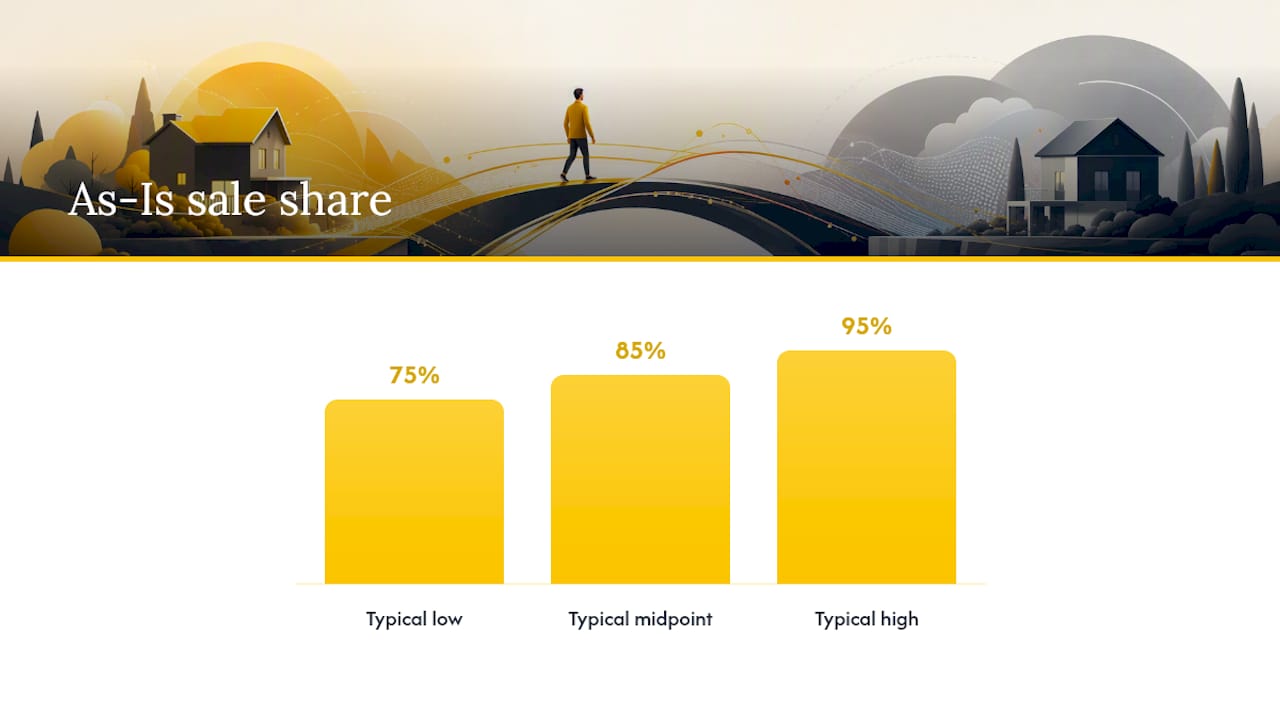
Selling as-is commonly costs sellers roughly 5% to 30% of market value, depending on condition and local demand, with most as-is sales landing between 75% and 95% of what a fully repaired home would fetch. This range exists precisely because buyers are pricing in both the visible repair scope and the risk premium for what they can't see yet.
Pro Tip: Never treat your contractor's first walk-through estimate as final. Get a written bid before you finalize an offer, then compare it against the discount you're requesting. If your requested discount doesn't cover the bid plus a cushion, you're underpricing your own risk.
How Appraisals Set Financing: LTV, Gaps, and Your Options
Lenders don't finance the purchase price. They finance a percentage of the appraised value, which is where loan-to-value comes in. If a lender caps LTV at 75% and the appraisal comes back at $300,000, the maximum loan is $225,000, regardless of what the contract says the buyer is paying. Understanding this math up front avoids a nasty surprise at closing, and Jaken Finance Group's guide to demystifying the loan-to-value ratio breaks down the calculation in more detail.
When the appraisal lands below the agreed purchase price, an "appraisal gap," buyers and lenders typically respond in one of these ways:
- Renegotiate the price down to match the appraisal, which works when the seller has room to move.
- The buyer covers the gap in cash, common in competitive markets where the seller won't budge.
- The buyer arranges second-position financing to bridge the shortfall without draining reserves.
- The lender issues an exception, though this is rare and usually reserved for strong borrower profiles.
Hard-money and conventional lenders behave differently here. Conventional lenders follow strict appraisal-driven LTV rules with little flexibility and longer timelines. Asset-based hard-money lenders underwrite primarily to property value, including projected ARV in rehab deals, and can move faster when the appraisal and purchase price don't match cleanly. Whichever route you choose, keep an appraisal contingency in your contract and confirm how much time you have to request a reappraisal if the first one comes in low.
Investor Math: ARV, Repair Costs, and the 70% Rule
Investors don't ask "what's a fair price." They ask "what's the maximum I can pay and still hit my profit target." The formula:
- Start with ARV, the projected value after renovations, based on comps of already-renovated homes nearby.
- Subtract estimated repair costs, ideally from a contractor bid, not a guess.
- Subtract your target profit margin, the minimum return that makes the deal worth your time and capital.
- The remainder is your maximum purchase price.
Most flippers apply a shortcut version of this formula known as the 70% rule: offer no more than 70% of ARV minus repair costs. The 30% gap covers financing costs, holding costs, selling costs, and profit, all in one number. It exists because as-is value alone rarely captures the full risk premium a rehab project carries, and ARV itself is capped by neighborhood comparables, so over-improving beyond what the comps support won't raise your ceiling.
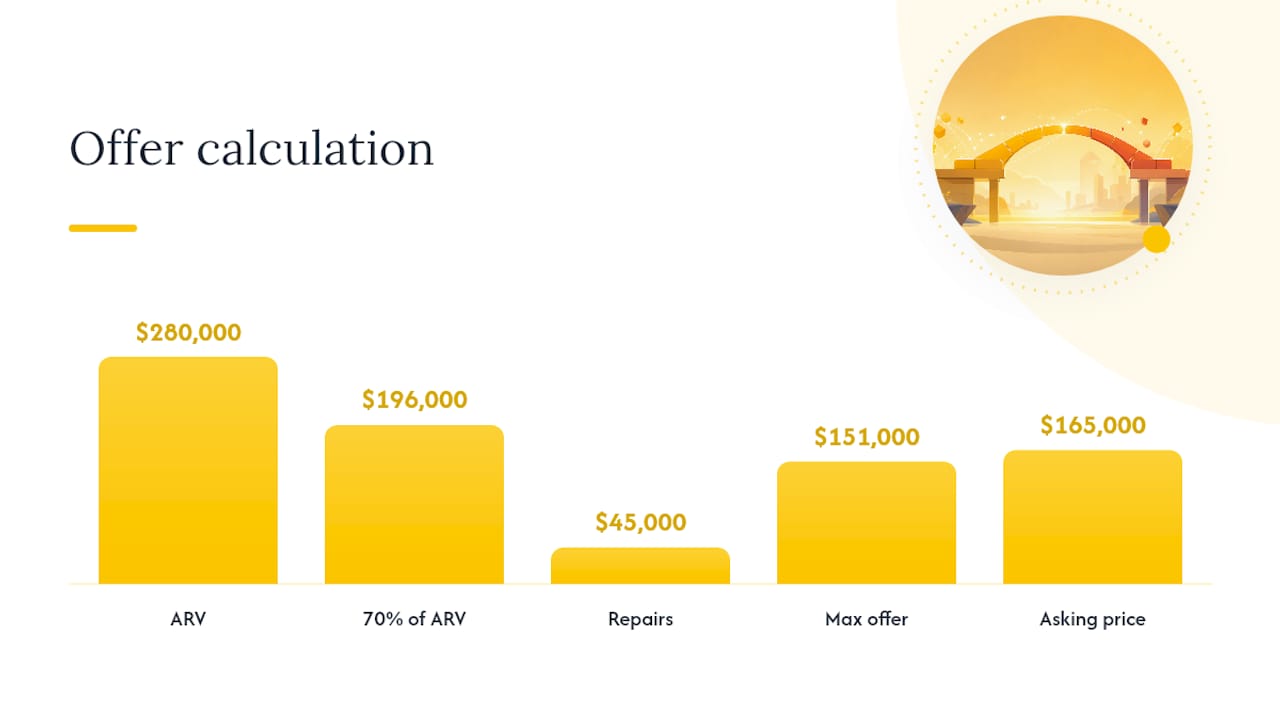
Here's a worked example. A property has an ARV of $280,000. Repairs are bid at $45,000. Applying the 70% rule: $280,000 × 0.70 = $196,000, minus $45,000 in repairs, leaves a maximum offer of $151,000. If the seller's asking price sits at $165,000, based on as-is value, you have a $14,000 gap to negotiate or walk away from.
Due Diligence Checklist Before You Close on an As-Is Property
As-is doesn't mean unexamined. It means the seller won't fix anything, not that you should skip finding out what's broken.
- Order specialist inspections for roofing, foundation, electrical, and HVAC before your contingency period expires.
- Keep your appraisal and inspection contingencies in the contract until you have real numbers back, not just verbal assurances.
- Get at least one written contractor bid, not a verbal estimate, and add a holdback reserve of 10% to 15% for scope creep.
- Watch for red flags: undisclosed water damage, permit issues, or a seller unwilling to allow a full walk-through.
Pro Tip: If a contractor's bid comes back significantly higher than your initial estimate, don't just walk away. Go back to the seller with the bid in hand and reopen price negotiations. Numbers move sellers faster than opinions.
Prioritizing Appraisal Certainty Over Speed
Investors often treat a low appraisal as a deal killer. It shouldn't be, but it does need a plan before you sign anything. When financing is conventional, appraisal certainty should drive how you structure the deal, because the lender's LTV math doesn't bend for a good story. When speed matters more than a clean appraisal, an appraisal gap can be worth accepting, but only if you've already priced the gap into your funding plan rather than discovering it at the closing table.
Asset-based hard money exists for exactly this mismatch. It underwrites to the property's value and projected ARV rather than a rigid appraisal-to-LTV formula, which is why it closes faster and tolerates the kind of timing friction that kills conventional deals. That flexibility isn't free, and it isn't the right tool for every purchase, but for a buyer staring down an appraisal gap with a closing deadline, it solves a problem conventional lending simply won't.
— Jason Taken
Funding As-Is Purchases Without Waiting on a Perfect Appraisal
Conventional lenders stall deals when the appraisal doesn't match the purchase price. Jaken Finance Group underwrites to the property's value and projected ARV instead, so an appraisal gap doesn't automatically kill your timeline.
That means fix-and-flip buyers, quick acquisitions off auction lists, and rehab projects with tight closing windows can move on asset-based terms rather than waiting weeks for a conventional file to clear underwriting. Loans can close in as few as five days, sized around the property itself rather than a rigid credit-score cutoff. If you're weighing a purchase where as-is value, ARV, and purchase price don't line up neatly, start with Jaken Finance Group's asset-based hard money loan program and get a real number on what the property can support before you finalize your offer.
Sources
The definitions and figures in this guide draw on Investopedia's explanation of appraised value versus market value, Resideline's breakdown of as-is value versus ARV, and iBuyer's data on as-is sale discounts. For appraisal methodology specific to distressed properties, see this guide to as-is appraisals. Investors calculating renovation budgets can also review Jaken Finance Group's guide on how to calculate ARV for fix-and-flip deals.
This article is general information, not a substitute for advice from a qualified financial advisor. Consult a qualified financial professional about your own circumstances before acting on anything here.
- How Much Do You Lose Selling As Is? | iBuyer blog