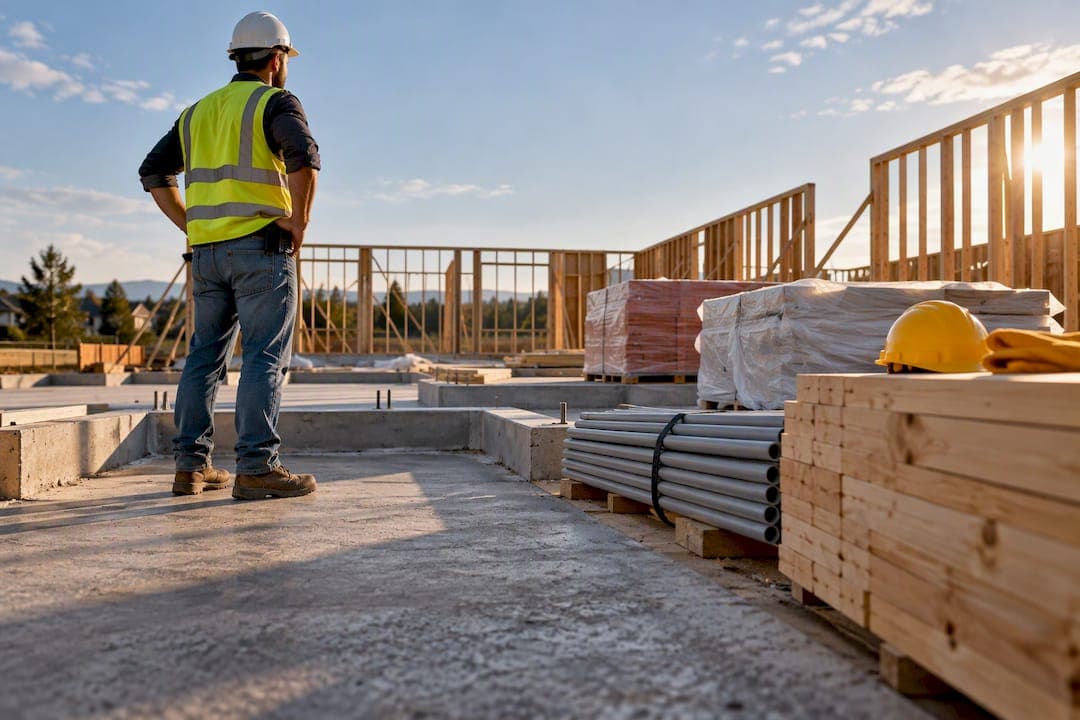
A construction contingency reserve is budget set aside for known uncertainties and identified risks within a project's baseline, distinct from escalation and management reserve. The FHWA recommends sizing it with a risk-allocated expected-value model rather than an arbitrary percentage, then checking that figure against stage-based percentage ranges. Sound governance, meaning a logged baseline, documented draws, and scheduled reassessment, keeps the reserve auditable and defensible to owners, sureties, and lenders.
TL;DR:
- Contingency reserves should be calculated based on a risk-allocated expected value from identified risks, not just a percentage of total costs.
- Separating contingency, allowances, escalation, and management reserve prevents double counting and clarifies control over each risk type.
- Reassessing contingency quarterly or at key design milestones ensures the reserve remains aligned with updated project risks and scope changes.
- Using percentage thresholds for contingency is only a screening tool; the primary focus should be on comprehensive, documented risk registers tied to project stage.
- Precise tracking and documentation of contingency draws with approval processes protect transparency and prevent unwarranted reserve depletion.
Table of Contents
- What separates contingency from allowances, escalation, and management reserve
- Why separating contingency buckets protects the budget
- How to calculate a contingency reserve
- Sizing guidance and percentage ranges by project stage
- Managing, tracking, and reporting contingency draws
- When to reassess the reserve
- How contingency sizing affects construction financing
- What the standards get right, and what they leave out
- Financing support for projects that carry a defined contingency plan
- Sources
- FAQ
What separates contingency from allowances, escalation, and management reserve
Estimators often blur these categories, which creates duplicate or hidden contingency in a budget. ASTM E2168 classifies allowance, contingency, and reserve sums separately, and that classification matters for accurate cost control. An allowance covers a known scope item whose exact cost is undecided, such as unselected finishes. Contingency covers known uncertainties: incomplete design, unforeseen site conditions, permitting delays, or procurement risk. Escalation covers the time value of cost, meaning inflation between estimate and construction. Management reserve sits outside the contract baseline entirely and is held for unknown unknowns rather than identified risks.
- Allowance: a placeholder for a defined scope item with an undetermined final cost.
- Contingency: funds tied to specific, identified risk events with a probability and impact.
- Escalation: the projected cost increase from market and time delay, tracked separately from risk.
- Management reserve: funds held above the baseline for risks not yet identified, usually controlled by the owner or program office.
Why separating contingency buckets protects the budget
Grouping every risk dollar into one line item makes it impossible to tell who controls the money or why it was spent. AIA guidance on managing contingency recommends aligning ownership of each bucket with the party that carries the underlying risk. Separating buckets also prevents double counting, since a design risk and an owner scope change should never draw from the same pool.
- Design contingency covers incomplete or evolving design documents and typically sits with the design team or owner.
- Construction contingency covers field conditions and constructability risk, often controlled by the contractor under reporting rules.
- Owner contingency covers owner-directed scope changes and stays under direct owner control.
- Escalation reserve covers market cost movement between estimate and procurement.
- Management reserve covers unidentified risk and is released only under program-level authorization.
Contracts should state which party requests draws from each bucket, what documentation is required, and how unused funds are treated at closeout.
How to calculate a contingency reserve
Three methods cover most projects, and each fits a different stage of design maturity.
Risk-allocated expected value multiplies the probability of each identified risk by its cost impact, then sums the results. The expected values are $12,000, $5,000, and $9,000, for a combined contingency reserve of $26,000. This is a worked illustration, not a market benchmark: the FHWA supports this structure of probability times impact summed across identified risks.

Three-point estimating uses optimistic, most likely, and pessimistic cost inputs for each work package, then derives contingency as the gap between the base estimate and a selected percentile of the resulting distribution. DOE guidance on contingency inputs walks through building these three-point inputs before running a probabilistic analysis.
Monte Carlo simulation runs thousands of iterations across correlated risk variables to produce a full probability curve, and it suits complex or high-value projects where risks interact. It is not suited to early-stage estimates with thin data, since the model only reflects the quality of the inputs.
- Use expected-value math for a fast, defensible reserve figure on most projects.
- Reserve three-point and Monte Carlo methods for large, complex, or late-stage estimates with reliable risk data.
- Poor inputs produce a precise-looking number that is still wrong, so prioritize risk register quality over model sophistication.
A single unmitigated design risk carried at a given probability and impact adds a calculable expected exposure to the reserve, illustrating how one poorly scoped item can move the total materially, based on the FHWA's expected-value framework, illustrating how one poorly scoped item can move the total materially.
Sizing guidance and percentage ranges by project stage
Percentage rules of thumb are useful only as a screening check against a risk-based calculation, never as the primary method. GSA cost-estimating guidance ties contingency percentage to design maturity, and the range narrows sharply as documents progress.
- Programming or planning stage: roughly 10%, reflecting minimal design detail.
- Concept design: roughly 7% to 10%.
- Design development: roughly 5% to 7.5%.
- Intermediate construction documents: roughly 2% to 5%.
- Final construction documents: approaching 0% for some cost categories, since remaining risk shifts to construction-phase contingency.
AIA's guidance places design contingency commonly between 5% and 10%, consistent with the GSA staging. Delivery method shifts these ranges too: design-bid-build often carries lower construction-phase contingency because design is more complete at bid, while construction-manager-at-risk and design-build projects may carry higher early contingency to cover overlapping design and construction activity. Treat any percentage as a sanity check on the expected-value total, not a replacement for it.
Managing, tracking, and reporting contingency draws
A contingency reserve only functions as intended when it is managed like a controlled budget account rather than a lump sum. Set a baseline amount at approval, then log every draw against it with the triggering risk, approval authority, and remaining balance. Our guide on construction contingency budget basics covers governance structures for owners and project managers in more detail.
- Baseline: the approved reserve amount at contract execution or budget lock.
- Draw documentation: date, risk ID, requested amount, approved amount, cost code, and change order reference.
- Approval threshold: a defined dollar limit above which owner sign-off is required before release.
- Reporting cadence: quarterly reviews, aligned with AIA and FHWA recommendations, to compare remaining reserve against remaining risk exposure.
Pro Tip: Track contingency draws in the same cost report as the base budget, not a separate spreadsheet, so the owner sees total project exposure in one view.
Contracts should specify that unused contingency at substantial completion reverts to the owner or portfolio reserve rather than being absorbed as contractor profit, protecting both transparency and trust.
When to reassess the reserve
Contingency adequacy changes as design matures and risks resolve, so reassessment cannot wait for project closeout.
- Review the reserve at every design milestone, since scope and cost certainty shift with each submission.
- Run a quarterly reassessment on active construction projects regardless of milestone timing.
- Trigger an immediate review after geotechnical findings, bid results, permit issuance, or a major scope change.
- In each session, update the risk register, remove resolved risks, add newly identified ones, and recalculate expected value.
- Compare the updated reserve against the percentage check for the current design stage before reporting to stakeholders.
How contingency sizing affects construction financing
Lenders reviewing a construction loan look at the contingency reserve as part of underwriting, not as an afterthought. A reserve tied to a documented risk register, rather than a flat percentage, gives a lender clearer visibility into how draws will be requested over the loan term. Contingency sizing also interacts with draw schedules and interest reserve planning, since undersized contingency increases the odds of a mid-project funding gap. Our explanation of draw schedules for ground-up construction loans and our breakdown of how interest reserves are sized alongside contingency both cover how these figures interact on a short-term construction loan.
What the standards get right, and what they leave out

The public-sector guidance from FHWA, AIA, GSA, DOE, and ASTM gives estimators a defensible framework, and that framework holds up. Where practitioners go wrong is treating a single percentage as sufficient documentation, when the standards themselves treat percentages as a screening tool, not a substitute for a risk register.
The bigger gap is timing. Most reassessment happens only when a change order forces it, rather than on the quarterly or milestone cadence the guidance recommends. A reserve that was sized correctly at design development is often stale by the time construction starts, and nobody revisits the math until money runs short. Prioritize the reassessment discipline over the calculation method: a simple expected-value model reviewed every quarter beats a Monte Carlo simulation run once and never updated.
— Jason Taken
Financing support for projects that carry a defined contingency plan
Projects with a documented contingency reserve and risk register are easier to underwrite, and that matters when the financing itself is time-sensitive. Jaken Finance Group provides Fix and Flip Loans, Bridge Loans, and New Construction Loans at rates from 8.99% to 13.5%, along with DSCR Rental Loans from 5.75% to 10.5% for investors moving completed projects into long-term holds.
Asset-based underwriting focuses on the property as the basis for approval, with closings possible in a short time frame. Investors who need short-term liquidity to cover a funding gap alongside their contingency reserve can review our bridge loan program for details on structure and eligibility. To start a conversation about financing your next project, visit Jaken Finance Group and request a rate quote.
Sources
- Contingency Fund Management for Major Projects - FHWA
- Curating the Inputs for a Contingency Reserve Calculation - U.S. Department of Energy
- Managing the contingency allowance - AIA
- GSA cost-estimating guidance (P-120 excerpt) - GSA
- E2168 Standard Classification for Allowance, Contingency, and Reserve Sums in Building Construction Estimating - ASTM
FAQ
What is a good construction contingency percentage?
There is no single correct percentage, since the right figure depends on design maturity, project type, and risk exposure. AIA guidance notes that 5% to 10% is common for design contingency, while GSA staged guidance narrows that range as documents near completion. Use a percentage as a check against a risk-based calculation rather than as the primary method.
How much contingency reserve should be kept on a project?
The amount should come from summing the expected value of identified risks, meaning probability multiplied by cost impact for each item on the risk register, as FHWA guidance recommends. That figure is then checked against the stage-based percentage ranges from GSA and AIA for reasonableness. Reassessing the amount quarterly or at each design milestone keeps the reserve aligned with current risk.
What is the typical contingency percentage used in construction contracts?
Contract contingency percentages typically track design maturity, starting around 10% at programming and trending toward 0% by final construction documents for some cost categories, per GSA guidance. Construction-phase contingency is negotiated separately in the contract and often depends on delivery method. These figures are starting points for negotiation, not fixed requirements.
How much is a good contingency reserve fund?
A defensible reserve fund is one built from a documented risk register rather than a flat guess, using the expected-value method described in FHWA guidance. The total should reflect the specific risks on that project, such as site conditions, permitting, and design completeness, rather than a borrowed industry average. Reassessing the fund at each milestone confirms it still matches remaining exposure.