
An interest reserve is a lender-held pool of loan proceeds that pays the loan's interest during construction and lease-up, so the borrower doesn't make monthly interest payments until the property stabilizes. Lenders use it on construction, bridge, and value-add loans where the asset produces no income yet. For borrowers, it converts an unpredictable monthly obligation into a line item already accounted for in the loan amount.
TL;DR:
- The majority of reserves are sized to cover interest through the property's break-even DSCR plus an extra two to three months, with regulators scrutinizing reserve calculations for accuracy.
- Reserve funding can be either loan-funded, adding interest costs to the total loan, or sponsor-funded, tying up liquidity but avoiding additional interest expenses.
- Reserve depletion often occurs due to permitting delays, slower lease-up, or faster front-loading, which may trigger options like equity injections or loan extensions to cover shortfalls.
- Reserve calculations should be based on realistic draw schedules, interest rates, and contingency buffers, avoiding oversizing that ties up unnecessary funds or undersizing that forces mid-project cash calls.
- Borrowers should review terms related to interest accrual, reserve extensions, and reporting before closing to ensure the reserve structure aligns with their project timelines and financial capacity.
Table of Contents
- What Is an Interest Reserve and How Does It Fit Construction Financing?
- How Lenders Size and Calculate an Interest Reserve
- A Worked Example: Calculating an Interest Reserve Step by Step
- What Happens When the Interest Reserve Runs Out
- Accounting and Tax Treatment of Capitalized Interest
- Lender Terms to Review Before You Sign
- How Jaken Finance Group Structures Interest Reserves in Practice
- When a Reserve Helps and When It's a Crutch
- Get Reserve-Ready Financing Built Around Your Project's Actual Timeline
- Sources
- FAQ
What Is an Interest Reserve and How Does It Fit Construction Financing?
An interest reserve is a restricted escrow account, typically controlled by the lender or its servicer, funded specifically to cover accruing loan interest while a project generates no cash flow. Instead of the borrower wiring monthly interest payments from a separate account, the servicer draws from the reserve and applies it directly to the loan.
Lenders fund the reserve in one of two ways, and the choice matters more than most borrowers realize at closing.
- Loan-funded reserves roll the reserve into the total loan amount, preserving the sponsor's cash for construction contingencies or other deals, but the borrower pays interest on the reserve funds themselves.
- Sponsor-funded reserves require the borrower to deposit cash upfront, avoiding that added interest cost but tying up liquidity the sponsor might need elsewhere.
That tradeoff is the source of what industry sources call negative arbitrage: borrowing money to pay interest on borrowed money, where the reserve dollars typically sit earning little or nothing while accruing a carrying cost, according to LegalClarity. Operationally, the servicer calculates accrued interest each month based on the outstanding balance, draws the amount from the reserve, and reports the remaining reserve balance alongside the construction draw schedule.
How Lenders Size and Calculate an Interest Reserve
Reserve sizing comes down to four inputs: the draw schedule, the interest rate, the number of months of coverage needed, and a contingency cushion. Get any one of these wrong and the reserve either overshoots (tying up unnecessary loan proceeds) or undershoots (forcing a borrower into a mid-project cash call).
Lenders generally use one of two calculation approaches:
- Month-by-month summation. The underwriter projects the outstanding loan balance for each month of the draw schedule, applies the interest rate to that balance, and sums the monthly interest across the construction and lease-up period. This is the more precise method because construction draws are rarely linear.
- Rule-of-thumb formula. A faster estimate uses Reserve ≈ Loan Amount × Interest Rate × Months × an average-outstanding factor, often between 0.4 and 0.6 depending on how front- or back-loaded the draw schedule is, per PeerSense.
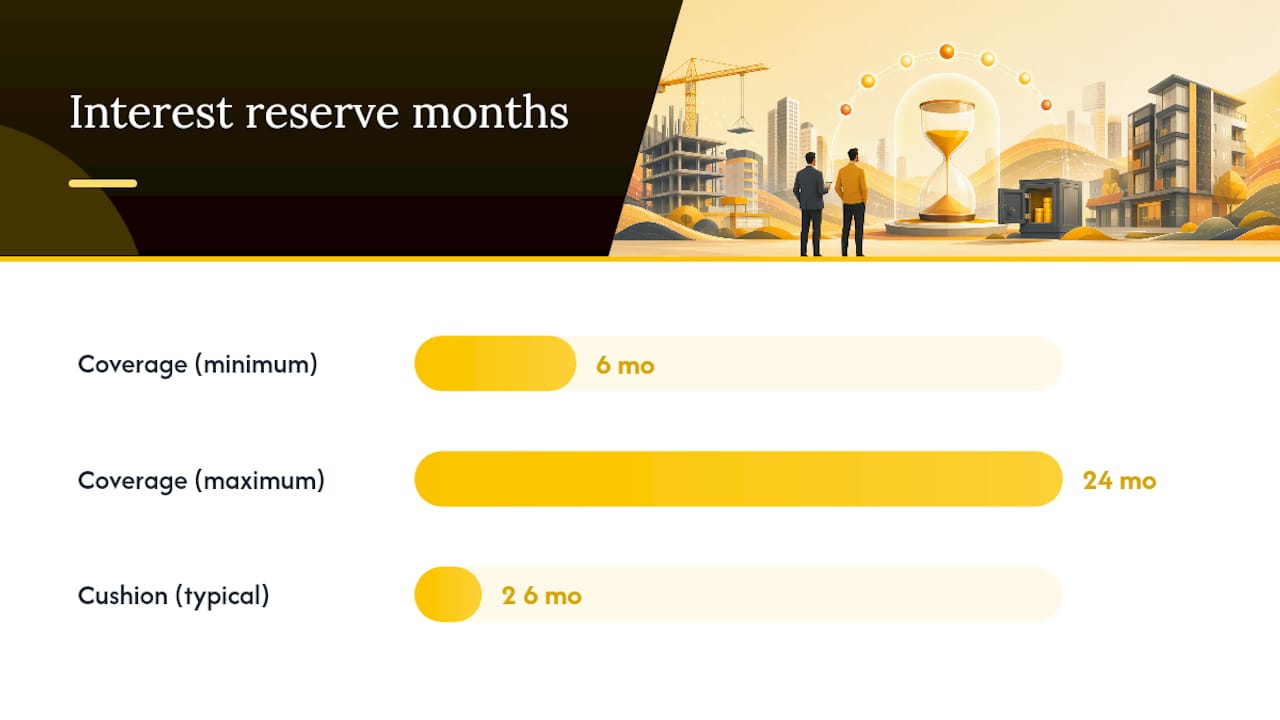
Coverage periods commonly range from 6 to 24 months depending on construction complexity and expected lease-up velocity, according to Adventures in CRE.
Statistic: Lenders typically size reserves to cover the period through break-even DSCR, then add a 2 to 3 month cushion beyond that projected date, a buffer industry underwriters build in specifically to avoid forcing a borrower back to the table for a reserve top-up mid-deal.
Regulators pay close attention to this figure: the OCC's Comptroller's Handbook directs examiners to evaluate whether reserve assumptions match a project's actual feasibility and timeline, and to expect documentation before any reserve extension or increase is approved.
A Worked Example: Calculating an Interest Reserve Step by Step
Rather than assuming the full $2,000,000 is outstanding from day one, the underwriter models the draw schedule against realistic disbursement timing:
- Months 1 to 3: average outstanding balance around $400,000 (site work, permits, foundation)
- Months 4 to 8: average outstanding balance around $1,200,000 (vertical construction)
- Months 9 to 12: average outstanding balance around $1,900,000 (finishes, close-out)
- Months 13 to 16 (lease-up): outstanding balance holds near the full $2,000,000
Statistic: Adding a standard 10% contingency buffer to that base figure protects against draw delays or a slower lease-up curve than projected, a practice Tacticares notes materially improves accuracy over flat averaging.
At payoff or refinance, any unused reserve balance doesn't disappear. Loan documents typically direct it toward one of three outcomes: a refund to the borrower, application against outstanding principal, or use toward remaining project costs, a point worth negotiating before closing rather than after, per Willowdale Equity. The reserve stops drawing once the property hits its break-even DSCR and starts servicing debt from operating income.
Borrowers running their own projections before signing can stress-test these numbers using a commercial property calculator to see how a slower lease-up timeline shifts total reserve need.
What Happens When the Interest Reserve Runs Out
Reserves deplete early far more often than they run long, usually for one of three reasons: permitting delays push the construction timeline past the modeled period, lease-up takes longer than projected, or draws front-load faster than the schedule assumed.
When a reserve runs dry before the project reaches break-even DSCR, lenders have several standard remedies.
- Equity injection: the sponsor deposits additional cash to replenish the reserve and keep interest payments current.
- Principal paydown or loan recast: the lender may require a partial paydown that reduces the outstanding balance and, with it, future interest accrual.
- Extension with fees: the lender extends the interest reserve period, typically for a fee, if the project remains fundamentally feasible.
- Draw freezes: construction draws pause until the borrower resolves the shortfall.
- Default: in the most severe cases, a depleted reserve combined with missed interest payments triggers default under the loan agreement.
The FDIC's guidance on construction and land development lending makes clear that any reserve extension or increase must be backed by a realistic reassessment of project feasibility and the guarantor's actual capacity to finish the job, not just optimism about the next quarter.
If the lender's reserve period is noticeably tighter than your own realistic build-out estimate, that gap is exactly where a mid-project cash call comes from.*
Accounting and Tax Treatment of Capitalized Interest
Interest paid from a reserve during active construction typically gets capitalized into the property's basis under standard accounting treatment rather than expensed immediately, and the IRS applies its own avoided-cost rules to determine how much construction-period interest must be capitalized. That capitalization delays the tax deduction and pushes it into depreciation recovery over time instead of an immediate write-off, a timing difference that affects real after-tax returns even though the total interest paid doesn't change, according to LegalClarity's tax treatment guide. Regulatory examiners, per OCC and FDIC guidance already cited, scrutinize whether reserve sizing assumptions were realistic in the first place, since undersized reserves often signal broader feasibility problems in a loan file.
Lender Terms to Review Before You Sign
A handful of clauses determine whether your interest reserve works for you or against you:
- Whether interest accrues on the undrawn reserve balance, not just the disbursed portion, since some loan structures charge interest on the full committed reserve regardless of draw timing.
- How capitalized interest gets calculated and reported, and how often you receive draw and reserve balance statements.
- Extension triggers and fees if the reserve depletes before stabilization, including what feasibility documentation the lender requires.
- DSCR recast thresholds that define exactly when the reserve stops funding and the property starts servicing its own debt.
Request the full draw schedule, the reserve accounting methodology, and a sample monthly reporting format before closing, not after the first draw. Reviewing terms on an acquisition and development loan structure before signing gives borrowers leverage to negotiate staged reserve funding rather than accepting a single lump-sum structure.
How Jaken Finance Group Structures Interest Reserves in Practice
Interest reserves are underwritten around actual asset value and realistic draw timing rather than rigid credit-score thresholds, with asset-based construction and bridge loans closing quickly. Sponsor-funded deposits can be used selectively, on deals where preserving loan proceeds for construction contingencies matters more than upfront liquidity. Funded deal examples are detailed in Jaken's case studies.
When a Reserve Helps and When It's a Crutch
A loan-funded reserve makes sense when the project's timeline is well-documented and the sponsor's liquidity is better deployed elsewhere. It becomes a crutch when it's used to paper over an unrealistic construction schedule. My rule: if the reserve barely covers the base-case timeline with no cushion, that's a feasibility problem, not a financing solution.
— Jason Taken
Get Reserve-Ready Financing Built Around Your Project's Actual Timeline
Traditional lenders often size interest reserves off rigid underwriting boxes that don't match how your project will actually draw funds. Jaken Finance Group underwrites asset-based construction and bridge loans around the property's real value and a realistic draw schedule, not a credit score, which means reserve sizing reflects your project instead of a generic template.

Explore Jaken's hard money lending options with no credit check requirement to see how reserve structuring works on asset-based deals, or review down payment funding for short-term loans if sponsor liquidity is tight going into closing. Run your numbers through the commercial property calculator and request underwriting on your next construction or bridge deal today.
This article is general information, not a substitute for advice from a qualified financial advisor. Consult a qualified financial professional about your own circumstances before acting on anything here.
Sources
- Comptroller's Handbook: Commercial Real Estate Lending (OCC)
- What Is an Interest Reserve? CRE Loan Definition | PeerSense
- What Is an Interest Reserve and How Does It Work? - LegalClarity
FAQ
What Does 3 Months of Reserves Mean?
It means the interest reserve is sized to cover three months of loan interest payments, typically referring to a post-construction cushion beyond the projected break-even DSCR date rather than the full construction period.
What Is the Monthly Payment for a $200,000 Construction Loan?
It depends entirely on the outstanding drawn balance and interest rate at any given point, since construction loans accrue interest only on funds actually disbursed, not the full committed amount; a lender-provided draw schedule is the only way to calculate an accurate monthly figure.
What Does "Interest on Reserve" Mean?
It refers to interest charged on funds held in the interest reserve account itself, which can include interest on the undrawn reserve balance depending on how the loan agreement defines the calculation.