Most office-to-residential conversions close on layered capital: a bridge or construction loan for acquisition and rehab, sponsor equity to fill the gap, and a long-duration instrument like C-PACE or an SBA 504/HUD takeout to bring down blended cost. The single highest-leverage move for a sponsor right now is engaging a lender with actual adaptive-reuse experience and commissioning a technical feasibility study before finalizing an acquisition offer, not after.
TL;DR:
- Engaging a lender with adaptive-reuse experience and commissioning a technical feasibility study before acquiring the property significantly improves conversion financing chances.
- Construction loans typically cover gut renovation, and permanent loans replace construction debt once the building is stabilized, with each stage funded by different lenders and instruments.
- Public programs like C-PACE and SBA 504 can lower long-term costs and extend project feasibility, especially when paired with private capital layers or historic tax credits.
- Realistic capital stacks involve a majority of bridge financing, 20-30% sponsor equity, and layered public incentives, with sizing based on as-completed values and stabilized NOI.
- Asset-based lenders offer fast, flexible short-term funding options for acquisition and gap financing, often closing within days, but are not substitutes for long-term public or agency financing.
Table of Contents
- What Loan Types Fund Office Conversion Financing?
- How Do Lenders Underwrite an Office Conversion?
- What Does a Realistic Capital Stack Look Like?
- Which Public Programs Improve Conversion Feasibility?
- What Technical Studies Do Lenders Require?
- What Rates and Leverage Should Sponsors Expect?
- How Should Sponsors Prepare a Lender Package?
- Where Does Asset-Based Lending Fit in a Conversion Stack?
- When Do Office Conversions Actually Make Sense?
- Get Fast, Asset-Based Capital to Move on a Conversion
- Sources
What Loan Types Fund Office Conversion Financing?
Office conversion financing rarely comes from one source. It moves through stages, and each stage calls for a different instrument.
Bridge loans cover acquisition and early-stage capital needs when a property isn't yet entitled or stabilized enough for permanent debt. These typically run from about one and a half to three years, size at a moderate to high loan-to-cost ratio, and price at SOFR plus a varying spread depending on sponsor strength and project complexity, according to Janover Pro's broker guide. Bridge capital closes fast, which matters when a seller wants certainty of execution.
Construction loans fund the actual gut renovation, floor-plate reconfiguration, and systems replacement once entitlements and plans are locked. Lenders here scrutinize the construction budget line by line and typically require a third-party cost review before releasing draws.
Permanent takeout loans replace the construction debt once the building reaches stabilized occupancy, usually underwritten by agency lenders, life insurance companies, or HUD-insured programs.
Beyond these three core products, sponsors increasingly layer in alternative capital:
- C-PACE financing for energy, resilience, and systems upgrades, amortized over 25 to 30 years and attached to the property tax bill rather than a personal or corporate guarantee.
- Adaptive-reuse debt funds that specialize in conversion risk and price accordingly.
- CDFIs (Community Development Financial Institutions), which sometimes offer below-market capital tied to affordability or community-benefit requirements.
- Mezzanine and preferred equity to bridge the gap between senior debt and sponsor cash when the loan-to-cost ratio falls short.
Bridge debt closes the fastest. C-PACE and CDFI capital tend to offer lower long-term costs, though they may require more time to arrange. For deeper background on how bridge structures compare across commercial property types, see this guide to commercial rehab bridge loans for value-add CRE.
How Do Lenders Underwrite an Office Conversion?
Lenders underwrite conversions on two tracks simultaneously: what the building is worth today as an office asset, and what it will be worth once it functions as residential units. That dual lens shapes every term in the loan.
According to Essex Capital Markets' financing guide, the underwriting sequence generally follows this order:
- As-is valuation of the existing office building, establishing the acquisition basis and current cash flow, if any.
- As-completed valuation, built from rent comps in the target submarket, a defensible cap rate, and stabilized net operating income projections once the building is leased as residential.
- Construction budget review, often verified by an independent cost consultant who checks hard costs, soft costs, and general contractor assumptions line by line.
- Contingency and interest reserve sizing, since conversions carry more unknowns than ground-up construction, hidden structural conditions, unexpected asbestos, outdated MEP systems that don't map cleanly to residential code.
- Sponsor track record and liquidity, where lenders weigh post-closing liquidity, net worth, and prior adaptive-reuse experience against the requested leverage.
Entitlement status matters more than most first-time conversion sponsors expect. A building still awaiting a zoning variance or a certificate of occupancy pathway carries meaningfully more execution risk, and lenders price that risk into both leverage and rate.
Pro Tip: Bring your rent comps and cap rate assumptions to the lender conversation before they ask. Sponsors who show up with a defensible as-completed valuation model, not just a construction budget, tend to move through underwriting committees faster because the lender isn't building that analysis from scratch on your behalf.
What Does a Realistic Capital Stack Look Like?
A capital stack for office conversion financing usually sequences through four phases: acquisition, construction, lease-up, and permanent takeout. Each phase has its own lender, its own pricing, and its own exit assumption baked in from day one.
A representative stack for a mid-size conversion (50 to 150 units) might look like this:
- Acquisition and construction bridge: 60% to 70% of total project cost, priced at a floating rate over SOFR.
- Sponsor equity: 20% to 30%, sometimes supplemented with preferred equity to reduce the sponsor's cash requirement.
- C-PACE: 15% to 25% of eligible project costs layered in once systems upgrades are scoped, reducing the amount of higher-cost bridge or mezzanine capital needed.
- Permanent takeout: sized off stabilized NOI at lease-up, typically 12 to 24 months after construction completion, replacing the bridge loan entirely.
Lenders almost always size construction loans off as-completed value rather than as-is value, but expect a haircut. As-is office valuations in many secondary markets have compressed sharply, and lenders know that discount is exactly why the conversion play exists in the first place.
The exit matters more than the entry. Essex Capital Markets notes that underwriting the permanent takeout from the first day of the deal, not after construction wraps, is what separates capitalized projects from ones that stall at lease-up waiting on a refinance that was never realistic to begin with.
Which Public Programs Improve Conversion Feasibility?
Public and quasi-public capital sources frequently make the difference between a conversion that pencils and one that doesn't, because they extend duration and lower blended cost in ways private debt structurally can't match.
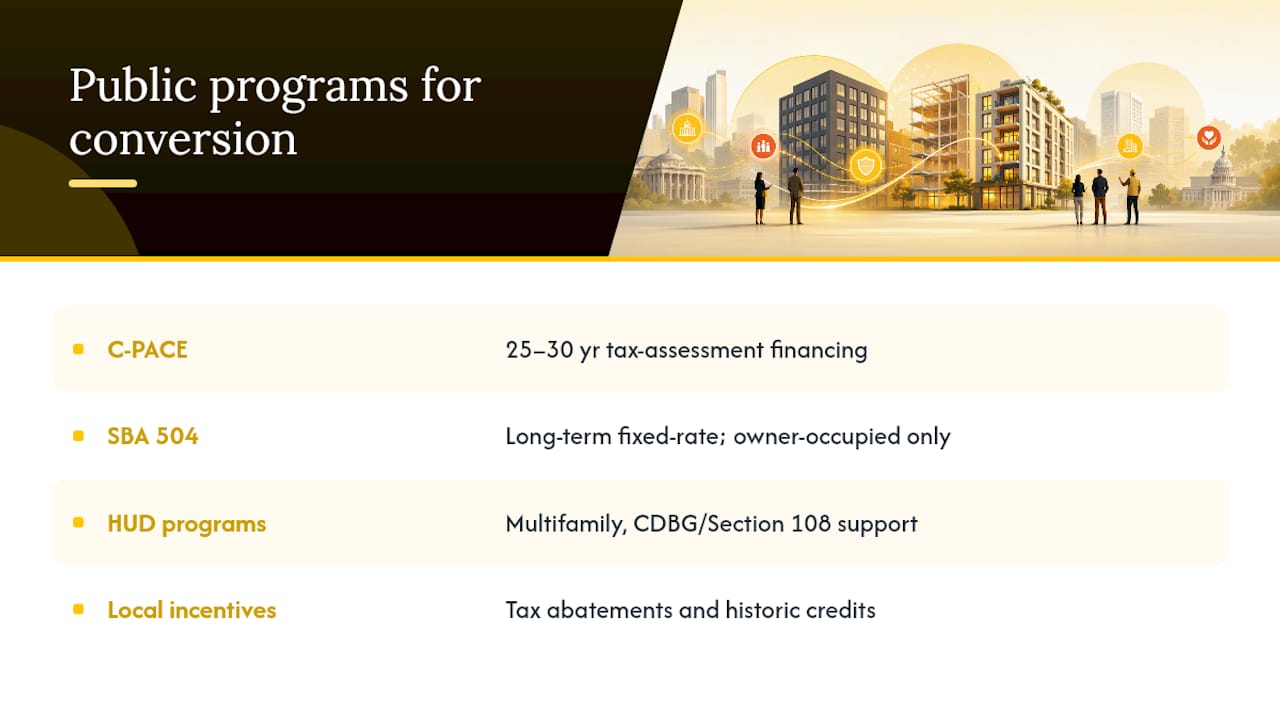
C-PACE finances energy efficiency, resilience, and qualifying building system upgrades, amortized over 25 to 30 years and secured against the property tax assessment rather than a corporate guarantee. Because it sits outside the traditional capital stack hierarchy in most states, it can reduce the amount of higher-cost mezzanine or preferred equity a sponsor needs to raise. C-PACE originations and deal sizes expanded materially through 2024 and 2025, and one landmark deal, The Geneva in Washington, D.C., used $465 million in C-PACE financing as part of its conversion capital stack, making it one of the largest C-PACE-financed adaptive-reuse projects on record.
SBA 504 loans, delivered through Certified Development Companies, offer long-term, fixed-rate financing for major fixed assets and can fund construction or renovation in qualifying owner-occupied scenarios, according to the SBA's 504 loan program page. The fixed-rate structure is attractive for sponsors trying to lock in long-term cost certainty, though eligibility generally requires an owner-occupancy component that doesn't fit every rental conversion. CDC New England's overview of fixed-rate financing in a volatile rate environment walks through why that rate certainty matters more now than it did a few years ago.
HUD programs, including multifamily financing tools and CDBG/Section 108 community development instruments, can support conversions in qualifying situations, particularly where affordability components or municipal partnership exist, per HUD's multifamily program resources.
Local tax abatements and historic tax credits round out the incentive stack in many markets, though qualification depends heavily on jurisdiction and building age.
For sponsors weighing SBA eligibility more closely, this breakdown of SBA 504 versus 7(a) for owner-occupied commercial real estate covers the mechanics in more depth.
What Technical Studies Do Lenders Require?
Before a lender commits capital, they want proof the conversion is physically possible, not just financially attractive on paper. JPMorgan's analysis of office-to-residential conversion treats the technical feasibility study as a lender precondition, not an optional diligence item.
- Floor-plate and daylighting analysis. Deep floor plates common in 1980s and 1990s office towers often can't reach natural light to interior units without cutting light wells or reconfiguring the core, a structural intervention that changes the entire cost basis.
- MEP capacity review. Office HVAC, electrical, and plumbing systems rarely map cleanly to residential code. Elevator counts and egress stair configurations frequently need upgrades to meet residential life-safety standards, and these systems changes are usually the single largest line item after core structural work.
- Environmental and hazardous-material assessment. Older buildings often carry asbestos, lead paint, or other remediation needs that must be reserved for explicitly, not folded into a general contingency line.
- Historic status review. Buildings eligible for historic designation can access valuable tax credits, but the approval process adds time and design constraints that lenders factor into their timeline assumptions.
Practical market experience backs this up: only a fraction of buildings that look convertible on paper actually pencil once realistic construction costs and financing terms are layered in, according to research compiled through HUD's Thriving Communities technical assistance program.
What Rates and Leverage Should Sponsors Expect?
Pricing and leverage benchmarks give sponsors a fast gut-check before committing to deep diligence on a building.
- Bridge and construction pricing: SOFR plus roughly 300 to 600 basis points, with interest-only payment structures during the construction period, per Janover Pro's bridge loan guide.
- Bridge leverage: typically 60% to 75% loan-to-cost, sized against as-completed value with a meaningful haircut applied to as-is office valuations.
- C-PACE: often finances 15% to 25% of total eligible project costs, amortized over 25 to 30 years, which translates to a lower annual debt service burden than an equivalent tranche of mezzanine debt.
- Permanent takeout benchmarks: agency, HUD, and life-company lenders generally target loan-to-value in the 65% to 75% range with debt-service coverage requirements set against stabilized residential NOI, not office-era cash flow.
Quick math check: on a $30 million conversion, a 20% C-PACE tranche financed over 28 years typically carries a materially lower annual cost than the same $6 million raised as preferred equity, since preferred equity often prices at double-digit returns while C-PACE tracks closer to long-term bond yields plus a spread.
How Should Sponsors Prepare a Lender Package?
A well-organized loan package shortens time-to-close more than almost anything else a sponsor controls.
- Assemble core documents before the first lender call: a market study with rent comps, a technical feasibility report, a line-item construction budget from a licensed general contractor, and a pro forma with sensitivity cases for lease-up delays and cost overruns.
- Know your negotiation levers going in. Lenders will often trade leverage for guarantees, larger interest reserves, or holdback escrows tied to construction milestones. Sponsors who offer a bigger interest reserve up front sometimes unlock better pricing elsewhere in the term sheet.
- Match the deal to the right channel. A mortgage banker can shop a deal across multiple private lenders quickly; a direct lender moves faster on straightforward bridge needs; HUD and agency channels demand more lead time but deliver the cheapest permanent capital.
- Watch for early warning signs: an entitlement timeline that keeps slipping, a construction estimate that changes materially between bids, or a sponsor liquidity position that thins out during due diligence. Each of these can stall or kill a deal if not addressed head-on.
Pro Tip: Order your third-party cost review before you go to market for debt, not after a lender requests it. A stale or optimistic budget is the fastest way to lose weeks in underwriting, and lenders notice when a sponsor hasn't stress-tested their own numbers.
Sponsors sizing their equity contribution should also review typical commercial loan down payment requirements before assuming a specific leverage point is achievable.
Where Does Asset-Based Lending Fit in a Conversion Stack?
Jaken Finance Group underwrites against the property's value and the sponsor's plan, not a credit score, which matters most in the acquisition and early-bridge phase of an office conversion where speed and flexibility beat rate. Closings in as few as five days let a sponsor lock up a building while entitlements and technical studies are still in progress, work that traditional bank underwriting typically won't touch until it's already done.

Jaken's asset-based products are best suited to acquisition bridge financing, down-payment funding to meet sponsor equity requirements, and second-position or gap capital when a primary construction lender's leverage falls short of total project cost. These aren't replacements for a permanent HUD or agency takeout, they're the capital that gets a conversion from signed contract to shovel-ready without waiting on a bank committee calendar. Sponsors can review funded deal case studies to see how these structures have played out on comparable value-add and rehab transactions.
When Do Office Conversions Actually Make Sense?
Office conversions pencil most reliably in metros with deep rental demand and older Class B towers with shallow enough floor plates to daylight interior units economically. Chasing every distressed office building is a mistake. The math only works when the discount on acquisition is steep enough to absorb conversion costs that routinely run higher than sponsors initially model.
Private bridge capital buys speed; public and agency capital buys lower long-term cost. Sponsors who run technical feasibility and start capital-market conversations before writing an offer consistently end up with better terms than those who work backward from a signed contract.
— Jason Taken
Get Fast, Asset-Based Capital to Move on a Conversion
Jaken Finance Group is the alternative to waiting on a bank committee when a conversion opportunity has a closing deadline. Where public programs like C-PACE and SBA 504 deliver the cheapest long-term capital but take months to structure, and traditional bank bridge debt demands pristine credit and lengthy approval cycles, Jaken underwrites the property and the plan, closing in as few as five days on acquisition and gap financing.
If a conversion target requires equity to meet a lender's down payment threshold, down payment funding for short-term loans can fill that gap without slowing the acquisition timeline. For sponsors who need senior or second-position capital to bridge to a permanent HUD or agency takeout, asset-based hard money lending with no credit check is built for exactly this kind of speed-driven acquisition. Reach out to discuss the specific structure of your building, timeline, and target takeout, and get a term sheet moving before your acquisition window closes.
Sources
- SBA 504 loans | U.S. Small Business Administration
- Office-to-Residential Conversion Financing | ECM Guide
- Bridge Loan for Office-to-Residential Conversion: A Broker's Guide | Janover Pro
- HUD multifamily programs | U.S. Department of Housing and Urban Development