
Loan-to-cost governs during construction and value-add periods because it tests the loan against verifiable project costs. Loan-to-value takes over at stabilization and refinance because it tests the loan against appraised worth. Lenders calculate both throughout a deal's life, and whichever ratio produces the lower loan amount is the one that binds. Debt yield and DSCR act as additional ceilings. The formulas, thresholds, and worked math below show exactly how that plays out in a real underwriting file.
TL;DR:
- Loan-to-cost ratios dominate during construction and value-add phases, with typical caps below 80%, while stabilized assets usually see LTV caps around 65-75%.
- Accurately defining and documenting TDC, including interest and soft costs, is crucial to prevent over- or underestimating loan limits and avoiding surprises at closing.
- The governing ratio shifts from LTC during construction and value-add to LTV at stabilization or refinance, so confirm the valuation regime with your lender before planning proceeds.
- Lenders run four constraints simultaneously—LTV, LTC, DSCR, and debt yield—and the lowest one determines the maximum loan amount, risking a sudden drop if appraisal values soften.
- Running cash flow and cost-overrun scenarios before locking in proceeds helps mitigate risks from appraisal compression, rising costs, and inaccurate assumptions.
Table of Contents
- LTC vs LTV: The Exact Formulas and What Goes Into Each
- When Does LTC Govern vs When Does LTV Take Over?
- How Lenders Size Loans: The Four-Constraint System
- Two Worked Examples: From Purchase to Stabilization
- Underwriting Checklist: What to Confirm Before You Sign
- Common Mistakes That Cost Borrowers Equity
- A Lender's-Eye View on the LTC vs LTV Trade-Off
- Get Financing That Matches Your Deal Stage
- Sources
- FAQ
LTC vs LTV: The Exact Formulas and What Goes Into Each
LTC = Loan balance ÷ Total development cost (TDC). TDC is the full capital stack required to bring a project to completion, and lenders expect every line item accounted for.
TDC typically includes:
- Land or acquisition cost
- Hard construction costs (materials, labor, contractor fees)
- Soft costs (architecture, engineering, permits, legal)
- Financed interest and carrying costs during construction
- Contingency and operating reserves
TDC generally excludes sponsor acquisition fees and organizational or promotional expenses, a distinction that trips up a surprising number of borrowers building their own models. Getting the loan-to-cost ratio calculation right at the term sheet stage prevents a nasty surprise at closing.
When Does LTC Govern vs When Does LTV Take Over?
The ratio that governs shifts as the deal moves through its lifecycle, and knowing which stage you're in tells you which number the lender is actually watching.
- Acquisition of a stabilized asset: LTV, using an as-is appraisal.
- Construction or value-add rehab: LTC, since there's no finished asset yet to appraise on a comparable basis.
- Exit, takeout, or permanent refinance: LTV again, but now on an as-completed or as-stabilized basis.
Bridge loans and construction-to-permanent products often run both tests simultaneously. A lender might size initial draws off LTC, then require an as-stabilized appraisal before issuing a takeout commitment. This is where LTV and ARV caps in hard-money underwriting matter most, because the after-repair value assumption drives how much proceeds a borrower can expect at exit.
Never assume a quoted percentage refers to the regime you have in mind. Ask the lender to state, in writing, whether their LTV figure is as-is, as-completed, or as-stabilized before you build a pro forma around it.
How Lenders Size Loans: The Four-Constraint System
Institutional and asset-based lenders rarely rely on one ratio. They run four constraints in parallel and let the lowest one bind:
- LTV — collateral test against appraised value
- LTC — collateral test against verified project cost
- DSCR — cash-flow test measuring net operating income against debt service
- Debt yield — a cash-flow floor measuring NOI against loan amount, independent of interest rate
A deal that looks fully financed on an LTC basis can suddenly become LTV-constrained if the exit appraisal comes in soft. That mechanical step-down is one of the most underappreciated risks in construction lending.
Typical bands: Construction and value-add lenders commonly cap LTC below roughly 75% to 80%, while permanent LTV on stabilized commercial assets usually runs 65% to 75%, depending on lender, property type, and market conditions.
When LTC binds, lenders often respond with construction holdbacks, staged draws, and interest reserves. When LTV binds instead, expect pricing adjustments, personal guarantees, or a request for additional equity to close the gap.
Two Worked Examples: From Purchase to Stabilization
Example 1: Value-add rehab.
- Purchase price: $400,000. Rehab budget: $150,000. TDC = $550,000.
- Lender caps LTC at 75%. Maximum loan = $412,500.
- Equity required to close: $137,500.
- After renovation, the property appraises as-stabilized at $650,000.
- Loan of $412,500 against $650,000 value = 63.5% LTV, well inside a typical refinance band.
Example 2: Ground-up development.
- Land: $300,000. Hard costs: $900,000. Soft costs: $200,000. TDC = $1,400,000.
- Lender caps LTC at 70%. Construction loan = $980,000.
- As-completed appraisal projects $1,700,000. Loan against that value = 57.6% LTV.
- Now stress the appraisal down 15% to $1,445,000 to model a softer exit market.
- The same $980,000 loan against the reduced value climbs to 67.8% LTV, still fundable, but the cushion shrinks fast.
That sensitivity run matters because rising construction spending and material costs push TDC higher on projects still in the pipeline, which increases equity requirements even before an appraisal enters the picture. Remodeling-driven cost increases have shown the same pattern on the rehab side. Run both a cost overrun scenario and an appraisal haircut on every deal before you commit to a proceeds number.
Underwriting Checklist: What to Confirm Before You Sign
Before accepting a term sheet, capture these inputs and confirm them against the Property Value Investments — grupa dewelopera lender's actual program:
- Loan balance and proposed LTC and LTV percentages
- Full TDC breakdown, line by line, with financed interest included
- The exact valuation regime the lender will use for LTV
- Projected NOI, DSCR, and debt yield at stabilization
- Assumed exit cap rate and how sensitive it is to market movement
Ask your lender directly: "Which valuation regime governs LTV at takeout?" "Do you require an interest reserve or operating deficit reserve?" "What line items count toward TDC?" "How are draws audited and held back?" Getting these answers in writing before closing eliminates the single biggest source of disputes at refinance.
Pro Tip: Request examples of comparable takeout loans or lender precedent on similar property types in your market. A lender who can point to recent, similar deals gives you a far more reliable read on their actual appetite than their published rate sheet ever will.
Whichever scenario produces the lowest proceeds is the one to plan around.
Common Mistakes That Cost Borrowers Equity
The most expensive errors in this process are almost always definitional, not mathematical.
- Misdefining TDC: including sponsor acquisition fees or excluding financed interest inflates or deflates LTC, throwing off the entire capital stack.
- Assuming LTV means as-stabilized: get the valuation regime confirmed in writing, every time.
- Ignoring appraisal compression risk: a soft exit appraisal mechanically lowers LTV proceeds even when the loan balance never changes.
Mitigate these with conservative contingency sizing, realistic holdback planning, and early, documented alignment with your lender on every assumption.
A Lender's-Eye View on the LTC vs LTV Trade-Off
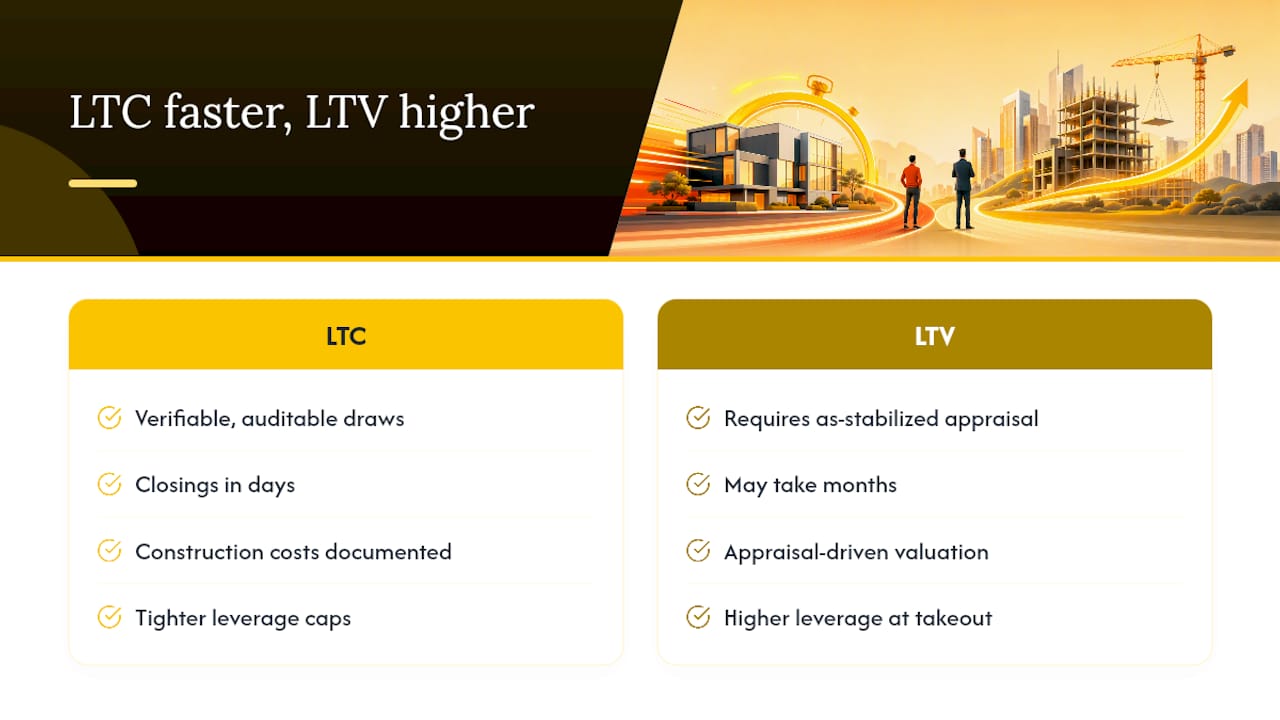
Asset-based lenders often lean on LTC precisely because it's verifiable and fast to underwrite. Construction costs are documented, contractors are bonded, and draws are auditable, which lets closings happen in days rather than months. That speed comes at a price: LTC-based financing generally carries tighter leverage caps than a fully seasoned LTV refinance.
Sponsors chasing execution certainty on a tight timeline should accept the lower LTC leverage. Those with room to wait for a stronger as-stabilized appraisal often do better pushing for LTV-based terms at takeout instead.
— Jason Taken
Get Financing That Matches Your Deal Stage
Whether your project is still cost-driven or has reached the value-driven refinance stage, the ratio your lender leans on determines how much cash you need at the table. Jaken Finance Group underwrites asset-based hard-money loans on the property itself rather than a credit score, with closings possible in as few as five days for rehab, new construction, and bridge scenarios. That speed matters most precisely when a construction loan is LTC-bound and every week of delay adds carrying cost to your TDC.
If you're weighing a fix-and-flip rehab, ground-up build, or short-term bridge against a future refinance, Jaken Finance Group's nationwide hard money and fix-and-flip lending team can walk your numbers through both LTC and LTV scenarios before you sign a term sheet. Reach out today to get a quote on your next deal.
Sources
- LTV vs LTC: When Each Governs CRE Debt Sizing
- Understanding Loan-to-Cost (LTC) Ratios in Real Estate Financing
- Building material price inflation — NAHB blog
This article is general information, not a substitute for advice from a qualified financial advisor. Consult a qualified financial professional about your own circumstances before acting on anything here.
FAQ
Are LTC and LTV the same thing?
No. LTC measures the loan against total project cost, while LTV measures the loan against appraised value, and the two can produce very different maximum loan amounts on the same deal.
What is LTC in mortgages?
LTC, or loan-to-cost, is the ratio lenders use primarily on construction and value-add loans to compare the loan balance against the full, documented cost of a project rather than its appraised value.
Does Jaken Finance Group use LTC or LTV for underwriting?
Jaken Finance Group's asset-based loans typically rely on LTC during construction and rehab phases, since verified project costs allow for faster, more flexible underwriting than waiting on a stabilized appraisal.