
For fix-and-flip financing, ARV-based metrics are what lenders prioritize. Loan-to-ARV and loan-to-cost ratios protect the lender's exit position, which is why private fix-and-flip lenders commonly cap advances at a conservative percentage of the after-repair value (ARV) rather than anchoring solely to the purchase price. LTV still matters at entry, but on a rehab deal, the as-completed value governs how much a lender will advance.
Here are the rule-of-thumb ranges investors need to know before approaching a lender:
- Loan-to-ARV (rehab loans): 65–75% of after-repair value
- Purchase LTV (acquisition): 70–80% of as-is value or purchase price
- Loan-to-Cost (LTC): 70–85% of total project cost (purchase + rehab + soft costs)
These three numbers will appear in almost every hard-money or bridge loan term sheet. Understanding how they interact, and which one will cap your loan, is the difference between a deal that funds and one that stalls at underwriting.
Key Takeaways
For fix-and-flip investors, ARV-based metrics govern rehab loan sizing, while LTV anchors entry-risk assessment, and the lesser-of rule determines which cap actually limits your advance.
| Point | Details |
|---|---|
| ARV governs rehab loan caps | Lenders cap fix-and-flip loans at 65–75% of ARV to protect exit position. |
| LTV measures entry risk | LTV uses as-is or purchase price; lenders apply the lesser of the two values. |
| Lesser-of rule determines funding | Run both LTARV and LTC caps; the smaller permitted loan amount is what the lender advances. |
| 70% rule sets your max offer | MAO = (ARV × 70%) − estimated repair cost; use 75–80% only in competitive markets with tight margins. |
| Jaken Finance Group | Offers asset-based fix-and-flip loans sized to ARV and LTC caps, closing in as few as five days. |
Table of Contents
- What Is ARV and How Do You Calculate It?
- What Is LTV and How Do You Calculate It?
- How Do ARV and LTV Compare Side by Side?
- What Are LTC and LTARV, and How Does the "Lesser-Of" Rule Work?
- How Do Lenders Actually Use These Ratios in Underwriting?
- Three Worked Examples You Can Copy
- How Jaken Finance Group Applies These Ratios in Real Deals
- How to Strengthen Your Deal to Qualify for a Larger Loan
- Common Mistakes Investors Make with ARV and LTV
- Underwriting Checklist to Prepare Before You Apply for a Flip Loan
- When Should You Prioritize ARV Over LTV on a Deal?
- Jaken Finance Group: Asset-Based Financing Built for ARV-Driven Deals
- Sources
What Is ARV and How Do You Calculate It?
After-Repair Value is the estimated market value of a property after all planned renovations are complete. It is not the current condition value and not the purchase price. ARV is a forward-looking figure that answers one question: what will this property sell for once the work is done?
Two primary ARV calculation methods
The sales-comparison approach (CMA) is the most reliable method for estimating ARV. It uses recently sold comparable properties, adjusted for differences in size, condition, and features, to project a post-renovation value. The price-per-square-foot method is a faster alternative, useful for quick screening.
Sales-comparison formula:
ARV = Average adjusted price per square foot of comps × Subject property square footage
Price-per-square-foot formula:
ARV = Comparable price per SF × Subject property SF
How to select and adjust comps
- Pull sales from the past 90–180 days within a half-mile radius (tighter in dense urban markets).
- Match on bed/bath count, square footage (within 20%), and property type.
- Use only renovated or move-in-ready comps, not distressed sales.
- Adjust for material differences: add value for a comp with fewer bathrooms, subtract for one with a larger lot.
- Weight the most recent and most similar sales most heavily.
The ARV formula itself is straightforward: ARV × 70% − estimated repair cost = Maximum Allowable Offer (MAO). The harder work is in the comp selection and adjustment, not the arithmetic.
Pro Tip: An investor's ARV estimate and a lender's as-completed appraisal are not the same document. Lenders order a formal appraisal from a licensed appraiser who uses the same sales-comparison method but applies USPAP standards. That appraisal number, not your spreadsheet, determines the loan cap. Build your ARV conservatively so the appraisal confirms rather than undercuts your underwriting.
What Is LTV and How Do You Calculate It?
Loan-to-value ratio measures the loan amount against the current, as-is value of a property. It answers the entry-risk question: how much equity cushion exists at the moment of purchase?
Formula:
LTV = Loan Amount ÷ Current Property Value (as-is or purchase price)
Quick example:
Which value lenders use
- For purchase loans, lenders typically use the lesser of the purchase price or the as-is appraised value.
- For refinances, the as-is appraisal governs.
- On rehab loans, lenders calculate both LTC and loan-to-ARV, and the lower permitted loan amount becomes binding.
LTV is a snapshot metric. It tells a lender how exposed they are today, before a single nail is driven. That is why it matters for acquisition loans and conventional financing, but it becomes secondary on heavy rehab deals where the post-renovation value is the real underwriting anchor.
How Do ARV and LTV Compare Side by Side?
The two metrics answer different questions at different stages of a deal. Confusing them, or presenting only one to a lender, is one of the most common errors fix-and-flip investors make.
| Metric | What it measures | Formula | When lenders use it | Effect on loan amount | Typical range (fix-and-flip) |
|---|---|---|---|---|---|
| LTV | Entry risk / equity cushion at purchase | Loan ÷ As-is value | Acquisition, bridge, refinance | Caps advance against current value | 70–80% of as-is or purchase price |
| Loan-to-ARV | Exit protection after renovation | Loan ÷ ARV | Rehab, fix-and-flip, bridge-to-sale | Caps advance against projected completed value | 65–75% of ARV |
| LTC | Execution / cost risk | Loan ÷ Total project cost | Construction, heavy rehab | Caps advance against all-in cost | 70–85% of total project cost |
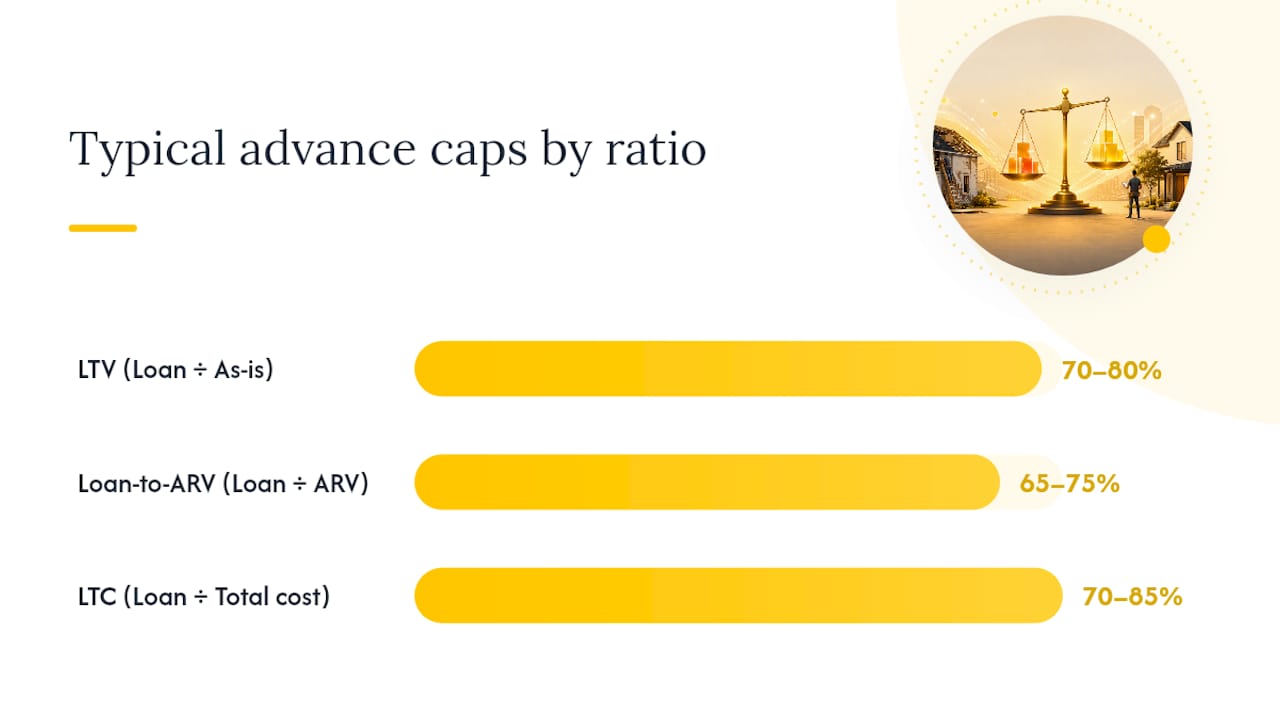
Purchase LTV indicates entry risk, LTC indicates execution risk, and ARV-based LTV shows exit risk. Presenting all three ratios together gives a lender a complete picture of the deal's risk profile at each stage.
For a light cosmetic flip, loan-to-ARV is usually the binding constraint. For a heavy gut-rehab or new construction project, LTC often caps the loan first because total costs are high relative to the as-is value. Knowing which ratio will bind before you submit a package lets you structure the deal accordingly.
What Are LTC and LTARV, and How Does the "Lesser-Of" Rule Work?
Two ratios that appear alongside LTV in rehab underwriting are Loan-to-Cost (LTC) and Loan-to-After-Repair-Value (LTARV). Both are calculated from the same loan amount but use different denominators.
LTC formula:
LTC = Loan Amount ÷ (Purchase Price + Rehab Costs + Soft Costs)

LTARV formula:
LTARV = Loan Amount ÷ ARV
How the "lesser-of" rule works
Lenders do not pick one ratio and ignore the others. They calculate the maximum loan permitted under each cap and then fund the smaller number. This is the "lesser-of" approach.
- Calculate the maximum loan under the ARV cap: ARV × lender's LTARV limit (e.g., 70%).
- Calculate the maximum loan under the LTC cap: Total project cost × lender's LTC limit (e.g., 80%).
- The lender advances whichever figure is lower.
When LTC binds first: Heavy reconstruction projects where total costs are high and ARV is uncertain.
When LTARV binds first: Light cosmetic flips where total costs are modest but the ARV cap is conservative.
Pro Tip: Always run both calculations before submitting a loan package. The ratio that produces the smaller permitted loan is the one the lender will use, and knowing it in advance lets you adjust the deal structure, bring in partner equity, or negotiate scope before the lender's underwriter does it for you.
How Do Lenders Actually Use These Ratios in Underwriting?
Lenders prioritize exit protection and cost control. On a fix-and-flip, the primary concern is whether the property will sell for enough to repay the loan after renovation costs, carrying costs, and transaction fees. That is why ARV-based caps dominate rehab loan underwriting.
What lenders typically require
- As-completed appraisal: Ordered by the lender from a licensed appraiser using USPAP standards; this number, not the investor's estimate, sets the loan-to-ARV cap.
- Draw schedule: Funds released in stages tied to verified construction milestones, not upfront in a lump sum.
- Contingency reserves: Many lenders require 5–10% of the rehab budget held in reserve to cover cost overruns.
- Borrower equity minimum: Even high-leverage programs typically require the borrower to contribute some equity or demonstrate skin in the game.
- Comp documentation: Lenders want to see the investor's comp analysis before ordering the appraisal, not after.
- Renovation scope and budget: A detailed line-item scope of work, not a rough estimate, is standard.
A low as-completed appraisal can reduce the loan size or kill a rehab deal entirely. Lenders do permit a formal reconsideration of value, but the stronger move is to present a tight comp package before the appraisal is ordered.
These ranges shift based on property type, borrower experience, and market conditions. You can review how these caps apply in hard-money programs at Jaken Finance Group's LTV and ARV overview.
Pro Tip: Submit your comp package with the renovation scope, not separately. Appraisers and underwriters are more likely to support a higher as-completed value when they can see exactly which renovations are planned and which nearby renovated sales support that value. A disorganized submission invites a conservative appraisal.
Three Worked Examples You Can Copy
Example 1: Maximum Allowable Offer using the 70% rule
Inputs: ARV = $350,000 | Estimated repair cost = $60,000
- ARV × 70% = $350,000 × 0.70 = $245,000
- MAO = $245,000 − $60,000 = $185,000
The 70% rule is the standard MAO formula for fix-and-flip investors.
Example 2: Lender cap using the lesser-of approach
- Max loan by LTARV: $350,000 × 0.70 = $245,000
- Max loan by LTC: $260,000 × 0.80 = $208,000
- Lesser-of: $208,000 (LTC binds in this scenario)
The investor expected $245,000 but the lender funds $208,000. The $37,000 gap must come from the investor's own capital or a gap loan.
Example 3: Straight LTV calculation
Inputs: Loan amount = $120,000 | Purchase price = $150,000 | As-is appraised value = $145,000
- LTV using purchase price: $120,000 ÷ $150,000 = 80%
- LTV using appraised value: $120,000 ÷ $145,000 = 82.8%
- Lender uses the lesser of purchase price or appraised value: $145,000, producing an LTV of 82.8%
| Example | Key Input | Formula | Result |
|---|---|---|---|
| MAO (70% rule) | ARV $350K, Repairs $60K | (ARV × 70%) − Repairs | MAO = $185,000 |
| Lesser-of lender cap | ARV $350K, Total cost $260K | Min(ARV × 70%, Cost × 80%) | Loan = $208,000 |
| LTV calculation | Loan $120K, Value $145K | Loan ÷ Lesser-of value | LTV = 82.8% |
How Jaken Finance Group Applies These Ratios in Real Deals
Jaken Finance Group underwrites on an asset-based model, meaning the property's value, ARV, and project scope drive the loan decision, not the borrower's credit score. This approach is designed for speed: deals can close in as few as five days when documentation is in order.
In a typical rehab submission, Jaken evaluates the as-is value, the proposed renovation scope, the ARV supported by comps, and the total project cost. The loan is sized against the more restrictive of the LTARV and LTC caps, consistent with the lesser-of principle. Borrowers with strong comp packages and detailed scopes of work tend to receive faster approvals and higher advance rates because the underwriting risk is clearly quantified.
Jaken Finance Group's asset-based underwriting focuses on the property's value and the investor's project plan, not minimum credit thresholds. Investors can verify lender licensing through the NMLS Consumer Access portal as a standard due-diligence step when evaluating any private lender.
Application checklist for a Jaken-style submission
- Comp package: 3–5 recently sold, renovated comparables with adjustments documented
- Scope of work: line-item renovation budget with contractor bids or detailed estimates
- Construction timeline: milestone schedule tied to draw requests
- ARV calculation: price-per-SF or sales-comparison analysis showing your methodology
- As-is value support: purchase contract and any existing appraisal or BPO
- Exit plan: sale timeline, target list price, and holding cost estimate
- Borrower experience summary: prior flips completed, references, or portfolio documentation
- Title and ownership documents: current title report or commitment
Lenders who use asset-based underwriting evaluate this package holistically. A complete, well-organized submission shortens the underwriting timeline and reduces the likelihood of a value-gap surprise at closing.
How to Strengthen Your Deal to Qualify for a Larger Loan
The most direct way to improve your leverage is to increase ARV credibility, reduce total project cost, or bring in additional equity. All three move the ratios in your favor.
- Tighten the scope and budget: Remove speculative upgrades that add cost without proportional ARV lift. Every dollar of unnecessary rehab cost reduces your LTC headroom.
- Stage the work to reduce LTC exposure: Phasing a project so the first draw covers structural and systems work, with cosmetic finishes in later draws, can reduce the initial loan-to-cost ratio and satisfy conservative lenders.
- Present high-quality, renovated comps: Weak or distressed comps drag the appraisal down. Spend time finding the best renovated sales within the tightest radius before submitting.
- Pre-order materials and lock contractor pricing: Cost certainty reduces contingency requirements, which lowers total project cost and improves LTC.
- Secure interim equity or partner capital: Bringing a partner's equity into the deal reduces the loan amount needed, which mechanically improves both LTV and LTC ratios.
- Explore scaling your portfolio strategically: Investors with a track record of completed projects often qualify for higher advance rates because lender risk is demonstrably lower.
Pro Tip: Kitchen and bathroom renovations consistently produce the highest ARV lift relative to cost in most U.S. markets. A $15,000–$20,000 kitchen update in a mid-range market can add $30,000–$40,000 to the as-completed value, improving your loan-to-ARV ratio without adding proportional cost. Cosmetic-only updates like paint and landscaping add less ARV per dollar spent.
Common Mistakes Investors Make with ARV and LTV
The four most damaging errors in fix-and-flip underwriting are over-optimistic ARV, under-budgeted rehab, ignoring LTC, and relying on a single comp. Each one can reduce the loan amount, delay closing, or kill the deal.
- Over-optimistic ARV → Remedy: Use only renovated comps from the past 90 days within a half-mile. If the best comps support $320,000, do not underwrite to $350,000 because you "believe in the neighborhood."
- Under-budgeted rehab → Remedy: Add a 10–15% contingency line to every scope of work before submitting. Lenders expect it; a budget without contingency signals inexperience.
- Ignoring LTC → Remedy: Run the LTC calculation before you run the LTARV calculation. On any deal where total costs exceed 70% of ARV, LTC will likely bind first.
- Relying on a single comp → Remedy: The sales-comparison approach requires multiple adjusted comps; a single sale is not a CMA. Lenders and appraisers will discount a one-comp ARV argument immediately.
On appraisal risk specifically: if the as-completed appraisal comes in below your ARV estimate, the loan cap drops automatically. A deal that requires a $350,000 appraisal to pencil out is fragile; one that works at $320,000 has room to absorb a conservative appraiser.
Underwriting Checklist to Prepare Before You Apply for a Flip Loan
A complete submission package eliminates the most common source of delay: lenders requesting documents one at a time over several days. Assembling everything before you apply compresses that timeline significantly.
- Comp pack: 3–5 renovated sales, adjusted, with a one-page ARV summary
- Scope and cost spreadsheet: line-item budget with contractor bids, material costs, and a 10% contingency line
- Construction timeline: milestone schedule with estimated draw dates
- Contingency and reserves documentation: evidence of liquid reserves beyond the project budget
- Title and ownership documents: current title commitment or preliminary title report
- Exit plan: target sale price, days-on-market estimate, and holding cost projection
- Borrower experience summary: list of prior completed projects with addresses and sale prices
- Entity documents: operating agreement, articles of organization, or corporate resolution if borrowing in an LLC
Acceptable formats for most lenders: a single organized PDF, a shared Google Drive folder, or a zipped file with clearly labeled documents. Avoid sending items piecemeal via email; a single organized package signals professionalism and speeds review.
For a detailed look at LTV and ARV caps in hard-money lending, Jaken Finance Group's blog covers the specific thresholds lenders apply by program type.
When Should You Prioritize ARV Over LTV on a Deal?
On heavy rehab projects, LTC often binds first. On light cosmetic flips, loan-to-ARV and ARV accuracy are the gating constraints. That single rule-of-thumb determines which metric to stress in lender conversations.
Scenario 1: Light cosmetic flip. A property purchased at $180,000 needs $25,000 in paint, flooring, and fixtures. Total project cost is $205,000. ARV is $280,000. LTC binds here, not LTARV, because the purchase price is high relative to the renovation scope. The investor's conversation with the lender should focus on reducing the loan amount needed or bringing equity to close the gap.
Scenario 2: Heavy reconstruction. A property purchased at $120,000 needs $130,000 in structural, mechanical, and cosmetic work. Total project cost is $250,000. ARV is $380,000. LTC binds again, but by a wider margin. Here, the investor should present a detailed scope and timeline to demonstrate cost certainty, which is the primary risk the lender is managing.
When ARV accuracy is the gating factor, typically on deals where total costs are modest relative to the projected value, the investor's energy should go into the comp package, not the budget spreadsheet. Presenting all three ratios together gives lenders the complete picture and positions the borrower as a sophisticated operator who understands how underwriting works.
Jaken Finance Group: Asset-Based Financing Built for ARV-Driven Deals
Jaken Finance Group closes fix-and-flip loans in as few as five days, underwriting on property value and project merit rather than credit score minimums.
For investors who need rapid, ARV-focused financing, Jaken Finance Group offers:
- Fix-and-flip loans sized to ARV and LTC caps
- High-leverage and 100% LTC programs for qualified projects
- Bridge loans and gap financing for deals with equity shortfalls
- Asset-based underwriting with no minimum credit score requirement
- Fast closings designed for competitive acquisition timelines
Investors who want to understand how asset-based hard-money lending applies ARV and LTC caps to their specific project can start a loan inquiry directly on the Jaken Finance Group website. The application process begins with the property details and renovation scope, not a credit pull.
Sources
- How LTV and ARV Work in Renovation and Construction Loans - LegalClarity
- LTV vs LTC vs ARV: Which Ratio Matters and When
- How To Calculate After-Repair Value (ARV) In Real Estate | BiggerPockets
This article is for general informational purposes only and does not constitute financial, legal, or lending advice. Confirm current program terms, caps, and eligibility requirements directly with your lender or a qualified financial professional.
This article is general information, not a substitute for advice from a qualified financial advisor. Consult a qualified financial professional about your own circumstances before acting on anything here.