
Lien priority determines who gets paid first when a property sells or forecloses, and in the United States the default rule is "first in time, first in right": whichever lien records first in the county land records generally collects first. That default breaks in predictable ways. Property tax liens, mechanic's liens under relation-back doctrine, HOA super-priority statutes, IRS filing rules, and purchase-money mortgage protections can all reorder the line. For investors and lenders, priority isn't academic. It sets who absorbs the loss when a deal goes sideways, and it drives pricing on every loan behind the first mortgage.
TL;DR:
- Property tax liens have super-priority status in nearly every state, often outranking recorded first mortgages, which can significantly impact foreclosure proceeds.
- Mechanic’s liens relate back to the start of construction and can jump ahead of mortgages if the work began before the mortgage was recorded.
- Federal tax liens do not have priority until the IRS files a public notice, creating a gap that lenders must verify during due diligence.
- Refinancing without a signed resubordination agreement can cause priority disputes, especially if the new loan assumes an outdated lien position.
- Most disputes over lien priority require court challenges and are determined by recording date, notice, actual knowledge, and valid subordination agreements.
Table of Contents
- How Lien Priority Works: Recording and the Default Order
- The Exceptions That Reorder Everything
- Why Lien Position Sets Your Interest Rate and Leverage
- A Priority Checklist Before You Fund, Refinance, or Bid
- Where Priority Assumptions Break: Three Real Scenarios
- How Bankruptcy Filings Affect Lien Priority
- Challenging Lien Priority in Court
- What Fast Closings Actually Protect Against
- Financing Around a Complicated Lien Stack
- Sources
- FAQ
How Lien Priority Works: Recording and the Default Order
Recording a lien with the county recorder or clerk creates "constructive notice," meaning the world is legally presumed to know about that claim the moment it hits the public record, regardless of whether anyone actually checked. That's why title companies race documents to the courthouse within hours of closing. A lender who waits a week to record a mortgage risks a judgment creditor or second lender jumping the line.
States handle competing claims through one of three recording statute types:
- Race statutes (rare) award priority to whoever records first, full stop, even if a later party had no way of knowing about the earlier unrecorded interest.
- Notice statutes protect a later purchaser or lender who had no actual or constructive notice of a prior unrecorded claim, regardless of recording order.
- Race-notice statutes, used by most states, require a party to both record first and lack notice of the earlier claim to win priority.
Absent an exception, a typical priority ladder on a financed property runs: property tax liens, then the first mortgage by recording date, then any second mortgage or HELOC, then judgment liens, then unsecured claims. Title searches exist to confirm this ladder holds for a specific parcel, because recording confers constructive notice rather than actual certainty. A stale or incomplete search is the single most common source of priority surprises in real estate closings.
The Exceptions That Reorder Everything
Several categories of liens skip the recording queue entirely, and every one of them matters more to lenders than the general rule does.
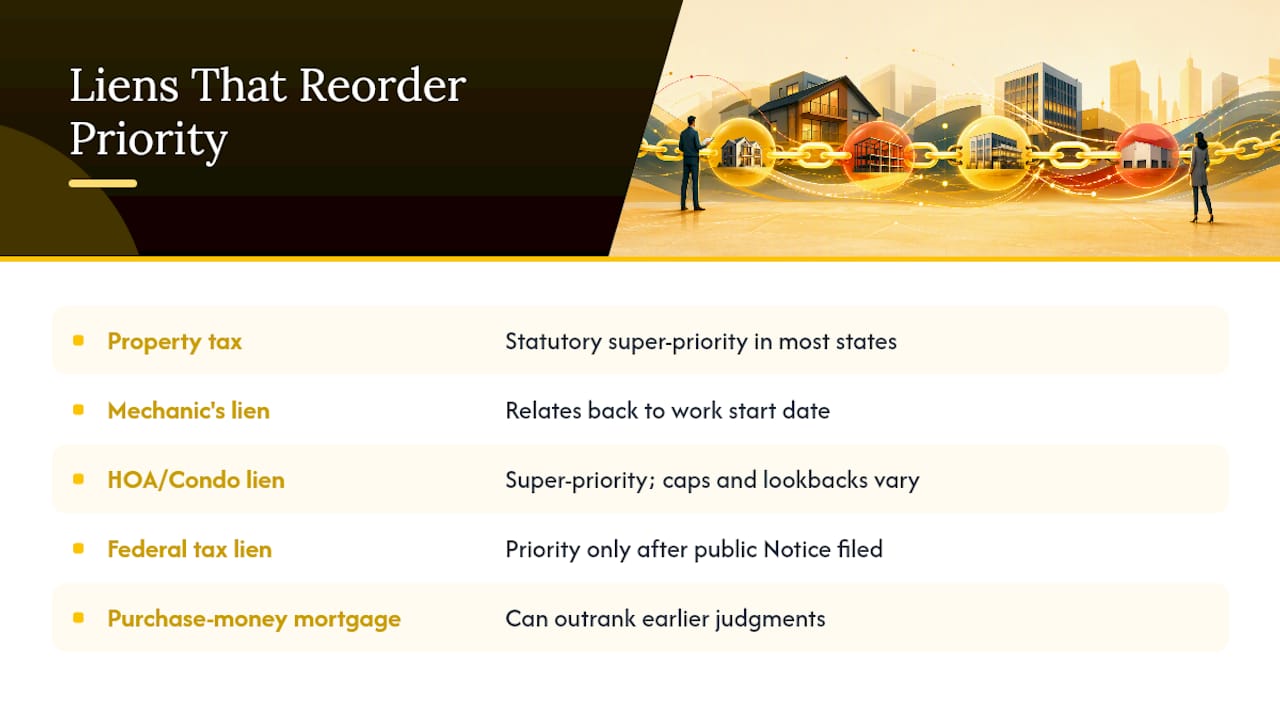
Property tax liens carry statutory super-priority in nearly every state. Local tax authorities get paid before private mortgage holders, even ahead of a first mortgage recorded years earlier, because governments write the rules that fund themselves.
Mechanic's liens often "relate back" to the date construction work began, not the date the contractor filed the lien. If a contractor started framing in March and a lender didn't record its mortgage until June, the mechanic's lien can jump ahead of that mortgage even though it was filed months later.
HOA and condo association super-priority liens exist in many states, though caps and lookback periods vary widely. Some states cap the super-priority portion at a limited number of months of assessments; others have no super-priority carve-out at all.
Federal tax liens attach automatically on IRS assessment and nonpayment, but they're generally not valid against a purchaser or mortgagee until the IRS files a public Notice of Federal Tax Lien. That gap between attachment and public filing is a real exposure window for lenders closing quickly.
Purchase-money mortgages get a carve-out too: a loan used to buy the property often outranks a judgment recorded earlier against the buyer, since the buyer didn't own the asset when that judgment was entered.
Recording statute type and lien caps both vary by state, which is why the same fact pattern can produce different outcomes in Texas versus New York.
Why Lien Position Sets Your Interest Rate and Leverage
Priority isn't just a legal ranking. It's the mechanism underwriters use to price risk. A first-lien lender collects in full before anyone junior sees a dollar, so first liens carry the lowest expected loss and the lowest rates. Second-lien and junior-position debt carries materially higher interest rates because that lender only recovers what's left after the senior claim is satisfied.
Lenders manage that exposure through a few concrete tools:
- Combined loan-to-value (CLTV) caps total secured debt against appraised value, keeping enough equity cushion to protect junior positions if the property sells at a discount.
- Title insurance commitments confirm the recorded lien stack before funding and flag exceptions the lender must clear or accept.
- Subordination agreements lock in where a lien sits relative to future financing, which matters enormously during refinance.
- Reserve requirements (interest reserves, tax escrows) reduce the odds a senior obligation goes unpaid and triggers a priority-consuming foreclosure.
Pro Tip: Before quoting a rate on a second-position deal, pull the payoff on every senior lien, not just the mortgage balance. A forgotten tax delinquency or an open judgment can quietly change the entire loss-severity math.
In a foreclosure waterfall, sale proceeds pay closing costs first, then the senior lienholder in full, then juniors in order until the money runs out. A junior lender behind an underwater senior position can walk away with nothing.
A Priority Checklist Before You Fund, Refinance, or Bid
Priority disputes are almost always preventable with the right diligence sequence, applied in this order:
- Order a current title report, not one from three months ago. Liens record daily, and a stale report misses recent judgments or mechanic's lien filings.
- Confirm real property tax status directly with the taxing authority. Delinquent taxes don't always show cleanly on a title report until they've been formally certified.
- Ask when construction work actually began, not when it was filed. Relation-back mechanic's liens can predate a mortgage recorded months later, so get start-date affidavits and lien waivers from contractors before funding.
- Secure a signed subordination agreement before closing a refinance, and insist on express resubordination language rather than assuming the new loan automatically inherits the old lien's position.
- Search for recorded federal tax liens against the borrower or the entity, and request a payoff or release letter where one exists rather than relying on verbal assurance.
- Read every exception listed on the title insurance commitment line by line, and get each one either removed, insured over, or explicitly accepted in writing before you fund.
Pro Tip: A title commitment's "Schedule B" exceptions section is where priority problems hide in plain sight. Read it before you read the loan terms.
Where Priority Assumptions Break: Three Real Scenarios
Priority theory holds up fine on paper. It breaks down in three recurring scenarios that trip up investors and lenders who skip diligence.
Scenario one: A property with $18,000 in delinquent property taxes forecloses. Sale proceeds cover the tax lien in full, but nothing is left for the second-position lender, who held a legally valid, properly recorded lien that simply sat behind a super-priority claim. Tax liens routinely consume proceeds before private creditors see a dime.
Scenario two: An investor buys at a junior-lien foreclosure auction, assuming the sale wipes the slate clean. It doesn't. The senior mortgage survives the sale, and the buyer now owns a property still encumbered by a first mortgage they didn't sign.
Scenario three: A borrower refinances without a signed resubordination agreement. The new lender assumes it steps into the old lender's senior position, but without explicit language, equitable subrogation outcomes vary by state and by title insurer practice, leaving priority genuinely uncertain.
Watch for these red flags on any title report: recent judgment filings, unexplained gaps between deed and mortgage recording dates, open building permits with no corresponding lien releases, and any "exceptions" section longer than half a page.
How Bankruptcy Filings Affect Lien Priority
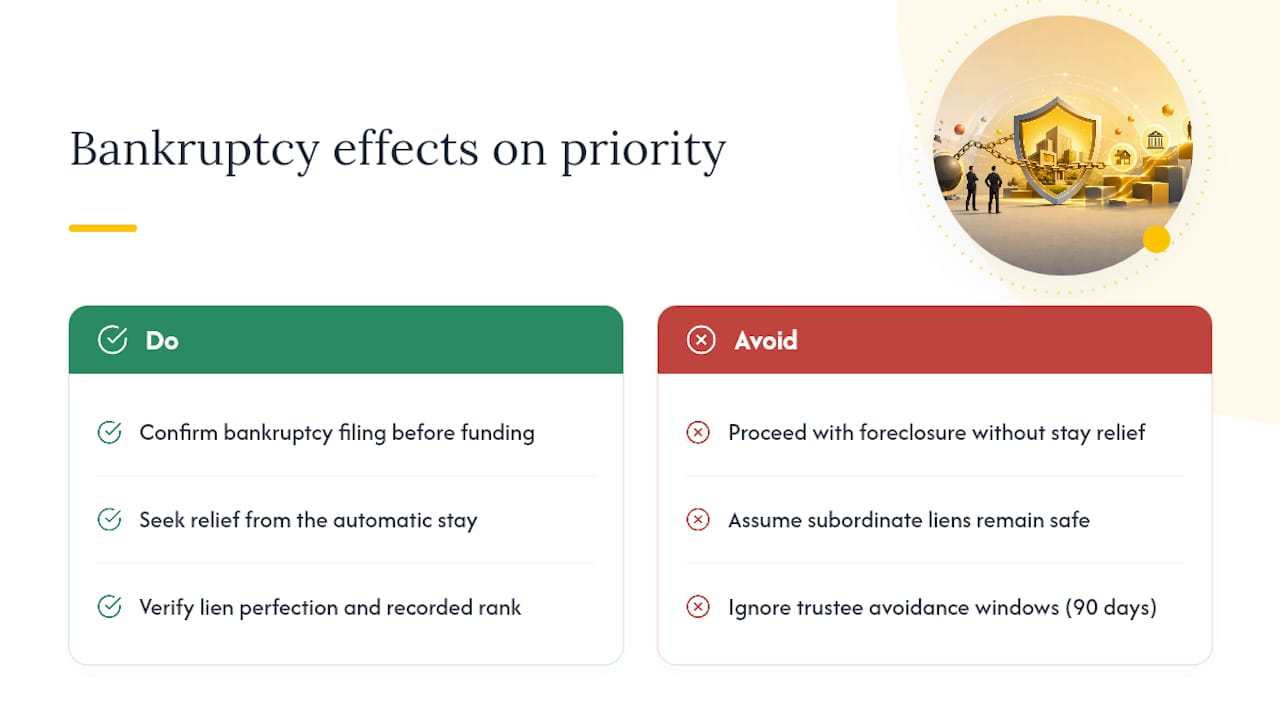
Filing bankruptcy doesn't erase lien priority. It freezes the timeline and shifts the venue where priority disputes get resolved. The automatic stay under federal bankruptcy law halts foreclosure and collection actions the moment a debtor files, which means a senior lender who was days from a foreclosure sale has to seek relief from the stay before proceeding.
Secured liens generally survive bankruptcy in their existing priority order. A first mortgage stays first, a second stays second, and unsecured judgment creditors typically fall further behind secured lienholders in the distribution scheme, since Chapter 7 liquidation and Chapter 13 reorganization plans both pay secured claims according to their recorded rank.
Where bankruptcy changes the picture is through the trustee's avoidance powers. A bankruptcy trustee can sometimes void liens perfected shortly before filing, particularly transfers that look like preferential payments to one creditor over others in the 90 days before filing, or liens that weren't properly perfected under state law before the bankruptcy petition. An unrecorded mortgage, for instance, can lose its secured status entirely in bankruptcy if a trustee successfully argues it never achieved proper priority against the estate.
For lenders financing investors with existing debt exposure, a live or recent bankruptcy filing on the borrower or a related entity is a diligence flag worth checking before funding any subordinate position. It changes both the timeline for enforcement and, in some cases, the priority stack itself.
Challenging Lien Priority in Court
Disputing where a lien sits in the priority stack requires filing a quiet title action or a declaratory judgment action, typically in the state court where the property sits. The party challenging priority has to show the recorded order doesn't reflect the actual legal ranking, whether that's because a senior lien was improperly perfected, a subordination agreement was breached, or a mechanic's lien's relation-back date is being misapplied.
Courts weigh a few recurring factors in these disputes. Recording date and compliance with the state's recording statute (race, notice, or race-notice) usually control absent a specific exception. Actual or constructive notice matters heavily in notice and race-notice states, so a party claiming ignorance of an unrecorded interest needs to show a genuine, documented lack of knowledge. Equitable doctrines like subrogation can shift outcomes in a lender's favor even without a clean paper trail, particularly in refinance disputes where the new loan clearly paid off the old one.
Evidence that wins these cases tends to be mundane: recorded timestamps, contractor invoices and start-date affidavits for mechanic's lien disputes, signed subordination agreements, and title company records showing what each party actually knew and when. A weak factual record, not a weak legal argument, is usually what sinks a priority challenge. Investors and lenders who keep clean paper trails on every recorded interest are the ones who prevail when a dispute eventually lands in front of a judge.
What Fast Closings Actually Protect Against
The gap between contract signing and funding is where most unwelcome liens appear. A slow 45-day conventional close gives a contractor time to file a mechanic's lien or a creditor time to record a judgment before the mortgage hits the record. That's the priority risk we underwrite around at Jaken Finance Group every day.
Before funding, we look hard at recorded exceptions, construction start dates, and any pending subordination history on a borrower's other assets. Ask any lender about their title exceptions, their resubordination track record on refinances, and whether they've confirmed current tax status directly with the county. If the answers are vague, the underwriting probably is too. When timing or an existing lien stack threatens to derail conventional financing, asset-based bridge lending becomes the more reliable path.
— Jason Taken
Financing Around a Complicated Lien Stack
When a title report comes back with exceptions, a pending mechanic's lien, or a refinance that needs clean resubordination language fast, conventional lenders often stall or decline outright. Jaken Finance Group underwrites on the asset, not the paperwork backlog, which means a complicated lien position doesn't automatically kill the deal.

Certain loan products can close in about a week to ten days, which reduces the risk of intervening liens appearing between contract and funding. For investors already carrying a first mortgage who need capital without disturbing that senior position, a second-position DSCR cash-out structure can raise cash while keeping the existing lien stack intact. Rates on Jaken's core investor products, including Fix and Flip Loans and Bridge Loans, are competitively priced, with no minimum credit score requirement and underwriting built around the deal's collateral and timing rather than a borrower's file.
If a title exception, a looming refinance deadline, or a subordinate lien is holding up your next deal, review the full menu of loan options and start a conversation about structuring around it.
This article is general information, not a substitute for advice from a qualified financial advisor. Consult a qualified financial professional about your own circumstances before acting on anything here.
Sources
- Junior lien — Legal Information Institute (Cornell)
- Lien priority in real estate — Nolo
- IRS IRM: Federal tax lien rules
- Lien priority and foreclosure — LegalClarity
FAQ
What Does Lien Priority Mean in Real Estate?
Lien priority is the legal ranking that determines which creditor gets paid first from sale or foreclosure proceeds, generally set by recording date under the "first in time, first in right" rule.
What Is the Difference Between a First Lien and a Second Lien?
A first lien is the senior claim recorded first and paid first from foreclosure proceeds; a second lien sits behind it and only collects if funds remain after the first lien is satisfied in full.
Can a Mechanic's Lien Outrank a Mortgage?
Yes. Under relation-back doctrine used in many states, a mechanic's lien can date back to when construction work began, which can place it ahead of a mortgage recorded after that start date.
Does Bankruptcy Erase Lien Priority?
No. Secured liens generally keep their existing priority rank through bankruptcy, though a trustee can sometimes void a lien that wasn't properly perfected before the filing.
How Does Jaken Finance Group Handle Deals With Existing Liens?
Jaken Finance Group underwrites based on the property's value and the recorded lien stack, offering products like Fix and Flip and Bridge Loans that close in as few as 7 to 10 days to limit exposure to intervening liens.
What Is Preferred Equity Versus Mezzanine Debt in Priority Terms?
Mezzanine debt is a lien-secured claim that sits behind senior mortgage debt but ahead of equity, while preferred equity holds no lien at all and is paid only from ownership distributions, making it the riskier of the two in a downside scenario.