
Florida's construction lien law, codified in Chapter 713 of the Florida Statutes, permits unpaid contractors, subcontractors, sub-subcontractors, material suppliers, and laborers to place a lien on private property when payment is withheld. The statute is precise, deadline-driven, and unforgiving of procedural errors — a single missed notice or late filing can extinguish rights that would otherwise be fully enforceable.
If you are a property owner: Verify that a Notice of Commencement is properly recorded before work begins, withhold final disbursement until you have collected executed lien releases, inspect any recorded claim at the clerk's office, and consult a Florida construction attorney before making any payment that could affect your liability.
If you are a lien claimant: Confirm your license is current, determine whether you must serve a Notice to Owner (NTO) under s. 713.06, prepare a Claim of Lien that satisfies every content requirement under s. 713.08, and record it within the statutory window — no later than 90 days after your final furnishing of labor, services, or materials.
- Owners: record Notice of Commencement before work begins
- Owners: collect lien releases and final payment affidavit before final disbursement
- Claimants: confirm licensure and NTO service before recording
- Claimants: record Claim of Lien within 90 days of final furnishing
- All parties: consult counsel when a lien is recorded or disputed
This article is general information, not legal advice. Confirm current statutory requirements with a licensed Florida construction attorney or the primary statute text.
Key Takeaways
Florida's construction lien law (Chapter 713) is a deadline-driven statute where a single missed notice or late filing extinguishes otherwise valid payment rights — making documentation and timing the two most important variables for every party on a project.
| Point | Details |
|---|---|
| NTO is the critical pre-filing step | Non-privity lienors must serve a Notice to Owner within 45 days of first furnishing or lose all lien rights. |
| 90-day recording deadline is absolute | A Claim of Lien must be recorded within 90 days of final furnishing; missing it extinguishes the lien by statute. |
| Unlicensed contractors have no lien rights | Section 713.02 bars unlicensed contractors, subcontractors, and sub-subcontractors from asserting any lien claim. |
| Collect waivers before every disbursement | Conditional partial waivers at progress payments and conditional final waivers at completion protect owners from double payment. |
| One-year enforcement window is a hard cutoff | A foreclosure action must be filed within one year of recording or the lien expires by operation of law. |
Table of Contents
- What does Florida lien law actually cover under Chapter 713?
- Who can file a mechanics or construction lien in Florida?
- What are the Notice to Owner rules and deadlines?
- What is a Notice of Commencement and who must record it?
- How do you perfect a lien by drafting and recording a Claim of Lien?
- What are the statutory deadlines for notices, filing, and enforcement?
- How do priority rules and extent limits affect multiple lienors?
- How is a construction lien enforced, and what are the cost exposures?
- Does an unlicensed contractor lose all lien rights?
- What types of lien waivers and releases should you collect?
- What should owners and claimants do immediately after a lien is recorded?
- What mistakes most often invalidate a Florida construction lien?
- Where can you find official forms and templates for Florida lien documents?
- Quick-reference timeline of every statutory deadline
- Why Florida lien law matters more than most investors realize
- Sources
What does Florida lien law actually cover under Chapter 713?
Chapter 713 is titled the "Construction Lien Law" and spans sections 713.001 through 713.37. It is the primary statutory authority governing mechanics and construction liens on private property in Florida. The chapter is divided into several parts, each addressing a distinct category of lien rights.
Part I (ss. 713.001–713.37) is the section most owners, contractors, and investors will encounter. It establishes who may file a construction lien, what notices are required, how a claim must be drafted and recorded, and how liens are enforced or discharged. The remaining parts address miscellaneous liens, oil and gas liens, and federal lien registration — important in specialized contexts but outside the scope of most residential and commercial construction disputes.
The statute's stated purpose is to protect the payment rights of those who furnish labor, services, or materials to improve private real property, while simultaneously preserving title clarity for owners and lenders. That dual purpose creates the tension at the heart of every lien dispute: a claimant's right to payment versus an owner's right to a clear title.
Key sections referenced throughout this guide:
- s. 713.001 — Definitions
- s. 713.02 — Types of liens and categorical exemptions (including the unlicensed-contractor bar)
- s. 713.05 — Liens for persons in privity with the owner
- s. 713.06 — Liens for persons not in privity with the owner (NTO requirement)
- s. 713.08 — Contents of a Claim of Lien and the 90-day recording deadline
- s. 713.12 — Extent of liens (contract price cap)
- s. 713.13 — Notice of Commencement requirements
| Chapter 713 Part | Coverage | Typical Reader |
|---|---|---|
| Part I (ss. 713.001–713.37) | Construction liens, notices, enforcement, discharge | Owners, contractors, subs, suppliers, investors |
| Part II | Miscellaneous liens (e.g., storage, agister) | Specialty service providers |
| Part III | Oil and gas liens | Energy sector parties |
| Part IV | Federal lien registration | Federal creditors |
When to read the statutory text directly: use this guide for procedural orientation and checklists, then verify each step against the primary statute language on flsenate.gov or the Online Sunshine portal before acting. County-specific recording rules and fee schedules require a separate check with the local Clerk of Circuit Court.
Who can file a mechanics or construction lien in Florida?
Florida law grants lien rights to a defined class of parties — not every participant in a construction project qualifies. Under s. 713.01 and s. 713.02, eligible lienors include:
- Contractors — those in direct contract with the owner (also called "prime contractors" or "general contractors")
- Subcontractors — those in contract with a contractor, not directly with the owner
- Sub-subcontractors — those in contract with a subcontractor
- Material suppliers — those who supply materials incorporated into the improvement
- Laborers — those who perform physical labor on the project
- Certain design professionals — architects, landscape architects, interior designers, engineers, and surveyors whose services are incorporated into the improvement
The privity distinction is the most consequential structural rule in Chapter 713. A contractor in direct contract with the owner (in privity) has lien rights under s. 713.05 and faces fewer pre-filing notice requirements. Subcontractors, sub-subcontractors, and material suppliers who are not in privity with the owner must comply with the additional Notice to Owner requirements under s. 713.06 — and failure to do so is a complete defense to enforcement.
A practical example clarifies the stakes. A general contractor hired directly by a homeowner is in privity and may record a Claim of Lien without serving a Notice to Owner. A tile supplier who sells materials to that general contractor's subcontractor is two steps removed from the owner, is not in privity, and must serve a timely NTO or lose all lien rights — regardless of how much money is owed.
Laborers occupy a narrow exception: they generally do not need to serve a Notice to Owner, but their lien rights are limited to the value of their direct labor contribution. Licensed professionals such as architects and engineers may have lien rights for services rendered, but only when those services are incorporated into an actual improvement on the property.
Section 713.02 also identifies categorical exclusions. Unlicensed contractors, subcontractors, and sub-subcontractors are barred from lien rights entirely — a point addressed in detail later in this guide.
What are the Notice to Owner rules and deadlines?
The Notice to Owner is not a lien. It is a pre-filing notice that non-privity lienors must serve on the owner (and, in some cases, the contractor) to preserve their right to later record a Claim of Lien. Under s. 713.06, the NTO must be served before commencing work or within 45 days after first furnishing labor, services, or materials — whichever comes first. Serving after the 45-day window, or not serving at all, is a complete defense to enforcement.
Allowable methods of service under s. 713.18 include certified mail with return receipt requested, personal delivery with written acknowledgment, and overnight courier with delivery confirmation. Each method creates a paper trail that can be produced in court. Serving by regular first-class mail alone is not sufficient.
Proof-of-service documentation matters as much as the service itself. Keep the certified mail receipt, the signed green card (PS Form 3811), and a copy of the NTO in the project file. If the owner refuses delivery, the statute's constructive service rules may still protect the claimant — but only if the attempt is documented.
Pro Tip: Send the NTO via certified mail and simultaneously via email or text to the owner's known address. The certified mail creates the legal record; the electronic copy creates a contemporaneous timestamp that can corroborate delivery in a dispute.
- Serve the NTO as early as possible — ideally before the first day of work
- Address the NTO to the owner at the address listed on the Notice of Commencement
- Retain the certified mail tracking number and delivery confirmation indefinitely
- If the project spans multiple contracts or phases, evaluate whether a new NTO is required for each phase
What is a Notice of Commencement and who must record it?
A Notice of Commencement (NOC) is a statutory document recorded by the owner (or the owner's authorized agent) in the public records of the county where the property is located, before construction begins. Its legal function is to identify the owner, the property, the contractor, and the lender — and to direct non-privity lienors to the correct address for serving their Notices to Owner. Without a properly recorded NOC, the owner loses significant protections and lienors may have difficulty identifying the correct service recipients.
Under s. 713.13, the NOC must contain:
- The legal description of the property and the street address
- The owner's name and address
- The contractor's name and address
- The name and address of any lender providing construction financing
- The name and address of any surety on a payment bond
- A description of the improvement to be made
- The owner's interest in the property (fee simple, leasehold, etc.)
- The expiration date of the NOC (generally one year from recording unless extended)
Recording steps: The owner or agent prepares the NOC, has it notarized, and records it with the Clerk of Circuit Court in the county where the property is located. A certified copy must be posted at the job site before work begins — typically at the front entrance or in a conspicuous location accessible to all workers and suppliers. Pinellas County's guidance recommends filing the NOC before any work commences and retaining a certified copy for the project file.
Owner verification checklist before disbursing funds:
- Confirm the NOC is recorded in the correct county's public records
- Verify the contractor's name and license number match the recorded NOC
- Confirm the NOC has not expired (check the expiration date)
- Verify the job-site posting is in place and legible
- Collect all NTOs served by subcontractors and suppliers and log them against the NOC's listed addresses
Lenders providing construction financing should independently verify the NOC before each draw disbursement. A missing or expired NOC can affect lien priority and expose the lender to subordinate claims it did not anticipate.
How do you perfect a lien by drafting and recording a Claim of Lien?
Perfecting a construction lien requires a Claim of Lien that satisfies every content element listed in s. 713.08 and is recorded within the statutory deadline. A claim that omits required content or is recorded late is unenforceable — and courts have consistently held that substantial compliance is not a substitute for the specific statutory requirements.
Required contents of a Claim of Lien (s. 713.08):
- Name and address of the lienor
- Name and address of the owner
- Description of the real property sufficient to identify it (legal description preferred)
- General description of the labor, services, or materials furnished
- Name of the person to whom the labor, services, or materials were furnished
- Amount unpaid, after all just credits and setoffs
- Date of first furnishing of labor, services, or materials
- Date of last furnishing of labor, services, or materials
- If an NTO was required: the date and method of service
- Signature of the lienor or authorized agent, under oath (notarized)
Step-by-step recording procedure:
- Prepare the Claim of Lien with all required content and have it notarized.
- Identify the correct Clerk of Circuit Court for the county where the property is located.
- Submit the claim for recording — in person, by mail, or through the clerk's e-recording portal where available.
- Pay the applicable recording fee (fees vary by county; confirm the current schedule with the clerk before submitting).
- Obtain a certified copy of the recorded claim with the official recording stamp, book, and page number.
- Serve a copy of the recorded Claim of Lien on the owner within 15 days of recording.
If the improvement spans multiple counties, a separate Claim of Lien must be recorded in each county's public records.
Filing window: The Claim of Lien may be recorded at any time during the project or after completion, but no later than 90 days after the final furnishing of labor, services, or materials. The 90-day clock runs from the last date of actual work or delivery — not from the date of the last invoice or the date payment was demanded.
Pro Tip: File the Claim of Lien well before the 90th day. Recording on day 89 leaves no time to correct a rejected or deficient filing. Experienced practitioners target day 60–75 to preserve a cure window if the clerk identifies a technical deficiency.
What are the statutory deadlines for notices, filing, and enforcement?
Every deadline in Florida's construction lien process is tied to a specific triggering event. Missing any one of them can be fatal to enforcement — and "fatal" in this context means the lien is unenforceable regardless of how legitimate the underlying payment claim is.
| Deadline | Triggering Event | Statute | Consequence of Missing |
|---|---|---|---|
| Notice to Owner service | Before commencing or within 45 days of first furnishing | s. 713.06 | Complete defense to enforcement |
| Notice of Commencement recording | Before work begins | s. 713.13 | Owner loses statutory protections; priority issues |
| Claim of Lien recording | Within 90 days of final furnishing | s. 713.08 | Lien right extinguished |
| Service of recorded Claim of Lien on owner | Within 15 days of recording | s. 713.08 | May affect enforceability |
| Commencement of foreclosure action | Within one year of recording Claim of Lien | s. 713.08 | Lien expires; no enforcement possible |
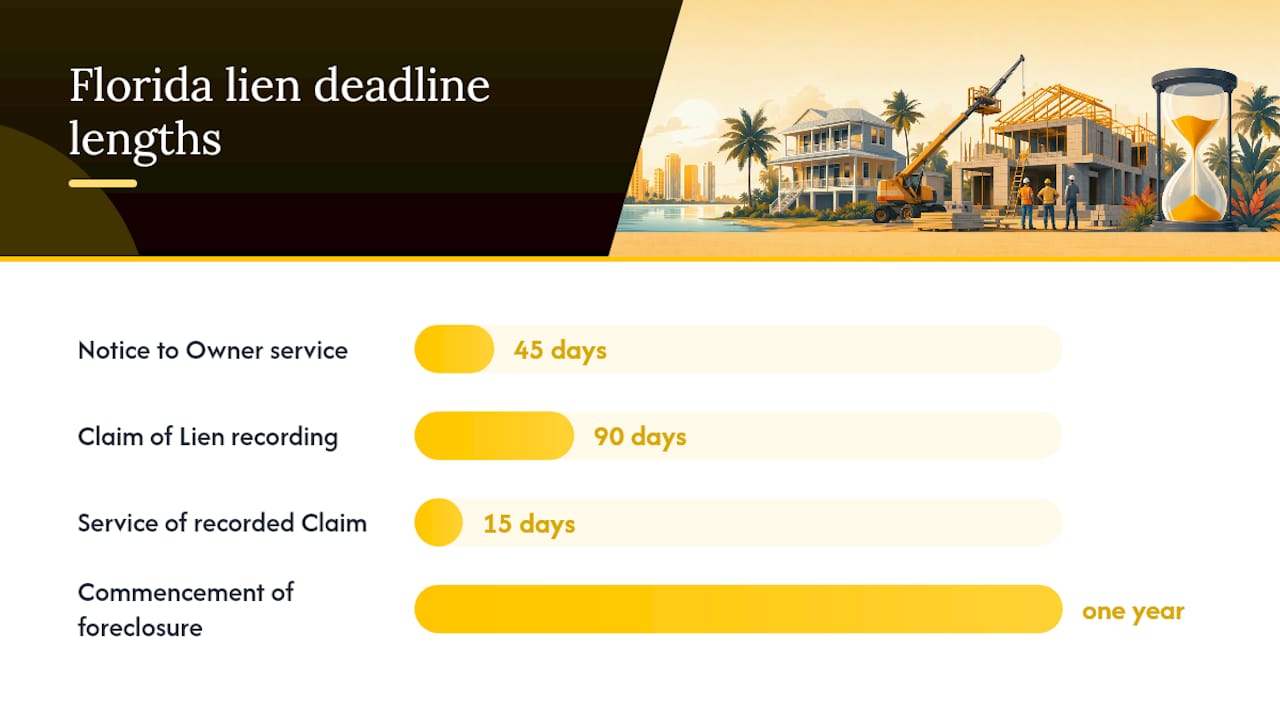
The one-year lien life is a hard cutoff. Under s. 713.08, a recorded lien remains valid for one year from the date of recording unless a foreclosure action or other legal proceeding to enforce or discharge it is commenced within that period. Once the year expires without action, the lien is extinguished by operation of law.
Deadline computation follows Florida's statutory time-calculation rules. When a deadline falls on a Saturday, Sunday, or legal holiday, or on a day when the clerk's office is closed, the deadline extends to the next business day. The Online Sunshine portal contains the chapter's time-computation provisions, which govern how these extensions are calculated.
- Build a project-specific deadline calendar at the start of every job
- Set internal alerts at 30 days, 15 days, and 5 days before each statutory deadline
- Never rely on the owner or contractor to notify you of critical dates
- Document the first and last dates of furnishing in writing at the time they occur — do not reconstruct them later from memory
How do priority rules and extent limits affect multiple lienors?
When multiple lienors record claims against the same property, Florida law determines the order in which they are paid and caps the total amount recoverable. Priority is not simply first-to-record; the statute applies specific rules based on the type of lienor and the structure of the direct contract.
Priority basics:
- Liens arising under a single direct contract generally share equal priority among themselves, regardless of recording order.
- Liens under different direct contracts are prioritized by the date of recording of the respective Notices of Commencement.
- A construction mortgage recorded before the Notice of Commencement generally has priority over construction liens arising after it — but this interplay is fact-specific and requires careful review of recording dates.
Extent limits under s. 713.12: The total amount of all liens arising from a single direct contract cannot exceed the contract price, less any payments the owner has properly made to the contractor before receiving notice of a lien claim. This cap protects owners from paying more than the agreed contract price in total, even when multiple subcontractors and suppliers file separate claims.
When available funds are insufficient to satisfy all lienors under a direct contract, courts allocate on a pro rata basis within each class of lienors. A practical example: if a direct contract is priced at $200,000 and the owner has paid $150,000 to the contractor, the maximum pool available to all lienors under that contract is $50,000. If a subcontractor claims $40,000 and a material supplier claims $30,000, each receives a pro rata share of the $50,000 pool — not the full amount of their respective claims.
- Lienors in privity (contractors) are generally paid before those not in privity, within the same contract
- Pro rata allocation applies within each class when funds are insufficient
- Mortgage priority relative to construction liens depends on recording dates and the structure of the financing
- Investors and lenders should review title commitments and lien searches before each draw disbursement
For investors using hard money lending to finance construction or rehab projects, understanding lien priority is directly relevant to collateral assessment and draw management.
How is a construction lien enforced, and what are the cost exposures?
A recorded Claim of Lien does not automatically result in payment. The claimant must take affirmative steps to enforce it, and the enforcement process carries real cost exposure for both sides.
Available enforcement procedures under Florida law:
- Retention of possession — available in limited circumstances where the lienor retains physical possession of the improved property
- Action in chancery (foreclosure) — the most common enforcement route; the claimant files a lawsuit to foreclose the lien and force a judicial sale of the property
- Ordinary action at law — a standard civil lawsuit for the unpaid amount, available in addition to or instead of foreclosure
- Special action — available in specific statutory circumstances
- Summary action — an expedited proceeding available under F.S. 85.011 for persons in privity with the owner
Under F.S., that fee exposure is a material risk for owners who contest a valid lien claim without a legitimate defense — and it is a meaningful incentive for claimants to pursue summary enforcement when the facts support it.
Enforcement step sequence:
- Record the Claim of Lien within the 90-day window.
- Serve a copy on the owner within 15 days of recording.
- Send a written demand for payment, specifying the amount owed and a reasonable response deadline.
- If payment or a negotiated resolution is not reached, file a foreclosure action in the circuit court of the county where the property is located — within one year of recording.
- Proceed through litigation; if successful, obtain a judgment and order of foreclosure.
- The property may be sold at judicial sale to satisfy the judgment.
Owner defenses and preservation steps:
- Verify the claimant's license status immediately upon receiving a lien notice
- Challenge service of the NTO if it was late or improperly delivered
- Examine the Claim of Lien for missing required content
- Post a lien transfer bond to remove the lien from the property while the dispute is resolved
- File a motion to discharge the lien if it is facially defective or time-barred
Owners who believe a lien is invalid should act quickly. Allowing a lien to sit uncontested for months can complicate title, delay closings, and affect financing. Investors who need to understand how liens interact with tax lien exposure and financing options should review both the statutory framework and their lender's draw conditions before proceeding.
Does an unlicensed contractor lose all lien rights?
Yes. Section 713.02 explicitly bars unlicensed contractors, subcontractors, and sub-subcontractors from asserting lien rights under Chapter 713. The policy rationale is straightforward: Florida's contractor licensing system protects consumers from unqualified work, and extending lien rights to unlicensed parties would undermine that protection by giving them a coercive collection tool.
The bar applies regardless of the quality of the work performed or the legitimacy of the payment claim. An unlicensed contractor who completes a renovation perfectly and is not paid still has no lien rights. The owner's defense is categorical, not factual.
How to verify licensure:
- Search the Florida Department of Business and Professional Regulation (DBPR) online license lookup at myfloridalicense.com
- Confirm the license type matches the scope of work (e.g., general contractor, electrical, plumbing)
- Verify the license is active and not suspended, revoked, or expired
- Record the license number and expiration date in the contract file at the time of signing
Recommended contract clause language: Require the contractor to represent and warrant in writing that it holds all required licenses, and require delivery of a copy of the license certificate before work begins. Tie final payment to confirmation that all subcontractors and sub-subcontractors are also properly licensed.
One important nuance: even when a contractor is unlicensed and barred from lien rights, other parties on the project — licensed subcontractors, material suppliers — may retain their own independent lien rights. The unlicensed status of the prime contractor does not automatically extinguish the rights of downstream parties who are themselves properly licensed. Bond claims may also remain available to certain parties even when lien rights are lost.
What types of lien waivers and releases should you collect?
Lien waivers and releases are the primary tool owners and lenders use to confirm that payment has been received and lien rights have been relinquished. Collecting the wrong type of waiver — or collecting it at the wrong time — can leave an owner exposed to a valid lien claim even after full payment.

Four waiver types and their legal effect:
| Waiver Type | When Effective | Risk if Misused |
|---|---|---|
| Conditional partial waiver | Upon receipt of specified progress payment | Claimant retains rights if payment is not actually received |
| Unconditional partial waiver | Immediately upon execution | Owner releases claimant's rights for work to date regardless of payment |
| Conditional final waiver | Upon receipt of final payment | Claimant retains rights if final payment is not actually received |
| Unconditional final waiver | Immediately upon execution | Complete release of all lien rights; no recourse if payment fails |
The distinction between conditional and unconditional is critical. An unconditional waiver signed before the check clears leaves the claimant with no lien rights even if the payment is later dishonored. Claimants should never sign an unconditional waiver until payment has been confirmed received.
When to collect waivers:
- At each progress payment milestone: collect a conditional partial waiver from the contractor, and require the contractor to deliver conditional partial waivers from all subcontractors and material suppliers who have served NTOs
- At final payment: collect a conditional final waiver from the contractor and all downstream parties, then exchange for unconditional final waivers once payment clears
- Before closing on a sale or refinance: confirm all waivers are unconditional and cover the full scope of work
Fields a valid waiver should include: name of the claimant, name of the owner, property description, amount of payment covered, scope of work covered, date, and signature of the authorized representative.
Pro Tip: Tie every disbursement — including draw payments on a construction loan — to receipt of properly executed conditional waivers from all parties who have served NTOs. Require the contractor's final payment affidavit (confirming all subs and suppliers have been paid) before releasing the final draw. Pinellas County's guidance specifically recommends this practice as a core owner protection.
What should owners and claimants do immediately after a lien is recorded?
The 72 hours after a Claim of Lien is recorded are the most consequential period in any lien dispute. Both owners and claimants have specific, time-sensitive actions to take.
Owner checklist — first 72 hours:
- Obtain a certified copy of the recorded Claim of Lien from the Clerk of Circuit Court.
- Verify the claimant's license status through the DBPR license lookup.
- Confirm whether the claimant served a timely Notice to Owner — check the date of first furnishing against the 45-day window.
- Review the Claim of Lien for missing required content (any omission may be a defense).
- Demand the contractor's final payment affidavit and all outstanding lien releases.
- Notify your lender immediately — most construction loan agreements require prompt disclosure of recorded liens.
- Consult a Florida construction attorney to evaluate whether to post a transfer bond, file a motion to discharge, or negotiate a release.
Claimant checklist — first 72 hours:
- Confirm the recorded claim contains all required content under s. 713.08.
- Verify that the NTO was served within the 45-day window and that proof of service is in the file.
- Assemble all supporting documentation: contracts, invoices, delivery receipts, photographs of work in place, and payment records.
- Calculate the one-year enforcement deadline from the recording date and calendar it immediately.
- Send a written demand for payment to the owner and contractor via certified mail.
Sample demand-for-release letter fields: date of letter; claimant's name, address, and license number; property description and recording information for the Claim of Lien; amount claimed; demand for payment or written dispute within a specified period (typically 10–14 days); statement that failure to respond will result in commencement of foreclosure proceedings. Deliver by certified mail with return receipt requested.
When to escalate: if the owner does not respond to a demand within the stated period, or if the owner's response disputes the claim without offering a credible basis, the claimant should file the foreclosure action before the one-year deadline. Negotiating past the deadline without a tolling agreement is a common and costly mistake.
What mistakes most often invalidate a Florida construction lien?
The most common lien failures are procedural, not substantive. A claimant with a completely legitimate payment claim can lose all enforcement rights because of a missed notice or a deficient affidavit.
Top pitfalls:
- Failing to serve the NTO on time — the single most common fatal error; the 45-day window runs from first furnishing, not from when payment is first disputed
- Waiting until day 89 or 90 to record — leaves no time to correct a rejected or deficient filing; the clerk's office may have a processing backlog
- Missing required content in the Claim of Lien — omitting the NTO service date and method when required, or leaving the first/last furnishing dates blank
- Serving the NTO on the wrong party — sending to the contractor's office instead of the owner's address listed on the Notice of Commencement
- Poor recordkeeping — inability to produce proof of service, delivery receipts, or contemporaneous records of first and last furnishing dates
- Failing to verify licensure — proceeding without confirming that all parties in the chain are properly licensed
Best-practices checklist:
- Retain all project documents (contracts, purchase orders, delivery tickets, invoices, correspondence) in a single organized file
- Use certified mail for every statutory notice and retain tracking numbers and signed receipts
- File the Claim of Lien by day 60–75 to preserve a cure window
- Require lien releases in every subcontract and supply agreement as a condition of payment
- Obtain a final payment affidavit from the contractor before releasing the final disbursement
Pro Tip: Maintain a project log that records the date of first furnishing, the date of last furnishing, the date and method of every notice served, and the date and amount of every payment made or received. This log is the single most useful document in any lien dispute — and the one most parties fail to keep.
Where can you find official forms and templates for Florida lien documents?
Official forms and recording instructions are available through the Clerk of Circuit Court in each Florida county. There is no single statewide form that all counties require, but the statutory content requirements under Chapter 713 apply uniformly. County clerks often publish sample forms and recording fee schedules on their websites.
Where to find forms and recording information:
- Clerk of Circuit Court (county-specific): Search "[county name] Clerk of Circuit Court recording" for the local e-recording portal, fee schedule, and any county-specific form requirements
- Pinellas County: Florida Lien Law Information — includes practical owner guidance, sample checklists, and links to recording procedures
- Online Sunshine (leg.state.fl.us): Provides the full statutory text of Chapter 713 and printable statute pages for reference
- flsenate.gov: The Florida Senate's official statute portal with the 2024 version of Chapter 713
Field-level template: Claim of Lien
| Field | Required Content |
|---|---|
| Lienor name and address | Full legal name and mailing address of the claimant |
| Owner name and address | As listed on the Notice of Commencement |
| Property description | Legal description from the deed or NOC; street address |
| Description of work/materials | General description sufficient to identify the scope |
| Person furnished to | Name of contractor, subcontractor, or owner who ordered the work |
| Amount unpaid | Dollar amount after all credits and setoffs |
| First furnishing date | Date labor, services, or materials were first provided |
| Last furnishing date | Date labor, services, or materials were last provided |
| NTO service date and method | Required if NTO was required; state date and delivery method |
| Signature and notarization | Signed under oath by lienor or authorized agent |
Printable filing checklist:
- Certified copy of recorded Claim of Lien (with book/page number)
- Proof of NTO service (certified mail receipt, signed green card)
- Certified copy of Notice of Commencement
- Copies of all contracts, purchase orders, and invoices
- Delivery receipts and photographs of work in place
- Final payment affidavit (owner's copy)
- All executed lien waivers and releases
- Attorney's contact information and enforcement deadline calendar
Recording fees vary by county and by the number of pages in the document. Contact the local clerk's office or check the online fee schedule before submitting. Most Florida counties now offer e-recording through approved vendors, which can reduce processing time.
Quick-reference timeline of every statutory deadline
| Deadline | Triggering Event | Statute | Fatal if Missed? |
|---|---|---|---|
| Notice of Commencement recorded | Before work begins | s. 713.13 | Yes — owner loses statutory protections |
| Notice to Owner served | Before commencing or within 45 days of first furnishing | s. 713.06 | Yes — complete defense to enforcement |
| Claim of Lien recorded | Within 90 days of final furnishing | s. 713.08 | Yes — lien right extinguished |
| Recorded Claim of Lien served on owner | Within 15 days of recording | s. 713.08 | May affect enforceability |
| Foreclosure action commenced | Within one year of recording Claim of Lien | s. 713.08 | Yes — lien expires by operation of law |
The NTO deadline and the 90-day recording deadline are the two most frequently missed and the two most consequential. Both are measured from objective, documentable dates — first furnishing and last furnishing — which is why contemporaneous project logs are indispensable.
When a deadline falls on a weekend or a day the clerk's office is closed, Florida's time-computation rules extend the deadline to the next business day. The Online Sunshine portal contains the governing time-computation provisions. Do not assume a weekend extension applies without confirming it against the statute — and never plan to use the extension as a buffer.
Why Florida lien law matters more than most investors realize
Florida's construction lien statute is one of the most technically demanding in the country. The procedural requirements are not formalities — they are the mechanism by which the legislature balanced the competing interests of unpaid contractors and property owners who need clear title. When those procedures are followed correctly, the system works. When they are not, the consequences fall entirely on the party who failed to comply.
For real estate investors, the stakes extend beyond any single project. A recorded lien on a property under renovation can freeze a refinance, delay a sale, and trigger default provisions in a construction loan agreement. Lenders conducting draw reviews will flag unresolved liens before releasing funds. Title companies will not insure a property with an open lien claim. The practical effect is that a single procedural failure by a subcontractor — or an owner who did not collect proper releases — can halt a project's entire financing structure.
The investor-specific lesson is this: lien compliance is not the contractor's problem alone. Owners and investors who treat lien management as a back-office administrative task, rather than a front-line risk management function, consistently find themselves in disputes that could have been avoided with a $50 certified mail receipt and a properly timed Notice of Commencement. Documentation and timing decide outcomes in this statute. There is no equitable exception for good intentions.
For investors with questions about financing structures that account for lien risk — including how liens affect collateral assessment and draw management — Jaken Finance Group's resources on private money lending for real estate address the intersection of lien exposure and asset-based underwriting.
Sources
The sources below are the authoritative references for verifying statutory language, obtaining forms, and confirming county-specific recording procedures. Official statute pages take precedence over any secondary guide, including this one.
- Chapter 713 - 2024 Florida Statutes - The Florida Senate
- 713.08 Claim of lien — Florida Statutes (Online Sunshine)
- Florida Lien Law Information - Pinellas County
To confirm county-specific recording fees and form requirements, contact the Clerk of Circuit Court in the county where the property is located. Most Florida county clerks maintain online portals with current fee schedules and e-recording instructions. Procedural details — particularly recording fees and accepted document formats — change periodically and should be verified directly with the clerk before submission.
This article provides general information about Florida lien law and is not a substitute for legal advice. Statutory requirements, deadlines, and county-specific procedures can change. Consult a licensed Florida construction attorney to confirm current rules and to evaluate your specific situation before taking any legal action.
Financing a Florida construction or rehab project? If a lien dispute is affecting your project's cash flow or your ability to close, Jaken Finance Group provides asset-based hard money and fix-and-flip loans designed for speed and flexibility. Learn how 100% fix-and-flip financing works and what lenders require — or explore asset-based loan structures that focus on property value rather than credit score.