
High-leverage financing fits your flip when your projected margin, after every fee and interest charge, still leaves a buffer of at least 10 to 15 percent against downside scenarios, and when speed-to-close determines whether you win the deal at all. Two checks matter before you sign anything: your margin buffer at a stressed ARV, and your realistic timeline to resale. If either fails, the checklist later in this guide tells you what to fix first.
TL;DR:
- Leverage is most effective when your project maintains a minimum 10 to 15 percent margin buffer after fees and interest, considering stressed ARV scenarios.
- Loan-to-cost and after-repair value caps determine how much funding you get and should align with your deal's scope, market conditions, and your profit targets.
- Draw speed, inspection process, and contingency handling often impact final margins more than the advertised interest rate and should be prioritized in lender selection.
- Cost overruns or lower-than-expected ARV can break high-leverage deals, so building a contingency budget of 10 to 15 percent and having a clear exit plan is essential.
- Asset-based underwriting from lenders like Jaken Finance Group allows funding based on property strength rather than personal credit, enabling quicker closings and higher leverage.
Table of Contents
- What Counts as High-Leverage Fix-and-Flip Financing?
- How Do LTC, LTV, ARV, and the 70% Rule Actually Work?
- What Trade-Offs Matter More Than the Headline Leverage Number?
- How Do You Choose the Right High-Leverage Loan for Your Deal?
- How Jaken Finance Group Underwrites High-Leverage Fix-and-Flip Loans
- Before You Apply: Checklist and a Quick Sensitivity Test
- Managing Risk on a High-Leverage Flip
- What Does a High-Leverage Flip Timeline Actually Look Like?
- What Does a High-Leverage Loan Actually Cost, Start to Finish?
- What Happens If the Flip Doesn't Go as Planned?
- The Real Advantage of High Leverage Is Discipline, Not Debt
- Jaken Finance Group Programs Built for High-Leverage Flips
- Sources
What Counts as High-Leverage Fix-and-Flip Financing?
High leverage in this market means a lender fronting a large share of both purchase price and rehab costs, sometimes close to the full project budget, secured primarily against the property rather than your personal credit. Four structures dominate the U.S. private lending market for flips, and each handles leverage differently.
- Bridge loans: Built to cover the gap between buying a property and either selling it or refinancing into permanent financing. Bridge loans work well when a flip might turn into a hold.
- Rehab and rehab-to-perm loans: Fund the purchase plus construction draws, then some convert into a longer-term loan if you decide to rent instead of sell.
- DSCR pivot programs: Not a flip loan at the outset, but a refinance exit for investors who complete the rehab and decide the numbers work better as a rental.
Lenders anchor high leverage two ways: loan-to-cost (LTC), which caps funding against your total purchase-plus-rehab budget, or after-repair value (ARV), which caps funding against the finished property's projected worth. LTC-based offers tend to produce the highest up-front leverage on lower-priced deals, while ARV-based caps often unlock more dollars on properties with strong post-renovation upside. Draw speed varies just as much as leverage: some programs fund the first draw within days of closing, others require a completed inspection cycle before releasing a dollar, which is exactly where private rehab lenders tend to outpace federally backed programs on turnaround time.
How Do LTC, LTV, ARV, and the 70% Rule Actually Work?
These four terms decide how much cash you bring to the table, and confusing them is the fastest way to misjudge a term sheet.
- LTC (loan-to-cost): Loan amount divided by total project cost (purchase price plus rehab budget). A 90% LTC offer on a $250,000 total cost funds $225,000, leaving you $25,000 to cover.
- LTV (loan-to-value): Loan amount divided by current appraised value, most relevant on bridge or DSCR-pivot financing rather than ground-up rehab deals.
- ARV (after-repair value): The property's projected market value once renovations are complete. Lenders use it to cap total exposure regardless of what you paid.
- The 70% rule: A flipping heuristic stating your total investment (purchase plus rehab) should not exceed 70% of ARV, minus a profit margin. It works best as a rough screen on retail deals; lenders often ignore it in favor of straight LTC or ARV math on off-market or wholesale purchases.
Statistic Callout: Leverage math cuts both ways: the same debt load that multiplies your return on a winning flip multiplies your loss on a deal that runs over budget or misses ARV.
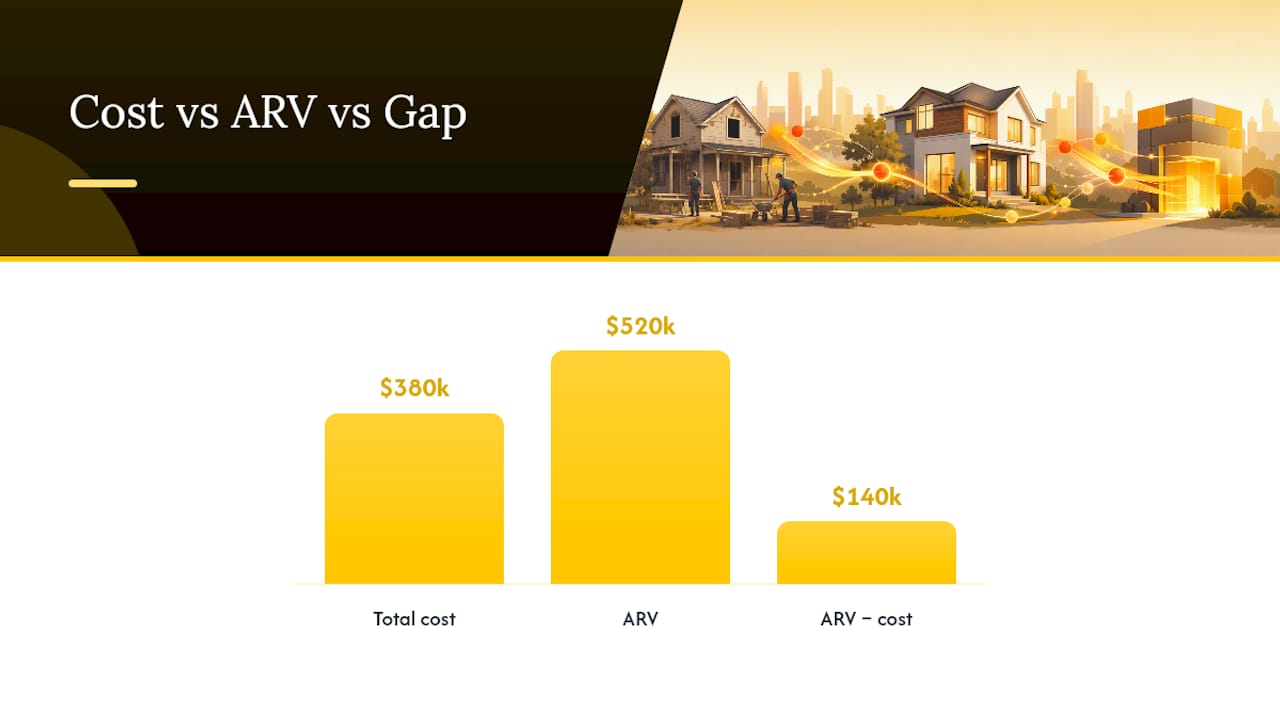
Here is the dollar impact on a $300,000 purchase plus $80,000 rehab budget, or $380,000 total cost, against a $520,000 ARV. At a high LTC level, you fund most of the total cost and bring a smaller amount of cash to closing. At an ARV-based cap, the lender funds a substantial amount that can cover the full total cost and leave room for a contingency draw. The ARV-based structure produced more available capital here because the spread between cost and ARV was wide. On a thinner-margin deal, the LTC structure often wins because it does not penalize you for a modest ARV.
What Trade-Offs Matter More Than the Headline Leverage Number?
A lender advertising 95% LTC means little if draw delays or fee stacking eat your margin before the first coat of paint dries. Four cost components deserve line-by-line scrutiny on every term sheet.
- Interest and points: Short-term rehab loans commonly carry rates and origination points in the ranges hard-money lenders publish, and points are charged on the full loan amount, not just funds disbursed.
- Draw and inspection fees: Each construction draw may trigger a third-party inspection charge, often $150 to $300 per visit, plus processing time that adds days to your rehab schedule.
- Prepayment terms: Some lenders charge a minimum interest period even if you sell early; others let you pay off penalty-free after a set number of months.
Draw speed affects more than convenience. A lender that takes 10 business days to release a draw after inspection can stall your contractor's crew, and idle labor plus extended interest carry compounds fast on a 6-month loan. Experienced investors note that draw speed and repayment flexibility often matter more to final margin than the lowest advertised APR.
Cost overruns and ARV shortfalls are the two events that break high-leverage deals. A loan with no contingency buffer turns the same overrun into an out-of-pocket emergency.
Pro Tip: Ask every lender how draw requests are inspected, whether it is a third-party visit or photo-based approval, before you compare interest rates. A photo-based draw process can save a week per draw on a multi-draw rehab.
How Do You Choose the Right High-Leverage Loan for Your Deal?
Run every term sheet through the same checklist so you compare apples to apples instead of getting distracted by whichever number the lender leads with.
- Confirm the allowed LTC and ARV caps, and ask which one governs your specific deal.
- Ask what percentage of the rehab budget is actually funded versus held back.
- Get the exact draw schedule: number of draws, inspection method, and typical turnaround time.
- Confirm days-to-close on a realistic, not best-case, file.
- Ask whether the loan is recourse or non-recourse, and what that means if the flip underperforms.
- Clarify inspection rules for both the initial appraisal and mid-construction draws.
- Ask how the lender handles a rehab budget overrun. Is there a contingency reserve or do you need a change order approved mid-project?
- Confirm exit expectations. Does the loan require a sale, or can it convert to a DSCR rental loan if your plans change?
Beyond the checklist, come prepared with these conversational questions:
- "What is your realistic days-to-close on a file like mine, not your marketing number?"
- "What happens to my rate or points if my exit takes three months longer than planned?"
- "Can I see a sample draw schedule from a recently funded deal?"
Weighting speed against price depends on your margin and experience level. A first-time flipper with a tight margin should prioritize price and contingency flexibility over speed, since a slower close rarely kills a deal with room to negotiate. A repeat investor competing on off-market inventory with a 20%+ margin can often justify paying more in points to lock a five-day close and win the property outright.
How Jaken Finance Group Underwrites High-Leverage Fix-and-Flip Loans
Asset-based underwriting means the property's purchase price, condition, and ARV drive the loan decision, not your personal credit history. Jaken Finance Group's underwriting approach evaluates the deal itself, which is why investors with inconsistent credit or a thin track record can still qualify for aggressive leverage when the property numbers support it.
Programs built around this model include:
- High-LTC options, including programs structured toward 100% of purchase and rehab cost on qualifying deals, detailed in Jaken Finance Group's 100% financing requirements.
- Closings in as few as five days on files with complete documentation.
- A rehab draw process designed around funded renovation costs rather than rigid milestone gates.
Funding-ratio success stories published by the firm illustrate the practical outcome of this approach: investors closing on properties that traditional lenders would have declined on credit alone, funded instead on the strength of the asset and the exit plan.
Before You Apply: Checklist and a Quick Sensitivity Test
Gather these before you call a lender: signed purchase contract, itemized contractor bid, three comparable sales, a written scope of work, and proof of builder's risk insurance. Lenders move faster when the file arrives complete.
Run a three-case sensitivity test on every deal before accepting a term sheet.
| Scenario | ARV Assumption | Rehab Budget | Flag If |
|---|---|---|---|
| Baseline | As appraised | As bid | Margin below 10% |
| ARV stress | ARV minus 10% | As bid | Margin below 5% or negative |
| Cost stress | As appraised | Rehab plus 20% | Margin below 5% |
If either stress case turns your margin negative, renegotiate price, rehab scope, or loan terms before signing. Once you have a term sheet in hand, confirm draw mechanics and days-to-close in writing before you release your purchase contingency.
Managing Risk on a High-Leverage Flip
High leverage means less of your own cash absorbs a mistake, so risk management has to happen before you close, not after a problem shows up. Start with a contractor bid that itemizes scope, since vague bids are the single most common source of mid-project overruns. Get a second, independent comp pull on ARV rather than trusting the appraisal alone, especially in a market with wide price dispersion between blocks.
Build a rehab contingency of 10 to 15% into your budget request, even if the lender does not require one. That reserve is what separates a manageable surprise, a cracked slab, unexpected mold, from a stalled project waiting on emergency cash. Carry builder's risk insurance for the full rehab period and confirm your policy covers vacancy, since a standard homeowner's policy typically does not.
Match your loan term to a realistic timeline, not an optimistic one. A 6-month hard money loan on a project with a 5-month best-case timeline leaves zero room for permitting delays, weather, or a slow buyer. Extending a loan or refinancing under pressure almost always costs more than borrowing the extra two months up front. Finally, track your draw schedule against contractor payment timing. A mismatch between when a draw funds and when a subcontractor expects payment is a common, avoidable source of project delays.
What Does a High-Leverage Flip Timeline Actually Look Like?
From application to exit, a typical high-leverage fix-and-flip project runs 4 to 9 months, though timelines vary widely by scope and market.
Loan application and underwriting typically take several business days once the file is complete, with asset-based lenders on the faster end since the process leans on the property rather than exhaustive income documentation. Closing follows shortly after approval, with some private lenders funding quickly on straightforward deals.
Rehab execution is usually the longest phase, running several weeks depending on scope, from cosmetic refreshes to structural work. Draws are requested as phases complete, inspected, and funded, a cycle that repeats multiple times on a typical project. Listing and marketing typically begin as soon as final touches are done, sometimes overlapping with the last draw request to save time.
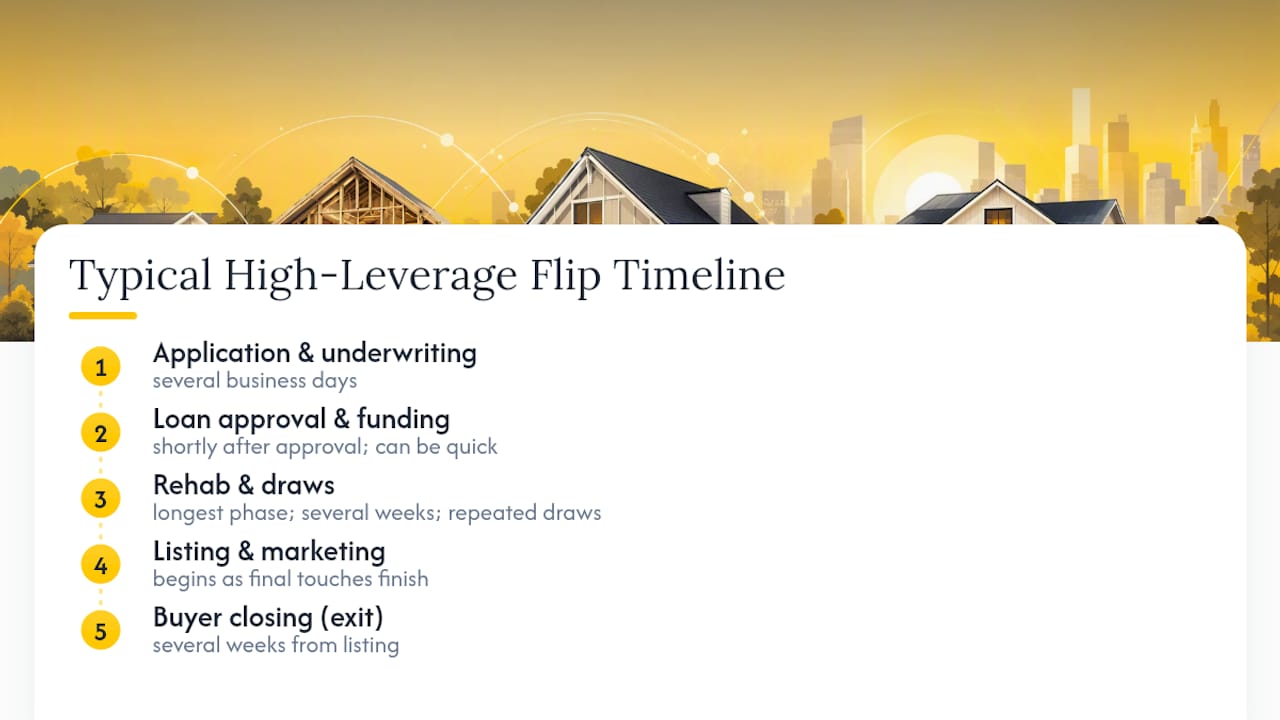
Closing with a buyer, the exit phase, generally takes several weeks from listing in a normal market, longer in a slow one. Add it up, and a project underwritten for a 6-month loan term often needs every one of those months, which is exactly why term length and realistic timeline need to match before you sign.
What Does a High-Leverage Loan Actually Cost, Start to Finish?
The headline interest rate is never the full cost. A realistic budget stacks four categories: interest, origination points, draw and inspection fees, and carrying costs.
Interest on short-term rehab loans typically runs in ranges published by active hard-money lenders, charged monthly on the outstanding balance, sometimes on the full committed amount depending on the lender's structure. Origination points, typically a small percentage of the loan amount, are charged once at closing. On a $360,000 loan, 2 points costs $7,200 before a single interest payment is due.
Draw fees add up fast on multi-draw projects. Inspection fees typically range per visit and can add several hundred to over a thousand dollars across multiple draws. Carrying costs, property taxes, insurance, utilities, and any loan extension fees, accumulate every month the property sits unsold. A project that runs two months past its planned exit can see carrying costs alone erase several thousand dollars of projected profit.
Investors should also account for the tax treatment of these costs. IRS Publication 535 outlines how loan interest and certain rehab expenses can be treated as deductible business expenses, which affects the true after-tax cost of borrowing and is worth reviewing with a tax professional before finalizing your project budget.
What Happens If the Flip Doesn't Go as Planned?
Every high-leverage flip needs a written exit plan B before closing, not after the rehab stalls. The most common contingency is converting the sale strategy to a rental hold, which is why DSCR pivot programs exist: they let an investor refinance a completed rehab into longer-term financing when the resale market softens or the ARV comes in lower than projected.
If a cost overrun eats into your contingency reserve, the next move is renegotiating draw amounts or requesting a short-term extension from your lender rather than pausing construction, since a half-finished property loses value faster than a finished one that sits on the market slightly longer. If the sale timeline slips, price adjustments in the first two weeks on market are almost always cheaper than the extra month of carrying costs from holding firm at an optimistic price.
The worst-case scenario, an ARV that comes in meaningfully below projection with no rental option, calls for an honest look at a discounted wholesale exit to a second investor rather than an extended hold that keeps interest accruing. Building this decision tree before you close, not during a crisis, is what separates investors who protect their capital from those who compound one bad assumption with another.
The Real Advantage of High Leverage Is Discipline, Not Debt
The conventional advice on fix-and-flip financing treats leverage as a shopping decision: find the highest LTC, lowest rate, done. That framing misses what actually determines outcomes. High leverage does not create profit. It removes the cushion that normally hides a bad assumption, which means the investors who do best with aggressive leverage are the ones who stress-tested their numbers before closing, not after a draw got delayed.
Where conventional guides fall short is treating draw speed and inspection process as a footnote next to the interest rate. In practice, a slow draw cycle on a tight-margin deal does more damage than an extra point of origination fee. Prioritize the lender's operational speed and contingency handling before you compare rate sheets. A five-day close and a responsive draw process on a well-underwritten deal will outperform a marginally cheaper loan that stalls your contractor twice.
— Jason Taken
Jaken Finance Group Programs Built for High-Leverage Flips
If you have run the sensitivity test and your margin holds up under stress, the next step is matching your deal to a program built for asset-based speed. Jaken Finance Group structures its fix-and-flip lending around the property, not your credit file, with programs that include leverage up to 100% of purchase and rehab cost on qualifying deals and closings in as few as five days.
These programs fit investors who have a complete file ready, a solid purchase contract, a real contractor bid, and comps that support the ARV, and who need capital to move as fast as the deal requires. Investors with inconsistent credit but a strong asset and clear exit plan are frequently the best fit, since the underwriting weighs the property and the numbers over a FICO score. If your next flip needs a decision measured in days rather than weeks, request a term sheet through Jaken Finance Group's application page and get a clear leverage number before your offer deadline passes.
Sources
Key references for this guide include HUD's 203(k) program rules, IRS Publication 535 on business expense treatment, and Federal Reserve G.19 consumer credit data for interest-rate context relevant to short-term investor loans.
- HUD — 203(k) Rehabilitation Mortgage Insurance
- IRS — Publication 535, Business Expenses
- Investopedia — Increase your real estate net worth through leverage strategies