
Hard money points are an upfront lender fee, calculated as a percentage of the loan principal, that you pay at closing rather than over time. One point equals 1% of the loan amount, and most hard money loans carry a range of points, commonly around a few percentage points, depending on risk and leverage. Points directly reduce your net cash at closing and raise your effective APR, increasing your overall loan cost, so comparing offers means comparing total dollars, not just headline rates.
TL;DR:
- Higher leverage and distressed properties typically lead to higher points due to increased lender risk.
- Paying points in cash at closing reduces the total upfront cost, while rolling them into the loan increases the principal and total interest paid.
- Short-term flips favor lower points even if the interest rate is higher, whereas longer holds may justify paying more upfront for a lower rate.
- Point costs can range from 1% to 4% of the loan size, significantly impacting total financing costs in short projects.
- Borrowers should compare total costs and real APRs, not just headline rates or percentage points, to accurately evaluate offers.
Table of Contents
- What Are Points on a Hard Money Loan?
- How Lenders Calculate Points and What Moves the Number
- Typical Point Ranges and What They Cost in Dollars
- How Points Change Your Closing Cash and ROI
- How to Lower Your Points and What to Demand in Writing
- A hard money and fix-and-flip lender underwrites loans on an asset-based basis, meaning the property's value, not the borrower's credit score, drives the terms, including points. This approach can enable closing deals quickly when documentation is complete, which matters because speed itself is one of the biggest levers borrowers have over point pricing.
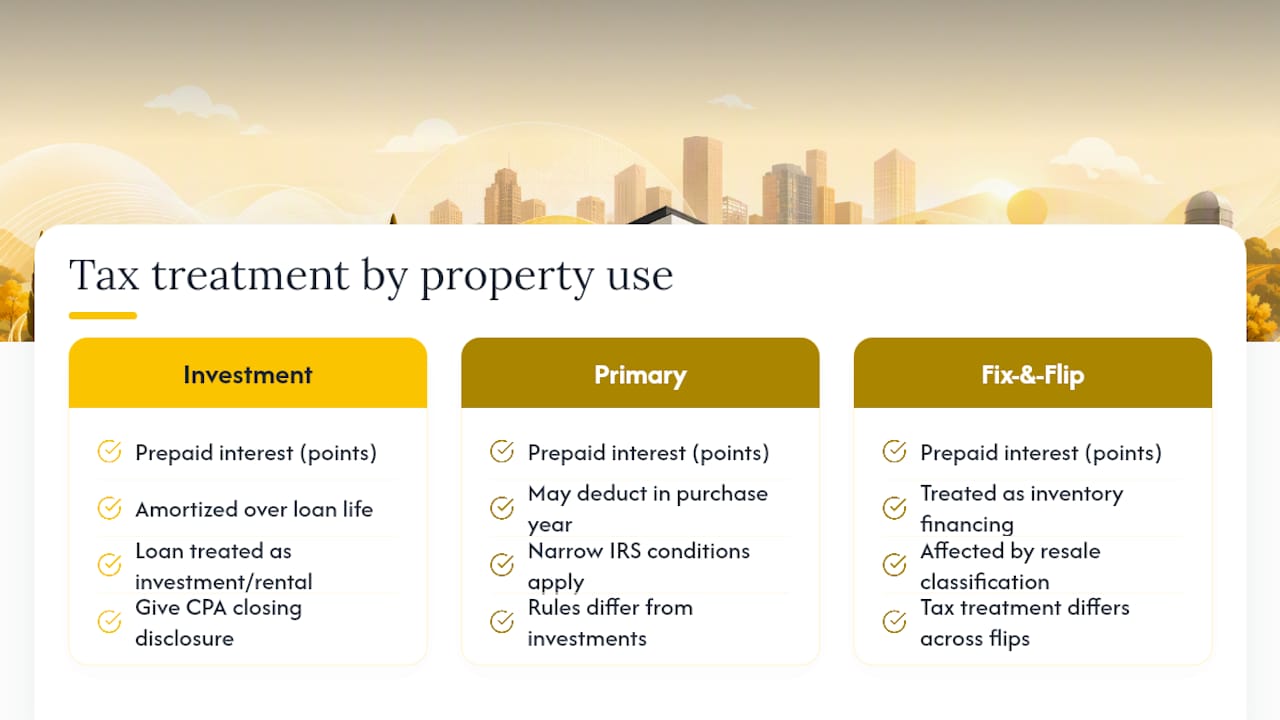
- Tax Treatment of Hard Money Points
- The Real Math Behind Points Nobody Talks About
- Get a Fast, Transparent Points Estimate
- Sources
- FAQ
What Are Points on a Hard Money Loan?
Points are percentage-based charges a lender collects upfront, separate from the interest rate you pay over the life of the loan. A single point equals 1% of your loan principal, paid at closing rather than amortized month by month, which makes points fundamentally different from interest, which accrues over time based on your outstanding balance. Hard money lenders lean on points because short-term deals often don't generate enough interest income alone to cover underwriting and administrative costs, according to Nav's breakdown of hard money mechanics.
Not all points work the same way. Understanding hard money points starts with knowing there are three common types:
- Origination points compensate the lender for processing, underwriting, and funding the loan. This is the most common charge on hard money deals.
- Discount points buy down your interest rate. Paying more upfront lowers your monthly rate, similar to conventional mortgage discount points.
- Extension points apply when you need to lengthen a loan term past its original maturity date, typically charged as an additional percentage if you can't sell or refinance on schedule.
Points are separate from third-party closing costs like title insurance, appraisal fees, and escrow charges. Those costs go to outside vendors, not the lender, and stack on top of points. Always request an itemized fee worksheet before closing so you can see exactly what's a lender charge versus a pass-through cost.
How Lenders Calculate Points and What Moves the Number
The math itself is simple: points (as a percentage) multiplied by the loan principal equals the dollar amount due at closing. A 3-point charge on a $150,000 loan comes to $4,500, due at the closing table alongside any other prepaid items.
What varies is the percentage a given lender charges, and that number moves based on several factors:
- Loan-to-value or loan-to-cost ratio. Higher leverage means higher risk to the lender, which usually pushes points up.
- Property condition and marketability. A distressed property in a slow market carries more exit risk, so lenders price that in.
- Borrower track record. First-time flippers often pay more points than investors with a documented history of completed projects.
- Loan size. Smaller loans sometimes carry higher point percentages because fixed underwriting costs get spread over less principal.
- Term length. Shorter terms compress the lender's window to earn yield, which can nudge points higher to compensate.
- Speed and documentation. A borrower who shows up with complete financials and a clear scope of work often closes faster and may negotiate fewer points than one who needs extensive back-and-forth.
Lenders charge points partly because short-duration loans need to generate yield upfront, since accruing interest over a few months rarely covers the cost of underwriting a deal quickly, per Nav's lending analysis.
Typical Point Ranges and What They Cost in Dollars
Hard money loans typically range from low to moderate points, though riskier deals or unusual property types can have higher points on some transactions, according to Shoprates' review of hard money loan terms. Here's what that looks like in real dollars across common loan sizes:
- $50,000 loan: 1 point costs $500; 2 points costs $1,000; 4 points costs $2,000.
- $200,000 loan: 1 point costs $2,000; 2 points costs $4,000; 4 points costs $8,000.
- $500,000 loan: 1 point costs $5,000; 2 points costs $10,000; 4 points costs $20,000.
Points get paid one of two ways. You can pay them in cash at closing, which reduces the money you bring to the table on the purchase itself but leaves your full loan proceeds untouched. Or you can roll points into the loan balance, which preserves cash on hand but increases the principal you're borrowing against and, in turn, the total interest you pay over the hold period. Rolling points makes sense when cash is tight; paying cash makes sense when you want to keep your loan balance, and therefore your monthly interest expense, as low as possible.
How Points Change Your Closing Cash and ROI
The formula is straightforward: net cash at closing equals your gross loan amount minus points minus third-party closing costs. A $200,000 loan with some points and typical third-party fees nets you less cash at closing than the loan amount.
Points also distort your effective APR in ways your monthly payment never shows. A loan quoted at 12% interest with 3 points paid upfront carries a real APR well above 12%, because the points function as prepaid interest compressed into a single lump sum rather than spread across the term. Experts generally recommend comparing total dollars, points plus interest plus fees, over your expected hold period, rather than comparing headline rates or points in isolation, according to Ambition Lending's guide to points versus interest rate.
Statistic Callout: A $200,000 loan with a few points and typical interest held for several months can have a total financing cost combining upfront fees and interest, a figure that The Credit People's worked example uses to illustrate how quickly points and short-term interest compound.
Here's how to work through a flip scenario yourself:
- Add total points paid in dollars to total interest accrued over your expected hold period.
- Add third-party closing costs on both the purchase and eventual sale or refinance.
- Subtract that combined figure from your projected profit to see your real, after-financing ROI.
Discount points that buy down your rate only pay off if you hold long enough to recoup the upfront cost. Lenders commonly offer some interest rate reduction per point, varying by lender and deal terms, so calculate your break-even month before agreeing to pay extra points for a lower rate, especially on a loan you expect to exit in under a year, per The Credit People's guidance on rate buy-downs.
How to Lower Your Points and What to Demand in Writing
You have more leverage over points than most first-time borrowers realize. A handful of levers tend to move the number:
- Bring more equity to the deal. A lower LTV signals less risk, and lenders routinely reward that with fewer points.
- Shorten your requested term. A tighter timeline reduces the lender's exposure window.
- Move fast on documentation. A clean, complete application package often earns a better quote than one that drags out underwriting.
- Use your track record. Repeat borrowers with a completed project history frequently negotiate lower points on subsequent deals.
- Get multiple quotes. Shopping two or three hard money lenders for your flip or rehab before committing gives you real leverage in the conversation.
Before you sign anything, request an itemized fee worksheet, a clear APR disclosure, and written confirmation of whether points are refundable if the loan falls through or rolls into the balance if you extend. Watch for lenders who bundle unrelated administrative charges under the "points" label. That's a common way hidden fees hide inside a number that sounds smaller than it actually is.
Pro Tip: Ask the lender to quote points as a flat dollar figure, not just a percentage, before you compare offers. It removes any ambiguity about what "3 points" actually costs on your specific loan amount.
A hard money and fix-and-flip lender underwrites loans on an asset-based basis, meaning the property's value, not the borrower's credit score, drives the terms, including points. This approach can enable closing deals quickly when documentation is complete, which matters because speed itself is one of the biggest levers borrowers have over point pricing.
Experienced lenders generally weigh points against rate differently than new investors expect. On a short six-to-nine-month flip, a lender would rather charge more in points and less in rate, since points get paid once while rate accrues daily against your balance. For a longer rental-to-hold strategy, the math flips.
To get an accurate points quote fast, have these ready:
- Purchase contract or property address
- Scope of work and renovation budget
- Proof of funds for your portion of the deal
- Recent comparable sales or an ARV estimate
Tax Treatment of Hard Money Points
Points paid on an investment property loan generally aren't deducted the same way owner-occupied mortgage points sometimes are. The Internal Revenue Service treats prepaid interest, which is what points functionally represent, under specific rules that depend on how the property is used and how the loan is classified.
For investment and rental property loans, points typically get amortized, deducted in portions, over the life of the loan rather than written off entirely in the year you pay them. That's a meaningful difference from a primary residence purchase, where certain point deductions can sometimes be taken in full in the year of purchase under narrower IRS conditions. Fix-and-flip loans complicate this further, since the property is held as inventory for resale rather than as a rental asset, which affects how financing costs get treated on your return.
The IRS Topic No. 504 on home mortgage points lays out the general framework for how prepaid interest is treated, but it doesn't cover every scenario an active investor runs into, especially across multiple flips in a single tax year with different loan structures. Given how much variation exists between origination points, discount points, and points rolled into a loan balance, this is one area where a qualified tax professional earns their fee. Get your CPA the closing disclosure from every loan you take out during the year rather than trying to reconstruct the numbers from memory later.
The Real Math Behind Points Nobody Talks About
Most guides to hard money points treat the topic like a vocabulary lesson: here's what origination points are, here's what discount points are, move on. That misses the actual decision investors face, which is a trade-off between two costs that behave completely differently over time. Points are fixed and front-loaded. Interest compounds against your balance for as long as you hold the loan. Treating them as interchangeable line items on a term sheet is how borrowers end up overpaying on deals they thought they'd priced correctly.
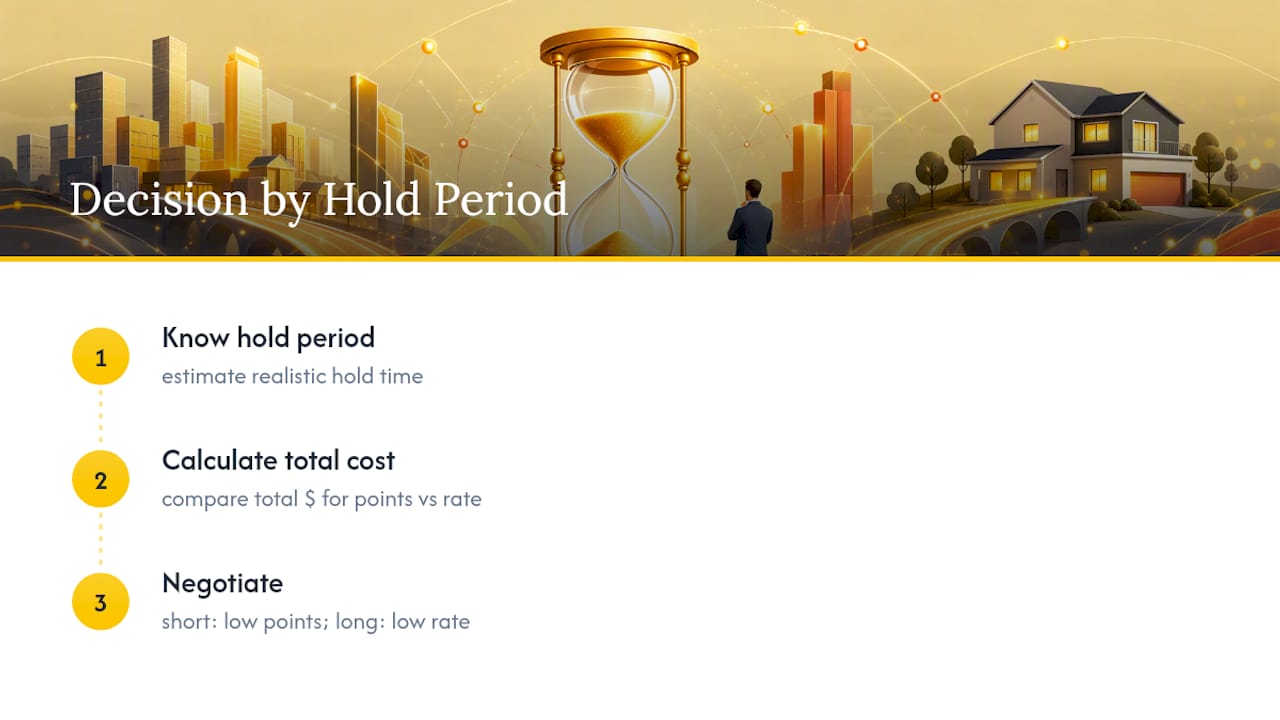
The conventional advice to "shop around for the lowest points" is incomplete advice. A lender charging 2 points at 13% interest can cost you more than one charging 4 points at 10.5% interest, depending entirely on your hold period. Short flips favor low points even at a higher rate. Longer holds flip that logic entirely. Investors who run both scenarios through actual numbers before signing consistently make better decisions than investors who anchor on whichever number looks the smallest on the term sheet.
What should come first isn't finding the lowest quote. It's knowing your realistic hold period cold, because that single number determines which cost, points or rate, deserves more of your negotiating energy.
— Jason Taken
Get a Fast, Transparent Points Estimate
Jaken Finance Group prices points based on the deal in front of you, not a generic credit-score matrix, because underwriting is built around the property's value and your exit plan rather than a FICO cutoff. That asset-based approach is why closings can happen in as few as five days once documentation is in hand, which matters most on competitive acquisitions or auction properties where timeline is the whole game.
Getting an accurate points quote fast comes down to preparation. Have your purchase contract, renovation scope, and a comparable sales estimate ready before you call, and the underwriting conversation moves considerably faster than it does for borrowers who show up with partial information. If your file has credit challenges or thin documentation, Jaken's asset-based hard money lending with no minimum credit score structures around the property's value rather than your credit profile. Ready to see what points and terms look like on your specific deal? Learn more about how asset-based lending works and start your application today.
Sources
- How Do Hard Money Loans Work? - Nav
- Hard Money Loan Terms Explained: Interest Rates, LTV, and Points - Shoprates
- Points vs Interest Rate: Compare Hard Money Offers - Ambition Lending
- IRS - Topic No. 504 Home Mortgage Points
FAQ
What do points mean on a hard money loan?
Points are an upfront lender fee equal to a percentage of your loan amount, paid at closing, with each point representing 1% of the total principal borrowed.
Are hard money points tax deductible?
Points on investment or fix-and-flip properties are generally amortized over the loan term rather than deducted in full the year they're paid, and the IRS recommends consulting a tax professional for your specific loan structure.