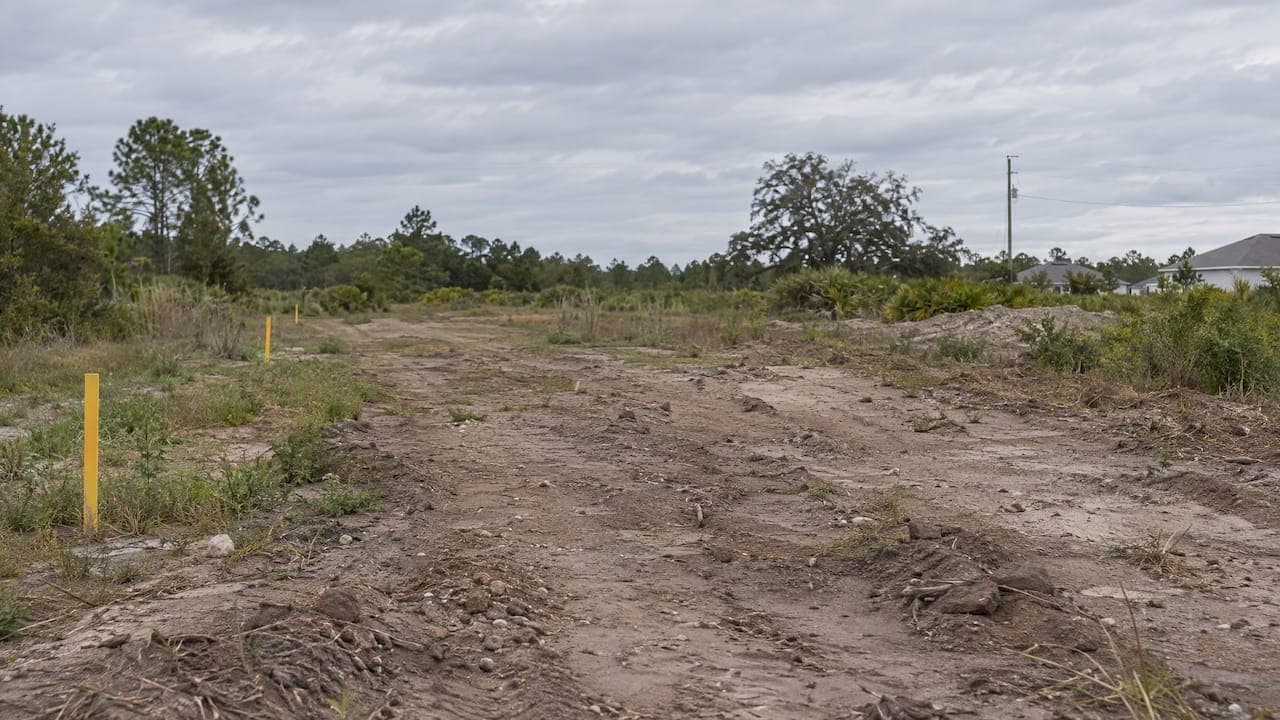
A hard money land loan is short-term, asset-based financing secured by a parcel of raw or improved land and issued by a private lender instead of a bank. The lender underwrites the land, the borrower's equity and the exit plan, not primarily the borrower's FICO score. This guide covers leverage, pricing, terms, documentation, compliance and the exit strategies that decide whether a land deal works.
TL;DR
- Hard money land loans are short-term (commonly 6 to 24 months), interest-only in most structures, and sized on land value and exit strategy rather than credit score.
- Leverage is lower on land than on a rehab: regulators set supervisory limits of 65% LTV for raw land and 75% for land development for banks, and private lenders typically price in the same risk.
- Improvements such as grading or utilities can reclassify a parcel from raw to improved land, which changes leverage and rate.
- The loan must be business purpose, and the file must document that. Misclassification creates legal exposure for the borrower and the lender.
- A land loan is a bridge. Plan the refinance, sale or construction takeout before you sign.
Table of Contents
- What a hard money land loan is
- How hard money land loan terms compare
- Why land is harder to finance than a house
- What lenders review on a land deal
- Business-purpose loans and compliance
- Exit strategies for a land loan
- Perspective
- Fund your land or ground-up project
- Checklist before you apply
- FAQ
- Sources
What a hard money land loan is
A hard money land loan finances the purchase or refinance of a parcel that has little or no income. Unlike a rental or a fix-and-flip, there is no building to rehab and no rent to cover the payment. That shapes everything: the lender looks at the land's market value, the zoning and entitlements, access to utilities and the borrower's plan to sell, subdivide, build or refinance.
Hard money is not the same as subprime lending. California's Senate banking committee backgrounder notes that the term has no statutory definition in that state and generally refers to lending by non-institutional sources. In practice, it serves investors with substantial equity or a strong project who cannot meet the documentation and timing demands of a bank, particularly on off-market or distressed parcels where speed decides who wins the contract.

Raw land versus improved land
Lenders classify land by its improvement status, and that classification drives leverage and pricing. The Federal Reserve's supervisory guidance on real estate lending standards lists separate maximum loan-to-value limits for categories such as raw land, land development, and construction. Private lenders are not bound by those limits, but they use the same logic to price risk.
| Land category | Typical condition | Supervisory LTV limit (banks) | What it means for you |
|---|---|---|---|
| Raw land | No utilities, no grading, no approved plans | 65% | Lowest leverage, highest equity requirement |
| Land development | Active site work, roads, utilities underway | 75% | More leverage, draw schedule and inspections |
| Improved or entitled lot | Utilities at the lot line, approved plat or permits | Varies by project | Often the best candidate for a construction takeout |
A practical point investors miss: minor site grading or existing utilities can move a parcel into a higher-leverage improved category. That can reduce the cash you need at closing, but it also changes the appraisal approach. Confirm the classification with your lender before you order the appraisal, not after.
How hard money land loan terms compare
Terms vary by lender, state and parcel. Market ranges reported by industry sources put most land deals at 6 to 24 months with interest-only payments and a balloon payoff, and LTVs of roughly 60% to 75% of appraised value. Treat these as general market ranges, not as a quote from any specific lender.
| Term | Typical hard money land structure |
|---|---|
| Loan term | 6 to 24 months, extensions sometimes available |
| Payments | Interest-only, or deferred interest on some programs |
| Leverage | Roughly 60% to 75% of land value, lower for raw land |
| Rate | Higher than bank land loans, priced by risk |
| Fees | Origination points plus third-party costs (appraisal, title, survey) |
| Credit | Secondary to land value, equity and exit |
| Closing speed | Days to a few weeks, depending on title and appraisal |
Pricing at Jaken Finance Group
Jaken Finance Group publishes a range of 8.99% to 13.5% for its new construction loans, which is the closest published pricing for ground-up work on a lot. Pricing for a specific land transaction depends on the parcel, leverage and exit, so request a scenario review rather than relying on a range. Our page on vacant land loans and raw land financing describes how we look at these deals.
Example: what a land payment looks like
Take a $200,000 land loan at an illustrative 12% interest-only. Annual interest is $24,000, or $2,000 per month. Add origination points: at 2 points, that is $4,000 at closing. Over a 12-month term, the carrying cost before taxes, insurance and due diligence is about $28,000, or 14% of the loan amount. The figure is arithmetic on assumed inputs, not a quote. It shows why a land hold with no income needs either a short timeline or a funded reserve.

This also answers a frequent search question: a $200,000 land loan costs far less per month on a long amortizing bank loan than on a short interest-only private loan, but the bank loan usually requires higher credit standards, more documentation and more time.
Why land is harder to finance than a house
Banks treat land as higher risk because it produces no income and is harder to resell in a downturn. Federal examination guidance on construction lending describes the general risk factors and controls lenders must manage, which is one reason conventional land financing is slow and conservative. Common results for borrowers are larger down payments, shorter amortization or balloon structures, and requirements for surveys, environmental review and proof of a build plan.
Hard money fills that gap for investors who have identified a deal with a clear value but a tight closing window. For a broader comparison, see our guide to hard money versus conventional financing.
What lenders review on a land deal
Expect the underwriting file to center on the parcel and the plan:
- Purchase contract and price. The lender compares the price with the appraised or broker-estimated value and sets leverage on the lower figure.
- Title and survey. Clear title, legal access and boundary confirmation. Landlocked or easement-restricted parcels are common reasons for a decline.
- Zoning and entitlements. Current zoning, permitted use, and the status of any approved plat, permits or variances.
- Utilities and site conditions. Availability of water, sewer or septic approval, power, and any environmental flags.
- Exit strategy. Sale, subdivision, refinance, or construction loan takeout, with a timeline that fits the term.
- Borrower entity and liquidity. The vesting entity (often an LLC), proof of down payment and reserves, and experience where relevant.
- Business-purpose documentation. A signed statement and supporting records of the investment purpose.
For the mechanics of submitting a file, our hard money application walkthrough lists the steps in order.
Business-purpose loans and compliance
Hard money land loans are generally made for business or investment purposes. That matters legally. TILA and Regulation Z do not apply to credit extended primarily for a business, commercial or agricultural purpose, but the creditor must determine in each case whether that standard is met.
Two cautions follow for investors:
- Document the purpose. Law-firm analysis from Hunton notes that compliance is less straightforward for business-purpose loans secured by residential real property. Keep records showing the land is held for investment or development, ideally in an entity.
- Do not use a business-purpose loan for personal consumer needs. Misapplying the exemption can strip consumer protections and create legal penalties. If you intend to build a personal residence on the parcel, speak with a real estate attorney before choosing a business-purpose product.
State rules also differ. Regulators have scrutinized hard money practices: in 2014, the New York Department of Financial Services opened an investigation into hard money loans secured by real estate structured with onerous terms. Check your state's licensing rules for private and commercial lenders, and ask a lender to explain any deed-in-lieu provision at origination before signing.
Exit strategies for a land loan
Because the loan is a balloon structure with a short maturity, the exit is the real underwriting question. Common routes:
- Sell the parcel after entitlements, a lot split or a rezoning increases its value.
- Refinance into longer-term debt once the land is improved or a lease or use produces income.
- Take out with a construction loan and move into vertical build. See our new construction loan page for ground-up options.
- Pay off from a related sale, such as a completed project elsewhere in your portfolio.
Build contingency into the timeline. Permitting, utility connections and municipal review often run longer than a first schedule assumes. Ask about extension terms and their cost before closing, and read our breakdown of hard money exit strategy and repayment options for how balloon payoffs and extensions work.
Perspective
We see most land deals fail on timing and equity, not on credit. An investor finds a parcel at a discount, the seller wants a quick close, and a bank cannot move in the window. Asset-based underwriting exists for that situation. Our approach is to evaluate the property, the leverage and the exit, with no minimum credit score, and to move quickly: we describe closings as fast as 7 to 10 days when title and the file are in order.
The discipline that separates profitable land investors is the carry calculation. Land has no rent, so every month of interest-only payments, taxes and insurance comes from reserves. We encourage investors to model the loan at the full term plus one extension, then ask whether the deal still works. If it does, the loan is a tool. If it does not, a lower leverage point or a different strategy is the better answer.
We also push borrowers to settle the classification question early. Whether a parcel is raw, partly improved or entitled changes the leverage and the draw structure, and it is cheaper to learn that before the appraisal.
— Jason Taken
Fund your land or ground-up project
If the parcel is the first step in a larger build, Jaken Finance Group offers asset-based financing for investors, including new construction, bridge and commercial property loans, with deferred payment options and nationwide coverage. Review the full list of real estate financing options, or send a deal for review through the pre-qualification form. Need financing for your next project? Start with the parcel, the plan and the exit.
Checklist before you apply
- Executed purchase contract and the seller's closing deadline.
- Survey, title commitment and confirmation of legal access.
- Zoning verification letter or municipal confirmation of permitted use.
- Utility availability and septic or sewer approvals where relevant.
- Entity documents (articles, operating agreement, EIN).
- Proof of down payment, closing costs and interest reserves.
- A written exit plan with dates and a fallback.
For timing expectations, see our hard money closing timeline.
FAQ
Is it hard to qualify for a hard money land loan?
Qualification centers on the land, your equity and your exit plan rather than credit score. The main hurdles are lower leverage on raw land, clear title and access, and a believable timeline to sell, refinance or build. Investors who bring a solid down payment and clean documents tend to move fastest.
How much can I borrow against raw land?
It depends on the lender, but market ranges commonly fall between 60% and 75% of appraised value, and raw land sits at the low end. Federal supervisory guidance sets a 65% limit for raw land for regulated banks, which private lenders often use as a reference point.
What are the downsides of a hard money loan?
Costs are higher than bank loans, terms are short, and most structures end in a balloon payoff. On land, there is no income to cover payments, so reserves matter. Plan the exit before closing and ask about extension fees.
How long does a hard money land loan take to close?
Timelines depend on title, survey and appraisal. We describe closings in as few as 7 to 10 days when the file is complete. Read how long a hard money loan takes to close for the steps that add time.
Sources
- Federal Reserve, Supervisory Letter SR 93-33 on real estate lending standards
- California Senate banking committee backgrounder on hard money lending
- How to get hard money land loans in Florida
- OCC Examination Handbook 213, Construction Lending
- California Mortgage Association: CFPB amicus brief on business-purpose loans
- Hunton: Beware of Business Purpose
- NYDFS press release on hard money lender investigation