
For most disciplined homeowner-investors running short, low-complexity flips, a HELOC is usually the lower-cost option. For larger rehabs, tight acquisition timelines, or deals where rate certainty matters, a fixed home equity loan or hard-money product is typically the stronger choice.
- HELOC wins when: you already have the line in place, the flip is cosmetic, the hold period is under four months, and your primary residence carries enough equity to absorb the risk.
- Fixed home equity loan wins when: you need a single large disbursement, want predictable monthly carry, and can tolerate a 3–6 week approval window.
- Hard money wins when: speed is non-negotiable, you lack sufficient home equity, or the deal structure requires rehab draws that neither home-equity product supports cleanly.
For deals that fall outside the home-equity box, Jaken Finance Group offers asset-based fix-and-flip financing that closes in as few as five days.
Key Takeaways
For most fix-and-flip investors, the right financing choice depends on hold period, deal complexity, and whether speed or rate certainty is the priority.
| Point | Details |
|---|---|
| HELOC best for short, cosmetic flips | Pre-secured revolving lines work well for holds under four months with defined, light rehab scopes. |
| Home equity loan for rate certainty | Fixed-rate lump-sum second mortgages lock in carry cost, making MAO modeling more reliable on larger budgets. |
| MAO math must include financing cost | Run the 70% rule with your actual rate, points, and fees; model carry at base, +30 days, and +60 days before committing. |
| Hard money fills the speed and equity gap | When neither home-equity product closes fast enough or equity is insufficient, asset-based hard money is the practical alternative. |
| Jaken Finance Group for speed and flexibility | Jaken Finance Group offers asset-based fix-and-flip loans closing in as few as five days, with no minimum credit score requirement. |
Table of Contents
- How do HELOC and home equity loans compare for fix-and-flip projects?
- How does a HELOC actually work for fix-and-flip financing?
- How does a home equity loan work for rehab and acquisition funding?
- HELOC vs home equity loan: a direct comparison for flippers
- How do you choose the right financing for your flip?
- What does the MAO math actually show about carry cost?
- What experienced operators actually do with these products
- Jaken Finance Group closes the gaps where home equity products fall short
- Sources
How do HELOC and home equity loans compare for fix-and-flip projects?
The table below covers the dimensions that matter most to a flipper evaluating these two products side by side.
| Dimension | HELOC | Home Equity Loan |
|---|---|---|
| Best for | Cosmetic flips, repeat investors with pre-secured lines | Single large acquisition or rehab with predictable budget |
| Loan structure | Revolving line of credit (draw as needed) | Lump-sum second mortgage |
| Interest type and rate risk | Variable (index + margin); rate can reset mid-project | Fixed rate; carry cost is locked from day one |
| Typical LTV / equity requirement | Up to 80–85% CLTV on primary residence | Up to 80–85% CLTV; varies by lender |
| Access to rehab draws | Flexible; draw at will during draw period | No staged draws; full sum disbursed at closing |
| Speed to close | 2–4 weeks for approval; faster if pre-secured | 3–6 weeks typically |
| Fees / closing costs | Lower than hard money; some lenders waive closing costs | Closing costs 2–5% of loan amount; origination fees vary |
| Repayment timeline and cashflow | Interest-only during draw period; full amortization after | Amortizing from day one unless interest-only option negotiated |
| How it affects MAO / carry cost | Variable rate creates carry-cost uncertainty; lower headline rate | Fixed rate simplifies MAO carry-cost modeling |
HELOC: top pros and cons for flippers
- Pros: Lower headline rate than hard money; revolving structure lets you reuse capital across multiple flips; interest-only draw payments preserve cash flow during rehab.
- Cons: Variable rate can increase carrying cost mid-project; approval takes 2–4 weeks, which can cost you competitive offers; your primary residence is the collateral.
Home equity loan: top pros and cons for flippers
- Pros: Fixed rate locks in carry cost for MAO modeling; lump-sum disbursement works for acquisitions with a defined budget; predictable amortization schedule.
- Cons: No staged draw access, so rehab funds must be self-managed; closing takes 3–6 weeks; full amortization begins immediately, raising monthly cash outflow.
Where neither product fits, hard money fills the gap. Hard money lenders underwrite on asset value rather than home equity, close in days, and typically structure rehab escrow draws tied to inspection milestones.
How does a HELOC actually work for fix-and-flip financing?
A HELOC is a revolving line of credit secured by the equity in your primary residence. The CFPB explains that a HELOC has two distinct phases: a draw period, during which you borrow and repay as needed, and a repayment period, during which the outstanding balance amortizes. Draw periods typically run several years; repayment periods often extend over a longer term.
For flippers, the mechanics that matter most are:
- Variable rate structure. Most HELOCs are indexed to the prime rate plus a margin. A rate increase mid-project raises your monthly interest carry and compresses margin. According to CapRateKit's financing comparison, HELOCs often carry lower headline rates than hard money but expose the borrower's primary residence to risk and typically require 2–4 weeks to approve.
- Draw mechanics. You access funds via check, transfer, or a linked account. There is no lender-controlled draw schedule tied to construction milestones, which gives you flexibility but also means you carry the full discipline burden for managing rehab disbursements.
- LTV and equity limits. Most lenders cap combined loan-to-value (CLTV) at 80–85% of the primary residence's appraised value. If your home is worth $500,000 and you carry a $300,000 first mortgage, your maximum HELOC is roughly $125,000 at 85% CLTV.
- Approval timeline. Expect 2–4 weeks from application to funding. That window can eliminate you from competitive offers unless the line is already in place.
- Concentration risk. Using your primary residence as collateral for a speculative flip means a project failure could threaten your home. That risk is real and should factor into reserve sizing.
The HonestCasa HELOC guide notes that HELOCs work best for repeat flippers who have the line secured before deal sourcing, allowing it to function as reusable capital rather than a reactive financing tool.
Pro Tip: *Pre-secure your HELOC before you need it. Arranging the line during a slow deal period means you can move on acquisitions immediately.
How does a home equity loan work for rehab and acquisition funding?
A home equity loan is a lump-sum second mortgage, not a revolving line. Rocket Mortgage's guide to flip financing describes home equity loans as fixed-payment instruments that offer predictable carry-cost outcomes but less flexibility for staged rehab disbursements. The full loan amount is disbursed at closing; you begin repaying immediately.
Key mechanics for flippers:
- Fixed vs. variable rate. Unlike a HELOC, a home equity loan carries a fixed interest rate for the life of the loan. That predictability is valuable when modeling MAO and carry costs, because your monthly interest expense does not change regardless of rate movements.
- Repayment schedule. Standard home equity loans amortize from day one. Some lenders offer interest-only periods, but these are less common than with HELOCs. Full amortization from closing means higher monthly cash outflow during the hold period.
- Closing time and fees. Expect 3–6 weeks to close. Closing costs typically run 2–5% of the loan amount and include origination fees, appraisal, title, and recording charges. These costs must be factored into your MAO calculation.
- Rehab draw access. A home equity loan does not provide staged construction draws. You receive the full sum at closing and manage disbursements to contractors yourself. This works when the rehab budget is well-defined and the contractor relationship is reliable. It creates cash management risk when the scope is uncertain.
- When it fits. A home equity loan is the better home-equity choice when you need a single large disbursement for acquisition plus a defined rehab budget, want rate certainty for carry-cost modeling, and can tolerate a 3–6 week approval window.
Pro Tip: Match the loan amortization period to your projected hold. If you plan to sell in five months, a 10-year amortizing loan means you are paying principal you will never benefit from. Negotiate an interest-only period equal to your expected hold plus a two-month buffer, or model the full amortizing payment into your carry-cost calculation from the start.
HELOC vs home equity loan: a direct comparison for flippers
The two products serve different deal profiles. The scenarios below illustrate which product fits each common flip situation.
| Comparison dimension | HELOC | Home equity loan |
|---|---|---|
| Rate certainty | Variable; rate risk increases on longer holds | Fixed; carry cost is predictable from day one |
| Rehab draw flexibility | Draw at will; no milestone inspections required | Lump sum only; no staged disbursements |
| Cash flow during hold | Interest-only draw payments keep monthly outflow low | Full amortization from closing raises monthly outflow |
| Speed to close | 2–4 weeks (faster if pre-secured) | 3–6 weeks |
| Total cost over hold | Lower headline rate but variable; total cost depends on rate movement | Higher headline rate but fixed; total cost is calculable upfront |
| Primary residence risk | Yes; line secured against primary home | Yes; second mortgage on primary home |
| Best hold period | Under 4 months; cosmetic or light rehab | 4–8 months; defined budget, larger single disbursement |
Scenario 1: Small cosmetic flip, 90-day hold. A $180,000 purchase with $20,000 in cosmetic work and a $240,000 ARV. The investor has a pre-secured HELOC at a competitive variable rate. The short hold period limits rate-reset exposure, and the revolving structure means the line resets for the next deal. HELOC wins here.
Scenario 2: Full gut rehab, $80,000 rehab budget, 6-month hold. The investor needs a single large disbursement at closing to fund acquisition and wants to lock in carry cost for MAO modeling. A home equity loan at a fixed rate provides rate certainty and simplifies the monthly cash flow model. Home equity loan wins here.
Scenario 3: Competitive offer, 7-day close required. Neither a HELOC nor a home equity loan closes in seven days. Hard money or a fix-and-flip loan structured around ARV closes this deal. The CapRateKit comparison notes that some lenders hold rehab funds in escrow and release draws over milestones, which affects required operator liquidity and is a key structural difference from home-equity products.
When comparing total financing cost, Flippers advises modeling rate plus points plus fees plus extension costs over the expected hold period, not headline rate alone. A slightly higher fixed-rate product with minimal points can outperform a low variable-rate line once fees and potential rate resets are included.
How do you choose the right financing for your flip?
Work through this checklist before committing capital to any financing structure.
Step-by-step decision process:
- Run your MAO analysis. Calculate MAO using the 70% rule from DealIntel: MAO = (ARV × 0.70) minus rehab costs minus holding costs minus closing costs minus financing fees. If the deal does not pencil at MAO, no financing product fixes it.
- Confirm available equity and line size. Verify your CLTV headroom on your primary residence. If CLTV at 85% leaves you with less than your acquisition plus rehab budget, home-equity products are not viable for this deal.
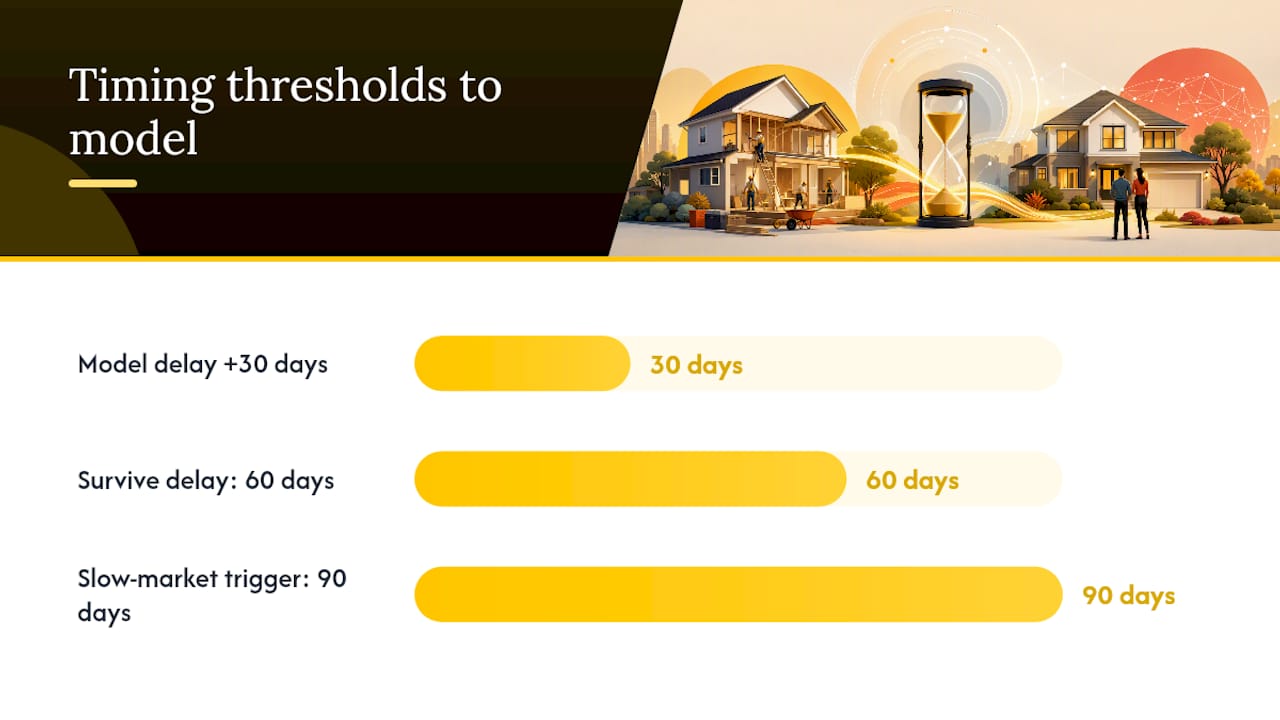
- Model carry costs at base, +30 days, and +60 days. Every deal should survive a two-month delay. Calculate monthly interest at your HELOC's current rate plus a 1.5% rate-increase scenario, and at your home equity loan's fixed rate. If the deal breaks at +30 days, the financing is too expensive or the purchase price is too high.
- Check draw mechanics. Confirm whether the lender controls rehab disbursements via escrow or releases funds directly. Lender-held escrow slows contractor payments and requires more operator liquidity upfront.
- Get written term options. Ask for extension terms, extension fees, and prepayment penalty language in writing before signing. Verbal assurances on extensions are not enforceable.
Questions to ask every lender:
- What index does the HELOC rate use, and what is the margin? What is the lifetime rate cap?
- How much advance notice is required to draw funds, and are there minimum draw amounts?
- What are the appraisal and seasoning requirements for the collateral property?
- What is the extension fee schedule if the project runs over the initial term?
- Is the loan recourse or non-recourse?
- Is the lender licensed in my state? (Verify at NMLS Consumer Access)
Red flags to walk away from:
- Draw schedules that are vague or entirely at lender discretion.
- A lender-callable line with no defined trigger conditions.
- Extension costs that are not disclosed in writing before closing.
- No NMLS license number or state licensing documentation available.
- Prepayment penalties that exceed two months of interest on a short-term flip loan.
When local market days-on-market exceed 90 days, DealIntel's fix-and-flip guidance recommends considering BRRRR or rental strategies rather than flips, because exit timing risk compounds financing cost in slow markets.
What does the MAO math actually show about carry cost?
The multiplier builds in an institutional buffer for overruns, timeline slippage, and financing costs. Here is a worked example.
Deal assumptions:
- ARV: $300,000
- Rehab budget: $40,000
- Estimated holding costs (utilities, taxes, insurance): $3,000
- Closing costs (buy and sell): $9,000
MAO calculation: MAO = ($300,000 × 0.70) minus $40,000 minus $3,000 minus $9,000 = $210,000 minus $52,000 = $158,000
Monthly carry cost comparison at $158,000 financed:
- HELOC at 8.5% variable: approximately $1,118/month in interest.
- Home equity loan at 9.5% fixed: approximately $1,250/month in interest.
- Hard money at 12% with 2 points: approximately $1,580/month in interest, plus $3,160 in origination points.
At a clean 4-month hold, the HELOC saves roughly $528 in interest versus the home equity loan and roughly $1,848 versus hard money (before points). But a 2-month delay changes the picture.
DealIntel's institutional assumptions recommend building a 4–6 month carry reserve into every flip model and note that every month beyond month six can add several thousand dollars in interest carry on a mid-sized loan.
Pro Tip: Run every deal with a +30 day and +60 day carry stress test before committing. The single largest unmodeled loss in fix-and-flip is timeline slippage. If the deal breaks at +30 days under your financing structure, either renegotiate the purchase price or choose a lower-cost financing product.
For a deeper look at how underwriting assumptions interact with LTC and points, the fix-and-flip underwriting primer from Jaken Finance Group covers institutional benchmarks in detail.
What experienced operators actually do with these products
The investors who use HELOCs most effectively treat the line as pre-positioned capital, not reactive financing. They secure the line during a quiet period, size it conservatively, and deploy it only on deals where the hold period is short and the rehab scope is well-defined. For larger projects or deals with tight acquisition deadlines, they shift to fixed second mortgages or hard money, accepting the higher rate in exchange for rate certainty and speed.

Risk management in this context is not abstract. Reserve sizing, contractor reliability, and exit-market liquidity are the three variables that determine whether a financing structure survives a delay. A HELOC that looks cheap on day one can become the most expensive option if a contractor walks off the job in month three and the rate resets in month four. Fixed-rate products and hard money remove one of those variables, which is worth paying for on complex projects.
Jaken Finance Group closes the gaps where home equity products fall short
Jaken Finance Group provides asset-based fix-and-flip financing that underwrites on property value rather than credit score, closes in as few as five days, and structures rehab escrow draws to match your project timeline.
Repeat investors, operators with non-standard credit profiles, and deals sourced at auction or with short close windows are the borrower profiles Jaken Finance Group serves most directly. The funded deal case studies show real outcomes across a range of project types and loan sizes. For investors who need to understand what a high-leverage program actually requires before applying, the 100% fix-and-flip financing requirements page covers documentation, LTC limits, and underwriting criteria in detail. Contact Jaken Finance Group to discuss your next deal and get a financing structure that matches the project timeline.
Sources
Before signing any second mortgage or HELOC for a flip project, confirm lender licensing and review consumer disclosures through these primary sources.
- What is the difference between a Home Equity Loan and ...
- Fix & Flip | DealIntel
- Fix and Flip Financing: Every Option Compared (2026) | CapRateKit
- Fix and Flip Loan Rates: Hard Money vs HELOC
- Loans for flipping houses: A complete guide | Rocket Mortgage
This article is general information, not a substitute for advice from a qualified financial advisor. Consult a qualified financial professional about your own circumstances before acting on anything here.