
Can you use a HELOC for a down payment on investment property?
Yes. Fannie Mae and Freddie Mac allow HELOC funds as down payments when the line of credit is secured by existing home equity, treating those funds as secured debt rather than unsecured borrowing. That distinction matters to underwriters: secured equity carries less risk weight than a personal loan or credit card advance.
Practical permissibility, however, depends on the individual lender. Lender overlays frequently impose restrictions beyond agency guidelines, including minimum reserve requirements, higher LTV thresholds, or outright prohibition of HELOC-sourced down payments on investment properties. Investors must verify each lender's overlay policy before assuming agency guidelines apply.
Key underwriting realities to address upfront:
- Three concurrent debt obligations: The original primary mortgage, the HELOC, and the new investment property mortgage all count against DTI simultaneously.
- Equity threshold: Most lenders require 15–20% equity in the primary residence, a credit score of 680 or higher (720+ preferred), and a DTI at or below 45%.
- Fund sourcing and seasoning: Underwriters require a documented paper trail showing the origin of HELOC draws. Allowing funds to season in a bank account for at least 60 days before application simplifies verification.
- Reserve requirements: Lenders often require post-closing reserves covering several months of payments across all three obligations.
- DTI stress-testing: Many lenders calculate DTI using a stressed HELOC payment rate, not the current variable rate, which can reduce qualifying power more than investors anticipate.
Table of Contents
- Key risks every investor must understand before drawing HELOC funds
- Why HELOCs appeal to investors funding acquisition and renovation
- Alternatives to a HELOC and when each one fits better
- A strategic framework for deploying HELOC funds responsibly
- HELOC down payment scenarios with financial outcomes
- Step-by-step process to apply for and use a HELOC for a down payment
- Key Takeaways
Key risks every investor must understand before drawing HELOC funds
Cross-collateralization is the most consequential risk. If the investor defaults on either the HELOC or the new property's mortgage, the lender can pursue foreclosure on the primary residence. That exposure is not theoretical; it is a contractual feature of secured home equity lending.
Additional risks require careful analysis:
- Variable rate exposure: HELOC rates are tied to prime, meaning monthly payments can rise materially when the Federal Reserve tightens. Budgeting at current rates without stress-testing for a 200–300 basis point increase is a common planning error.
- DTI compression: Adding HELOC repayments to existing obligations can push DTI above qualifying thresholds for subsequent acquisitions, limiting portfolio growth.
- Tax non-deductibility: Per IRS Publication 936, HELOC interest is generally not deductible when the funds are used to purchase a different property. Investors who assume deductibility and build it into their pro forma returns will overstate net yield.
- Timing risk: HELOC approval and fund draws must be completed before the investment property's closing date. Delays in HELOC processing have caused investors to miss closings or face rate-lock expirations.
- Lender freeze risk: Lenders can reduce or freeze a HELOC credit line if the primary residence's appraised value declines, cutting off access to funds mid-project.
Pro Tip: Maintain a cash reserve equal to at least three months of combined payments across all three obligations before drawing HELOC funds. Model payment escalations at prime plus 2% to confirm the investment still cash flows under stress conditions.

Why HELOCs appeal to investors funding acquisition and renovation
A HELOC's structural flexibility makes it well-suited to real estate investment, where capital needs are rarely linear. Key advantages include:
- Revolving access to equity: Investors can draw funds as needed up to the approved limit during a draw period that typically extends 10 years, then repay and redraw without reapplying.
- Lower upfront costs: HELOC closing costs are generally lower than those of a cash-out refinance, preserving capital for acquisition and renovation budgets.
- Interest-only draw period: During the draw phase, many HELOCs require only interest payments, which improves early-stage cash flow on a newly acquired property.
- Preservation of liquid reserves: Using home equity avoids depleting savings accounts or liquidating investment positions, keeping emergency capital intact.
- Competitive offer capability: Immediate access to HELOC funds allows investors to present cash-like offers in competitive markets, a meaningful advantage when competing against all-cash buyers.
- Dual-purpose deployment: The same credit line can fund the down payment and cover renovation costs on a fix-and-flip or BRRRR project, reducing the number of financing instruments required.
Alternatives to a HELOC and when each one fits better
Not every investor's situation favors a HELOC. The right instrument depends on rate environment, equity position, credit profile, and project timeline.
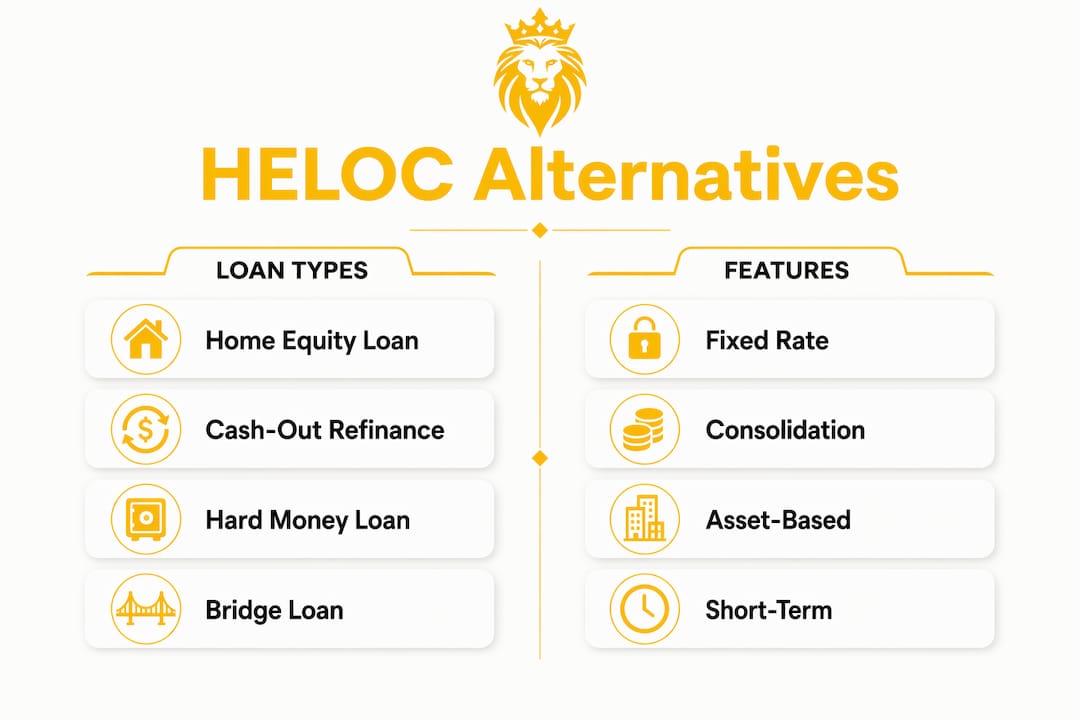
Home equity loan: A fixed-rate lump sum disbursement eliminates variable rate exposure. Investors who need payment predictability across a 24–36 month hold period often prefer this structure over a revolving line. The tradeoff is less flexibility: the full amount is drawn at closing, and unused funds still accrue interest.
Cash-out refinance: This approach locks in a fixed rate on the full loan balance and consolidates the primary mortgage and equity access into one payment. Closing costs are higher than a HELOC, and investors with favorable existing mortgage rates may find refinancing economically counterproductive. Explore cash-out refinance requirements for investment properties before committing.
Hard money loans: Asset-based lenders evaluate the deal on property value and ARV rather than borrower credit scores or DTI ratios. For investors who cannot qualify for a HELOC due to DTI compression or credit constraints, hard money lending provides speed and flexibility that conventional equity products cannot match. Closings in five days or fewer are achievable.
Bridge loans: Short-term bridge financing covers the gap between purchasing a new property and selling or refinancing an existing one. Bridge loans typically carry higher rates than HELOCs but offer faster execution and do not require the primary residence as collateral in all structures.
Matching the instrument to the investor's risk tolerance and exit strategy is the core decision. Fixed-rate products suit investors who prioritize payment certainty; revolving equity lines suit those who need capital flexibility across multiple project phases.
A strategic framework for deploying HELOC funds responsibly
Executing a HELOC-funded acquisition without a structured plan increases the probability of DTI problems, missed closings, and cash flow shortfalls. The following sequence reflects best practice:
- Calculate equity and DTI first: Determine the maximum HELOC amount based on LTV, then model the three-payment DTI scenario before approaching any lender. Confirm the investment property's projected net operating income covers all three obligations with margin.
- Secure HELOC approval early: Apply for the HELOC before identifying a target property. Approval timelines vary; having the line in place eliminates timing risk at closing.
- Draw and season funds: Transfer the required down payment amount to a dedicated account at least 60 days before the investment property application. This satisfies most underwriting seasoning requirements and simplifies source-of-funds documentation.
- Maintain a full paper trail: Document every HELOC draw, transfer, and deposit. Underwriters will trace the funds from the HELOC statement through to the closing account.
- Budget for three payments from day one: Build the HELOC payment, primary mortgage, and investment property mortgage into the monthly operating budget before closing. Do not assume rental income will cover all three immediately.
- Plan the interest-only-to-amortization transition: When the HELOC draw period ends, payments shift to principal plus interest. Model this transition and confirm the investment still cash flows at the higher payment level.
- Monitor property values and credit: A decline in the primary residence's value can trigger a HELOC freeze. Monitoring both the primary and investment property's market value protects access to the credit line.
Pro Tip: Use the HELOC's revolving structure to fund both the down payment and renovation costs on a single project. Drawing only what is needed at each phase minimizes interest expense and preserves credit availability for contingencies.
For investors who need gap financing, second-position capital, or fast-close acquisition funding alongside a HELOC strategy, Jaken Finance Group's asset-based lending programs provide a complementary solution without credit score minimums.
HELOC down payment scenarios with financial outcomes
Scenario A: BRRRR acquisition with HELOC down payment An investor owns a primary residence valued at $450,000 with a $180,000 mortgage balance. Available equity at 80% LTV: $180,000. The investor draws $60,000 from a HELOC to cover a 20% down payment on a $300,000 rental property, then finances the remaining $240,000 with a conventional investment mortgage. Monthly obligations: primary mortgage, HELOC interest on $60,000 at a variable rate, and the rental property mortgage. If the rental generates $2,200/month gross and the combined three-payment obligation totals $3,100, the investor needs $900/month from other income to break even before expenses. After stabilization and a DSCR refinance, the HELOC balance can be repaid from cash-out proceeds.
Scenario B: Fix-and-flip with dual-purpose HELOC draw An investor draws $80,000 from a HELOC: $50,000 for a down payment on a $250,000 distressed property and $30,000 reserved for renovation. A hard money loan covers the remaining acquisition cost. The HELOC's interest-only draw period keeps carrying costs low during the six-month renovation. Upon sale at ARV, the HELOC balance is repaid in full from net proceeds. This structure avoids liquidating investment accounts and keeps the investor's capital base intact for the next acquisition.
Step-by-step process to apply for and use a HELOC for a down payment
- Assess your equity position. Calculate 80% of your primary residence's current appraised value, subtract the outstanding mortgage balance, and confirm the result covers the target down payment with margin.
- Check your credit and DTI. Most HELOC lenders require a 680+ FICO and a DTI at or below 45% before the new investment property mortgage is added.
- Select a HELOC lender and apply. Submit income documentation, property appraisal, and mortgage statements. Approval timelines range from two to six weeks depending on the lender.
- Receive approval and establish the credit line. Once approved, the line is open but no interest accrues until funds are drawn.
- Draw funds and season the deposit. Transfer the down payment amount to a dedicated account. Allow 60 days of seasoning before submitting the investment property mortgage application.
- Apply for the investment property mortgage. Disclose the HELOC as a liability. Provide bank statements showing the seasoned down payment funds and their source.
- Close on the investment property. Bring the seasoned HELOC funds to closing as the down payment. Confirm all three monthly payment obligations are budgeted.
- Execute the repayment plan. Prioritize HELOC paydown using rental income, project sale proceeds, or refinance cash-out to reduce variable rate exposure and restore equity in the primary residence.
For investors who need down payment funding structured around short-term acquisition timelines, Jaken Finance Group offers asset-based solutions designed to close alongside or in place of HELOC draws.
Need fast, flexible financing for your next acquisition? Jaken Finance Group structures hard money and fix-and-flip loans for real estate investors nationwide, with closings in as few as five days and no minimum credit score requirement. Contact Jaken Finance Group to discuss how asset-based lending fits your HELOC strategy.
Key Takeaways
Using a HELOC for a down payment is permissible under Fannie Mae and Freddie Mac guidelines, but lender overlays, cross-collateralization risk, and DTI impact require disciplined planning before execution.
| Point | Details |
|---|---|
| Agency permissibility | Fannie Mae and Freddie Mac allow HELOC funds as down payments when secured by existing home equity. |
| Cross-collateralization risk | Defaulting on the HELOC or new mortgage can trigger foreclosure on the primary residence. |
| Equity and credit threshold | Most lenders require a substantial equity stake, a good credit score, and a manageable debt-to-income ratio to qualify. |
| Tax non-deductibility | Per IRS Publication 936, HELOC interest is generally not deductible when used to purchase a different property. |
| Fund seasoning requirement | Allowing HELOC draws to sit in a bank account for at least 60 days simplifies underwriting source-of-funds verification. |