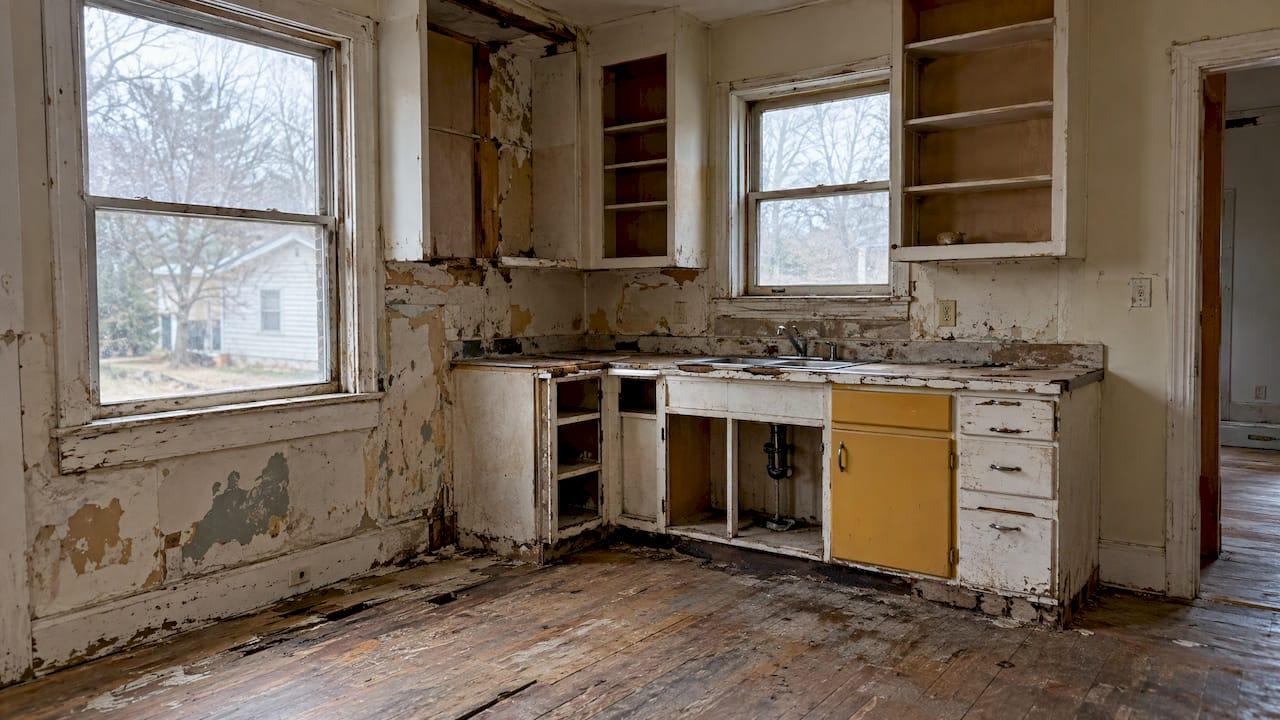
Distressed property financing is usually asset-based: the lender underwrites the property's as-is and after-repair value, the rehab budget and your exit, not only your credit file. Jaken Finance Group lends on that basis nationwide, with no minimum credit score, leverage up to 100% of cost, and closings in as few as 7 to 10 days. That speed matters because a distressed purchase, whether a pre-foreclosure, an auction, an REO or a vacant property with deferred maintenance, rarely waits for a conventional appraisal and underwriting cycle.
TL;DR
- A property is distressed when its condition, its title or the circumstances of the sale (foreclosure, tax default, estate sale) make it hard to finance with a standard mortgage.
- Short-term asset-based loans (fix and flip, bridge, new construction) fund the purchase and rehab, then a DSCR rental loan or cash-out refinance replaces them.
- Jaken's published ranges: 8.99% to 13.5% for fix and flip, bridge, new construction and commercial property loans; 5.75% to 10.5% for DSCR rental loans.
- Lenders size the loan on as-is value, after-repair value (ARV), the rehab budget and the exit plan. A complete package prevents most delays.
- FHA 203(k) is built for owner-occupants, so investors generally plan on asset-based loans.
Table of Contents
- What makes a property distressed, and why it changes financing
- Financing options for a distressed purchase
- How much leverage to expect, and what to compare
- What lenders evaluate and what to prepare
- What slows a closing or makes financing fall through
- Planning the exit before you close
- Local factors in Chicago, Washington, DC and Florida
- Our approach to distressed deals
- Financing for your next distressed property
- FAQ
- Sources
What makes a property distressed, and why it changes financing
A distressed property is one that sells under pressure or in poor condition. Common cases include:
- Physical distress: failed systems, roof damage, fire or water damage, long vacancy, code violations.
- Financial distress: the owner is behind on the mortgage, taxes or HOA dues, and sells before or during foreclosure.
- Legal or process distress: auction sales, REO inventory held by a lender, probate and estate sales, properties with liens.
Conventional lenders want a property that appraises well today, is habitable, and closes in 30 to 45 days. A distressed asset often fails all three tests. The as-is value may be far below the after-repair value, the house may not meet minimum property standards, and an auction may demand cash or a closing in days.
The sale process also shapes the numbers. A professional presentation from the Mortgage Bankers Association on valuing distressed assets lists the items that drive recovery at a judicial foreclosure sale: the judgment amount, court costs, prior liens, commissions, transfer taxes and the lag before proceeds arrive, which depends on how long a state's courts take to confirm the sale. For a buyer, the takeaway is practical: liens, timing and state process affect both your price and your closing date, so confirm them before you commit capital.
Financing options for a distressed purchase
Match the loan to the stage of the project. Most distressed deals pass through three stages: acquire, renovate, then hold or sell.
| Stage | Loan type | Jaken's published rate range | Typical use |
|---|---|---|---|
| Acquire and rehab | Fix and flip loan | 8.99% to 13.5% | Purchase plus renovation budget on a property you will sell |
| Acquire quickly, then decide | Bridge loan | 8.99% to 13.5% | Short-term funding when the property needs time, stabilization or a lease-up |
| Build or tear down | New construction loan | 8.99% to 13.5% | Ground-up builds, including on cleared distressed lots |
| Commercial asset | Commercial property loan | 8.99% to 13.5% | Distressed retail, office, mixed-use and multifamily |
| Hold as rental | DSCR rental loan | 5.75% to 10.5% | Long-term financing based on rental cash flow |
Jaken also offers gap lending, second-position DSCR cash-out, cash-out refinance, portfolio refinance and an investment property HELOC. These have no published price on our site.
Fix and flip loans
A fix and flip loan is the default tool for a distressed property you plan to renovate and resell. Underwriting centers on the purchase price, the rehab budget and the ARV, which is the estimated value after repairs are complete. Jaken offers leverage up to 100% of cost (loan to cost, or LTC), deferred payment options and no minimum credit score. For the document list, see our guide to fix and flip loan requirements, and for the process from application to funding, how to get a fix and flip loan.
Bridge loans
A bridge loan covers a short period between acquisition and a longer-term solution. It fits a distressed property that needs to be cleared of liens, stabilized, leased or repositioned before permanent financing is possible. Investors who plan to hold can read more about bridge loans for real estate investors. In Chicago, there is a dedicated page for bridge loans in Chicago.
New construction loans
When a structure is a teardown, the better play can be a new build. New construction loans for investors fund ground-up projects on the same asset-based footing. Build-to-rent operators and developers can pair them with a DSCR refinance once the units are leased.
Gap and second-position funding
Gap lending is designed for the portion of a deal that a first-position lender will not cover, such as part of the down payment or the rehab. Because distressed purchases often have a low as-is value and a large renovation budget, a layered structure can keep your cash in the deal smaller.
Why FHA 203(k) rarely fits investors
The FHA 203(k) program finances purchase and rehabilitation in one mortgage, and it is often mentioned for distressed homes. Under HUD's rules, the Standard 203(k) requires at least $5,000 in repairs and an FHA-approved consultant, and the Limited version covers nonstructural repairs up to $75,000. The same guidance states that investor purchases of HUD REO properties are not eligible. A lender product snapshot also lists a minimum cash investment of 3.5% on the Standard product. Those conditions are built for a buyer who will live in the home. Investors who want to compare the two paths side by side can read FHA 203(k) vs hard money for fix and flip.
How much leverage to expect, and what to compare
Leverage on a distressed deal is measured three ways, and the lender's offer should be compared on all of them:
- Loan to cost (LTC): the loan as a share of purchase price plus rehab budget. Jaken's positioning is up to 100% LTC.
- Loan to value (LTV): the loan against the as-is value.
- Loan to ARV: the total loan against the after-repair value. This ceiling protects the lender if the renovation underperforms.
When you compare offers, line up the following:
- Interest rate and origination points
- Whether rehab funds are held back and released in draws, and how fast draws are processed after an inspection
- Whether interest is paid monthly or deferred
- Term length and extension terms
- Prepayment terms and any balloon payoff at maturity
- Closing costs and third-party fees
A lower headline rate with slow draws can cost more than a slightly higher rate with fast draws, because crews stall and carrying costs accumulate. Run the numbers with our free calculators before choosing, and model the worst case: a rehab that takes two extra months.
Worked example
Assume a distressed duplex with a $200,000 purchase price, a $60,000 rehab budget and a $340,000 ARV. Total cost is $260,000. At 90% LTC, the loan is $234,000 and your cash in is $26,000, plus points and closing costs. The loan to ARV is about 69%. At 100% LTC the loan is the full $260,000, or about 76% of ARV. These figures are illustrative only and are not a quote. Actual terms depend on the property, the budget and the borrower's experience.

What lenders evaluate and what to prepare
Asset-based underwriting moves the focus from the borrower's FICO score to the deal. Even so, a lender needs to see that the numbers work and that the project will be finished. Prepare these before you apply:
- Signed purchase contract, or the auction terms
- Scope of work and line-item rehab budget, ideally from a contractor you have named
- Comparable sales supporting the ARV
- Photos of the property and any inspection or code reports
- Title information that shows liens, back taxes or open permits
- Your entity documents, if buying in an LLC
- Proof of funds for the down payment and reserves
- A real estate experience summary, if you have one
- Your exit plan: sale price and timeline, or a refinance
Larger lenders follow the same logic. Fannie Mae's Multifamily Selling Guide, for example, requires that for rehab-funded transactions the appraisal state as-is and as-completed values, and that the submission include sources and uses of funds, the rehabilitation budget and the timeline. Having those items in order from the start speeds a private lender as well. Brokers submitting deals can look at our loan submission examples to see how a complete file looks.
Title, liens and surplus
Title is the part of a distressed deal that most often surprises buyers. Prior liens, unpaid taxes and a foreclosure's judicial history can all affect what you actually acquire. If you buy at or after a foreclosure sale, a real estate attorney in the state is the right professional for title and lien questions. In Florida, for example, the clerk handles any money left over after a sale under Section 45.032 of the Florida Statutes, and an overview of foreclosure surplus funds in Florida explains how those claims work. Understanding who is entitled to proceeds helps you read the auction file and the title chain correctly.
What slows a closing or makes financing fall through
Speed is the reason investors use private capital, and most delays are preventable:
- An incomplete scope of work. If the budget has no line items, the lender cannot size the rehab holdback.
- An ARV that comparables do not support. Pull recent sales of renovated homes nearby, not asking prices.
- Title defects found late. Order title work as soon as the contract is signed.
- Insurance on a vacant or damaged property. Bind coverage before closing, since lenders require it.
- Entity paperwork. An LLC without an operating agreement or EIN stalls the file.
- Unrealistic timelines. A foreclosure auction with a cash deadline needs a lender who can fund within days.
On timing, Jaken's positioning is closings in as few as 7 to 10 days. For a time-sensitive auction or off-market deal, tell the lender the deadline on the first call.
Planning the exit before you close
Short-term loans are meant to be repaid, so the exit is part of the underwriting. There are two main ways out.
Sell. A flip repays the loan from sale proceeds. Build in carrying costs, closing costs and a margin for a slower market. Jaken's fix and flip guides cover ARV, rehab budgeting and distressed deals.
Refinance and hold. For a rental, the usual exit is a DSCR loan. The debt service coverage ratio compares the property's rental income to its debt payments, so the lender qualifies the property rather than your personal income. Use the DSCR calculator to test whether the rent supports the payment, and see how much you can borrow with a DSCR loan. Jaken's published range for DSCR rental loans is 5.75% to 10.5%. Investors who already own the property can also look at a cash-out refinance or a portfolio refinance. A video on refinancing and rehabbing an investment property walks through the sequence.
Before you close the short-term loan, confirm that the post-rehab rent and value will clear the DSCR threshold. If they will not, adjust the scope or the price, not the hope.

Local factors in Chicago, Washington, DC and Florida
State law and local process change the timeline of a distressed purchase, so check these before you offer:
- Illinois (Chicago). Foreclosure is judicial, and state law sets a redemption period, during which the former owner may have the right to reclaim the property. That affects when you can get clear possession and begin work. Many Chicago buyers target older two-flats and small multifamily buildings, where scope and permits drive the budget.
- Washington, DC. Older rowhouses and a thorough permitting process make an accurate scope and timeline important. A lender's draw schedule should be consistent with how long permits actually take.
- Florida. Insurance and condition are central on older or storm-affected properties, and surplus funds after foreclosure sales follow the state's statute described above.
- Indiana. Smaller price points often favor flippers with tight budgets, so leverage and draw speed matter.
Jaken lends nationwide, so the same asset-based structure applies in each market, and the underwriting adapts to local values and comparables.
Our approach to distressed deals
Distressed deals are won on speed and certainty. A seller facing foreclosure or an estate deadline picks the buyer who can close, and a rehab that stalls on funding loses money every month it sits.
We lend against the property: its value, the renovation plan and the exit. That is why we offer no minimum credit score, leverage up to 100% LTC, deferred payment options and closings in as few as 7 to 10 days. The structure is designed so that an investor with a strong deal and limited cash can still move.
Our advice is to match the loan to the plan. Use a fix and flip loan when you will sell, a bridge loan when the property needs time, a construction loan when you are rebuilding, and a DSCR loan when you will hold. Then confirm the exit before you sign.
Jason Taken
Financing for your next distressed property
Jaken Finance Group funds fix and flip, bridge, new construction, commercial and DSCR rental loans for investors across the United States, with asset-based underwriting and no minimum credit score. If you have a distressed property under contract or at auction, review the loan options and start your application.
For rehab-focused projects, see rehab loans for investment property.
FAQ
What is the best loan for a distressed property?
It depends on the plan. A fix and flip loan suits a renovate-and-sell project, a bridge loan suits a property that needs time or stabilization, and a DSCR loan suits a long-term rental after repairs. Asset-based lenders such as Jaken underwrite the property's value and your exit rather than relying on a credit score.
Can I get financing for a distressed property with bad credit?
Yes, with asset-based lending. Jaken Finance Group has no minimum credit score and sizes loans on the property and the project. A strong ARV, a realistic budget and a clear exit carry the most weight.
How fast can a distressed property loan close?
Jaken's positioning is closings in as few as 7 to 10 days. A complete file, with the contract, scope of work, budget and entity documents ready, helps keep that timeline.
Can I use an FHA 203(k) loan to buy a distressed property as an investor?
The 203(k) program is built for owner-occupants. HUD's guidance also states that investor purchases of HUD REO properties are not eligible. Investors typically use fix and flip or bridge loans for the same purpose.
Sources
- MBA: Practical Application of Distressed Assets Valuation
- HUD 203(k) Rehabilitation Mortgage Insurance Program guidance
- FHA 203(k) Standard product snapshot
- Fannie Mae Multifamily Selling Guide
- Florida Statutes, Section 45.032
- Illinois Compiled Statutes, 735 ILCS 5/15-1603