
Yes — hard-money lenders can finance assignment deals, but the structure determines whether the fee gets funded, partially funded, or excluded from loan proceeds entirely. Three funding paths cover most scenarios in assignment financing with hard money: (1) the hard-money lender underwrites the assigned position as a standard asset-based acquisition loan, funding the purchase price and sometimes a portion of the assignment fee; (2) transactional funding covers the A-to-B leg of a double close, repaid immediately from B-to-C proceeds; or (3) the assignment fee is restructured into a recognized settlement line item such as a commission or coordination fee that passes lender underwriting.
When assignment financing with hard money typically works:
- The ARV-to-purchase-price spread is wide enough to satisfy the lender's LTV cap and still leave profit
- The purchase agreement explicitly permits assignment or the investor plans a double close
- An experienced title company familiar with assignment transactions is handling closing
- The buyer has a documented exit strategy (resale or refinance) the lender can underwrite
- The assignment fee is disclosed on the settlement statement or restructured into a recognized line item
When it usually fails:
- The purchase contract contains an anti-assignment clause and no double-close alternative is arranged
- The spread between contract price and end-buyer price is too thin to support lender LTV requirements
- The lender's program policy excludes assignment fee funding above a set cap
- Title is clouded by liens, judgments, or chain-of-title gaps
Pro Tip: If a lender caps how much of the assignment fee it will fund, compliant reclassification of part of that fee as a commission or construction coordination charge can sometimes resolve the shortfall — but only with full disclosure and, where required, a licensed agent. Consult a real estate attorney before restructuring any fee.
Key Takeaways
Assignment financing with hard money works when the ARV spread is wide, the contract is assignable, and the fee is documented transparently on the settlement statement.
| Point | Details |
|---|---|
| Three funding paths | Direct assignment loan, transactional funding for double close, or fee restructured as a settlement line item. |
| MAO/70% rule is the ceiling | Purchase price plus any funded assignment fee must stay at or below ARV × 70% minus repairs. |
| Lender fee caps are real | Many lenders cap assignment fee funding at 10% of purchase price; buyers must bring the remainder in cash. |
| Title and legal review first | Anti-assignment clauses, chain-of-title gaps, and state-specific rules must be resolved before marketing any contract. |
| Jaken Finance Group | Funds asset-based assignment deals across the United States, with closings in as few as five days for qualifying files. |
Table of Contents
- Core terms you must know before arranging assignment financing
- How an assignment deal gets funded with hard money, step by step
- What hard-money lenders typically require and charge for assignment deals
- What lenders will ask for and how they underwrite assignment transactions
- Legal and title issues you must resolve before relying on assignment financing
- Typical funding timeline and cost breakdown for assignment deals
- When to use assignment vs. double close vs. transactional funding vs. private partner
- Worked example: MAO calculation and hard-money loan fit
- How Jaken Finance Group supports assignment financing
- What most investors get wrong about assignment financing
- Jaken Finance Group funds assignment deals across the United States
- Sources
Core terms you must know before arranging assignment financing
Understanding the vocabulary is not optional when you are coordinating between a seller, a buyer, a hard-money lender, and a title company. A misused term in a contract or a loan application can delay closing or kill the deal.
Key definitions:
- Assignor: The original buyer who signed the purchase agreement with the seller and now transfers that contract position to a new buyer.
- Assignee: The new buyer who steps into the assignor's contractual rights and obligations.
- Assignment: The legal transfer of equitable interest in a signed purchase agreement from assignor to assignee, documented in a written assignment addendum.
- Equitable interest: The assignor's contractual right to purchase the property — not legal title, but a recognized interest that can be transferred.
- Assignment fee: The spread between the contract price (A-to-B) and the price the end buyer pays (B-to-C). Assignment fees commonly run within the typical market range and are typically collected at closing through the title company's escrow account.
- MAO / 70% rule: Maximum Allowable Offer = (ARV × 70%) − estimated repairs. This formula sets the ceiling a buyer should pay so the deal supports both profit and lender requirements.
- ARV (After Repair Value): The property's projected market value after all planned renovations are complete. Hard-money lenders anchor their LTV calculations to ARV, not current as-is value.
- Transactional funding: Ultra-short-term capital used to fund the A-to-B purchase in a double closing, repaid the same day or within days from B-to-C proceeds.
- Double close: Two sequential closings — A sells to B, then B immediately sells to C — that keep the assignment fee off the HUD-1 visible to both the original seller and end buyer.
- Subject-to: Acquiring a property subject to the existing mortgage, leaving the original loan in place. Carries due-on-sale risk.
- Escrow holdback: Funds held in escrow pending completion of a condition (repairs, documentation), sometimes used to bridge timing gaps in assignment transactions.
How the assignment fee appears on the settlement statement: When paid through escrow, the fee shows as a line item on the closing disclosure, typically labeled as an assignment fee or consulting fee. Some investors and lenders prefer off-escrow payment via a separate consulting agreement, though this approach carries its own disclosure and tax implications. State-specific contract language governs what is permissible.
Consult a real estate attorney for state-specific assignability language before marketing any contract.
How an assignment deal gets funded with hard money, step by step
The sequence below applies to a standard assignment where the lender underwrites the assigned position. Variations for double closes and transactional funding are noted where the path diverges.
Step-by-step funding sequence:
- Execute the A-to-B purchase agreement with the seller, including an explicit assignability clause or "and/or assigns" language in the buyer field.
- Market the contract to qualified end buyers, confirming their financing capacity before accepting an assignment fee.
- Vet the end buyer's proof of funds or loan pre-approval — lenders will require this before underwriting the assigned position.
- Engage the hard-money lender early, ideally before the inspection period expires. Provide the purchase agreement, assignment addendum, ARV comps, and repair estimates at first contact.
- Order a title search immediately. Title issues are the most common cause of assignment deal failures, and lenders will not issue a commitment without a clean title report.
- Lender underwrites the ARV, repair scope, and exit strategy. For a hard money loan, underwriting focuses on property value and repair estimates rather than borrower credit alone.
- Receive lender commitment and loan documents. Review the assignment addendum language with the title company to confirm it aligns with lender requirements.
- Close at the title company. The assignment fee is disbursed from escrow per the settlement statement. The lender funds the purchase; the assignee takes title.
Three funding flows and when each applies:
- Flow A (Direct assignment funding): The hard-money lender underwrites the assigned contract and funds the purchase price. The assignment fee may be partially funded within loan proceeds if the lender's program allows it, or paid separately by the end buyer at closing.
- Flow B (Transactional funding for double close): The investor uses transactional funding to close A-to-B, then immediately closes B-to-C. The end buyer's hard-money loan funds the B-to-C purchase, and transactional funding is repaid from those proceeds.
- Flow C (Buyer's hard-money loan, fee as line item): The end buyer secures a hard-money loan independently. The assignment fee is structured as a recognized line item on the settlement statement, paid from the buyer's loan proceeds or cash at closing.
Who signs what and when:
- Assignor and seller sign the original purchase agreement
- Assignor and assignee sign the assignment addendum (with seller consent if required)
- Assignee and lender sign loan documents
- All parties provide title instructions to the escrow officer before closing
Pro Tip: Contact the lender as soon as the purchase agreement is executed, not after the inspection period. Underwriting for hard money loans in real estate can move in days, but title issues and ARV disputes take time to resolve.
What hard-money lenders typically require and charge for assignment deals
Hard-money lenders use asset-based underwriting, meaning the property's ARV and repair scope drive the loan amount more than the borrower's credit profile. That said, assignment deals introduce underwriting variables that standard fix-and-flip loans do not carry.
Typical loan terms for assignment financing:
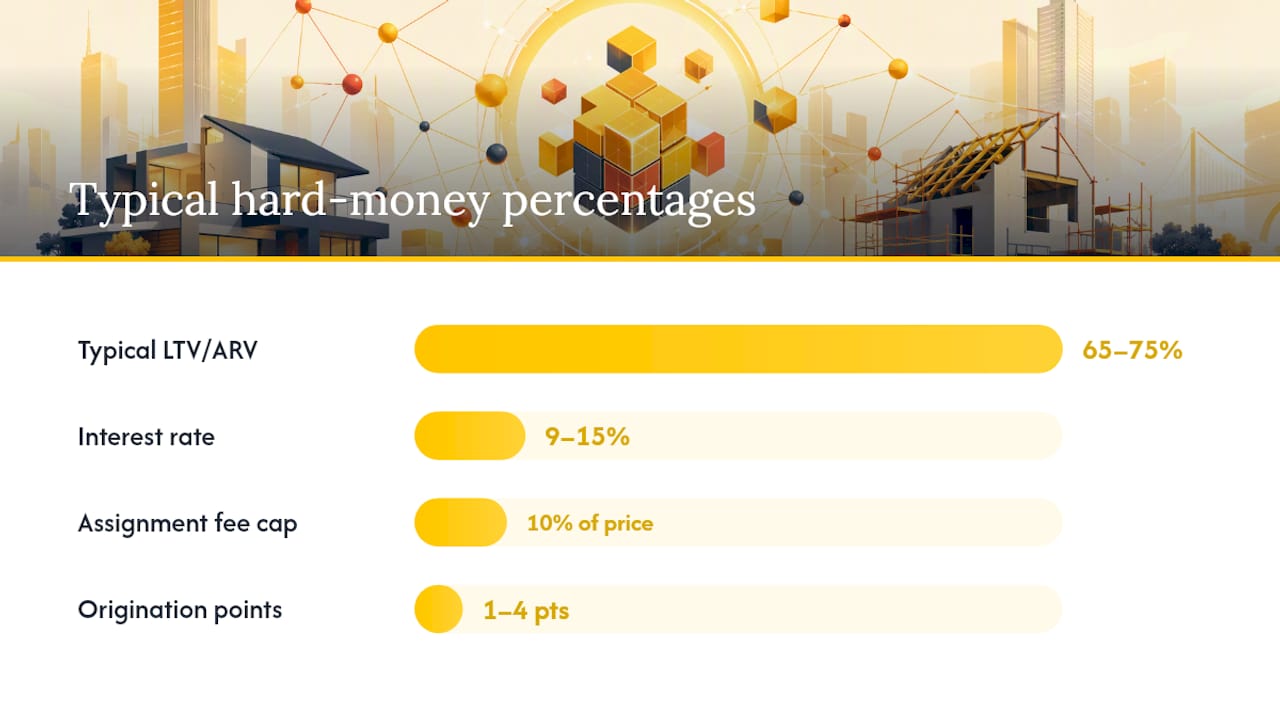
- LTV/ARV: Most hard-money lenders lend 65%–75% of ARV. Some programs fund up to 100% of purchase price plus rehab costs when the deal's ARV spread supports it.
- Interest rates: Generally range from 9%–15% annually, depending on deal risk, borrower experience, and lender program.
- Origination points: Typically 1–4 points (1%–4% of the loan amount), paid at closing.
- Loan term: Usually 6–18 months, structured as interest-only with a balloon payoff at maturity.
- Assignment fee funding: Lenders vary significantly. Some will fund a portion of the assignment fee within loan proceeds; others cap funded assignment amounts at 10% of the purchase price, leaving the remainder for the buyer to bring in cash or restructure.
- Prepayment: Many hard-money programs carry a minimum interest period (often 3–6 months) even if the loan is repaid early.
Statistic callout: Lenders applying the MAO/70% rule expect the purchase price (including any funded assignment fee) to stay at or below 70% of ARV minus repairs. A deal where the combined purchase price and assignment fee push past that ceiling will face underwriting resistance regardless of the lender's stated LTV.
The distinction between LTV (loan-to-value based on current or as-is value) and LTC (loan-to-cost, based on total project cost) matters in assignment deals. When a lender uses ARV-based underwriting, the funded amount is anchored to the projected post-renovation value, which often allows higher leverage than an as-is appraisal would support. Understanding hard money lending benefits in this context helps investors structure deals that pass underwriting without leaving excessive cash on the table.
What lenders will ask for and how they underwrite assignment transactions
A clean, well-organized loan file shortens the approval timeline and reduces the back-and-forth that delays closings. Lenders underwriting assignment deals scrutinize several areas that standard purchase loans do not require.
Document checklist:
- Signed purchase agreement (A-to-B), including the assignability clause
- Executed assignment addendum signed by assignor and assignee
- End buyer's proof of funds or hard-money loan pre-approval letter
- Title search or preliminary title report showing no undisclosed liens or judgments
- Repair estimates from licensed contractors, itemized by trade
- Comparable sales (comps) supporting the ARV, pulled within 90 days and within one mile where possible
- Contractor bids aligned with the repair estimate
- Exit strategy documentation (executed B-to-C purchase agreement or refinance plan)
- Proof of non-refundable earnest money deposit, if applicable
- Entity documents (operating agreement, articles of organization) if borrowing through an LLC
Underwriting focus areas:
- ARV credibility: Lenders will order their own appraisal or BPO. Comps that are too old, too distant, or from a different property class will be rejected.
- Repair scope accuracy: Underwriters cross-reference contractor bids against the repair estimate. Gaps between the two raise red flags about project feasibility.
- Exit plan credibility: A signed B-to-C contract is the strongest exit evidence. A refinance plan requires documentation of the property's income potential or the borrower's refinance eligibility.
- Title cleanliness: Liens, judgments, and chain-of-title gaps must be resolved before closing. Title companies familiar with assignments will flag these early.
- Assignment fee transparency: Large assignment fees relative to the purchase price attract underwriter scrutiny. Transparent documentation — signed contracts, buyer proof of funds, and clear comps — reduces questions. Where legally permissible, packaging part of the compensation as a recognized settlement line item can smooth underwriting, but requires full disclosure and, where applicable, a licensed agent.
- Borrower experience and liquidity: Most hard-money lenders prefer borrowers with at least one completed deal and sufficient reserves to cover carrying costs.
The hard money loan approval process is faster than conventional underwriting, but a disorganized file can add days. Assembling every document before the first lender call is the single most effective way to accelerate approval.
Legal and title issues you must resolve before relying on assignment financing
Assignment deals carry legal exposure that standard purchase transactions do not. Title companies and lenders will surface these issues during underwriting; investors who identify them first avoid last-minute deal collapses.
Legal risks to evaluate before marketing any contract:
- Anti-assignment clauses: Many seller-drafted contracts prohibit assignment without written seller consent. Marketing a contract with this language before obtaining consent exposes the assignor to breach claims.
- Seller consent requirements: Even when a contract is assignable, some states or contract forms require explicit written seller consent. Verify this with a real estate attorney before proceeding.
- Due-on-sale acceleration: Subject-to transactions leave the original mortgage in place. The lender holding that mortgage can call the loan due upon transfer of title, creating immediate payoff risk.
- Chain-of-title concerns: Assignments that are not properly recorded or that involve gaps in the ownership chain can cloud title, making it difficult or impossible for the end buyer to obtain title insurance.
- Recording and deed issues: In some states, recording the assignment addendum is required. Failure to record can affect the assignee's priority position.
- Tax treatment of assignment fees: The IRS generally treats assignment fees as ordinary income, not capital gains. Investors who receive assignment fees regularly may be classified as dealers rather than investors, with additional tax consequences. Consult a tax advisor before structuring any assignment transaction.
Creative financing structures — including full cash assignments, subject-to, and holdback escrow arrangements — each carry distinct title, timing, and underwriting consequences. Attorney review is not optional for these paths.
How title companies handle assignment deals: Experienced title companies will issue a title commitment that names the assignee as the insured buyer. They will also require the assignment addendum as a closing document and may impose additional conditions (seller acknowledgment, lender approval of the assignment) before issuing the policy. Title companies unfamiliar with assignments sometimes refuse to close them or impose conditions that effectively require a double close.

Pro Tip: Before marketing any contract, add an explicit assignability clause and negotiate escrow protections for any holdback with the seller. Have a real estate attorney review the contract language in your state — what is standard in one jurisdiction may be unenforceable in another.
Typical funding timeline and cost breakdown for assignment deals
Speed is one of the primary reasons investors use hard-money for assignment financing. Conventional lenders typically require 30 or more days to close; hard-money lenders can often fund in a fraction of that time when the file is clean.
Sample timelines:
- Hard-money expedited funding: 3–10 business days from complete file submission to closing, assuming clean title and a responsive borrower
- Transactional funding (double close): Same-day to 3 business days; the A-to-B and B-to-C closings are often scheduled back-to-back on the same day
- Conventional buyer financing: 30 or more days, with no guarantee of closing if the buyer's lender objects to the assignment structure
The speed advantages of hard money over conventional financing are most pronounced in competitive markets where sellers will not wait for a 45-day conventional close.
Cost breakdown for assignment financing with hard money:
- Origination points: 1–4 points on the loan amount, paid at closing
- Interest: 9%–15% annually, typically charged on a monthly basis for the duration of the loan
- Transactional funding fees: Usually a flat fee or 1%–3% of the transaction amount for same-day or short-duration double closes
- Title fees (double close): Two sets of title fees apply when a double close is required — one for A-to-B and one for B-to-C
- Wire and settlement fees: $25–$50 per wire, plus escrow/settlement fees that vary by state and title company
- Appraisal or BPO: $300–$600 depending on the lender's requirements and property type
Timeline callout: The three items that most commonly determine closing speed are title clearance, end-buyer proof of funds, and lender appraisal or BPO. Investors who order the title search and appraisal simultaneously with lender engagement cut days off the critical path.
When to use assignment vs. double close vs. transactional funding vs. private partner
The right structure depends on the contract's assignability, the size of the fee, the end buyer's financing, and how much of the transaction the investor wants disclosed to each party.
Decision guide by structure:
- Standard assignment: Use when the contract is explicitly assignable, the fee is modest relative to the purchase price, and the end buyer's lender will accept the assignment. Lowest cost and fewest moving parts.
- Double close with transactional funding: Use when the contract bans assignment, the fee is large enough that disclosure to the seller or buyer creates negotiation risk, or the end buyer's lender requires a clean title chain. Higher cost (two sets of closing fees plus transactional funding charges) but cleaner title and more privacy.
- Subject-to: Use when the seller has an existing low-rate mortgage and the investor wants to acquire without new financing. Carries due-on-sale risk and requires careful legal structuring. Not appropriate for quick-flip assignments.
- Private partner / equity partner: Use when the deal requires more capital than a single hard-money loan can cover, or when the investor lacks the liquidity to cover carrying costs. Adds complexity and profit-sharing obligations.
Comparison across key dimensions:
- Speed: Transactional funding and standard assignments close fastest; private partner arrangements take longer to negotiate.
- Cost: Standard assignment is cheapest; double close adds two sets of title fees and transactional funding charges.
- Disclosure/privacy: Double close provides the most privacy between A-to-B and B-to-C pricing; standard assignment exposes the fee on the settlement statement.
- Contract permissibility: Double close works even when assignment is prohibited; subject-to requires seller cooperation and carries legal risk.
- Buyer/seller liquidity requirements: Transactional funding requires proof of a signed B-to-C contract or buyer funds before the lender will commit.
Pro Tip: When the assignment fee exceeds $15,000 or the contract contains anti-assignment language, a double close with transactional funding is usually the safer choice. The additional closing costs are predictable; the legal exposure from ignoring an anti-assignment clause is not.
Worked example: MAO calculation and hard-money loan fit
The deal: A distressed single-family property with an ARV of $250,000 and an estimated repair cost of $40,000.
Step-by-step calculation:
- ARV: $250,000
- Repair estimate: $40,000
- MAO = (ARV × 70%) − repairs: ($250,000 × 0.70) − $40,000 = $175,000 − $40,000 = $135,000
- A-to-B contract price (assignor's purchase price): $115,000
- Assignment fee: $20,000
- End buyer's total acquisition cost: $115,000 + $20,000 = $135,000 (equal to MAO — deal is at the ceiling)
- Lender funds (75% of ARV): $250,000 × 0.75 = $187,500 maximum loan; but lender caps funded amount at purchase price + eligible costs
- Lender-funded amount (purchase + rehab): $115,000 + $40,000 = $155,000 (within the $187,500 ARV cap)
- Assignment fee funding: Lender caps assignment fee funding at 10% of purchase price = $11,500. Buyer must bring the remaining $8,500 in cash.
- Borrower cash requirement at closing: $8,500 (unfunded assignment fee balance) + origination points + closing costs
| Item | Amount |
|---|---|
| ARV | $250,000 |
| Estimated repairs | $40,000 |
| MAO (ARV × 70% − repairs) | $135,000 |
| A-to-B contract price | $115,000 |
| Assignment fee | $20,000 |
| Lender-funded amount (purchase + rehab) | $155,000 |
| Assignment fee funded by lender (10% cap) | $11,500 |
| Buyer cash required (unfunded fee balance) | $8,500 |
| Projected gross profit (ARV − total cost) | $55,000 |
The lender can fund this deal, but the buyer must bring $8,500 in cash to cover the unfunded portion of the assignment fee, plus closing costs and points. The projected gross profit of $55,000 (ARV minus total acquisition and rehab cost) provides adequate margin for a fix-and-flip exit.
Pro Tip: Package ARV comps and contractor bids tightly before submitting to the lender. An underwriter who disputes the ARV by even $15,000 can push the deal outside the lender's LTV ceiling, requiring the buyer to bring more cash or renegotiate the assignment fee.
How Jaken Finance Group supports assignment financing
Jaken Finance Group funds asset-based deals across the United States, with closings in as few as five days when the file is complete. For assignment transactions, the programs most relevant to investors are the fix-and-flip loan (including 100% purchase-plus-rehab financing for qualifying deals), asset-based acquisition loans that underwrite on property value rather than FICO score, and bridge financing for investors who need to move quickly on a contracted position.
Documents Jaken Finance Group commonly requires for assignment deals:
- Signed purchase contract (A-to-B) with assignability language or assignment addendum
- ARV comps pulled within 90 days, supporting the projected after-repair value
- Itemized repair estimates from licensed contractors
- End buyer's proof of funds or loan pre-approval
- Preliminary title report confirming no undisclosed liens
- Exit strategy documentation (executed B-to-C contract or refinance plan)
- Entity documents if the borrower is an LLC or other legal entity
Illustrative funding path: An investor contracts a distressed property at $115,000 with a $20,000 assignment fee and an ARV of $250,000. The investor contacts Jaken Finance Group at contract execution, submits the purchase agreement, comps, and contractor bids, and receives a term sheet within 24–48 hours. Jaken underwrites the ARV and repair scope, issues a commitment, and coordinates with the title company to close the assigned position. The assignment fee is documented on the settlement statement; the portion within Jaken's program cap is funded through loan proceeds, and the buyer brings the balance in cash. Closing occurs within the inspection period.
Jaken Finance Group's funded deal case studies illustrate how asset-based underwriting supports investors across a range of deal structures, including those with nontraditional credit profiles.
What most investors get wrong about assignment financing
The conventional advice on assignment financing focuses almost entirely on finding the deal and negotiating the fee. That framing misses where most assignment deals actually break down: the intersection of lender policy, title company requirements, and contract language — three systems that rarely talk to each other until closing day.
Each of those problems is solvable in isolation. Together, with a closing deadline looming, they are deal-killers.
The more productive framing is to treat assignment financing as a three-party coordination problem from the moment the purchase agreement is signed. The lender, the title company, and the attorney need to be in the deal early — not as a formality, but because their requirements shape what the contract must say, how the fee must be documented, and which funding path is actually available for that specific deal.
Hard-money lenders are well-suited to assignment financing precisely because their underwriting is asset-based and their timelines are short. But "well-suited" does not mean "automatic." The investor's job is to present a file that answers every underwriter question before it is asked: clean comps, itemized contractor bids, a signed B-to-C contract or refinance plan, and a settlement statement that documents the fee in a form the lender's compliance team will accept. That preparation is what separates investors who close assignments consistently from those who lose deals to preventable paperwork problems.
Jaken Finance Group funds assignment deals across the United States
Hard-money lending for assignment transactions requires a lender that underwrites on asset value, moves fast, and understands how assignment fees interact with loan proceeds. Jaken Finance Group offers asset-based hard money loans with no minimum credit score requirement, closings in as few as five days, and programs that include 100% purchase-plus-rehab financing for qualifying fix-and-flip deals.
For investors working assignment contracts, Jaken Finance Group evaluates the deal on the property's ARV and repair scope, not on a borrower's FICO history. That distinction matters when a deal needs to close in days, not weeks. Submit a complete file — purchase contract, assignment addendum, ARV comps, contractor bids, and buyer proof of funds — and Jaken Finance Group can issue a term sheet within 24–48 hours. Contact Jaken Finance Group directly to discuss your assignment deal and get a funding decision based on the numbers that actually matter.
This article provides general information about real estate financing structures and is not a substitute for legal, tax, or financial advice. Consult a licensed real estate attorney, CPA, and qualified lender to confirm current rules and program availability for your specific transaction.
Sources
The following sources provide additional depth on the technical and legal dimensions of assignment financing with hard money:
- Real Estate Assignment Contract: Free Template + Guide
- Transactional Funding Guide For Wholesalers
- Here’s How to Get Assignment Fees Financed
- What Is a “Hard Money” Loan, and How Does it Work?