
Transactional funding is a short-term loan, often held for just a few hours to a few days, that lets a wholesaler close on a property (the A to B transaction) moments before reselling it to an end buyer (the B to C transaction). It's repaid the same day, or within days, straight out of the resale proceeds. The catch: it only works when the title company will cooperate on a double close and a funded end buyer is already lined up.
TL;DR:
- Transactional funding typically costs 1% to 3% of the purchase amount, with higher fees if the resale takes longer than a day.
- It requires both signed contracts with the seller and end buyer, proof of funds, and a cooperative title company willing to handle double closes.
- The process involves wiring funds into escrow for a same-day or near-instant resale, with repayment coming from the second sale before day’s end.
- This funding is ideal when the deal involves legal or privacy constraints on assignment fees, or when conventional financing favors holding title beforehand.
- Lenders prioritize the contracts and escrow verification over borrower credit, making bad credit less of an obstacle to securing transactional funding.
Table of Contents
- What Is Transactional Funding and When Do You Need It?
- How the Double Close Actually Works, Step by Step
- What Does Transactional Funding Cost? Fees and Example Math
- What Do You Need to Qualify for Transactional Funding?
- Transactional Funding vs. Assignment and Bridge Loans
- How to Vet a Transactional Lender Before You Commit
- Practitioner Notes on Getting Same-Day Deals Funded
- When Transactional Funding Belongs in Your Toolbox
- Fast Financing Options From Jaken Finance Group
- Sources
- FAQ
What Is Transactional Funding and When Do You Need It?
Transactional funding, sometimes called same-day funding or flash funding, is a loan structured around a double close, also known as a simultaneous close. Instead of assigning a contract to an end buyer for a fee, the wholesaler actually takes title to the property, then immediately resells it in a second closing, minutes or hours later. The lender covers the A to B purchase and gets repaid from the B to C sale proceeds.
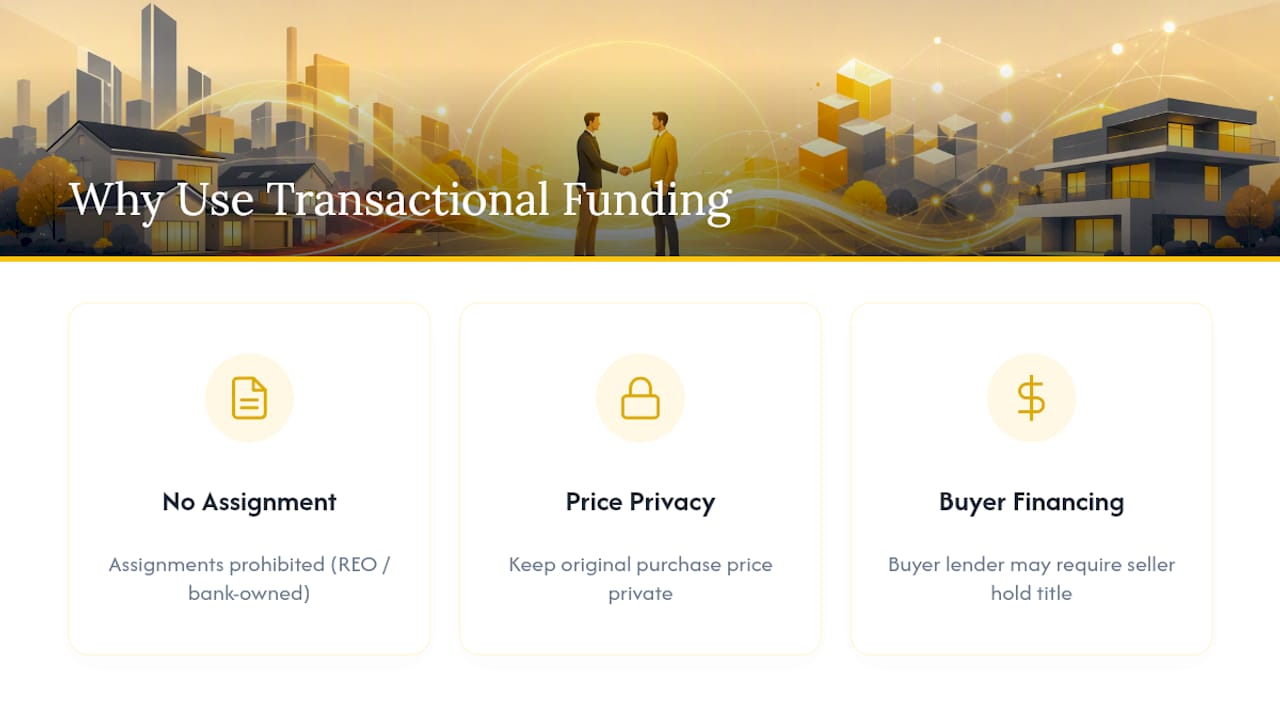
Why go this route instead of a simple assignment of contract? Three scenarios come up constantly in the field. First, the seller's contract may prohibit assignments outright, common with bank-owned or REO listings, where the seller wants a clean, direct sale. Second, the wholesaler may not want the end buyer to see the original purchase price, since an assignment fee on paper reveals the spread. A double close keeps that number private. Third, the end buyer might be using conventional financing, and many conventional lenders require the seller (in this case, the wholesaler) to already hold title before they'll fund, which makes a simultaneous close the only workable structure.
Transactional funding is ultra-short-term financing built exactly for this gap, borrowed for as little as a few hours and repaid the moment the second closing funds. Wholesalers who run several deals a month lean on it because it removes the need to have six figures in cash sitting idle, waiting for a resale that might close before lunch.
How the Double Close Actually Works, Step by Step
The mechanics run through a title company acting as the traffic cop, with the transactional lender wiring funds into escrow and getting repaid out of the second wire before the day ends.
- The wholesaler signs an A to B purchase contract with the original seller, and a separate B to C contract with the end buyer, both routed through the same title company or closing attorney.
- The transactional lender reviews both contracts and confirms the end buyer's proof of funds or loan approval before agreeing to fund the A to B side.
- On closing day, the title company opens escrow, and the transactional lender wires the A to B purchase funds directly into that escrow account.
- The A to B closing records, with the wholesaler now holding title, typically for minutes rather than days.
- The B to C closing happens immediately after, often in the same escrow session, and the end buyer's funds (cash or their lender's wire) land in the same title account.
- The title company disburses proceeds: the transactional lender is repaid first, off the top, along with its fee, and the wholesaler keeps the remaining spread.
Coordinated deals can move through this entire sequence in under an hour, with wires hitting escrow and both closings recording back to back, according to Deal Run's transactional funding guide. Most transactions land somewhere between same-day and a few days, depending on how quickly the end buyer's funds clear and whether the title company needs extra time for a title search or lien payoff.
Wiring discipline matters more here than in almost any other financing structure. Confirm wiring instructions verbally with the title company before sending funds, since wire fraud targeting real estate closings has become a routine attack vector. Get written confirmation from the title company that both contracts are in file and that the end buyer's funds are verified in escrow before the lender releases a dime.
What Does Transactional Funding Cost? Fees and Example Math
Transactional funding is priced per deal, not per year, and that changes how you need to evaluate it. Lenders typically charge in one of three ways, sometimes combined:
- Percentage fee: a flat percent of the funded amount, commonly 1% to 3% for a same-day close.
- Flat fee: a fixed dollar amount regardless of loan size, more common on smaller deals.
- Per-day holding fee: an additional daily charge if the B to C closing slips past the same day.
Same-day closings commonly fall in that 1% to 3% range, while extended holds stack an additional percentage plus per-day charges on top, since the lender's capital is exposed longer.
Pro Tip: Ask every transactional lender for their fee schedule in writing before you sign anything, specifically what happens if the B to C closing slips a day or two. That's where "cheap" same-day funding turns expensive fast.
Run the math on a typical deal. That's $3,600. If your spread between the A to B price and the B to C price is $12,000, you net $8,400 after the funding fee, still a strong return for capital you never had to source yourself. Compare that to a bridge loan or hard money loan carrying an 8.99% to 13.5% rate held for the same few hours: annualized, the transactional fee appears high, but given the very short term, it is comparatively minor next to the deal's total spread. Flip margins nationally give useful context here: when the typical flip spread supports a few thousand dollars of profit, a 2% funding fee rarely changes whether the deal makes sense.
What Do You Need to Qualify for Transactional Funding?
Transactional lenders underwrite the deal, not the borrower, which is why the documentation list looks different from a conventional loan application.
- Executed A to B contract. The purchase agreement between the wholesaler and the original seller, fully signed.
- Executed B to C contract. The resale agreement between the wholesaler and the end buyer, with agreed price and closing date.
- End buyer's proof of funds letter (POF) or loan pre-approval, confirming the resale can actually fund.
- Business entity documents, since most transactional lenders fund LLCs or corporations rather than individuals directly.
- Title commitment or preliminary title report, showing the property is clear to close.
- Written escrow confirmation from the title company, verifying both contracts are on file and funds are ready to move.
Because the lender's security comes from the contracts and the title escrow rather than the borrower's credit, many skip credit checks entirely, underwriting the transaction rather than the person. A signed A to B and B to C contract, plus cooperation from a title company willing to hold escrow and confirm funds, is the baseline requirement nearly every lender in this space enforces.
Build a pre-closing folder before you ever call a lender: both contracts, the end buyer's POF, your entity paperwork, and the title company's contact information. Lenders that see a complete file move faster, sometimes approving same-day requests within a couple of hours.
Transactional Funding vs. Assignment and Bridge Loans
Transactional funding solves a specific problem well, but it isn't the default choice for every deal.
Pros:
- Covers up to 100% of the purchase price, so you need little or no cash of your own.
- Closes fast, often same-day, matching the pace wholesalers actually work at.
- Keeps your assignment fee and purchase price private from the end buyer.
Cons:
- Fees stack quickly if the resale closing slips, turning a 2% cost into something much higher.
- If the end buyer's financing falls through at the last minute, you're left holding a property you funded with borrowed money.
- Requires a title company experienced with double closes; not every closing office will cooperate.
Pro Tip: If your assignment fee would run higher than the transactional funding cost, and the deal doesn't require a double close for legal or privacy reasons, a straight assignment is almost always simpler.
As a rule of thumb: reach for transactional funding when your spread comfortably covers the fee and something forces a double close, an anti-assignment clause, an REO seller, or a conventionally financed end buyer. When none of those apply and you just need a few weeks of holding capital instead of a few hours, a bridge loan or standard hard money loan usually fits better.
How to Vet a Transactional Lender Before You Commit
Not every lender advertising transactional funding actually has the title relationships to execute on tight timelines. Ask direct questions before you're mid-deal and out of options.
Questions to ask:
- What's your typical turnaround from signed contracts to wired funds?
- Is your fee a flat percentage, a flat dollar amount, or a per-day charge, and what triggers each?
- Do you require the title company to send written escrow confirmation before you'll wire?
- What's the maximum number of days you'll hold funds if my B to C closing slips?
Red flags to walk away from:
- Vague or shifting fee quotes that change once you're committed to the deal.
- No established relationships with title companies that handle double closes regularly.
- Reluctance to put escrow instructions and repayment terms in writing.
- Pressure to wire before the title company confirms both contracts are on file.
A lender's comfort discussing wiring windows and escrow procedure in specific detail, rather than generic reassurance, tells you whether they've actually closed these deals before.
Practitioner Notes on Getting Same-Day Deals Funded
Lenders funding transactional deals typically ask for the same starting package every time: both signed contracts, the end buyer's proof of funds, and confirmation from title that escrow is open. Borrowers who show up with that file complete, rather than piecing it together after the request, get faster answers and fewer last-minute scrambles.
Title coordination is where deals actually die, not underwriting. Call the title company before you submit anything to a lender and confirm they've handled simultaneous closings before; not every office has. Lock your wiring window early in the day rather than late afternoon, since a wire that misses a bank's cutoff pushes the whole closing to the next business day, and that's exactly the delay that turns a cheap same-day fee into a multi-day holding cost.
Jaken Finance Group's own guidance for loan officers working transactional and gap deals covers this same sequence in more procedural depth in the Loan Officer's Guide to Transactional & Gap Funding, useful reading before your first double close.
When Transactional Funding Belongs in Your Toolbox
Transactional funding earns its place when the deal structure demands it, not just when cash is tight. The real skill isn't finding a lender willing to fund a double close; it's building enough discipline around title coordination and buyer verification that the fast timeline never becomes a liability. Counterparty risk is the part most new wholesalers underestimate: an end buyer's financing falling through at the last hour is a bigger threat than any fee schedule.
Treat the spread, not the deal count, as your filter. If the numbers work after fees and the buyer's funds are verified, execute. If either is shaky, wait.
— Jason Taken
Fast Financing Options From Jaken Finance Group
Jaken Finance Group offers asset-based lending that evaluates property value rather than credit scores, providing financing solutions designed for timely closings and flexibility.
For deals that don't fit a strict transactional structure, or when you need holding capital for a few weeks rather than a few hours, Jaken's Bridge Loans and Fix and Flip financing run at rates between 8.99% and 13.5%, with leverage up to 100% of the cost. Investors juggling multiple properties can also look at gap lending to cover the space between a purchase and permanent financing.
Before you apply, have your purchase contract, entity documents, and a scope of work or resale plan ready. Start by reviewing current loan options and rates to see which product matches your next deal's timeline.
Sources
- What Is Transactional Funding? Complete Guide | Deal Run
- A Real Estate Investor’s Guide To Transactional Funding
- ATTOM: 2024 year-end home flipping report
This article is general information, not a substitute for advice from a qualified financial advisor. Consult a qualified financial professional about your own circumstances before acting on anything here.
FAQ
What Are the Three Types of Real Estate Funding for Wholesalers?
Wholesalers generally rely on assignment of contract, transactional funding for double closes, and traditional financing like bridge or hard money loans when they need to hold a property longer than a same-day resale. Each fits a different deal structure: assignment for simple flips, transactional funding when a double close is legally or strategically required, and bridge financing for anything with a longer hold period.
How Much Does Transactional Funding Cost?
Same-day transactional funding commonly costs 1% to 3% of the funded amount, charged as a flat fee, a percentage, or a combination with per-day holding charges if the closing slips. Extended holds beyond the same day push costs meaningfully higher, since the lender's capital stays exposed longer.
Is Owner Financing a Good Idea for the Buyer?
Owner financing can work well for buyers who can't qualify for a conventional loan, since it skips traditional underwriting in favor of terms negotiated directly with the seller. It's a separate structure from transactional funding entirely; owner financing extends over months or years, while transactional funding is designed to be repaid within hours or days.
What Is Transactional Finance and What Does It Entail?
Transactional finance in real estate refers to short-term, deal-specific loans used to fund one leg of a double closing, typically the A to B purchase, repaid immediately from the B to C resale. It requires signed contracts on both legs, a cooperating title company, and a verified end buyer, rather than a traditional credit-based approval process.
Can I Get Transactional Funding With Bad Credit?
Yes, most transactional lenders don't run credit checks at all, since they secure the loan through the contracts and the title escrow rather than borrower creditworthiness. What actually matters is having both contracts signed, a funded end buyer, and a title company willing to handle the double close.