
Most closing delays trace back to one problem: the title isn't marketable due to issues such as recorded liens, ownership gaps, or errors in public records that a title company can't clear on its own. When that happens, the title insurer won't issue a clean policy and the lender won't fund, regardless of how ready the buyer and seller are otherwise.
The first three moves matter more than anything else you'll read below:
- Review the preliminary title commitment with the title officer line by line and identify exactly which exception is holding things up.
- Request payoff or release documentation for any lien named in the commitment, whether it's a mortgage, judgment, or HOA balance.
- Notify your lender immediately and request a documented extension if the cure will take longer than your rate-lock window allows.
The Consumer Financial Protection Bureau notes that title documentation is a core part of what determines whether a lender will actually fund at closing, not a side formality. The American Land Title Association (ALTA) sets the industry standards title companies follow when clearing these exceptions, and Jaken Finance Group, which structures asset-based real estate loans around speed, sees this exact bottleneck play out routinely on investor deals where timing is everything.
Key Takeaways
Title defects delay closings because lenders require clear, insurable title before funding, and resolving them fast depends on reviewing the commitment early, documenting every cure step, and knowing when to escalate to counsel.
| Point | Details |
|---|---|
| Review the prelim first | Identify the exact exception on the title commitment before assuming the worst about a defect. |
| Get releases and payoffs in writing | Request recorded satisfactions or payoff letters immediately, since verbal confirmation won't satisfy a lender. |
| Request extensions early and specifically | Give the lender a defect description and a realistic cure date rather than a vague delay notice. |
| Escalate clerical vs. legal correctly | Fix recording errors quickly, but route fraud, forged deeds, or heir disputes straight to an attorney. |
| Consider asset-based financing for timing pressure | Jaken Finance Group's asset-based loans can close in as few as five days once title is cleared or insured over, helping investors avoid losing a deal to a stalled conventional timeline. |
Table of Contents
- Common Title Defects That Most Often Delay Closings
- Why Title Defects Stop a Closing: The Underwriter's View
- What Buyers and Sellers Should Do at Each Stage of Escrow
- How Title Companies and Attorneys Actually Cure Defects
- Realistic Timelines and Costs for Common Title Fixes
- Your Contract Rights When Title Problems Surface
- How Experienced Closers Avoid Last-Minute Title Crises
- A Faster Path When Title Delays Threaten Your Closing Timeline
- Frequently Asked Questions
- Sources
Common Title Defects That Most Often Delay Closings
Title problems fall into two buckets: paperwork errors that get fixed in days, and ownership disputes that can take months. Knowing which bucket you're in changes everything about how you plan the rest of the transaction.
The chart below breaks down the defects title officers see most often, who typically has to fix them, and roughly how fast that fix moves.
| Title Defect | Usual Fix | Who Resolves It | Speed |
|---|---|---|---|
| Unreleased mortgage or paid-off lien | Obtain payoff proof, record a satisfaction | Prior lender / seller | Days to weeks |
| Judgment lien against seller | Prove non-association or negotiate payoff | Seller / attorney | Days to months |
| Unpaid property taxes or HOA dues | Pay balance, obtain release letter | Seller / HOA | Days |
| Errors in public record (names, legal description) | File a correction affidavit or corrective deed | Title company / seller | Days |
| Defective or forged deed | Investigate chain, possibly quiet title | Attorney | Weeks to months |
| Probate or unknown heirs | Open probate, locate heirs, obtain court order | Estate attorney | Months |
| Boundary or survey discrepancy | Order new survey, negotiate boundary line | Buyer / seller / surveyor | Weeks |
| Easements or restrictions | Confirm on title, negotiate terms | Buyer / seller | Days |
| Missing or defective power of attorney | Obtain properly executed POA or ratification | Seller / attorney | Days to weeks |
A few of these deserve extra attention because they surprise people. TitleTrackr's research on common title search defects flags unreleased mortgages as one of the most frequent findings on a title search, often because the original lender merged or dissolved years ago and nobody filed the release. That's the so-called dead lender problem, and it's more common on older properties than most sellers expect.
Judgment liens carry a similar trap. Courts index judgments by name, not by property, so a seller with a common name can get flagged for a judgment that belongs to a completely different person. Clearing that requires an affidavit of non-association, and if the courthouse records aren't digitized, tracking down proof can eat several days on its own.
Here's the practical order of operations when a defect surfaces:
- Identify which category the defect falls into (clerical vs. ownership dispute).
- Assign responsibility immediately, don't let it sit unassigned between buyer, seller, and title company.
- Request the specific document that clears it (release, affidavit, corrective deed, or court order).
- Set a realistic timeline based on whether courthouse records are digitized.
- Loop in the lender the moment you know the timeline might slip.
Why Title Defects Stop a Closing: The Underwriter's View
A title defect doesn't just slow down paperwork. It stops the title insurer from issuing a policy without an exception, and it stops the lender from funding because most loan agreements require clear title as a condition of closing. Underwriters place a hold the moment the chain of title can't be verified, and that hold doesn't lift until the specific exception is either cured or insured over.
Rate locks add real pressure here. Locks often run for a few weeks to a couple of months, and if a title cure drags past that window, the buyer risks losing the locked rate and having to re-qualify at current terms. Mondaq's explainer on clouds on title makes the point clearly: some clouds clear in a single recording, while others require a judge's signature, and lenders have no appetite for funding into the uncertainty in between.
Missing payoff documentation is the quiet killer in this process. Even when everyone agrees the mortgage is paid off, the lender won't fund without a recorded satisfaction or a payoff letter the title company can rely on. If the original lender has been acquired or gone out of business, tracking down that documentation through NMLS Consumer Access to find the successor servicer becomes the actual task at hand, not just an administrative footnote.
Pro Tip: Ask your title officer directly whether the defect qualifies for an insured-over solution before you assume a full legal cure is required. Underwriters will often issue a policy with an exception or an indemnity if the risk is small and well-documented, which can save weeks compared to waiting on a court filing or a hard-to-find lienholder.
What Buyers and Sellers Should Do at Each Stage of Escrow
The best defense against a title delay is catching the problem before it becomes urgent. Early due diligence during due diligence, not the week of closing, is what separates a minor hiccup from a blown closing date.
Before listing or making an offer:
- Order an early title search or preliminary title report, even before you're under contract.
- Gather payoff paperwork for any existing loans on the property.
- Request the HOA resale package if the property is part of an association.
- Order a survey if boundary lines have ever been in question.
During escrow:
- Review the title commitment with the title officer as soon as it arrives, not the week before closing.
- Request payoff statements from every lienholder named in the commitment.
- Confirm that lien releases are actually recorded, not just promised.
- Check for open municipal permits or code violations tied to the parcel.
- Prepare corrective documents in advance if a clerical error is already known.
At the closing table:
- Triple-check every name and legal description against the deed and the title commitment.
- Confirm wire instructions directly with the title company by phone, never by email alone.
- Arrange a mobile notary or backup signing option in case a party can't appear in person.
- Confirm recording timelines with the escrow officer so you know exactly when the deal is truly final.
If you need to ask for an extension, be specific. Tell the lender the exact defect, the document needed to cure it, and a realistic date. A vague "we need more time" request gets far less traction than "we're waiting on a recorded satisfaction from a servicer, expected within 10 business days." Inman's reporting on preventing title issues points out that most failed deals with curable title defects fail because of communication breakdowns, not because the defect itself was unsolvable. Missed calls to a lienholder or a forgotten extension request kill more deals than actual legal disputes do.
How Title Companies and Attorneys Actually Cure Defects
Most title defects get cured through a handful of standard tools, and title officers reach for the simplest one first. A clerical error in a legal description or a misspelled name usually gets fixed with a correction affidavit or a corrective deed, both of which can be recorded in a matter of days once the paperwork is signed.

Unreleased mortgages require the title company to track down the payoff amount, confirm it was paid, and get a satisfaction recorded. When the original lender no longer exists, this often means using Chicago building permit and lien research techniques as a model: search successor servicers, obtain historical loan documents, and in stubborn cases, use an indemnity agreement backed by the title insurer to move forward without the actual release in hand.
When a defect involves missing heirs, forged instruments, or unresolved ownership claims, the cure options narrow considerably:
- Quiet title action: a court proceeding that establishes clear ownership when other parties can't be located or won't cooperate. This typically takes months and requires an attorney.
- Probate proceedings: required when an owner died without clear estate transfer, and heirs need to be identified and confirmed by a court before title can pass cleanly.
- Indemnity escrow: funds held back at closing to protect the buyer or lender against a known but unresolved risk, often used as a bridge while a slower cure works its way through.
Title insurance changes the calculus in a lot of these cases. As the CFPB explains about owner's title insurance, the policy protects the buyer against certain historical defects that surface after closing. That means underwriters can sometimes issue a policy with a specific exception for a known, low-risk issue rather than demanding a full legal cure, which is often the fastest path to closing when the alternative is a multi-month court process. Underwriters won't insure over everything, though. Active fraud, unresolved probate with unidentified heirs, and forged deeds almost always require full cure before any policy gets issued.
Realistic Timelines and Costs for Common Title Fixes
Not every title issue costs weeks. The gap between a same-day fix and a six-month court battle depends entirely on which category the defect falls into, and planning your rate lock and moving timeline around the wrong assumption is how buyers end up scrambling.
| Defect Type | Typical Timeline | Approximate Cost Range |
|---|---|---|
| Recording correction / affidavit | Days | Filing fees only, typically low cost |
| Lien release collection (responsive lender) | Days to two weeks | Minimal, mostly administrative |
| Dead lender / successor tracing | Two to six weeks | Varies; may require title-curative service fees |
| HOA dues clearance | Days to one week | Amount owed plus release admin fee |
| Probate / unknown heirs | Several months | Court costs plus attorney fees, often several thousand dollars |
| Quiet title action | Several months to a year | Attorney fees typically in the low to mid thousands |
A routine title search commonly wraps up within a couple of weeks in straightforward cases, but that window stretches considerably the moment a defect surfaces, according to background practitioner commentary on curative timing. What pushes costs and timelines higher, specifically:
- A dead lender that requires tracing through successor servicers or bankruptcy records.
- Out-of-state property records that aren't accessible through the local recorder's office.
- County courthouses that haven't digitized older filings, forcing manual document pulls.
Given that range, build contingency time into any closing calendar the moment a defect is flagged, rather than assuming the fastest-case scenario will hold. A buyer relying on a 30-day rate lock has almost no margin if the fix turns out to require a court filing.
Your Contract Rights When Title Problems Surface
Most purchase agreements include a title defect clause that gives the seller a defined cure period, usually somewhere between 15 and 30 days, before either party gains the right to walk away. That means a buyer generally can't cancel the moment a defect appears; the contract typically requires giving the seller a fair chance to fix it first.
Here's how the remedies usually work in practice:
- Documented extension request: put the reason for the delay and the expected cure date in writing to the lender and all parties, not just a verbal heads-up.
- Escrow holdback: funds get held in escrow to cover a known, quantifiable risk, allowing the deal to close while the underlying issue finishes resolving.
- Seller cure before funding: the most common outcome, where the seller resolves the lien or error using proceeds from the sale itself.
- Buyer termination: available only after the cure period specified in the contract expires without resolution, and usually with earnest money returned.
The CFPB's guidance on the mortgage closing process is a useful reference point here because it lays out, in plain language, what documentation lenders require before funding, which helps buyers understand why an extension request needs specifics rather than vague reassurance.
Pro Tip: Keep every communication about a title defect in writing, including emails confirming phone calls. If the issue later becomes an indemnity claim against the title insurer, that paper trail is what supports your claim.
Some situations call for an attorney immediately rather than after escalation: suspected fraud, a forged deed, unresolved heirs with a plausible claim to the property, or any case heading toward quiet title. This article offers general information, not legal advice, and complex title disputes should go through a qualified real estate attorney familiar with your state's recording and probate rules.
How Experienced Closers Avoid Last-Minute Title Crises
The professionals who rarely get blindsided by a title defect aren't lucky. They order the title search the day a contract is signed, not two weeks before closing, and they treat problem-prone property types, probate transfers, older urban parcels, and heavy rehab projects, as automatic candidates for extra scrutiny up front.
At Jaken Finance Group, that habit shows up specifically around properties tied to probate transfers, where title complications are the rule rather than the exception. Investors who order title work early on these deals routinely close on schedule; those who wait almost always hit a hold they didn't see coming.
One habit that separates a smooth closer from a stressed one: keep certified payoff receipts on file the moment they're issued during escrow, rather than trusting that the lienholder will record the release promptly on their own. Recorded releases sometimes lag weeks behind the actual payoff, and having proof in hand lets a title officer proceed with an indemnity solution instead of waiting on the county recorder.
A trusted, responsive title company relationship matters more than most buyers realize until they're without one. The difference between a title officer who returns calls same-day and one who takes a week isn't cosmetic. It's often the entire gap between closing on schedule and losing a rate lock.
A Faster Path When Title Delays Threaten Your Closing Timeline
When title issues push a conventional closing past the calendar you were counting on, a hard-money or asset-based loan can be the tool that keeps a deal alive. Jaken Finance Group underwrites primarily on property value rather than the borrower's credit profile, which means an investor facing a title delay on one deal isn't necessarily locked out of moving forward on financing for another opportunity, or restructuring the current one, while the cure works through.
This isn't a workaround for every title problem. Marketable title is still a requirement for most permanent financing, and defects like active fraud or unresolved probate claims need legal cure regardless of who's funding the loan. Where asset-based lending helps most is speed and flexibility once a defect is cured or once an indemnity solution has cleared the underwriter's objection, closings can move in as few as five days rather than waiting out a full conventional underwriting cycle a second time.
Eligibility depends on the property's condition, your exit plan, and the specific nature of the title issue involved. If you're an investor weighing options while a title cure is in progress, review the requirements for 100% fix-and-flip financing or explore how asset-based underwriting works to see whether it fits your timeline.
Frequently Asked Questions
What is the most common title issue that delays closing? Unreleased mortgages and judgment liens top the list. A prior loan that was paid off years ago but never had its satisfaction recorded is one of the most frequent findings on a title search, and clearing it depends entirely on how fast the original lender or its successor responds.
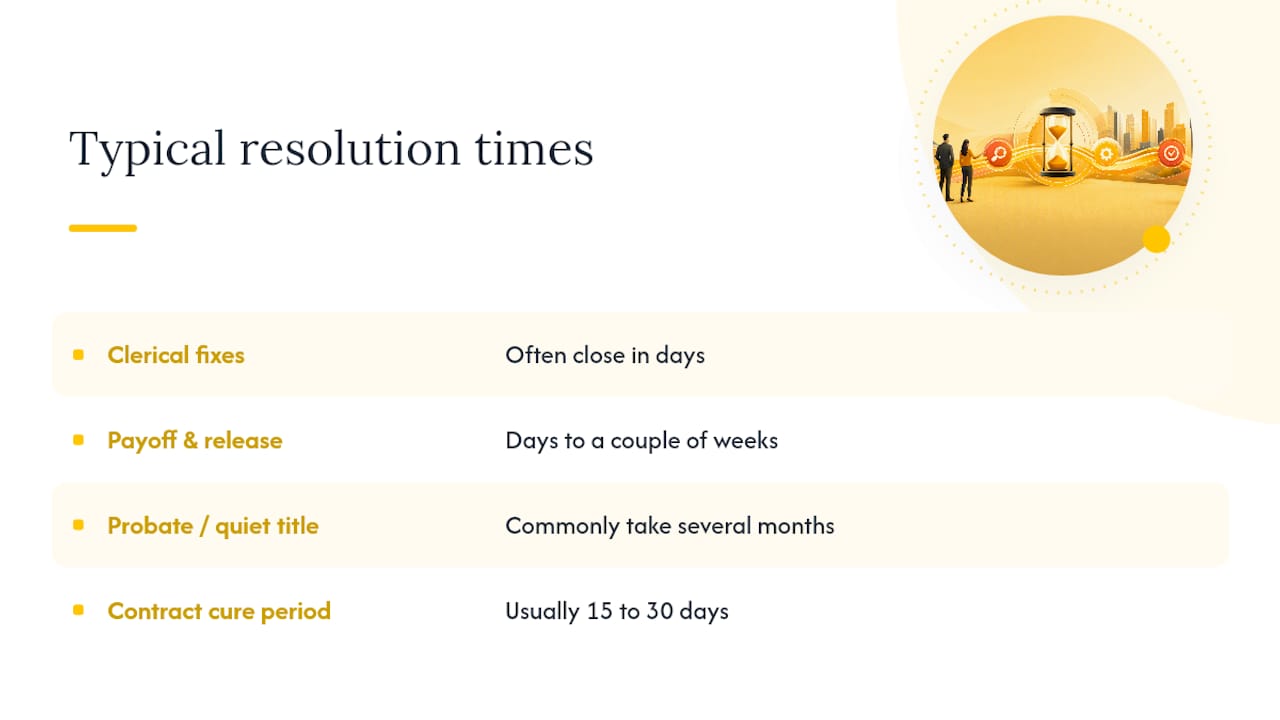
How long does it typically take to resolve a title issue? Clerical fixes like correction affidavits often close in days. Payoff and release collection usually runs days to a couple of weeks. Probate and quiet title cases, by contrast, commonly take several months because they involve court proceedings.
Can a closing proceed if a title issue isn't fully cured? Sometimes. Underwriters can issue title insurance with a specific exception or use an indemnity arrangement for smaller, well-documented risks, letting the closing move forward without a full legal cure. Higher-risk defects like fraud or unresolved heirship claims almost always require complete resolution first.
Who is responsible for fixing a title defect, the buyer or the seller? It depends on the defect. Sellers typically handle liens, judgments, and payoff issues, since those are usually tied to their ownership history. Buyers and title companies more often manage boundary disputes, survey issues, and clerical corrections discovered during the search.
Can a buyer walk away from a deal because of a title problem? Only after the contract's cure period, usually 15 to 30 days, expires without resolution. Most purchase agreements require giving the seller a reasonable chance to fix the issue before a buyer can terminate and recover earnest money.
This article is general information, not a substitute for advice from a qualified lawyer. Consult a qualified legal professional about your own circumstances before acting on anything here.
Sources
For readers who want to go deeper on any point covered above, these resources cover the official rules and the practitioner-level detail:
- Mortgage closing (Consumer Financial Protection Bureau)
- Common title search defects and how to find them (TitleTrackr blog)
- How real estate agents can prevent title issues from derailing a deal (Inman)
- What a 'cloud on title' actually means and why it delays closings (Mondaq)
Readers dealing with a lien tied to unpaid taxes or a judgment may also find value in Joe Mastriano PC's overview of liens and levies, which walks through how these claims attach to property and what it takes to release them.