
Short answer: yes, but only in specific ways. A seller credit can offset closing costs on a hard-money purchase, but it will not create lender-acceptable down payment funds or protect your loan-to-value once a hard-money lender underwrites the deal. Most hard-money lenders calculate LTV against the purchase price minus the seller credit, which shrinks your maximum loan amount even as it lowers your line-item costs.
Three outcomes typically follow:
- Credit toward closing costs — reduces cash-to-close but can lower the loan amount the lender is willing to fund.
- Seller carry — the seller becomes the lender for some or all of the purchase price, replacing or supplementing hard money.
- Price-adjustment treatment — some lenders simply treat the credit as a reduction in effective purchase price, which reshapes underwriting math entirely.
A 2024 Zillow survey found that 35% of recent successful buyers with a low rate got special financing from a seller or builder, and nearly half locked rates below 5% in a market averaging 6 to 8% on 30-year fixed loans. This is the upside case. Jaken Finance Group underwrites these deals against property value and collateral, not FICO scores, which is where the seller-credit conversation gets interesting for investors moving fast.
Key Takeaways
The financing choice that matters most is how a lender calculates loan-to-value once a seller credit is on the table, because that single rule determines your real cash-to-close.
| Point | Details |
|---|---|
| Credits cut costs, not proceeds | A seller credit lowers closing costs but many hard-money lenders reduce LTV against the discounted price. |
| Program caps don't apply to hard money | Conventional, FHA, and VA credit caps govern institutional loans; private hard-money terms are set lender by lender. |
| Split-stack lowers blended cost | Seller carry for the purchase price plus hard money for rehab often beats an all-hard-money structure on total cost. |
| Document everything before closing | Get the credit policy, Loan Estimate, and payoff language in writing to protect your refinance exit. |
| Jaken Finance Group funds on value | Asset-based underwriting and fast closings let investors move on seller-credit deals that conventional lenders would slow down or reject. |
This article is general information, not a substitute for advice from a qualified financial advisor. Consult a qualified financial professional about your own circumstances before acting on anything here.
Table of Contents
- What Is Seller Credit in a Hard Money Deal?
- Do Conventional and Hard Money Lenders Treat Seller Credits the Same?
- Three Deal Structures That Combine Seller Credit and Hard Money
- What Are the Risks of Mixing Seller Credit and Hard Money?
- How Do You Document a Seller Credit With a Hard Money Lender?
- When Combining Seller Credit and Hard Money Actually Works
- Get Fast, Asset-Based Funding for Your Next Deal
- Sources
What Is Seller Credit in a Hard Money Deal?
Three terms get used loosely in real estate investing conversations, and mixing them up costs investors money at the closing table.
- Seller credit (also called an interested-party contribution, or IPC) is money the seller agrees to contribute toward the buyer's closing costs, prepaids, or discount points. It shows up as a line-item deduction on the Closing Disclosure, not as cash in hand.
- Seller financing (seller carry) is a different animal entirely. The seller becomes the lender, holding a promissory note or deed of trust instead of collecting full payment at closing.
- Hard money is short-term, asset-based private lending. The lender underwrites primarily against the property's value and exit strategy, not the borrower's income or credit history.
Confusing a credit with a carry note is the single most common mistake investors make when structuring these deals.
Do Conventional and Hard Money Lenders Treat Seller Credits the Same?
No, and the gap between them is where deals get won or lost. Conventional, FHA, VA, and USDA loans cap seller credits by program: conventional loans typically allow 3 to 9% depending on LTV, FHA caps at 6%, VA at 4%, and USDA at 6%. None of these programs let a seller credit fund the buyer's required down payment, and any credit above the cap gets forfeited rather than refunded.
Hard-money lenders operate differently, but not necessarily more generously. Most will accept seller-paid closing costs without objection. The catch is how they calculate loan-to-value: many hard-money lenders base LTV on the purchase price minus the seller credit, not the full contract price. If you negotiate $10,000 in seller credit on a $200,000 purchase, some lenders will underwrite against $190,000, not $200,000, which shrinks your maximum loan proceeds even as your closing costs drop.
That mechanic matters because using a hard-money loan to fund a conventional down payment is generally blocked by CLTV rules and underwriting guidelines that require down payment funds to come from the borrower or an approved source. Investors sometimes assume they can layer hard money on top of a conventional purchase to cover the gap. That assumption fails at underwriting almost every time.
Hard money itself carries a real cost. Rates commonly run 10 to 18% or higher, with closings possible in days rather than weeks. That speed is the trade-off for the rate.
Pro Tip: Ask your hard-money lender in writing, before you sign a purchase contract, exactly how they treat seller credits in their LTV calculation. That single answer changes your cash-to-close math and can determine whether the deal pencils at all.
Three Deal Structures That Combine Seller Credit and Hard Money
Each of these structures solves a different problem. Match the structure to what the deal actually needs.
You bring less cash to closing, but your loan proceeds shrink slightly too. Timeline: 7 to 12 days to close, 6 to 9 months to stabilize and sell or refinance.
Structure B: Split-stack with seller carry for the purchase, hard money for rehab. Smart investors split the capital stack, letting the seller carry the purchase price at a lower rate while hard money funds only the rehab portion. Rehab draws typically fund in 5 to 10 days once the note is recorded.

Structure C: Seller carry replaces part of purchase financing, hard money bridges to refinance. The seller holds a junior note; hard money or a bridge loan funds the remainder and any rehab. This structure demands clean subordination language and a defined refinance exit into DSCR financing so the balloon payoff and the seller note don't collide.
What Are the Risks of Mixing Seller Credit and Hard Money?
Regulatory exposure exists mostly around repeat seller financing, not one-off deals. Ability-to-repay rules under Dodd-Frank generally apply only to sellers who extend credit more than five times in a year, so an occasional seller-carry deal usually sits outside that framework. Due-on-sale clauses on the seller's existing mortgage remain a real risk if the seller carries a note while still owing their own lender.
- Appraisal adjustments tied to the credit can trigger a lower appraised value if the appraiser treats the credit as a price concession.
- CLTV reduction happens automatically when a hard-money lender deducts the credit from purchase price before calculating loan proceeds.
- Foreclosure exposure falls on the seller if the buyer defaults on a carried note, especially without a professional servicer.
- Informal servicing, missing payoff language, and undocumented balloon terms are the fastest way to sink a note's resale value on the secondary market.
Pro Tip: Insist on a licensed loan servicer and written payoff waterfall language before closing. A seller note with clean servicing records is a sellable asset; one handled with a handshake and a spreadsheet usually isn't.
How Do You Document a Seller Credit With a Hard Money Lender?
- Get the hard-money lender's credit policy in writing before you go under contract, not after.
- Request a Loan Estimate or term sheet showing exactly how the credit affects your LTV and cash-to-close.
- Draft a purchase agreement addendum specifying the credit amount and how it applies at closing.
- If seller carry is involved, execute a promissory note and deed of trust, with subordination language if a hard-money lender sits in first position.
- Set title and payoff instructions early so escrow can execute cleanly.
- Confirm whether the appraiser will treat the credit as a price reduction.
- Get explicit balloon-payoff language if a seller note is involved.
- Line up a professional servicer, especially if you plan to sell the note or refinance into longer-term rental debt later.
Pro Tip: Recorded documents and professional servicing aren't optional if you ever plan to sell the note or refinance out of hard money. Buyers of paper and conventional refinance lenders both want a clean, provable payment history.
When Combining Seller Credit and Hard Money Actually Works
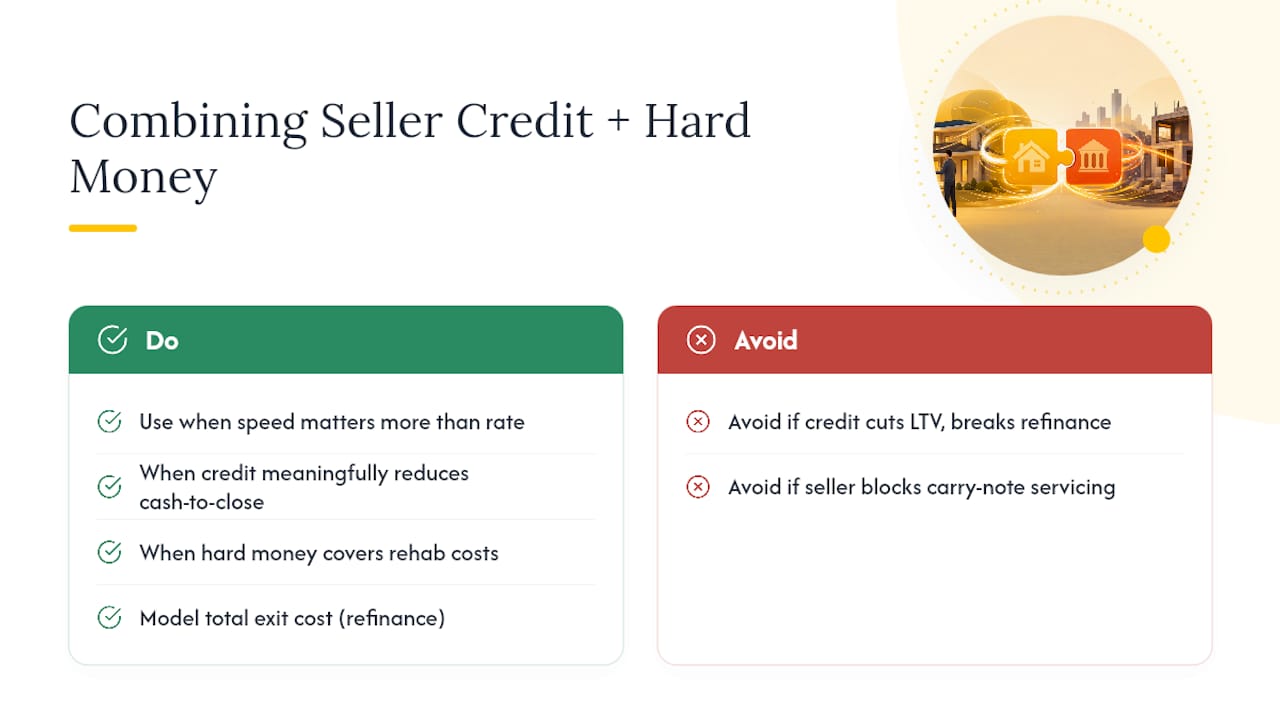
Combining seller credit with hard money earns its place when speed matters more than rate, and the credit meaningfully reduces cash-to-close while a hard-money loan or rehab-focused draw structure covers renovation costs on a tight timeline. It falls apart when the credit shrinks your LTV enough to break your refinance math, or when a seller won't put a carry note through professional servicing. Model your total cost to exit, usually a refinance, before you agree to any structure.
Get Fast, Asset-Based Funding for Your Next Deal
Seller credits and carry notes can stretch your capital, but they still leave a gap that needs to close fast, and that's where an asset-based lender earns its keep. Jaken Finance Group underwrites against property value rather than credit score, which means a seller-credit deal that a bank would reject on paper can still fund in as few as five days.

Investors working fix-and-flip deals use Jaken Finance Group's 100% fix-and-flip financing programs to cover acquisition and rehab draws without tying up personal cash, even when a seller credit has already reduced the purchase-side loan amount. The asset-based underwriting model means credit history takes a back seat to the deal itself, and rehab draws release on a schedule built for real construction timelines, not bank bureaucracy. If you have a contract with a seller credit already negotiated and need to know exactly how it affects your loan proceeds, apply directly through Jaken Finance Group's fix-and-flip program page and get a term sheet before you're locked into a closing date you can't hit.
Sources
- What Is Seller Financing and How Does It Work? | Zillow
- Hard Money vs. Seller Carry: Which Is Better? | Noteservicingcenter
- Can you use a hard money loan for a down payment? | LegalClarity