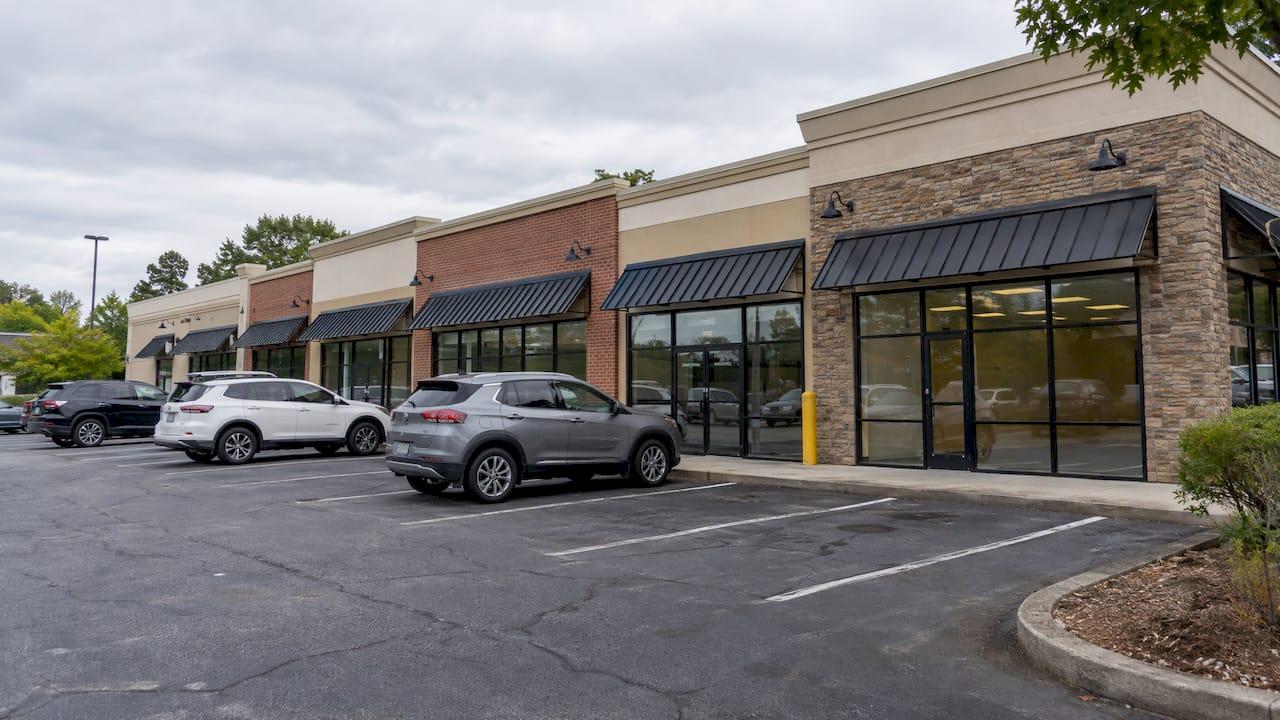
A retail center bridge loan is short-term, interest-only financing used to buy, reposition or refinance a strip center, neighborhood center or similar retail property that does not yet qualify for permanent debt. It covers the gap between the day the investor needs capital and the day the property is leased up, renovated or otherwise stable enough for a long-term loan or a sale. This guide covers typical terms, leverage, underwriting, the application process and exit planning.
TL;DR
- A retail center bridge loan funds acquisition, lease-up or renovation. It is typically interest-only and runs 12 to 36 months, then is repaid by a refinance or sale.
- Lev's bridge quote data for unanchored shopping centers (January to June 2026) shows fixed quotes of 5.88% to 7.00% and floating quotes of 6.12% to 8.35%, at 60% to 75% LTV.
- Lenders weigh the property, the loan-to-value ratio, the exit plan and sponsor liquidity ahead of credit score.
- Jaken Finance Group publishes bridge and commercial property loan rates of 8.99% to 13.5%, with no minimum credit score and closings in as few as 7 to 10 days.
- Build the exit before you close: document the lease-up plan, the refinance target and the reserves to cover a delay.
Table of Contents
- What a retail center bridge loan is and when investors use one
- Bridge versus permanent financing for a retail center
- Rates, leverage and coverage: what the data shows
- What lenders consider when qualifying a retail center
- How to apply and close a retail center bridge loan
- Planning the exit before you close
- Our perspective
- Financing a retail center with Jaken
- Choosing a structure that fits the plan
- FAQ
- Sources
What a retail center bridge loan is and when investors use one
Bridge financing exists for properties in transition. A conventional or agency-style lender wants a stabilized asset: high occupancy, seasoned leases and cash flow that already supports the debt. A retail center that is half vacant, has leases rolling soon or needs façade and tenant work does not meet that standard yet. The bridge lender underwrites the business plan and the collateral instead, and the borrower repays when the property reaches the standard.
Common situations for retail centers:
- Acquisition of an under-leased center. The seller has vacancy, below-market rents or deferred maintenance, and the buyer intends to fill suites and raise net operating income.
- Lease-up and tenant improvements. Funds cover buildout allowances and leasing costs for new tenants.
- Refinance of a maturing loan. The existing debt is due, but occupancy or cash flow has not yet reached permanent-loan levels.
- Speed-driven purchases. An auction, estate sale or motivated seller requires a close faster than a bank can deliver.
- Repositioning. A center changes its tenant mix, for example adding medical, fitness or service tenants.
For a closer look at how asset-based bridge funding fits these plans, see our article on when hard money bridge fits retail value-add deals. Investors in other markets can compare the approach with our Atlanta strip-center bridge loan guide, which covers vacancy and tenant work.
Bridge versus permanent financing for a retail center
The two loan types answer different questions. Bridge debt supports a defined transition. Permanent debt supports the long-term hold once the property meets the lender's requirements.
| Feature | Retail center bridge loan | Permanent retail loan |
|---|---|---|
| Purpose | Acquire, reposition, lease up, refinance in transition | Long-term hold of a stabilized asset |
| Typical term | 12 to 36 months | 5 to 30 years |
| Payments | Interest-only, often floating | Amortizing, often fixed |
| Underwriting focus | Property value, business plan, exit | Current in-place cash flow |
| Leverage | Commonly 60% to 75% LTV | Varies by lender and property |
| Speed | Days to a few weeks | Often 45 to 90 days or more |
The term and structure ranges above reflect common industry descriptions of bridge versus permanent debt, including a comparison from a commercial capital advisory that places bridge loans at 12 to 36 months and interest-only, with permanent loans running 5 to 30 years. Individual lenders set their own terms, so use these as planning ranges, not quotes.
Rates, leverage and coverage: what the data shows
Pricing depends on property type, occupancy, location, sponsor strength and whether the rate is fixed or floating. The most useful public benchmark for this property type comes from Lev's bridge loan quote data for unanchored shopping centers, covering January through June 2026 in the United States:
| Metric | Range in quotes | Median |
|---|---|---|
| Fixed-rate quotes | 5.88% to 7.00% | 6.51% |
| Floating-rate quotes | 6.12% to 8.35% | 7.02% |
| LTV | 60% to 75% | n/a |
| DSCR requirement | 1.20x to 1.35x | n/a |
These quotes reflect a specific loan-size band and a marketplace of lenders in the first half of 2026, so they describe the market, not any one lender's offer. Rates move with the benchmark, and floating rates reset with it.
Jaken's published pricing
Our published rate range for bridge loans and commercial property loans is 8.99% to 13.5%. Asset-based underwriting, no minimum credit score, deferred payment options and leverage of up to 100% of cost are part of how we structure transactions for investors who need speed and flexibility. Final rate, leverage and terms depend on the property, the business plan and the borrower's experience, and are confirmed in the term sheet.

Costs beyond the rate
Budget for the full cost of capital, not only the coupon:
- Origination points charged at closing.
- Third-party reports: appraisal, environmental review, title, survey and insurance.
- Legal and closing costs.
- Interest reserve or holdback if the loan funds renovation or tenant improvements in draws.
- Extension fees if the plan may run past the initial term.
Run the all-in cost against the projected stabilized value. A bridge loan is justified when the value created by lease-up and repositioning exceeds financing costs by a comfortable margin.
What lenders consider when qualifying a retail center
Bridge underwriting is asset-first. Lenders generally look at the following, roughly in this order of weight:
- Property quality and location. Traffic counts, visibility, parking, trade-area demographics and physical condition.
- Leverage discipline. Loan-to-value, and loan-to-cost on value-add deals. Lender-published guidance commonly puts bridge leverage at 60% to 75% LTV, with lower caps on heavier value-add or special-use assets.
- Exit certainty. A written, credible path to repayment.
- Sponsor liquidity and experience. Cash reserves to cover debt service and a delayed exit, plus a track record with similar assets.
- Credit. It matters, but less than it does at a bank.
Retail-specific factors
Retail underwriting adds details that apartments or industrial buildings do not:
- Tenant mix. Necessity and service tenants such as medical, dental, fitness, grocery and quick-service food generally read as more durable than discretionary retail.
- Lease rollover. Staggered expirations reduce the risk of several tenants leaving in the same year. Weighted average lease term is a standard measure.
- Occupancy and in-place income. Vacant space is typically underwritten at no income, which is the reason a bridge loan exists.
- Tenant improvement and leasing cost budgets. Lenders want line-item budgets tied to a realistic leasing schedule.
- Anchor status. Anchored and unanchored centers are priced differently, and the Lev data above is specific to unanchored centers.
Our page on retail and strip center loans for purchase and value-add outlines how we approach these properties. Mixed-use buildings with ground-floor retail and apartments above are covered under mixed-use property bridge loans.
How to apply and close a retail center bridge loan
A well-prepared package shortens the timeline. The sequence below is typical for asset-based bridge lending.
- Define the scenario. Purchase or refinance, purchase price or payoff, renovation and tenant improvement budget, target occupancy and the planned exit.
- Assemble the property package. Rent roll, leases, trailing 12-month operating statement, tax bills, insurance details, and photos or a site summary.
- Assemble the sponsor package. Entity documents, a real estate schedule, proof of liquidity and a short summary of comparable projects.
- Request a term sheet. Review rate, points, leverage, term, extension options, prepayment terms, recourse and draw mechanics.
- Order third-party reports. Appraisal, environmental, title and survey are ordered once the term sheet is accepted.
- Underwriting and legal documents. The lender confirms value, leases and borrower authority, and counsel prepares the loan documents.
- Close and fund. For renovation or tenant work, remaining funds are released in draws against completed work.
Our stated timeline is closings in as few as 7 to 10 days when the file is complete and third-party reports come back on schedule. Speed depends mostly on how quickly leases, financials and entity documents are delivered.
Recourse
Guaranty structure is a key term on commercial bridge loans. Review how it works on our commercial bridge loan guaranty page, which describes recourse up to $10 million.
Planning the exit before you close
The most common pattern in commercial real estate is to buy an underperforming property with bridge money, complete the improvements, stabilize occupancy and cash flow, and then refinance into permanent debt. A bridge loan is built around that finish line, so the exit plan belongs in the underwriting from day one.
Exit routes
- Refinance into permanent debt. Conventional bank, life company, agency or CMBS-style loans become available once occupancy and rent rolls meet their standards. Lender guidance for stabilized retail often points to occupancy in the mid to high 80s percent or above, though requirements vary.
- Refinance into an SBA loan. If an owner-operator will occupy the building, an SBA structure can follow the bridge. Our article on bridging now and moving to SBA later explains the sequence.
- Sale of the stabilized center. Selling after lease-up repays the loan from proceeds.
- DSCR-based refinance. A stabilized property can move to a cash-flow-based loan, with rates published by Jaken from 5.75% to 10.5% for DSCR rental loans.
Build in a margin for delay
Lease-up, permits and contractor schedules rarely run exactly to plan. Several practical steps keep the exit on track:
- Choose a term with room beyond the base-case schedule, and confirm extension options and their conditions at the outset.
- Keep cash reserves for interest and carrying costs for several months beyond the plan.
- Track occupancy and net operating income monthly against the refinance threshold you need.
- Begin conversations with permanent lenders well before maturity, so you know the exact debt yield, DSCR and occupancy targets.
- Check the extension mechanics on any floating-rate loan. FBT Gibbons notes that extension options often come with conditions such as extending interest rate caps to the new maturity date, which can add cost when rates are elevated. Price that into the plan up front.
Our perspective
We see retail center bridge loans as a tool for one specific job: getting a property from its current condition to the condition a permanent lender or buyer wants to see. The strongest transactions start with a clear exit and a budget tied to leasing milestones.
Our approach is asset-based. We underwrite the property, the plan and the borrower's ability to execute, and we do not require a minimum credit score. That lets investors with strong projects and varied credit profiles move quickly, with closings in as few as 7 to 10 days, high leverage of up to 100% of cost where the deal supports it, and deferred payment options that preserve cash during lease-up.
For retail, we pay close attention to tenant mix, rollover schedule and the tenant improvement budget, because those items determine how fast income arrives. Investors who document those items at the start usually get cleaner term sheets and faster closings.
Jason Taken
Financing a retail center with Jaken
Jaken Finance Group provides bridge loans for real estate investors nationwide, with published rates of 8.99% to 13.5% for bridge and commercial property loans. We fund purchases, refinances and value-add business plans for retail and strip centers, mixed-use buildings and other commercial assets.

Review our retail and strip center loans, compare options on our commercial property loans page, or send your scenario through our bridge loans for real estate investors page. Need financing for your next retail project? Send the rent roll, purchase price and business plan to start a term sheet.
Choosing a structure that fits the plan
Match the loan to the project rather than the other way around.
- Light lease-up, existing improvements. A bridge loan with interest-only payments and a short term, sized on value.
- Heavy renovation or tenant buildout. A loan with a holdback for draws; see our guide to commercial rehab bridge loans for value-add CRE.
- Mixed retail and residential. A structure that accounts for both income streams.
- Stabilized property needing a long hold. Skip the bridge and compare cash-flow-based options, including DSCR financing.
For general background on how bridge loans work across property types, read bridge loans for real estate investors: what to know. A broader overview of our commercial offering is on our commercial real estate financing page.
FAQ
How long is a retail center bridge loan?
Terms commonly run 12 to 36 months. Choose a term that covers your lease-up schedule plus a cushion, and confirm extension options before closing.
How much can I borrow against a retail center?
Market quotes for unanchored shopping centers in the first half of 2026 showed leverage between 60% and 75% LTV. Jaken states that leverage of up to 100% of cost is available on qualifying transactions, depending on the property and plan.
Do I need good credit for a retail bridge loan?
Bridge lenders weigh the property, leverage, exit and liquidity ahead of credit. Jaken uses asset-based underwriting with no minimum credit score.
What is the difference between a bridge loan and a permanent loan?
A bridge loan is short-term, interest-only financing for a property in transition. A permanent loan is long-term debt, usually with a lower rate, secured by a stabilized property and underwritten on its current cash flow.
Sources
- Lev: Unanchored center bridge loans nationally, January to June 2026
- GS Partners: Bridge loans vs. permanent financing
- FBT Gibbons: Interest rate environment complicates commercial real estate maturities