
A rent-ready property is physically prepared for leasing but has not yet demonstrated sustained market-level income, requiring bridge or asset-based capital; a stabilized property carries proven NOI at market occupancy (typically 85–95%) and qualifies for permanent debt such as DSCR or agency financing. Three implications follow immediately:
- Valuation: Rent-ready assets are priced on ARV or post-rehab projections; stabilized assets are valued by direct capitalization of in-place NOI.
- Financing: Rent-ready deals draw hard money, bridge, or rehab loans with shorter terms and higher rates; stabilized assets access permanent DSCR or commercial loans at lower cost.
- Timeline: Reaching rent-ready status takes weeks to months of physical rehab; reaching stabilized status requires an additional 3–12 months of consistent occupancy and NOI after lease-up.
Jaken Finance Group funds both stages with distinct products, from fix-and-flip bridge loans to build-to-rent DSCR programs for stabilized exits.
Key Takeaways
Rent-ready properties require bridge or asset-based capital underwritten on ARV; stabilized properties qualify for permanent DSCR debt underwritten on trailing NOI, and the financing gap between the two stages determines investor return outcomes.
| Point | Details |
|---|---|
| Stabilized occupancy benchmark | Lenders typically require 85–95% occupancy held for 3–12 months before underwriting permanent debt. |
| Valuation method differs | Rent-ready assets are valued on ARV; stabilized assets use direct-cap on in-place NOI. |
| Financing product by stage | Bridge and hard-money loans fit rent-ready; DSCR and permanent loans fit stabilized assets. |
| Economic vs. physical occupancy | A fully occupied building with active concessions is not stabilized in lender terms; collections must match scheduled rent. |
| Jaken Finance Group | Funds both stages: fix-and-flip bridge for rent-ready rehab and DSCR programs for stabilized exits. |
Table of Contents
- What does "rent-ready" mean for underwriting?
- What does "stabilized" mean for lenders and appraisers?
- How do rent-ready and stabilized properties compare?
- How do lenders underwrite each property type?
- How do you choose between rent-ready and stabilized strategies?
- Worked underwriting examples
- How Jaken Finance Group funds rent-ready and stabilized assets
- Tax considerations and depreciation by property state
- Common risks and how to mitigate them
- What experienced lenders actually prefer
- Jaken Finance Group: funding rent-ready and stabilized deals
- Sources
What does "rent-ready" mean for underwriting?
A rent-ready property is physically habitable and legally permitted for occupancy, either immediately or after a defined scope of targeted rehab. The term describes a readiness condition, not an income condition. Lenders underwriting rent-ready deals focus on ARV, rehab budget, and draw schedule rather than trailing NOI.
Rent-ready checklist:
- Certificate of occupancy (CO) issued or obtainable post-rehab
- All required safety items addressed: HVAC, plumbing, electrical, smoke/CO detectors
- Unit-level touch items complete: flooring, paint, appliances, fixtures
- No deferred maintenance that would fail a habitability inspection
- Lease-up marketing plan in place; units staged or photo-ready
- Executed management agreement if third-party managed
Typical rehab tiers and cost bands:
- Light cosmetic: $5,000–$20,000 per unit; 30–60 days
- Medium renovation: $20,000–$50,000 per unit; 60–120 days
- Heavy/gut rehab: $50,000+ per unit; 4–9 months
From a tax standpoint, rehab costs may be capitalized and depreciated over 27.5 years for residential or 39 years for commercial property, though certain repair-vs.-improvement distinctions under IRC Section 263(a) can allow immediate expensing. Rent-ready status also determines when rehab or construction lending draws begin and when interest reserves are consumed.
What does "stabilized" mean for lenders and appraisers?
A stabilized property is operating at its expected steady-state performance: occupancy at or near the market norm for its asset class, tenants paying full contractual rent, and no major renovation or re-tenanting underway. Lenders underwrite permanent debt on in-place, proven income, not projections.
Stabilization signals lenders and appraisers verify:
- Physical occupancy at or above the market benchmark (often 90–95% held for several consecutive months, per Rentana's lease-up benchmarks)
- Economic occupancy confirmed: collections match scheduled rent, concessions have burned off
- Trailing NOI window of 3–12 months showing consistent performance
- DSCR at or above lender threshold (commonly 1.20x–1.25x for multifamily)
- Estoppel certificates executed by tenants confirming lease terms
- Expense normalization: management fees, taxes, insurance, and capex reserves at market rates
Critically, stabilization is both an occupancy and income test. A physically full building with heavy concessions or weak collections remains economically unstabilized.
How do rent-ready and stabilized properties compare?
The core difference is income certainty: rent-ready assets offer upside potential with execution risk; stabilized assets offer predictable cash flow with lower return variance.
| Dimension | Rent-Ready | Stabilized |
|---|---|---|
| Occupancy / income predictability | Low to moderate; projected | High; trailing NOI verified |
| Valuation approach | ARV or post-rehab projection | Direct-cap on in-place NOI |
| Typical financing | Hard money, bridge, rehab loans | DSCR, permanent, agency-style |
| Timeline to target performance | 2–12 months (rehab + lease-up) | Already achieved; 3–12 months lookback |
| Risk level / reserves | Higher; interest reserves required | Lower; standard operating reserves |
| Ideal investor strategy | Value-add, fix-and-flip, BRRRR | Buy-and-hold, portfolio refinance |
Rent-ready pros and cons:
- Pro: Acquisition price reflects distressed or pre-income condition, creating equity upside
- Pro: ARV-based lending allows high leverage on improved value
- Con: Execution risk on rehab cost and timeline
- Con: No income during rehab; interest carry erodes returns
Stabilized pros and cons:
- Pro: Immediate cash flow; lender confidence supports lower rates
- Pro: Refinance or sale priced on proven NOI
- Con: Acquisition price reflects stabilized value; less upside
- Con: Lease concentration or expiration cliffs create renewal risk
How do lenders underwrite each property type?
Underwriting pivots on income predictability: rent-ready deals require lenders to underwrite projected income and rehab execution, while stabilized deals allow lenders to underwrite in-place, collected revenue. That distinction drives every term difference.
Underwriting items that change by property state:
- LTV: Rent-ready bridge loans often land at 65–75% of ARV; stabilized DSCR loans may reach 70–80% of stabilized value
- DSCR: Not applicable during rehab; required at 1.20x–1.25x minimum for stabilized permanent debt
- Trailing NOI lookback: None for rent-ready; 3–12 months required for stabilized
- Reserves: Interest reserves sized for full rehab and lease-up period on rent-ready deals; 3–6 months PITIA on stabilized
- Documentation: Rent-ready requires scope of work, contractor bids, draw schedule; stabilized requires rent rolls, trailing P&L, estoppels, and tax returns
- Rent commencement proof: Lenders focus on collected revenue and rent commencement dates, not just signed leases
Sample loan scenarios:
- Rent-ready (bridge/hard-money): $300,000 purchase, $80,000 rehab budget, $500,000 ARV. Lender advances 70% of ARV ($350,000), covering purchase and most of rehab. 12-month term, interest-only at 10–12%, interest reserve built in. Exit: refinance to DSCR once stabilized.
- Stabilized (DSCR/permanent): $500,000 purchase priced to NOI. Trailing NOI of $36,000, cap rate 7.2%. Lender underwrites 75% LTV ($375,000), 30-year amortization, rate at 7–8%, DSCR 1.22x. No interest reserve required.
Pre-closing to refinance checklist:
- Confirm CO and habitability compliance before first draw
- Track rent commencement dates separately from lease execution dates
- Accumulate 3–12 months of bank statements showing consistent collections
- Obtain estoppel certificates from all tenants before refinance application
- Normalize expenses to market rates before submitting trailing P&L
Pro Tip: Size your interest reserve to cover the full projected lease-up period plus a 30-day buffer. Lenders will scrutinize reserve adequacy at origination, and a short reserve is one of the most common reasons bridge loans go into default.
How do you choose between rent-ready and stabilized strategies?
The decision rule is straightforward: choose rent-ready if you have the team, capital, and timeline to execute rehab and lease-up profitably; choose stabilized if you need immediate cash flow, have limited execution bandwidth, or are deploying capital at scale into a buy-and-hold strategy.
Decision checklist:
- How many months can you carry interest before rent commencement?
- Do you have a verified contractor and a fixed-price scope of work?
- What is the submarket's absorption rate — how long does a comparable unit sit vacant?
- Does your exit timeline align with lender stabilization requirements?
- Is your lender appetite confirmed for both the bridge and the DSCR takeout?
- Have you stress-tested lease-up at 20% slower absorption than your base case?
Red flags to avoid:
- Concession dependence: if leasing requires free rent exceeding one month, net effective rent will underperform face rent and compress NOI
- Lease expiration concentration: more than 30% of leases expiring in the same 90-day window creates renewal cliff risk
- Under-budgeted interest carry: a 6-month rehab estimate with a 6-month interest reserve leaves no margin for delays
- Unrealistic lease-up speed: absorption assumptions faster than comparable submarket data
- Weak tenant credit in commercial assets: single-tenant exposure without personal guarantees
Worked underwriting examples
These two scenarios use the same submarket to isolate the impact of property state on returns, valuation, and financing terms.
Example A: Buy/rehab/lease-up (rent-ready)
Example B: Stabilized purchase
Key takeaway: The stabilized buyer pays full value but receives immediate, predictable cash flow with no execution risk. The trade-off is a lower return ceiling.
How Jaken Finance Group funds rent-ready and stabilized assets
Jaken Finance Group funds both asset stages with distinct products calibrated to each property state and investor timeline. For rent-ready deals, the primary tools are fix-and-flip and hard-money bridge loans underwritten on ARV rather than credit score, with closings available in as few as five days. For stabilized exits, build-to-rent DSCR programs provide permanent financing once the trailing NOI window is satisfied.
Product callouts:
- Fix-and-flip / bridge: Targets rent-ready rehab and lease-up; asset-based underwriting; interest reserves available; no minimum FICO requirement
- Hard-money bridge: Covers acquisition and construction draws; short-term (6–18 months); exits to DSCR or sale
- Build-to-rent DSCR: Permanent financing for stabilized BTR portfolios; underwritten on in-place NOI; designed for buy-and-hold investors
Pro Tip: When planning a BRRRR exit, confirm your DSCR lender's stabilization window before you close the bridge loan. A lender requiring 12 months of trailing NOI means your bridge term must cover rehab plus lease-up plus the full lookback period.
Jaken Finance Group's funded deal case studies document real loan structures across both property states.
Tax considerations and depreciation by property state
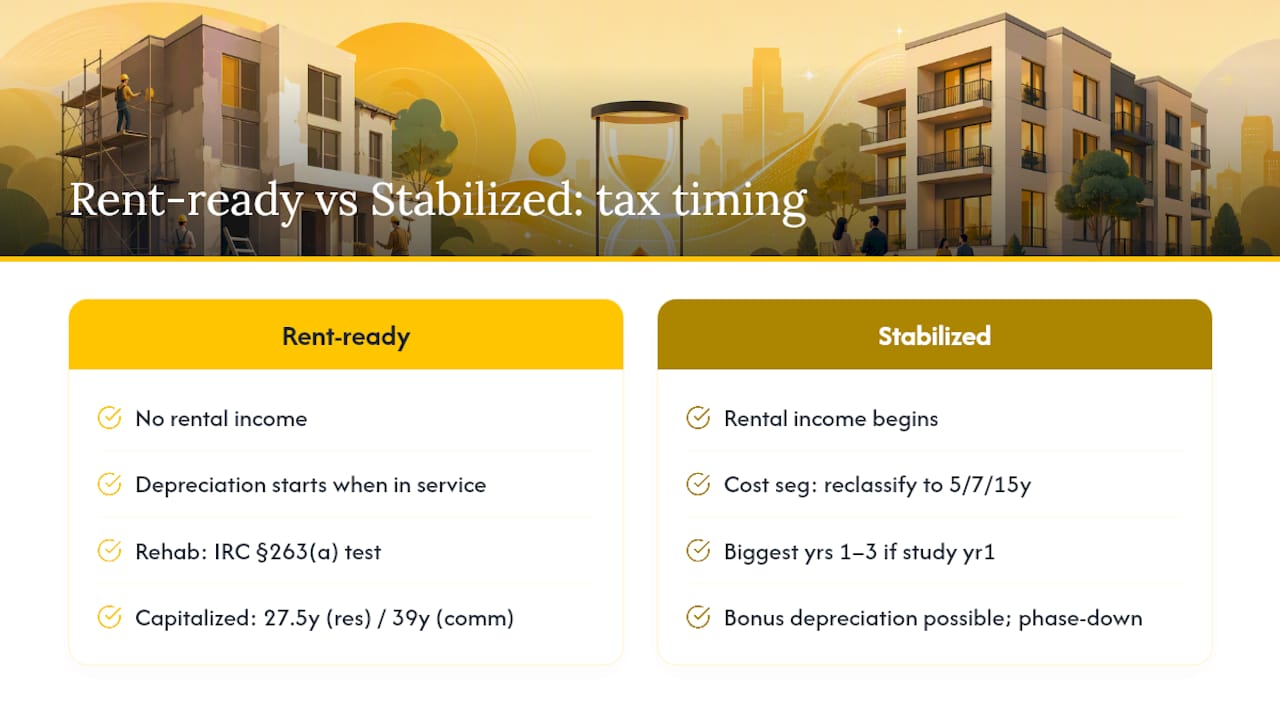
Rent-ready and stabilized properties follow different tax timelines. A rent-ready property in active rehab generates no rental income, so depreciation does not begin until the property is placed in service. Rehab costs must be analyzed under IRC Section 263(a) to determine whether they are immediately deductible repairs or capitalized improvements depreciated over 27.5 years (residential) or 39 years (commercial).
Once stabilized and placed in service, cost segregation studies can accelerate depreciation by reclassifying components — flooring, fixtures, land improvements — into 5-, 7-, or 15-year property classes, generating front-loaded deductions. Investors who complete a cost segregation study in year one of stabilized operations typically capture the largest depreciation benefit in the first three years of ownership. Bonus depreciation rules under current tax law may allow immediate expensing of qualifying short-life components, though phase-down schedules apply. Consult a qualified tax advisor to confirm current-year bonus depreciation percentages and passive activity loss limitations before modeling tax benefits into your underwriting.
Common risks and how to mitigate them
Rent-ready risks:
- Rehab cost overruns: Mitigate with fixed-price contracts, a 10–15% contingency reserve, and lender-approved draw inspections at each milestone
- Extended vacancy during lease-up: Mitigate by pre-marketing units before construction completion and confirming submarket absorption data
- Interest reserve exhaustion: Size reserves to cover the full projected lease-up period; stress-test at 120% of base-case timeline
- Permit or CO delays: Engage a permit expediter in high-volume municipalities and confirm inspection scheduling lead times before closing
Stabilized property risks:
- Lease expiration concentration: Stagger renewal dates at acquisition; offer early renewal incentives to distribute expirations
- Deferred maintenance discovery: Commission a full property condition assessment (PCA) before closing; negotiate seller credits for identified capex
- Rent growth assumptions: Model flat rent in year two of a stress case; lease-up decisions on pricing and concessions affect renewal cliffs and year-two exposure
- Economic vacancy vs. physical vacancy: Track collections separately from occupancy; a 95% physically occupied building with 10% concession exposure is not stabilized in lender terms
What experienced lenders actually prefer
Most experienced lenders and advisors default to stabilized acquisitions when capital cost is high and execution teams are thin. Rent-ready deals generate the highest returns per dollar invested, but only when the rehab scope is tight, the submarket absorption is confirmed, and the interest carry is fully reserved.
Two heuristics apply consistently.
Two lender warnings: interest reserves are almost always undersized on first-pass models, so add 60 days to your projected lease-up timeline before sizing the reserve. And covenant pacing matters — if your bridge loan has a stabilization covenant at month 12, a 10-month lease-up leaves no room for a single slow month. Build the covenant trigger around a stress-tested absorption model, not a best-case one.
Jaken Finance Group: funding rent-ready and stabilized deals
Investors who need capital for a rent-ready rehab or a stabilized refinance have a direct path through Jaken Finance Group's asset-based lending programs, which underwrite on property value rather than borrower credit score.
Jaken Finance Group offers fix-and-flip financing for rent-ready acquisitions and rehab draws, hard-money bridge loans for lease-up carry, and DSCR programs for stabilized exits. Closings in as few as five days are available for qualifying deals. To get started, submit a loan inquiry at Jakenfinancegroup, use the online loan calculator to model your scenario, or contact the team directly for a deal review. Loan terms vary by asset class, market, and borrower profile; all underwriting is subject to property condition and income verification at the time of application.
Sources
The sources below formed the primary research base for this article. Each covers a distinct dimension of the rent-ready vs. stabilized distinction.
- Stabilized Property — CRE Finance Glossary | RefiLoop Lender Data
- Lease-Up Period Explained: How Properties Reach Stabilized Occupancy | Private Equity Bro
- What Is a Stabilized Property: Definition and Metrics - LegalClarity
- Stabilization in CRE: Definition, Lease-Up Path & Benchmarks | Cove Glossary
- What Is Lease-Up? 5 Core Components
This article is general information, not a substitute for advice from a qualified financial advisor. Consult a qualified financial professional about your own circumstances before acting on anything here.