
The fastest path to rehab budget approval is submitting a complete, lender-ready package: a line-item scope of work (SOW), signed contractor bids, a draw schedule with verifiable milestones, a standard contingency percentage, and ARV assumptions backed by comps. Lenders use that package as the governing document for every draw, so gaps at submission translate directly into underwriting delays or budget reductions.
Three actions to take today:
- Get 2–3 signed contractor bids and map each line item to a specific budget category
- Build a draw schedule with 4–5 inspectable milestones tied to your budget phases
- Photograph the property and document all permit requirements before submission
Pro Tip: Submit AIA G702/G703 forms (or a lender-equivalent schedule of values) with your initial package. Lenders recognize these forms immediately, and they signal that your draw process is already organized.
Key Takeaways
A lender-ready rehab budget paired with signed contractor bids, a draw schedule, and a standard contingency percentage is the single most reliable path to fast rehab budget approval with a hard-money lender.
| Point | Details |
|---|---|
| Lead with a complete package | Submit SOW, signed bids, draw schedule, ARV comps, and contingency together at first submission. |
| Use line-item detail | Break every category into quantities and unit costs; lump sums trigger underwriting reductions. |
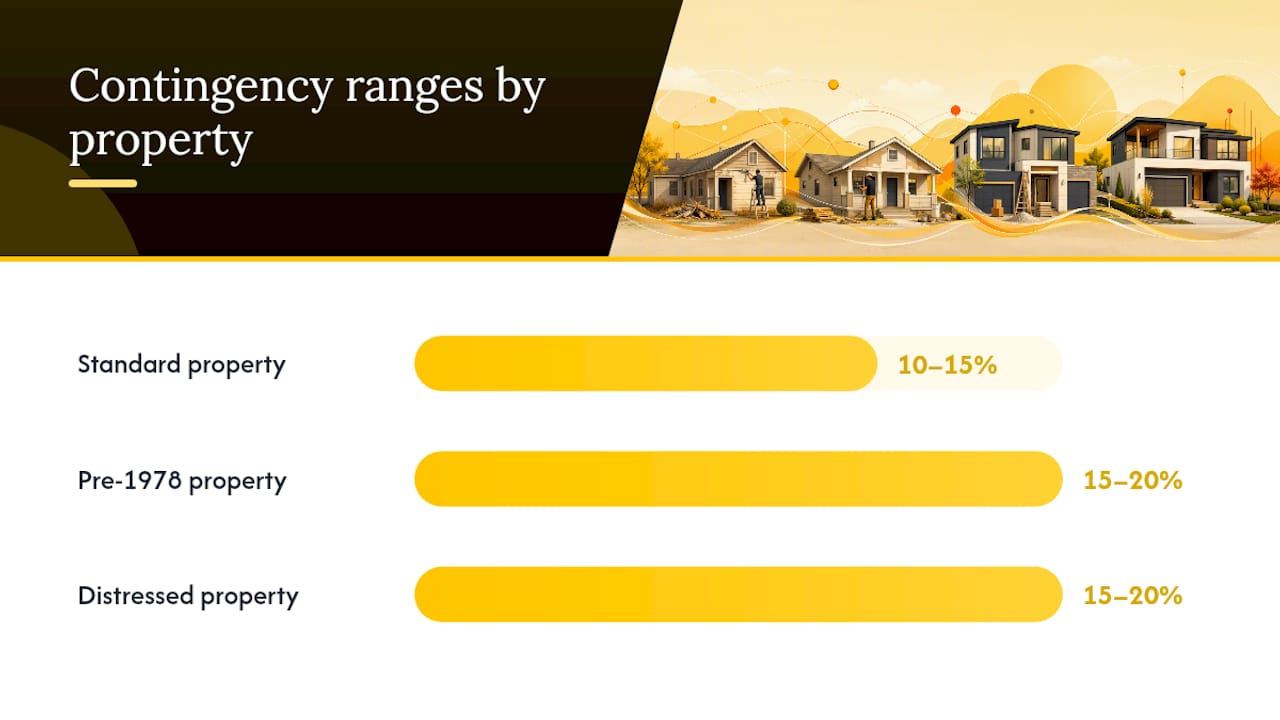
| Set the right contingency | Budget 10–15% of hard costs; raise to 15–20% for pre-1978 or distressed properties. |
| Prepare draw documentation | AIA G702/G703 forms, dated photos, and lien waivers are required at every draw inspection. |
| Jaken Finance Group | Asset-based underwriting with no minimum credit score; fast decisions for complete, lender-ready packages. |
This article is general information, not a substitute for advice from a qualified financial advisor. Consult a qualified financial professional about your own circumstances before acting on anything here.
Table of Contents
- What do lenders actually check when reviewing a rehab budget?
- What documents does a lender require alongside the rehab budget?
- How to build a lender-ready line-item rehab budget
- How your budget turns into a draw schedule and what inspectors verify
- What is the typical approval timeline and what fees should you plan for?
- What budget red flags cause lenders to cut or reject a submission?
- What should you do if a lender reduces or rejects the rehab budget?
- How Jaken Finance Group evaluates and approves rehab budgets
- An underwriting perspective on what actually moves budgets through faster
- Jaken Finance Group: fast rehab budget approval for fix-and-flip investors
- Sources
What do lenders actually check when reviewing a rehab budget?
Hard-money underwriters evaluate rehab budgets against six core tests: scope completeness, cost realism, contractor credibility, contingency adequacy, permit requirements, and ARV alignment. A budget that passes all six moves through underwriting quickly. One that fails even two of them typically triggers a reduction request or a full resubmission.
Underwriting checkpoints:
- Scope completeness: Every major trade category is listed with quantities and unit costs, not lump sums
- Cost realism: Line-item costs fall within local market ranges for labor and materials
- Contractor credibility: Bids come from licensed, insured contractors with verifiable track records
- Contingency: Hard costs include a contingency reserve; older or distressed properties warrant a higher contingency
- Permit requirements: Structural, electrical, and plumbing work shows permit applications or approvals
- ARV alignment: Total project cost (purchase + rehab + carry) leaves adequate margin against the appraised ARV
Underwriters map budget totals to the ARV to confirm the deal pencils. That triggers scrutiny on every line item.
Self-audit checklist before submission:
- Does every category have a unit cost and quantity?
- Is each line item supported by a signed contractor bid?
- Does the contingency meet the 10–15% floor?
- Are permits identified for all trade work?
- Does the ARV comp set support your exit price?
Pro Tip: The single biggest underwriter trust-builder is a detailed contractor bid mapped directly to your budget line items. A signed GC bid that mirrors your SOW eliminates the most common source of underwriting questions.
What documents does a lender require alongside the rehab budget?
A well-constructed rehab budget is necessary but not sufficient. Lenders require a complete supporting package before they can approve the budget and release the first draw.
Required documents:
- Detailed contractor bids (itemized labor and materials, license and insurance info, inclusions and exclusions)
- Signed SOW matching budget line items, with material specs, timeline, responsible parties, and exclusions
- Permit applications or approvals for all trade work requiring permits
- Dated property photos covering every area included in the budget
- Proof of borrower funds for the down payment and any projected overages
- Contractor license and certificate of insurance
- AIA G702/G703 forms or a lender-equivalent schedule of values for draw submissions
- Appraisal or comparable sales supporting the ARV assumption
When full bids aren't available pre-closing, some lenders accept verified estimates from licensed contractors, provided the contractor signs the SOW before the first draw. Confirm this with your specific lender before submitting estimates in place of signed bids.
Submission best practice:
- Bundle all documents into a single labeled PDF
- Name each file to match its corresponding budget line item (e.g., "Kitchen_Bid_ABC_Contractors.pdf")
- Include a cover sheet listing every document in the package
Pro Tip: Lenders process packages faster when files are labeled and organized. A disorganized submission signals a disorganized project.
How to build a lender-ready line-item rehab budget
Lenders prefer detailed budgets that map to draw verification rather than lump-sum allowances. Every category should show quantities multiplied by unit costs so an inspector can verify percent-complete at each draw.
Budget structure:
- Hard costs: Demo, framing, roofing, HVAC, plumbing, electrical, windows, flooring, kitchen, bathrooms, exterior
- Soft costs: Permits, architectural/engineering fees, inspections
- Carrying costs: Interest, insurance, utilities during rehab
- Contingency: 10–15% of total hard costs (15–20% for older homes or unknown systems)
- Allowances: Clearly defined dollar caps for owner-selected finishes
Sample kitchen line-item breakdown ($14,100 total):
For city-level per-square-foot benchmarks, Jaken Finance Group publishes average fix-and-flip rehab costs that borrowers can use to validate local unit costs before submission. City-specific data is also available for markets like Indianapolis and Chicago.
Pro Tip: *Use a higher contingency on any property built before 1978, or any deal where you haven't seen inside the walls.
How your budget turns into a draw schedule and what inspectors verify
Once the budget is approved, it governs every draw. Draw requests require an updated SOW, invoices and receipts, dated labeled photos, and AIA G702/G703 forms. Inspectors verify completed work before funds are released, with inspection costs typically ranging from lower to moderate fees per visit.
Typical 5-draw schedule:
| Draw | Phase | Budget Categories |
|---|---|---|
| Draw 1 | Demo and framing | Demo, structural, rough framing |
| Draw 2 | Rough-ins | Plumbing, electrical, HVAC rough |
| Draw 3 | Drywall and insulation | Drywall, insulation, windows |
| Draw 4 | Finishes | Flooring, cabinets, fixtures, paint |
| Draw 5 | Final | Punch list, landscaping, final inspections |
Inspection documentation for each draw:
- Dated photos labeled by room and trade
- Invoices and receipts matching the draw amount
- AIA G702 (payment summary) and G703 (schedule of values showing percent complete)
- Lien waivers from contractors and subcontractors where applicable
Retainage, commonly a portion of each draw, is held by the lender until project completion. On a $250,000 rehab, that means $25,000 is withheld across draws and released at final inspection. Factor retainage and per-draw inspection fees into your cash flow model before closing.
What is the typical approval timeline and what fees should you plan for?
- File submission to initial underwriting review: 24–72 hours for most hard-money lenders with a complete package
- Underwriting questions and document requests: 2–5 business days if the package has gaps; 0–1 days with a clean submission
- Budget sign-off and loan commitment: 3–7 business days from complete file
- First draw after closing: Typically 1–2 weeks post-close, following the first inspection
Fees that affect rehab cash flow:
- Origination points (typically 2–4 points on the loan amount)
- Per-draw inspection fees ($150–$300 each)
- Interest carry on the full loan balance or on drawn funds, depending on lender structure
- Retainage holdback (commonly 10% per draw, released at completion)
Inspection fees and retainage should be factored into financial planning for the rehab project. Build both figures into your rehab financial planning before you commit to a purchase price.
What budget red flags cause lenders to cut or reject a submission?
- Lump-sum categories (e.g., "Kitchen renovation: $25,000" with no line items): Fix — break into unit costs with quantities and a signed GC bid
- Missing contractor bids: Fix — obtain signed bids from licensed contractors before submission
- No contingency line: Fix — add 10–15% of hard costs as a named contingency category
- Vague allowances (e.g., "Flooring allowance: $8,000" with no SF or material spec): Fix — specify SF, material grade, and installation cost separately
- Scope not tied to ARV: Fix — attach a comp set showing how the finished product supports the exit price
- Missing permits: Fix — pull permit applications before submission or note pending status with a timeline
- Unrealistic timeline: Fix — map each phase to a realistic trade sequence; a 90-day gut rehab submitted as a 30-day project raises immediate flags
Pro Tip: For rapid remediation, have your GC sign the SOW directly and provide an AIA-style schedule of values. Two competitive bids for any line item over $10,000 eliminate the most common underwriter objections in a single step.
What should you do if a lender reduces or rejects the rehab budget?
A reduction or rejection is a document problem, not a deal-killer. Work through this sequence:
- Request written reasons for every line-item reduction or rejection
- Map each lender reduction to the specific budget line and identify the missing documentation
- Supply the missing documentation: signed bids, additional photos, permit applications, or contractor references
- If the lender questions cost realism, provide two competitive bids for the disputed line items
- Offer a borrower-funded overage escrow for any line the lender will not fund at full value
- Propose a revised draw schedule tied to more verifiable milestones if the timeline was flagged
Negotiation and fallback options:
- Present contractor-signed change orders showing the basis for any costs the lender questioned
- Bring on a licensed GC as the borrower's agent if the lender's concern is contractor credibility
- Request a conditional approval with re-underwrite triggers tied to specific milestones
- If the lender's reduction makes the deal unworkable, evaluate whether a different loan product or lender structure fits the project better
A clear change-order process matters here: once a budget is approved, material changes require lender sign-off and may trigger re-underwriting. Minor adjustments within existing categories are often acceptable; adding new work categories or large cost increases typically require a formal modification request.
How Jaken Finance Group evaluates and approves rehab budgets
Jaken Finance Group's underwriting review follows a defined sequence:
- Initial package review: SOW, contractor bids, draw schedule, contingency, ARV comps, and proof of funds are checked for completeness
- Underwriting checks: Line-item costs are compared against local market ranges; contractor license and insurance are verified; ARV assumptions are stress-tested against the comp set
- Contractor documentation: Signed bids and GC sign-off on the SOW are required before the first draw; estimates may be accepted pre-closing on a case-by-case basis
- Inspection and draw flow: Each draw is triggered by a completed inspection; AIA G702/G703 or equivalent forms are required with every draw request
- Change-order policy: Budget modifications require written lender approval; minor reallocations within approved categories are reviewed on a case-by-case basis
A borrower submitted a $180,000 rehab budget on a 1940s row home with a single lump-sum line for mechanicals. Underwriting reduced the mechanical allocation by $22,000 due to insufficient documentation. The borrower obtained two signed HVAC and plumbing bids, resubmitted with an updated G703, and received approval within four business days. The deal closed on schedule.
Pro Tip: Properties with existing code violations require additional documentation at submission. Review Jaken Finance Group's guidance on financing properties with code violations before submitting a budget that includes compliance repairs.
An underwriting perspective on what actually moves budgets through faster
Most budget delays come from one source: a borrower who knows the project but hasn't translated that knowledge into lender-readable documentation. The underwriter isn't on-site. Every judgment call they make is based on what's in the file.
A practical rule: if you can't verify a cost with a signed bid and a dated photo, the underwriter will likely exclude it or flag it for additional documentation. That's not a policy preference — it's the only defensible position when the approved budget governs every draw disbursement.
Transparency in documentation doesn't just speed approval. It reduces the back-and-forth that extends timelines by days or weeks. A complete, well-labeled package submitted once moves faster than three rounds of document requests on an incomplete one.
Jaken Finance Group: fast rehab budget approval for fix-and-flip investors
Jaken Finance Group offers asset-based hard-money lending with no minimum credit score requirement, meaning underwriting focuses on the deal and the documentation, not your FICO. For fix-and-flip borrowers, that translates to faster decisions and fewer obstacles between a complete budget submission and a funded loan.
Key advantages for borrowers preparing rehab budgets:
- Asset-based underwriting that evaluates the property and project, not credit history
- Flexible draw structures accommodating projects from light cosmetic work to full gut rehabs
- Willingness to work with estimated bids pre-closing on qualifying deals
- Fast turnarounds designed to keep acquisition timelines intact
To start, submit your line-item budget, SOW, contractor bids, and ARV comps. Jaken Finance Group's team reviews packages and provides decisions quickly. For borrowers seeking high-leverage options, review the 100% fix-and-flip financing requirements to confirm your deal structure qualifies before applying.
Sources
- The Complete Guide to Hard Money Draw Requests (For Developers Who'd Rather Be On Site) | Builos Blog | Builos
- How Hard Money Lenders Evaluate Rehab Budgets