
Investment property financing usually comes down to four paths: conventional investor loans, DSCR/non-QM programs, portfolio loans, or private and hard money for speed and rehab work. Which one fits depends on your profile:
- Long-term buy-and-hold investors typically qualify best through conventional or portfolio loans.
- Self-employed borrowers or those with non-traditional income usually turn to DSCR or non-QM programs.
- Fix-and-flip operators and buyers needing a fast close rely on hard money or private capital.
Before applying anywhere, pull your credit snapshot, confirm your available down payment and cash reserves, and run a DSCR or property cash-flow scenario. That single step tells you which lender category will actually say yes.
Key Takeaways
Investment property financing succeeds when the loan structure matches the investment timeline, the borrower's documentation path, and the deal's speed requirements.
| Point | Details |
|---|---|
| Match loan to hold period | Use rehab or bridge loans for short-term flips and DSCR or conventional loans for long-term rentals. |
| Expect a rate premium | Investment loans typically price 1% to 2% higher than owner-occupied mortgages due to lender risk cushions. |
| Budget real reserves | Lenders often require 3 to 12 months of PITI in reserves before approving a loan. |
| Compare full Loan Estimates | Look at APR, points, and fees across lenders, not just the advertised rate. |
| Consider fast, asset-based options | Jaken Finance Group underwrites on property value and offers closings in as few as five days for time-sensitive deals. |
Table of Contents
- What Types of Loans Work for Investment Properties?
- What Do Lenders Require to Approve an Investment Property Loan?
- Why Do Investment Property Loans Cost More Than Primary Residence Mortgages?
- How Should You Choose the Right Financing Path?
- What Alternative Financing Strategies Do Investors Use?
- When Does Asset-Based, Fast-Close Lending Make Sense?
- What Would I Do Next if I Were Financing a Rental Right Now?
- How Jaken Finance Group Fits Into Your Financing Plan
- Sources
What Types of Loans Work for Investment Properties?
Every financing route trades off cost, speed, and flexibility differently, and matching the loan to the deal matters more than chasing the lowest headline rate.
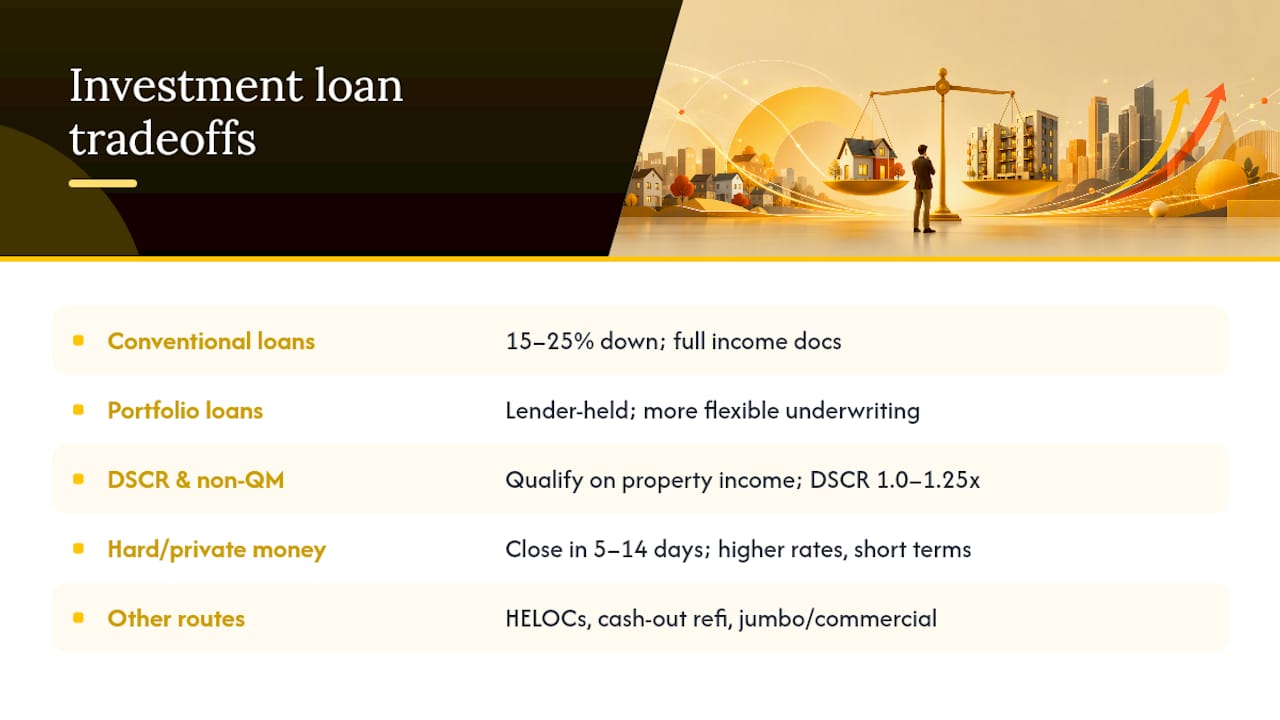
Conventional investor loans come from banks and credit unions and work best for stabilized, move-in-ready rentals. Expect down payments in the 15% to 25% range depending on the lender and property type, per NASB's investment property loan guidelines. These loans serve single-family rentals and small multifamily properties well but require full income documentation.
Portfolio loans stay on the originating bank's books instead of being sold to Fannie Mae or Freddie Mac. That gives the lender more flexibility on borrower profile, property condition, or loan structure, which helps investors who own several properties already or who have a deal that doesn't fit conventional boxes.
DSCR and non-QM loans qualify borrowers using the property's income rather than personal tax returns. A DSCR loan calculates net operating income divided by annual debt service. A ratio above 1.0 generally signals positive cash flow, and lenders often set minimum thresholds between 1.0x and 1.25x, according to NASB's DSCR loan program. Non-QM programs also include bank-statement and profit-and-loss loans for self-employed borrowers, as outlined in HousingWire's non-QM guide.
Hard money and private money close fast, often in five to fourteen days, but carry higher rates and shorter terms. They fit rehab projects and time-sensitive acquisitions.
Other routes worth knowing: HELOCs and cash-out refinances on an existing property to fund the next purchase, and jumbo or commercial financing once loan size or property type exceeds standard limits.
What Do Lenders Require to Approve an Investment Property Loan?
Underwriting for investment properties runs stricter than for a primary residence, and the criteria stack up in a fairly predictable order.
- Credit score. Higher scores unlock better pricing and lower down payment requirements; borrowers below typical thresholds often face rate add-ons or higher equity requirements.
- Down payment. Most lenders land in the 15% to 25% range, with some requiring 20% or more and setting minimum loan amounts, per NASB.
- Cash reserves. Lenders commonly want proof of three to twelve months of PITI (principal, interest, taxes, insurance) set aside, according to The Mortgage Reports. Reserves cover vacancy or unexpected repairs without derailing your payment history.
- Debt-to-income ratio. Existing mortgages on other properties count against you here, which is why many investors eventually shift toward DSCR loans that skip personal DTI calculations entirely.
- Documentation path. Bank-statement loans, DSCR programs, and P&L or 1099-based underwriting all exist for borrowers whose tax returns understate true cash flow.
Pro Tip: Gather your reserve documentation before you apply, not during underwriting. Missing proof of liquidity late in the process is one of the most common reasons deals stall or die at the finish line.
Why Do Investment Property Loans Cost More Than Primary Residence Mortgages?
Investors should expect to pay roughly 1% to 2% more than owner-occupied borrowers, a pricing gap driven by the lender's added risk cushion on non-owner-occupied properties, according to Bankrate.
That premium reflects a few converging factors:
- Investor default risk. Borrowers are statistically more likely to walk away from a rental than a home they live in.
- Treasury yield linkage. Rate movements track broader benchmarks, and lenders layer investor risk on top of that baseline.
- Loan purpose and profile. A cash-out refinance on a rental typically prices higher than a straightforward purchase loan.
When comparing offers, look past the headline rate. The Consumer Financial Protection Bureau recommends comparing full Loan Estimates: rate, APR, origination points, and appraisal or escrow costs side by side. A lower rate with high points can cost more than a slightly higher rate with none, depending on how long you plan to hold the loan.
How Should You Choose the Right Financing Path?
Matching the loan to the investment timeline is the single biggest decision point, and it's one a lot of first-time investors get backward.
- Match the loan term to your hold period. A short-term rehab loan makes sense for a six-month flip; a 30-year DSCR or conventional loan fits a buy-and-hold rental.
- Run conservative cash-flow numbers. Use realistic rent estimates and expense assumptions, not best-case projections, when calculating your DSCR.
- Confirm your documentation path early. Know whether you're going conventional, bank-statement, or DSCR before you start shopping lenders.
- Compare Loan Estimates from multiple lenders, not just advertised rates, following the CFPB's comparison approach.
- Weigh speed against rate. If you're in a competitive bidding situation, a hard money or private loan that closes in days rather than weeks can preserve the deal, but plan your refinance or exit strategy before you sign.
Pro Tip: Run your numbers through a DSCR calculator before you talk to a single lender. Knowing your ratio in advance tells you which loan category you actually qualify for and saves you from wasting time on applications that were never going to close.
What Alternative Financing Strategies Do Investors Use?
When conventional underwriting doesn't fit the deal, or speed matters more than the lowest rate, investors turn to a handful of creative structures.
- Hard money and private money carry higher rates and shorter terms but close fast, making them the default for competitive acquisitions and rehab-heavy purchases.
- Seller financing, subject-to deals, and lease options let buyers structure terms directly with the seller, though each carries legal complexity that deserves a real estate attorney's review before signing.
- The BRRRR stack (buy, rehab, rent, refinance, repeat) uses short-term rehab capital for acquisition and construction, then refinances into a DSCR or conventional rental loan to pull equity back out, a pattern detailed by Home Pros.
- Partnerships and private capital trade a share of control or profit for access to funds an investor doesn't have alone.
Each route solves a specific problem: capital gaps, credit gaps, or timing gaps. None of them replace sound underwriting on the property itself.
When Does Asset-Based, Fast-Close Lending Make Sense?
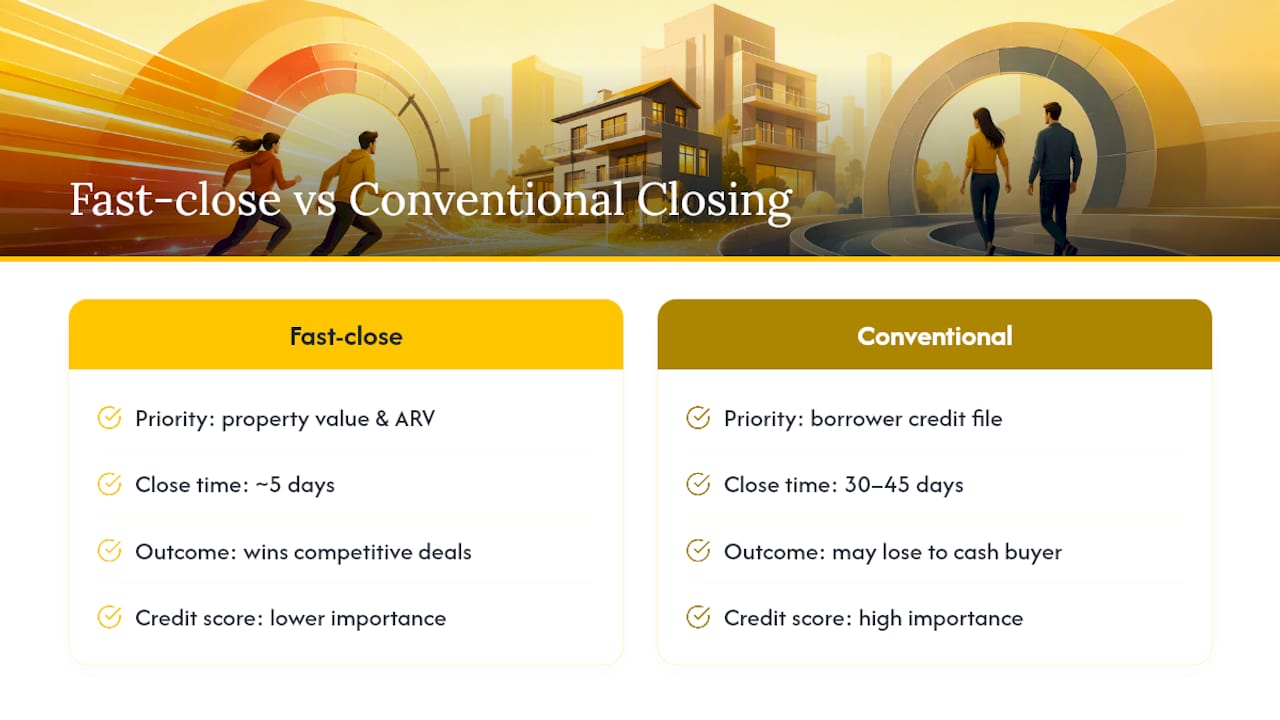
Fix-and-flip buyers and bridge borrowers routinely lose deals to slower financing. A property under contract with a tight closing window doesn't wait on a forty-five day conventional underwriting cycle.
Asset-based lending flips the underwriting priority: the property's value and after-repair value matter more than the borrower's credit score. That structure exists because speed itself has value in a competitive market.
A deal that closes in five days instead of thirty isn't just faster paperwork. It's the difference between winning a competitive off-market purchase and losing it to a cash buyer who moved first.
Jaken Finance Group underwrites this way, prioritizing the asset over a credit file, which is precisely why fast-close, rehab-focused financing exists as its own category rather than a conventional-loan afterthought.
What Would I Do Next if I Were Financing a Rental Right Now?
I'd run the DSCR calculation first, before touching a lender application. Confirm your down payment and reserves match the property's real numbers, not optimistic ones.
My operational tip: on off-market or competitive buys, prioritize speed and document your exit plan in writing before you close. If your file doesn't fit standard documentation, use a DSCR calculator or talk to a specialist rather than forcing a conventional application that's likely to stall.
How Jaken Finance Group Fits Into Your Financing Plan
If speed and asset value matter more to your deal than a perfect credit file, Jaken Finance Group is built around exactly that scenario. Jaken Finance Group offers hard money, fix-and-flip, bridge, new construction, and DSCR rental loans, all underwritten against the property rather than a rigid credit-score cutoff, with closings possible in as few as five days.
Before applying, gather your purchase contract, scope of work or rehab budget, proof of reserves, and entity documentation if you're borrowing through an LLC. Investors weighing full-leverage rehab funding should review what lenders require for 100% fix-and-flip financing, while buy-and-hold investors can start by running numbers through the DSCR calculator or learning how a DSCR loan works. For a broader look at how financing differs across property types, Yigal Realty's overview of property financing is a useful primer. When you're ready to move on a deal, start your application directly with Jaken Finance Group and get a real quote instead of a rate guess.
Sources
- Understand the different kinds of loans available — Consumer Financial Protection Bureau
- Investment property rates today — Bankrate
- Non‑QM loans guide — HousingWire
- Investment Property Loan — NASB
This article is general information, not a substitute for advice from a qualified financial advisor. Consult a qualified financial professional about your own circumstances before acting on anything here.