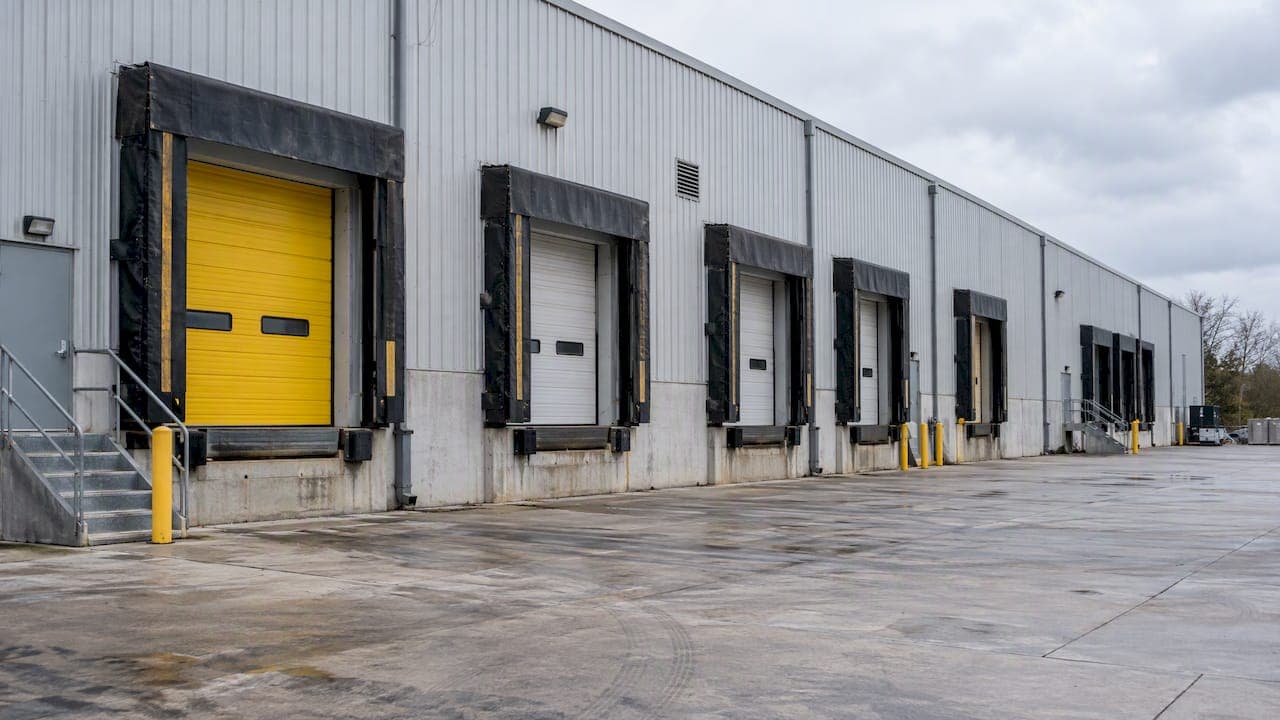
An industrial bridge loan is short-term, asset-based financing for a warehouse, flex or light industrial building that cannot yet qualify for permanent debt. The property may be vacant, may have little lease term left, or may need capital improvements first. The loan carries the asset through acquisition, renovation and lease-up until it can be refinanced or sold. This guide covers how the product works, what leverage and pricing look like, what lenders underwrite, where the risk sits and how to plan the exit before closing.
TL;DR
- Industrial bridge loans fund the gap between acquisition and stabilization. Regulators describe them as short-term financing usually written for up to three years.
- In early 2025, industrial bridge pricing was quoted at SOFR plus 300 to 350 basis points, with leverage up to 75% of value or cost, for institutional-quality deals.
- Underwriting centers on the business plan, the as-stabilized value, the borrower's track record and, above all, a credible exit.
- The main risk is not the rate. It is a refinance that fails because value, rents or lender requirements move against the plan.
- Jaken Finance Group lends on asset value rather than credit score, with no minimum credit score and closings in as few as 7 to 10 days.
Table of Contents
- What an industrial bridge loan finances
- How the process works, from application to payoff
- Typical leverage, pricing and terms
- What lenders underwrite on an industrial bridge loan
- Risks and downsides to price in
- Plan the exit before you close
- Our perspective on industrial bridge financing
- Financing an industrial purchase with Jaken Finance Group
- Choosing between lender types
- FAQ
- Sources
What an industrial bridge loan finances
Industrial real estate is a broad category: distribution warehouses, small-bay multi-tenant buildings, flex space with office build-out, cold storage, light manufacturing and truck-adjacent land. Permanent lenders and agencies want stabilized occupancy, seasoned leases and a debt yield that clears their floor. Many good industrial deals do not meet those tests on the day you need to close.
A bridge loan fits when one of these conditions applies:
- Vacancy or partial occupancy. The seller has a half-empty building, and the value lies in leasing it.
- Short remaining lease term. A single tenant has two years left, and a permanent lender will not underwrite past the expiration.
- Deferred capital needs. Roof, dock doors, clear-height upgrades, electrical service, sprinklers or LED retrofits that have to be completed before the building leases at market.
- Speed. A seller with a competing offer will not wait for a 60 to 90 day bank process.
- Repositioning. Converting a single-tenant box to multi-tenant, or a obsolete site into modern small-bay units.
The OCC's commercial real estate lending handbook describes this structure plainly: a bridge loan provides short-term financing so that newly constructed or acquired commercial properties can reach stabilization. Industrial is one of the asset classes where that stabilization path is most readable, because rent per square foot, tenant demand and build costs are easy to benchmark.
For a closer look at the value-add case, see our guide to bridge loans for value-add industrial buildings, and our overview of industrial and warehouse property loans for purchase and rehab.
How the process works, from application to payoff
The sequence below reflects how most private and non-bank bridge loans move. Timelines vary with the file and the lender.
- Scenario and term sheet. The borrower submits the purchase contract or current mortgage, the property address, a budget, a rent roll or leasing plan and a summary of experience. The lender returns indicative terms: amount, rate, points, term, interest reserve and holdbacks.
- Application and deposit. The borrower accepts terms and funds third-party costs, typically appraisal, environmental screening and sometimes a property condition report.
- Underwriting and third-party reports. The lender verifies value, the renovation budget, entity documents, insurance and title. On industrial property the environmental review matters more than on most other asset types, because of historic use, storage tanks and adjacent parcels.
- Closing. Funds are wired to the title company. Rehab or tenant-improvement money is often held back and released in draws as work is verified.
- Hold period. The borrower renovates, leases and stabilizes. Payments are usually interest-only, and some structures defer or reserve interest.
- Exit. The loan is repaid by a refinance into permanent debt, by a sale, or by an extension if the plan is on track but not finished.
Speed is the feature that most separates private bridge lenders from banks. Our closings can take as few as 7 to 10 days when the file is complete and the property is straightforward. Timing depends on title, the environmental review and how quickly the borrower returns documents.
Typical leverage, pricing and terms
Published figures for industrial bridge loans come mostly from institutional-quality transactions, so treat them as a reference point rather than a quote. According to a 2025 market update on bridge pricing, industrial bridge loans priced at SOFR plus 300 to 350 basis points, with leverage up to 75% of loan-to-value (LTV) or loan-to-cost (LTC). The same update noted that lenders were lowering underwritten exit debt yields to reach higher loan proceeds.
The OCC's handbook puts the typical maximum term at about three years. Most bridge structures add extension options, often tied to performance tests such as occupancy or debt service coverage.
| Term | What to expect |
|---|---|
| Loan term | Up to about three years, with extension options |
| Payments | Interest-only is common during the hold |
| Leverage (institutional bank or debt-fund bridge) | Up to 75% of LTV or LTC for industrial |
| Floating-rate pricing (2025 market update) | SOFR + 300 to 350 basis points |
| Rehab funding | Holdback released in draws against inspected work |
| Recourse | Varies: non-recourse is more common at institutional scale, personal guarantees are common in the private market |
Private asset-based lenders price differently from banks and debt funds. Jaken Finance Group publishes a rate range of 8.99% to 13.5% for commercial property loans and bridge loans. We position higher leverage, up to 100% loan-to-cost on qualifying deals, no minimum credit score and deferred payment options as the trade for that pricing. The rate is higher than permanent debt because the loan is short, the asset is in transition and the lender takes the lease-up risk. Whether the premium is worth paying depends on what the speed and leverage make possible.
A worked comparison
Take a hypothetical $3,000,000 small-bay industrial purchase with a $500,000 renovation budget and a total cost of $3,500,000. This is an illustration, not a quote.
- At 75% LTC, the loan is $2,625,000 and the borrower contributes $875,000 in equity.
- At 90% LTC, the loan is $3,150,000 and equity falls to $350,000.
- Interest-only carry on $2,625,000 at 10% is $262,500 per year, or about $21,875 per month on the fully funded balance.
The lower equity at higher leverage can let an investor complete two projects instead of one. The cost is higher carry, so the lease-up schedule needs more margin for delay. Run the carry against a conservative leasing timeline, not the best case.
What lenders underwrite on an industrial bridge loan
Bridge underwriting looks forward. A permanent lender asks what the building earns today. A bridge lender asks what it will earn after the plan is executed, and whether the borrower can get it there.
The property
- Location and demand. Proximity to highways, ports, rail and population centers, and the vacancy and absorption of the submarket.
- Physical specifications. Clear height, dock-high versus grade-level doors, column spacing, truck court depth, power, sprinklers and parking. These decide who can lease the space.
- Environmental condition. Industrial sites carry a higher likelihood of contamination issues, so a Phase I environmental report is a routine requirement in most commercial bridge lending.
- As-is and as-stabilized value. The appraisal supports leverage on both. Lenders usually size on the lower of the measures.
The business plan and budget
The renovation scope, contractor bids, permit status and leasing assumptions drive the file. Lenders want to see rents backed by comparable leases in the submarket, not asking rents from a broker's flyer. The Dentons guidance on defensive construction lending advises lenders to limit non-market risk through pre-commitment investigation, independent reviews by architects, engineers or environmental consultants and a firm source of repayment. Borrowers who arrive with those reviews already done tend to move faster.

The borrower
Experience owning or renovating comparable assets is weighed heavily. Liquidity matters too: reserves to cover interest, cost overruns and a leasing delay. Regulators expect depository lenders to focus on cash flow available to service debt, and private lenders apply the same logic through interest reserves and borrower liquidity checks.
Is it difficult to qualify?
It depends on the lender type. Banks and debt funds apply institutional standards: strong sponsorship, net worth and liquidity tests, and often a minimum loan size in the millions. Asset-based private lenders put more weight on the property, the equity in the deal and the exit. At Jaken Finance Group there is no minimum credit score, and underwriting centers on the asset. A borrower with limited experience can still be approved, though a thinner track record usually means lower leverage or a tighter budget review.
Risks and downsides to price in
Bridge loans are useful because they accept risk that permanent lenders will not. That risk passes to the borrower in specific ways.
- Refinance risk. The OCC has pointed to refinancing difficulty when values fall and loan-to-value requirements tighten, a problem that grows if rates rise without an economic recovery. A bridge loan sized on today's lending standards can face stricter standards at maturity.
- Floating or high rates. Carry rises with the index on floating-rate loans. Private fixed-rate loans avoid index risk but cost more from day one.
- Execution delay. Permits, equipment lead times and contractor availability can push lease-up past the original term.
- Leasing shortfall. Achieving less than underwritten rent reduces the appraised value and the refinance proceeds.
- Fees. Origination points, exit fees, extension fees and draw inspection costs can add up. Ask for a full cost schedule before signing.
- Guarantees. Many private bridge loans require a personal or corporate guarantee. Read the carve-outs.
Regulators emphasize underwriting discipline and prudent risk management in CRE lending, and a borrower should apply the same discipline from the other side of the table: stress the plan before signing, not after.
Plan the exit before you close
The exit is the most important line in the file. There are three common routes.
1. Refinance into permanent debt. Once the building is leased and the income is documented, a bank, life company, agency-style or DSCR-based loan replaces the bridge. Model the debt service coverage and debt yield the permanent lender will require, then compare the result with the bridge payoff amount. Our partners in the investor community cover DSCR loan costs to model for rental assets, which is a useful starting point for sizing a take-out.
2. Sale. Some business plans end in a sale to an owner-user or an investor after renovation. The exit price should hold up if the market softens by a few percent.
3. SBA or owner-user financing. If the building is bought for your own operating company, a short bridge can win the deal and an SBA loan can replace it later. See how this works in bridge now, SBA later for commercial buildings.
A practical checklist before closing:
- Calculate the refinance amount at a conservative value and a higher-than-expected permanent rate. If proceeds fall short of the payoff, you need more equity, a longer term or a different structure.
- Confirm extension terms and their cost in writing.
- Hold a reserve for interest and one quarter of leasing delay.
- Know your plan if the permanent market is closed: a second extension, a partial paydown or a sale.
The OCC notes that prudent loan workouts are often in the best interest of both the institution and the borrower. In practice, a borrower who raises a problem early has more options than one who waits until maturity. For a regional example of exit-first thinking, see our piece on planning the exit on small-bay industrial bridge loans in Dallas-Fort Worth, and our DFW industrial loans from $2 million to $10 million.
Our perspective on industrial bridge financing
We see the same pattern on most industrial files. The purchase is rarely what fails. The plan fails when the borrower underestimates time. A building that needs four months of work and four months of leasing is carried for eight months, and the closing date of the bridge loan sets a clock that the contractor and the market do not know about.

For that reason we underwrite the asset and the exit first. Credit score tells us little about whether a 60,000 square foot building in a strong distribution corridor will lease at the projected rent. The property's value, the budget, the equity in the deal and the borrower's plan tell us more. That is why we have no minimum credit score and why we can offer high leverage, up to 100% LTC, on qualifying transactions, with deferred payment options that preserve cash during the renovation.
We also encourage borrowers to treat speed as a tool, not a goal. A fast close helps when it secures a below-market purchase. It hurts when it skips environmental review or a realistic contractor bid. Use the days we save to do those two things properly.
— Jason Taken
Financing an industrial purchase with Jaken Finance Group
Jaken Finance Group provides asset-based bridge and commercial property loans to investors nationwide, with rates published from 8.99% to 13.5%, no minimum credit score and closings in as few as 7 to 10 days. Explore commercial property loans by asset class, review our bridge loans for real estate investors, or start with industrial and warehouse loans. Investors working in the Midwest can also see our bridge loans in Illinois and commercial lending in Illinois.
Choosing between lender types
No single lender type fits every industrial deal. Describing them by what they do:
| Lender type | Strength | Constraint |
|---|---|---|
| Bank | Lower rates, relationship pricing | Slower, strict credit and seasoning requirements |
| Debt fund or CMBS-style bridge lender | Larger loans, non-recourse options | Higher minimum loan size, institutional sponsors |
| Private asset-based lender | Speed, flexible underwriting, higher leverage | Higher rate and fees |
| Seller financing | Negotiable terms | Rare, depends on the seller's own debt |
If you are comparing structures across property types, our comparison of investment property loans lays out which loan fits which situation. For a general introduction to the product outside industrial, read about commercial bridge loans for investors.
FAQ
What is an industrial property bridge loan?
It is short-term financing for a warehouse, flex or light industrial building that needs time or capital before it qualifies for permanent debt. Regulators describe bridge loans as financing that lets acquired or newly built commercial property reach stabilization. The loan is repaid by a refinance or a sale.
How much leverage can I get on an industrial bridge loan?
Institutional-quality industrial deals were quoted at up to 75% LTV or LTC in early 2025. Asset-based private lenders can go higher on qualifying deals. At Jaken Finance Group, leverage reaches up to 100% LTC depending on the project and borrower.
What is the downside of a bridge loan?
The cost is higher than permanent financing, and the loan has a short maturity. If rents, values or lender standards shift before maturity, the refinance may not cover the payoff. Stress-test the exit and negotiate extension terms before closing.
Do I need good credit to qualify?
Not with an asset-based lender such as Jaken Finance Group, which sets no minimum credit score and underwrites on the property and the plan. Banks and debt funds weigh sponsor credit, net worth and liquidity far more heavily.
Sources
- Commercial Real Estate Lending, OCC Comptroller's Handbook
- Bridge Loan Pricing and Market Update, Schelin Uldricks & Co.
- OCC Deputy Comptroller testimony on commercial real estate
- Defensive Construction Lending, Dentons
- Statement on Prudent Risk Management for CRE Lending, Federal Reserve