
A bridge loan is a short-term, interest-only loan that lets you purchase a new property before your existing one sells, using your current home as collateral. It fills the funding gap that appears when closing dates don't align, giving you access to equity you haven't yet received from a sale.
Here are the core mechanics at a glance:
- Loan duration: Typically 6 to 36 months, with most residential deals running 6 to 12 months
- Repayment structure: Interest-only monthly payments, with a lump-sum balloon payment at maturity
- Collateral: Your primary residence or other real estate assets
- Primary benefit: Purchase without a sale contingency, closing on a new home before the old one sells
- Exit: Loan is repaid from sale proceeds or a permanent refinance
How bridge loans work: the mechanics explained
The loan enables access to equity from your existing property to create usable capital. You borrow against your current property, receive funds quickly, and apply them toward the down payment or full purchase price of the new home. Once your original property sells, sale proceeds repay the outstanding principal in a single balloon payment.
Two common structures exist. In the first, the bridge loan acts as a second mortgage on your current home, covering only the down payment on the new purchase. In the second, one larger loan pays off your existing mortgage entirely and funds the new purchase, consolidating both obligations temporarily. Lenders can fund bridge loans in as little as two weeks, compared to the 30–45 days typical of conventional mortgage approval.

What lenders require to qualify
Qualification standards for bridge financing are stricter than many borrowers expect.
- Credit score: Many lenders require a minimum FICO of 740, though requirements vary
- Debt-to-income ratio (DTI): Lenders prefer a low DTI, typically below 50%
- Home equity: You generally need at least 20% equity; most lenders cap borrowing at 80%–85% of property value
- Exit strategy: Lenders require a credible repayment plan, such as a signed sale contract or permanent financing pre-approval
- Documentation: Standard mortgage paperwork applies, including income verification and property appraisal
- Lender relationship: Some lenders require you to use their permanent financing product to qualify for the bridge
Repayment terms and schedule
Bridge loan repayment centers on a final balloon payment, not gradual amortization. Monthly obligations are interest-only, keeping cash flow manageable during the transition period. Some lenders allow full payment deferral until the property sells, rolling accrued interest into the final payoff.
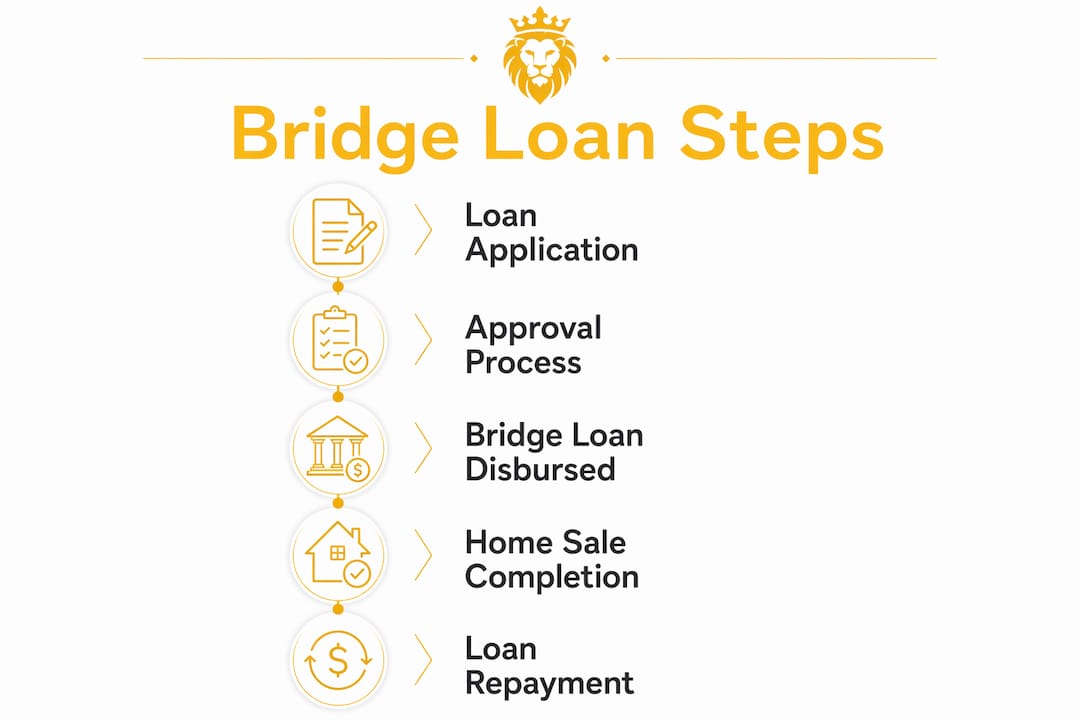
The critical risk is timing. If your existing home does not sell before the loan matures, you face two scenarios: pay the balloon from other funds or face foreclosure. Borrowers carrying an existing mortgage simultaneously manage two loan payments, which strains cash flow. Structuring the sale to close at the start of the repayment window reduces that pressure considerably.

Advantages and disadvantages of bridge financing
Advantages:
- Purchase a new home without waiting for your current one to sell
- No sale contingency required on the new offer, strengthening your negotiating position
- Fast funding, sometimes within two weeks
- Payment flexibility, including interest-only or deferred options
- Access to equity before the sale closes
Disadvantages:
- Interest rates of 8%–14% as of mid-2026, materially higher than conventional mortgage rates
- Origination fees are typically a small percentage of the loan amount due at closing
- Foreclosure risk if the exit strategy fails, regardless of prior payment history
- Potential dual mortgage payments if the original home mortgage remains active
- Short repayment window creates pressure if the property sale is delayed
What bridge loans actually cost in 2026
Rate range: 8%–14% all-in as of mid-2026, with origination fees of 1–3 points due at closing.
Interest rates on bridge loans run significantly higher than permanent debt because lenders price for short duration and transition risk. On a $300,000 bridge loan at 11%, monthly interest-only payments run approximately $2,750. Origination fees add $3,000–$9,000 at closing on that same loan amount.
Additional costs include appraisal fees, title insurance, and standard closing costs. Rolling fees into the loan principal increases your effective rate because you pay interest on those capitalized costs for the full term. Borrowers who treat bridge financing as long-term debt routinely overpay on cost of capital compared to conventional alternatives.
Alternatives to bridge loans
Several options can accomplish the same goal with lower cost or less risk:
- HELOC: A home equity line of credit draws on existing equity at lower rates, though approval takes longer and requires the home to be in good standing
- Contingent offer: Making your new purchase contingent on selling your current home eliminates the need for bridge financing, though sellers in competitive markets often reject contingencies
- Seller financing: Negotiating directly with the seller for a short-term carry note can replicate bridge loan mechanics without institutional fees
- Rent-back agreement: Selling your current home and renting it back from the buyer for 30–90 days provides sale proceeds while you finalize the new purchase
- Personal savings or liquid assets: Funding the gap from savings avoids debt entirely, though this depletes reserves
Each alternative involves trade-offs in speed, cost, and negotiating leverage. The right choice depends on your equity position, timeline, and local market conditions.
Top U.S. bridge loan lenders compared
Three lenders serve distinct segments of the bridge loan market.
| Lender | Services offered | Specialization | Best for | Rating |
|---|---|---|---|---|
| Rocket Mortgage | Home loans, bridge loans, refinancing, equity access | Veterans, first-time buyers, general homebuyers | Homebuyers seeking a full-service mortgage lender with broad product range | 3.7★ |
| CoreVest Finance | Bridge loans, rental loans, fix-and-flip credit lines, new construction, multifamily | Residential real estate investors, portfolio financing | Investors needing flexible bridge and investment property financing across multiple states | 4.2★ (55 reviews) |
| Herring Bank | Regional banking, bridge loans, personal lending | Local borrowers, community banking | Borrowers who prefer personalized underwriting from a regional institution | — |
Rocket Mortgage suits homebuyers who want a single lender for both the bridge and the permanent mortgage. CoreVest Finance has closed over $25 billion in loans across 46 states, making it the strongest option for investors managing multiple properties or needing investor-specific products like fix-and-flip credit lines. Herring Bank fits borrowers who value a direct relationship with a regional lender over national scale.
How to select the right bridge loan and lender
Choosing the wrong lender or loan structure is the most common and costly mistake in bridge financing.
- Compare total cost, not just rate: Add origination points, appraisal fees, and closing costs to the interest expense to calculate true cost of capital
- Verify your exit before applying: A signed sale contract or permanent financing pre-approval is the minimum credible exit; JPMorgan recommends lenders offering bridge-to-permanent financing to reduce transition costs
- Confirm the lender's timeline: Some lenders fund in 72 hours; others take two weeks. Match the timeline to your closing deadline
- Check seasoning requirements: Many permanent lenders require 6–12 months of ownership before refinancing at the new appraised value, which can conflict with a short bridge term
- Negotiate extension options: Build in one or two extension periods at defined fees rather than accepting a hard maturity with no flexibility
- Get multiple quotes: Bridge loan pricing varies widely by lender, LTV, and borrower profile
Asset-based bridge loans for real estate investors
Asset-based bridge lending operates on different underwriting logic than residential bridge loans. The lender's primary focus is the property's value and the business plan, not the borrower's FICO score or W-2 income.
- Underwriting basis: After-repair value (ARV) or current appraised value, not credit score
- Use cases: Fix-and-flip acquisitions, new construction, BRRRR execution, rental portfolio expansion, distressed property purchases
- Speed advantage: Asset-based lenders close in 7–14 days versus 30–45 days for conventional financing
- LTV structure: Most cap at 65%–80% of ARV, with loan-to-cost structures available for value-add deals
Jaken Finance Group specializes in this category, offering bridge loans for real estate investors with closings in as few as five days and no minimum credit score requirement. The underwriting centers on the property's value and the investor's exit plan, making it accessible to borrowers who would not qualify under conventional criteria.
Typical timeline for obtaining and using a bridge loan
The full cycle from application to payoff typically runs as follows:
- Application and approval: 24–72 hours for initial approval with most bridge lenders
- Appraisal and documentation: 5–10 business days
- Funding: 2 weeks from application in most cases
- Active loan period: 6–12 months for residential; up to 36 months for commercial or investment deals
- Exit: Balloon payment from sale proceeds or permanent refinance, coordinated to close before loan maturity
Delays in the property sale are the most common source of timeline problems. Borrowers should build a buffer of at least 60–90 days between the expected sale date and the loan maturity date.
How bridge loans affect your credit score and financial profile
Taking out a bridge loan affects your credit profile in several ways. The application triggers a hard inquiry, which causes a small, temporary score reduction. The loan itself adds to your total debt load, which raises your DTI and can affect qualification for permanent financing.
Carrying two mortgages simultaneously, even temporarily, increases your credit utilization and monthly obligations. Lenders evaluating your permanent mortgage application will see both loans on your credit report. On-time interest payments during the bridge period contribute positively to payment history. A missed payment or default, however, carries the same consequences as any secured loan default, including foreclosure on the collateral property.
Key questions to ask lenders before choosing a bridge loan
Before signing any bridge loan agreement, get clear answers to the following:
- What is the all-in rate, including origination points and all fees?
- What is the exact maturity date, and what happens if I miss it?
- Are extension options available, and what do they cost?
- Do you require me to use your permanent financing product to qualify?
- How do you handle the payoff if my property sale closes before the loan matures?
- What documentation do you require for the exit strategy?
- Is the rate fixed or floating, and what index does it track?
Jaken Finance Group: asset-based bridge financing for investors
Real estate investors who need speed and flexible underwriting have a different set of requirements than traditional homebuyers. Conventional bridge lenders and retail mortgage banks prioritize credit scores and income documentation. Jaken Finance Group takes a different approach.
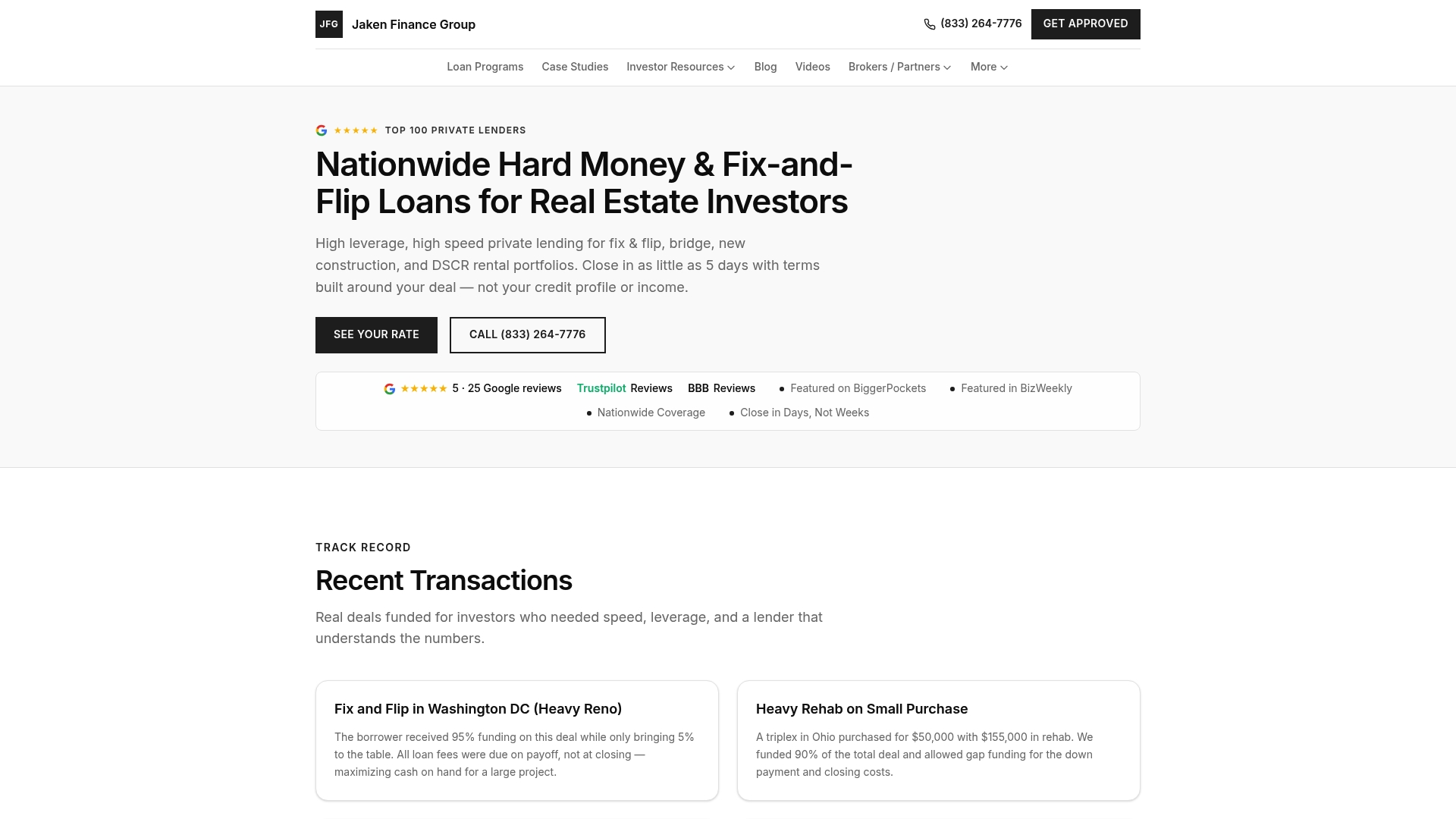
Jaken Finance Group provides hard money and bridge loans nationwide, with closings in as few as five days and underwriting based on property value rather than FICO. There is no minimum credit score requirement. Loan products cover fix-and-flip, new construction, DSCR rental, gap financing, second-position loans, and commercial real estate. For investors who need to move fast on a distressed property, a value-add acquisition, or a BRRRR deal, Jaken Finance Group offers a direct path to capital without the documentation burden of institutional lenders. Explore asset-based loan options to see what your deal qualifies for.
Key Takeaways
Bridge loans are short-term, interest-only loans secured by real estate that fill the funding gap between buying a new property and selling an existing one, with 2026 rates running 8%–14% and terms of 6–36 months.
| Point | Details |
|---|---|
| Core structure | Interest-only payments during the term, with a full balloon payment due at maturity from sale proceeds or a refinance. |
| 2026 cost range | Rates run 8%–14% with origination fees of 1%–3% of the loan amount due at closing. |
| Qualification threshold | Most lenders require at least 20% home equity and a DTI below 50%; some set a minimum FICO of 740. |
| Foreclosure risk | Failure to repay by the maturity date can trigger foreclosure regardless of prior payment history. |
| Jaken Finance Group | Offers asset-based bridge loans with no minimum credit score and closings in as few as five days, suited to real estate investors. |