
For fast closings on distressed or as-is properties, hard money is usually the right tool; for long-term buy-and-hold purchases where cost matters more than speed, a bank or conventional loan wins. Most experienced investors use both: a hard money loan to acquire and rehab, then a refinance into conventional or DSCR financing once the property stabilizes.
TL;DR:
- Hard money loans are ideal for quick closings on distressed or auction properties, typically closing in 7 to 14 days, whereas bank loans take 30 to 60 days.
- The total cost of a hard money loan over short-term holds can be lower than a conventional loan with a lower interest rate but higher closing costs and longer approval times.
- Hard money underwriting focuses on the property’s value and exit plan, making it accessible for distressed deals, while banks consider borrower credit, income, and debt load.
- When planning a refinance, investors should account for seasoning requirements, have leases and repairs lined up, and secure a preliminary appraisal early.
- For long-term buy-and-hold properties, conventional financing generally offers lower total interest and costs over the full loan term.
Table of Contents
- Hard Money vs Bank Loan: The Quick Comparison
- What Do Rates, Points, and Payment Structure Actually Cost?
- How Do Lenders Decide Who Qualifies?
- When Should You Choose Hard Money Over a Bank Loan?
- What Does the Application and Closing Process Look Like?
- How Do You Plan the Refinance Exit?
- What Happens If the Refinance Falls Through?
- What Jaken Finance Group Sees Across Real Investor Deals
- The Real Test Isn't Rate. It's Whether Your Exit Plan Survives Contact With Reality
- Ready to Move Faster on Your Next Deal?
- Where to Verify These Numbers Yourself
- Sources
- FAQ
Hard Money vs Bank Loan: The Quick Comparison
The core tradeoff comes down to speed versus cost. Hard money lenders underwrite the property, not the borrower's balance sheet, so they can close in days. Banks underwrite the borrower's income, credit, and debt load, which takes longer but produces a lower rate.
Here's how the two stack up on the metrics that matter most to an investor comparing financing paths:
- Rate range: Hard money typically runs 8% to 15% plus 1 to 4 points; conventional investment loans generally land in the 6% to 8% range depending on credit and loan type.
- Term structure: Hard money loans usually run 6 to 24 months with interest-only payments and a balloon payoff; conventional loans amortize over 15 to 30 years.
- Underwriting basis: Hard money lenders focus on after-repair value (ARV) and loan-to-value (LTV); banks focus on credit score, debt-to-income (DTI), and documented income.
- Documentation: Hard money requires a scope of work and exit plan; banks require tax returns, pay stubs, and full asset verification.
A borrower chasing a distressed property at auction cares about the bottom two rows. A borrower refinancing a stabilized rental cares about the top two.
What Do Rates, Points, and Payment Structure Actually Cost?
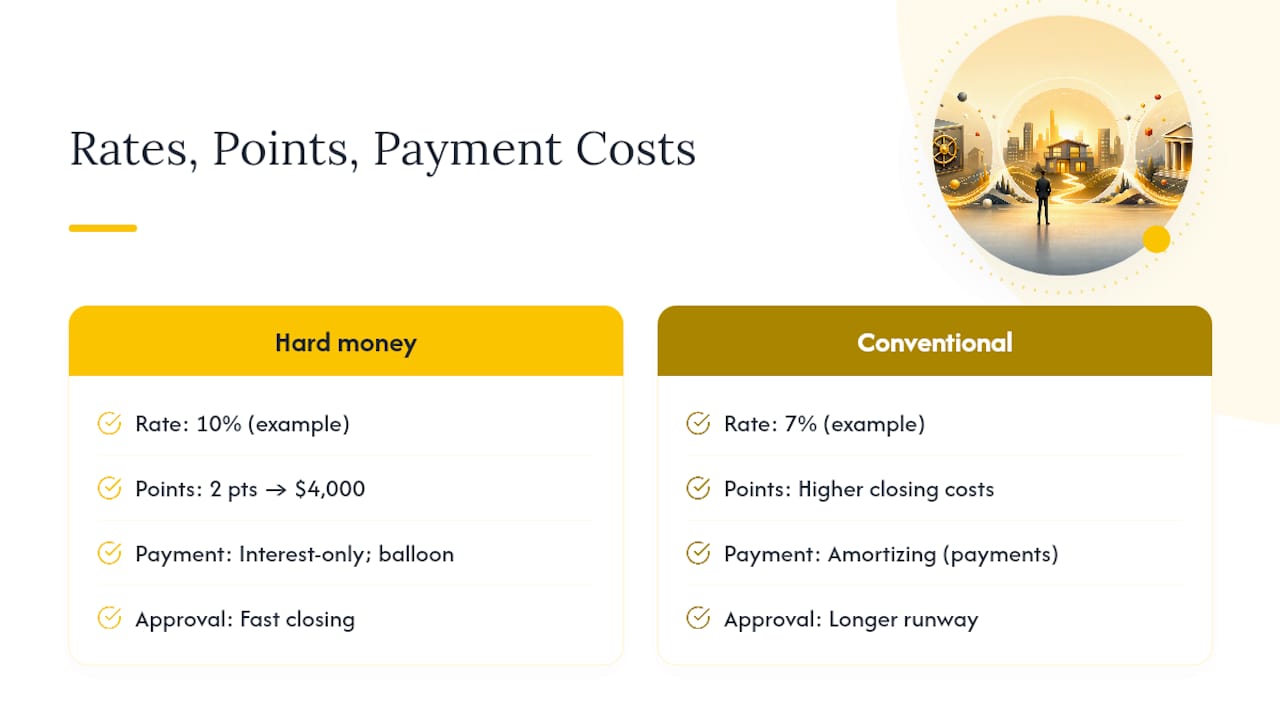
Rate alone tells you almost nothing about what a loan actually costs over a short hold. Modeling total carry cost, meaning interest plus points plus financing fees, matters more than comparing headline rates when the hold is under two years, according to HardMoneyScout's investor guide. A 10% hard money rate with 2 points can cost less in absolute dollars over six months than a 7% conventional loan carrying higher closing costs and a longer approval runway that delays your renovation start.
Hard money's premium over bank financing exists because the lender is taking on a shorter-duration, higher-risk position secured mainly by the property itself. Points are charged upfront as a percentage of the loan amount, so a $200,000 loan at 2 points costs $4,000 before a single interest payment is made. That upfront cost pushes the effective APR well above the quoted rate, especially on short holds.
Payment structure is where the two diverge most sharply. Hard money loans are almost always interest-only, with the full principal due at the balloon payoff, either through sale or refinance. Conventional loans amortize, so each payment chips away at principal from day one.
You'd pay roughly $22,000 in interest plus $4,000 in points, or about $26,000 in total carry cost. You can run your own numbers with a hard money loan calculator before committing to either path.
How Do Lenders Decide Who Qualifies?
Hard money lenders and banks are evaluating almost entirely different things, which is why a borrower who gets rejected by one can often get approved by the other within the same week.
Hard money underwriting centers on the property. Lenders order an appraisal or broker price opinion (BPO), calculate the ARV, and lend against a percentage of that figure rather than the purchase price alone, since hard money lenders underwrite to recovery value in case they need to foreclose and resell.
Conventional underwriting is borrower-centered:
- Credit scores typically need to clear 620 to 680 depending on the lender and loan program.
- DTI ratios generally must stay under 43% to 45%.
- Full income documentation, tax returns, and reserves are required.
- Owner-occupancy rules can restrict which loan programs apply to investment property.
Pro Tip: If asset protection matters to you, ask upfront whether the lender allows vesting the loan in an LLC. Many hard money lenders accept or prefer LLC vesting, while conventional lenders often require personal-name vesting, which can complicate liability planning later.
When Should You Choose Hard Money Over a Bank Loan?
The right financing choice depends on the property's condition, your timeline, and how clear your exit plan is. Run through this sequence before you commit to either option:
- Check the clock. If you're closing on an auction or trustee sale with a 10- to 21-day window, hard money is often the only financing that can move fast enough.
- Assess the property's condition. Distressed properties, gut renovations, and new construction draws rarely qualify for conventional financing until they're habitable.
- Confirm your exit strategy. A clear refinance or sale plan within 6 to 12 months supports hard money; an uncertain timeline argues for conventional financing from the start.
- Check your reserves. Hard money's higher carry cost demands a contingency cushion for cost overruns or a slower-than-planned sale.
- Consider a hybrid approach. Acquire and rehab with hard money, then refinance into a DSCR rental loan or conventional mortgage once the property is stabilized and rent-ready.
For a long-term buy-and-hold purchase of a rent-ready property, skip hard money entirely and go straight to conventional financing. You'll save thousands over the loan term.
What Does the Application and Closing Process Look Like?
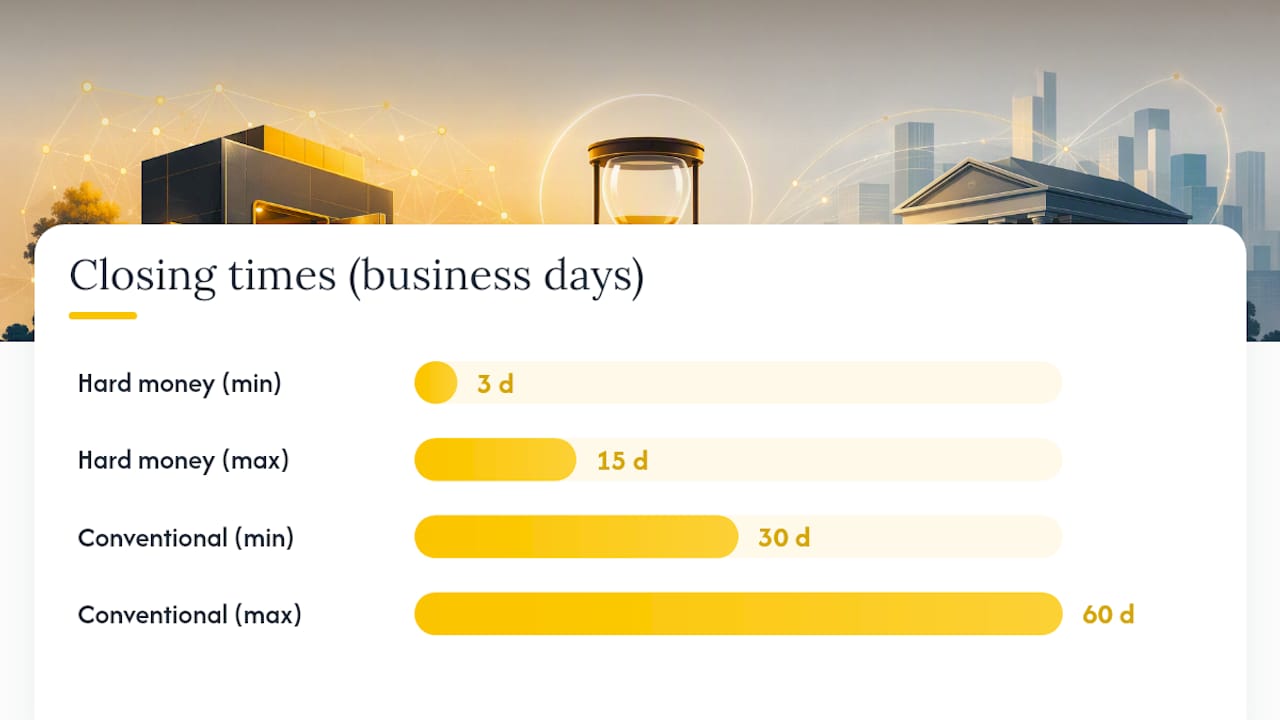
The timeline gap between the two loan types is the single biggest reason investors choose one over the other. Hard money loans typically close in 3 to 15 business days; conventional loans usually take 30 to 60 days, driven by appraisal scheduling, title work, and full income underwriting.
Delays on either side tend to come from the same culprits: a slow appraisal, an incomplete scope of work, missing permits, or a title issue that surfaces late. Investors who've closed several hard money deals move faster because they arrive with a complete package, and an established relationship with the lender shortens the review cycle further.
Before applying for either loan type, have these ready:
- Purchase contract or auction confirmation
- Detailed scope of work and contractor bids (hard money)
- Two years of tax returns and pay stubs (conventional)
- Proof of reserves for carrying costs and contingencies
- Entity documents if vesting in an LLC
How Do You Plan the Refinance Exit?
A hard money loan without a refinance plan is a liability waiting to mature. Three exit routes cover most scenarios: a conventional cash-out refinance for a stabilized rental, a DSCR loan sized to the property's rental income rather than your personal income, or a portfolio refinance if you're consolidating several properties under one lender.
Timing matters as much as the route. Most conventional and DSCR lenders require a seasoning period, often 3 to 6 months of ownership or stable rental history, before they'll refinance a property purchased with hard money. Build that seasoning window into your original loan term rather than assuming a same-day flip into permanent financing.
A DSCR refinance at 7.5% amortized cuts that to around $1,750 a month while building equity, according to the same carry-cost framework HardMoneyScout uses for investor comparisons. The math argues for refinancing the moment the property qualifies, not waiting out the full hard money term.
Before you approach a refinance lender, line up signed leases if the property is a rental, complete any remaining repairs, and order your own appraisal estimate so you aren't surprised by the number the lender comes back with.
- Confirm seasoning requirements with your target refinance lender early
- Line up leases and repair completion before applying
- Get a preliminary appraisal estimate to avoid surprises
What Happens If the Refinance Falls Through?
The scenario that damages investors most isn't a bad rate. It's a hard money balloon payment coming due with no refinance approved and no buyer under contract. Conservative ARV estimates and a cash reserve covering three to six months of carry cost are the cheapest insurance against that outcome.
High carry costs also compress flip margins faster than most first-time investors expect; every extra month on a hard money loan eats directly into profit. If you've pledged personal property or a primary residence as additional collateral, foreclosure risk extends beyond the investment property itself.
Pro Tip: Have a professional underwriting review of your exit plan before you close, not after you're three months into a renovation and the market has shifted.
What Jaken Finance Group Sees Across Real Investor Deals
Some hard money lenders underwrite primarily on the property's value and the borrower's exit plan rather than credit score alone, allowing for fast closings once a file is complete. That speed matters most on the deals this article has walked through: auction purchases, distressed acquisitions, and rehab projects where a 45-day conventional timeline would kill the contract.
Investors typically use Jaken Finance Group's asset-based loans to acquire and renovate, then refinance into conventional or DSCR financing once the property is rent-ready or resold. A few resources worth bookmarking as you plan your own deal:
- The approval process breakdown for what documentation actually speeds up a close
- A rundown of the core benefits of hard money financing for investors weighing their first deal
- Notes on commercial applications of hard money for larger asset classes
The Real Test Isn't Rate. It's Whether Your Exit Plan Survives Contact With Reality
Most investors fixate on the rate gap between hard money and bank financing, then get blindsided by a refinance that takes longer than expected. Pay the premium for speed when the deal genuinely requires it, distressed condition, auction deadline, or a rehab timeline no bank will touch, and insist on conventional or DSCR financing the moment a property qualifies. Model your exit before you sign anything, and keep a reserve big enough to survive a slower market than the one you planned for.
— Jason Taken
Ready to Move Faster on Your Next Deal?
Jaken Finance Group underwrites on the property's value, not just a credit score, so investors who'd stall out waiting on a bank can still close on distressed properties, auction deals, and rehab projects that need to move now. The lineup covers the situations this article walked through directly: Fix and Flip Loans priced at 8.99% to 13.5% for renovation deals, Bridge Loans for fast acquisitions and construction draws, and DSCR Rental Loans for the refinance exit once your property is stabilized.
Every deal in this article eventually needs an exit, and the refinance step matters as much as the initial close. If you're weighing a hard money purchase against a conventional path right now, request a quote through Jaken Finance Group's loan options page to see actual rate and term numbers against your specific property and timeline.
Where to Verify These Numbers Yourself
Before committing to either financing path, run your own numbers rather than taking any guide's word for it, including this one.
- FDIC's deposit insurance resources explain how bank-backed lending differs structurally from private hard money capital.
- NMLS Consumer Access lets you verify any lender's licensure and complaint history before signing.
- A hard money loan calculator helps you model your own carry cost against the examples above.
Sources
- FDIC: Deposit Insurance
- Hard money loan — Wikipedia
- Mortgagecalculator
- Hard Money Loans vs. Conventional Loans: Complete 2026 Investor Guide — HardMoneyScout
FAQ
What Are the Downsides of Hard Money Loans?
The main downsides are cost and balloon risk: rates commonly run 8% to 15% plus 1 to 4 points, and the full principal is typically due at the end of a 6 to 24 month term. If your refinance or sale falls through before that deadline, you face default risk on the property pledged as collateral.
What Is the 70% Rule for Hard Money Loans?
Lenders use this cushion to protect their position if they need to foreclose and resell, since hard money underwriting is based on recovery value rather than the borrower's income.
How Long Do You Have to Pay Off a Hard Money Loan?
Most hard money loans carry terms of 6 to 24 months with interest-only payments and a balloon payoff at the end. Some lenders structure fix-and-flip and bridge loans within a short-term window to match a renovation or resale timeline.
Why Would Someone Use a Hard Money Loan Instead of a Bank Loan?
Investors choose hard money when speed or property condition rules out a bank, such as auction purchases with a 10 to 21 day close window or distressed properties that don't qualify for conventional underwriting. Hard money loans can close in 7 to 14 days, compared to 30 to 60 days for a typical conventional loan.
Is a Bank Loan Always Cheaper Than Hard Money?
Over a long hold, yes, a conventional loan's amortizing payments and lower rate almost always cost less in total interest. Over a short hold under two years, total carry cost, not the headline rate, determines which option actually wins, and hard money frequently comes out ahead once you factor in the deals a bank simply won't finance.