
Asset-based hard money is typically the faster, more flexible option for time-sensitive fix-and-flip acquisitions, closing in days rather than weeks under rules governed by Regulation Z. A longer-term, mortgage-style rehab loan can outperform it when the scope is small and the plan is to hold or refinance rather than sell quickly. Jaken Finance Group works primarily in the former category, financing acquisition and rehab for investors who need speed over amortization.
TL;DR:
- Hard money loans can close within a week with documentation for quick deals, but they have higher interest rates and costs than long-term refinancing options.
- Hard money underwriting prioritizes property value and exit plan over borrower credit, making credit scores less relevant in qualification.
- Longer-term rehab loans require more extensive documentation, longer closing times, and are better suited for investors planning to hold properties and qualify with strong income and credit.
- When a quick close is critical for a distressed property, paying higher points for hard money often outweighs the cost of missed deadlines or missed market opportunities.
- Proper preparation, including contractor bids and proof of funds, significantly accelerates approval and funding process across both financing types.
Table of Contents
- How hard money works for fix-and-flip investors
- Longer-term rehab-to-mortgage financing for investors
- Comparing speed, cost, leverage, and exits across both options
- How to choose the right financing for your deal
- Exit strategies and tax planning for rehab projects
- What originators look for when a file needs to move fast
- How Jaken Finance Group supports your next rehab deal
- Sources
- FAQ
How hard money works for fix-and-flip investors
Hard money loans are secured primarily by the property rather than the borrower's income or credit profile. Terms typically run 6 to 36 months, structured as interest-only payments with a balloon payment due at maturity, a format standard across bridge and hard-money products in the private lending market. Underwriting centers on the property's after-repair value (ARV) and the deal's loan-to-cost (LTC) ratio rather than a borrower's FICO score, though most lenders still confirm liquidity and exit capacity.
Documentation investors should have ready before applying:
- Purchase contract or property under contract details.
- Contractor scope of work with itemized bids and a project timeline.
- Proof of funds for the down payment or reserve requirement.
- Recent bank statements showing liquidity for carry costs.
- An exit plan, either comparable sales data or a refinance term sheet.
Funding ratios commonly reach a high percentage of acquisition and rehab costs combined, with draws released against contractor invoices and inspection milestones rather than disbursed as a lump sum. Costs run higher than conventional financing: origination points, interest, and per-draw inspection fees are standard, but the trade-off is a close measured in days instead of the 30 to 45 days typical of mortgage-style underwriting.
Longer-term rehab-to-mortgage financing for investors
This article uses "203k-style" financing to mean a longer-term, mortgage-like rehab loan built for investors, distinct from the FHA 203(k) program designed for owner-occupant homebuyers. The investor version blends purchase and renovation costs into one amortizing loan, underwritten more like a conventional mortgage than an asset-based bridge product.
Underwriting on this financing type scrutinizes income, credit history, and debt-to-income ratio alongside the appraisal, and lenders typically require contingency reserves tied to the appraised after-repair value. Closing timelines run longer than hard money because appraisal review, income documentation, and often mortgage insurance underwriting all add processing steps.
This structure tends to fit:
- Investors planning to hold the property as a rental rather than sell it quickly.
- Smaller-scope rehabs where extended underwriting timelines are not a deal risk.
- Borrowers with clean, well-documented income and strong credit history.
- Deals where amortizing debt service, not interest-only carry, fits the investor's cash flow plan.
Comparing speed, cost, leverage, and exits across both options
The two financing types serve different points in an investor's timeline and risk tolerance.
- Term length: Hard money runs 6 to 36 months; mortgage-style rehab financing amortizes over a standard 15 to 30 year term.
- Underwriting focus: Hard money underwrites the asset and exit plan; mortgage-style financing underwrites the borrower's income and credit.
- Speed to close: Hard money can close in days; mortgage-style rehab financing typically takes several weeks.
- Funding ratio: Hard money often funds a high share of acquisition plus rehab cost; mortgage-style products are more conservative and appraisal-bound.
- Rate and fee profile: Hard money carries higher points and interest for the speed and flexibility; mortgage-style financing carries lower rates but slower access to capital.
- Borrower profile: Hard money accommodates variable credit histories; mortgage-style rehab financing generally requires stronger income and credit documentation.
- Exit paths: Hard money commonly exits through sale or refinance into DSCR or conventional debt; mortgage-style rehab financing is often the exit itself.
Consider two scenarios. An investor with a 45-day close deadline on a distressed property needs hard money to beat the timeline, even at a higher rate. An investor buying a lightly worn rental property with a 90-day runway and strong personal credit may find the amortizing rehab mortgage cheaper over the holding period.
Margins are tightening industry-wide. Typical flipped-home gross profit fell to about $62,000 with a 25.5% ROI in 2025, and average flip timelines stretched to roughly 160 days from purchase to resale. Narrower margins make financing that minimizes carry cost and matches the actual exit timeline a bigger factor in whether a deal pencils.
How to choose the right financing for your deal
Start with the deal math before choosing a lender type.
- Set an ARV margin target and back into a maximum acquisition price that preserves it.
- Separate hard rehab costs (structural, systems, finishes) from soft costs (permits, design, carrying insurance).
- Build a contingency reserve, typically 10 to 15% of the rehab budget, into your total project cost.
- Estimate carry cost for your realistic timeline, not your optimistic one.
- Confirm whether your exit is a sale or a refinance, since each pulls different underwriting requirements.
Timeline is a cost variable, not just a convenience. When a delayed close risks losing the property or missing a seasonal sale window, paying higher points for a faster close usually costs less than the carry cost of a blown deadline. Red flags that point toward hard money include a seller demanding a fast close, a property that won't qualify for conventional appraisal due to condition, or a borrower whose income documentation isn't ready.
Before signing, ask any lender three questions: How fast can you actually fund from clear title? How are draws released against contractor invoices? What triggers a delay in your underwriting process?
Pro Tip: Get your contractor's itemized bid and timeline finalized before you apply, since draw-based hard money underwriting moves only as fast as your documentation does.
Exit strategies and tax planning for rehab projects
Three exits dominate fix-and-flip and rehab financing: selling at completion, refinancing into a DSCR or conventional loan, and holding as a long-term rental. A sale closes out interest-only carry fastest but depends on market timing. Refinancing into DSCR debt converts short-term interest-only carry into amortizing payments and requires the property to cash flow at underwriting. Holding without refinancing keeps the balloon maturity risk in place.
On the tax side, IRS guidance generally requires capitalizing construction-period interest and many related soft costs into the property's basis rather than deducting them immediately, which affects both project profit calculations and eventual taxable gain. Lenders evaluating an exit refinance will check completed rehab scope, updated appraisal value, and rental income documentation before approving the new loan.

What originators look for when a file needs to move fast
Files move fastest when the borrower's documentation matches the deal's urgency before the first conversation with underwriting. A common pattern among asset-based closings: a borrower with a tight contract deadline came in with an itemized contractor bid, a clear exit through resale comps, and proof of rehab funds already staked. That file cleared review in days because nothing had to be tracked down afterward.
The documents that matter most are the purchase contract, a contractor scope with a realistic schedule, and evidence of liquidity for both the down payment and initial carry. On draws, negotiate a schedule tied to inspection milestones rather than calendar dates, and require your contractor to submit invoices in the same format the lender expects.
— Jason Taken
How Jaken Finance Group supports your next rehab deal
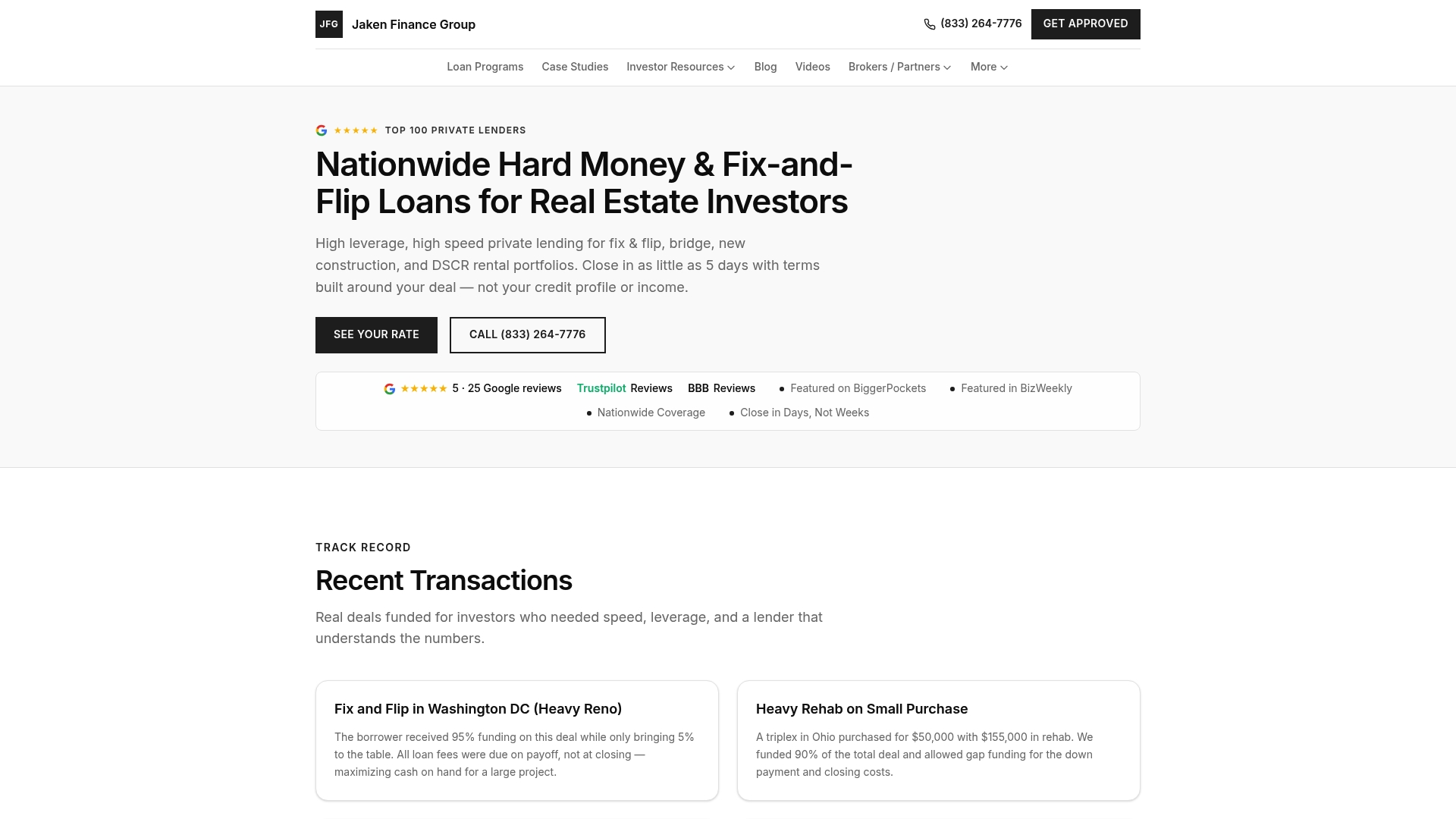
Jaken Finance Group offers Fix and Flip Loans, Bridge Loans, and New Construction Loans built around the same asset-based underwriting described above, with rates from 8.99% to 13.5% and closings available in as few as 7 to 10 days.
To move quickly, have your contract, contractor scope, and proof of funds ready before you apply. Visit the fix and flip and bridge loan programs page to review current terms and start a file.
Sources
Regulation Z clarifies disclosure rules for business-purpose loans, IRS Publication 5522 governs capitalizing rehab interest, and ATTOM's 2025 flipping report and HousingWire's 2025 private lending coverage ground the market figures cited above.
This article is general information, not a substitute for advice from a qualified financial advisor. Consult a qualified financial professional about your own circumstances before acting on anything here.
- ATTOM 2025 year-end home flipping report
- eCFR :: 12 CFR Part 226 -- Truth in Lending (Regulation Z)
- Publication 5522 (IRS)
FAQ
Is hard money more expensive than a mortgage-style rehab loan?
Yes, hard money typically carries higher points and interest rates than an amortizing mortgage-style rehab loan, reflecting the shorter term and asset-based underwriting. Jaken Finance Group's Fix and Flip and Bridge Loan rates run from 8.99% to 13.5%, which typically still costs less than a blown closing deadline on a time-sensitive deal.
How fast can a fix-and-flip loan actually close?
Asset-based hard money loans can close in as few as 7 to 10 days when documentation is ready, compared to several weeks for mortgage-style rehab financing that requires full income and credit underwriting. Speed depends heavily on how prepared the borrower's contractor bids and proof of funds are at application.
Does my credit score matter for hard money loans?
Hard money underwriting focuses primarily on the property's value and the deal's exit plan rather than credit score, unlike mortgage-style rehab financing which relies more heavily on income and credit history. Some hard money lenders underwrite with no minimum credit score requirement, focusing on the asset and deal structure instead.
What happens to my rehab loan interest for tax purposes?
IRS guidance generally requires capitalizing construction-period interest and many related soft costs into the property's basis rather than deducting them as current expenses. This affects both your project's realized profit and the taxable gain calculated at sale or refinance, so it should be built into your deal math from the start.
Can I refinance a hard money loan into a long-term rental loan?
Yes, refinancing a hard money loan into a DSCR or conventional rental loan is a common exit once rehab is complete and the property is stabilized. Lenders will typically check the finished scope of work, updated appraisal, and rental income before approving the refinance.