
Before signing anything, confirm four numbers: total cash-to-close, the leverage basis (LTV, ARV, or LTC), the draw release rules, and any binding clauses buried in the fine print. Those four line items decide whether a deal pencils out or quietly erodes your margin. Everything else on a hard money term sheet is detail; these are the filters that tell you whether to move forward or shop the offer elsewhere.
TL;DR:
- Confirm the total cash-to-close, leverage basis (LTV, ARV, or LTC), draw release rules, and binding clauses before signing any agreement.
- Be aware that the leverage basis affects the loan amount relative to property value or project cost, influencing actual funds available.
- Model total costs by adding origination fees, third-party costs, and interest over your expected hold period, as APR distorts short-term financing costs.
- Clarify draw schedules, inspection turnaround times, and specific closing conditions to prevent delays and unexpected costs.
- Understand the difference between a non-binding term sheet and a binding commitment letter, and negotiate the latter only after underwriting approval.
Table of Contents
- Term Sheet Anatomy: Decoding Loan Amount, Leverage, and Fees
- Modeling Cash-to-Close and Total Cost Over Your Hold
- Draw Schedules and Rehab Funding: Avoiding Cash Squeezes
- Conditions to Close: Where Timelines Quietly Break
- Term Sheet vs. Commitment Letter: The Legal Breakpoint
- Negotiation Checklist: Exact Questions to Ask Any Lender
- Why This Guidance Comes From Practical Lending Experience
- Extension and Default Provisions Worth Reading Twice
- Covenants and Obligations Borrowers Commit To
- Collateral and Security Interests Lenders Require
- Exit Strategies the Term Sheet Assumes You'll Use
- Hard Money Term Sheets vs. Traditional Mortgage Term Sheets
- Risks to Borrower and Lender the Term Sheet Reveals
- When Speed Justifies Paying More
- Jaken Finance Group: Programs Built Around These Term Sheet Realities
- Sources
- FAQ
Term Sheet Anatomy: Decoding Loan Amount, Leverage, and Fees
A hard money term sheet states the loan amount against a specific value basis, and that basis changes what the number actually means. A lender quoting 80% against as-is value offers less capital than one quoting 80% against after-repair value (ARV) on the same property. Confirm which basis applies before comparing two offers side by side, because a higher percentage on a lower basis can still mean less cash in hand.
Three leverage formulas show up repeatedly on term sheets:
- LTV (loan-to-value): loan amount divided by current appraised or purchase value.
- ARV (after-repair value): loan amount divided by the projected value once renovations are complete.
- LTC (loan-to-cost): loan amount divided by total project cost, including acquisition and rehab budget.
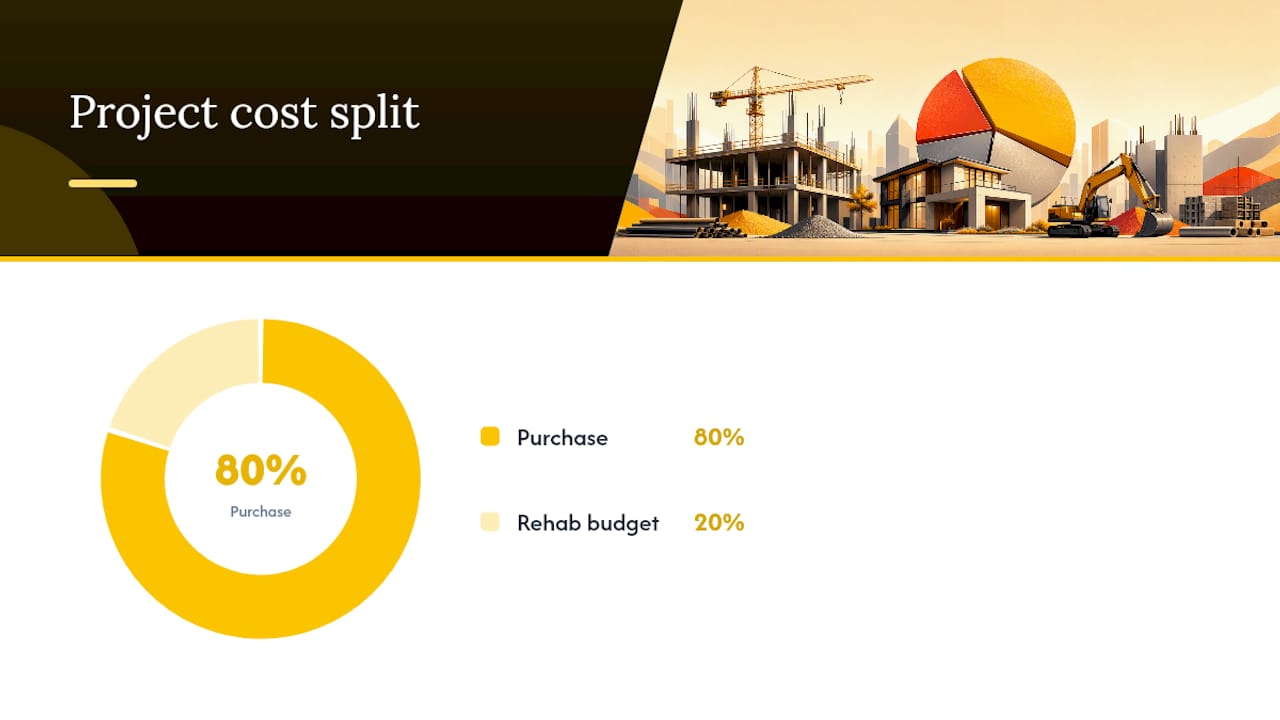
A $300,000 purchase with a $75,000 rehab budget has a total cost of $375,000. The numbers look close, but the underwriting logic behind each is different, and that affects how much rehab capital gets held in reserve versus disbursed at closing.
Rate structure matters just as much. Most hard money loan agreements are interest-only with a balloon payoff inside 24 months, and many carry a separate, higher default interest rate that kicks in automatically on a missed payment. Points and lender origination fees are usually negotiable; third-party costs like appraisal, title, and recording fees generally are not, since those go to outside vendors rather than the lender.
Modeling Cash-to-Close and Total Cost Over Your Hold
Compare offers in dollars, not percentages. A lower headline rate with more points can cost more than a higher rate with fewer points, depending on how long you plan to hold the loan.
- Add origination points, third-party closing costs, and any escrowed interest reserve to get upfront cash needed.
- Multiply the loan balance by the interest rate and the expected number of months held to get total interest cost.
- Add both figures together for total dollars spent over the hold period, then compare that number across lenders quoting different rate and point combinations.
Quick math: On a $250,000 loan at 11% with 3 points and a 9-month hold, points alone run $7,500 upfront. Interest over 9 months at 11% adds roughly $20,625. Total financing cost lands near $28,125, before third-party fees. Run the same math at 9.5% and 4 points, and the total often comes out close, sometimes higher, depending on the exact hold length.
APR was built for amortizing 30-year mortgages, and it distorts short-term hard money math badly. Total dollar cost over your expected hold is the metric that actually predicts your profit margin.
Draw Schedules and Rehab Funding: Avoiding Cash Squeezes
Rehab funds on most hard money deals release in stages rather than as one lump sum. An initial draw typically covers demolition or early materials, progress draws follow inspection milestones, and a final draw releases after a completion walkthrough confirms the scope is finished.
Lenders verify draw requests through photos, lien waivers, contractor invoices, or third-party inspector reports, and draw and inspection delays are a common source of holding-cost overruns on flip projects. A five-day inspection turnaround sounds reasonable until it stacks against a contractor crew sitting idle and waiting on payment.
Before signing, push for these specifics in writing:
- A defined initial material draw available at closing, not after the first inspection.
- A stated inspection service-level agreement (SLA), ideally 48 to 72 hours from request to funding.
- A capped inspection fee per draw, rather than an open-ended charge per visit.
Pro Tip: Ask the lender for their average draw turnaround time over the last 90 days, not their stated policy. Policies describe intentions; recent averages describe reality.
Conditions to Close: Where Timelines Quietly Break
Vague language is the enemy of a predictable closing. A term sheet that lists "standard conditions to close" without naming them shifts the risk of surprise requirements onto you, the borrower, right when you have the least leverage to push back.
Ask the lender to spell out every item explicitly:
- Valuation method: full appraisal, broker price opinion (BPO), or desktop review, and who orders it.
- Title requirements: clear title, resolved liens, and acceptable exceptions.
- Insurance: minimum coverage type, replacement cost basis, and lender as loss payee.
- Entity documentation: operating agreement, EIN, and authorized signer resolution if you're borrowing through an LLC.
Specifying conditions to close instead of relying on boilerplate language lets you run title, insurance, and entity paperwork in parallel rather than discovering a missing document three days before your scheduled closing.
Term Sheet vs. Commitment Letter: The Legal Breakpoint
A term sheet is a non-binding outline of proposed financing terms issued early in the process, often before full underwriting. A commitment letter is different: it's a binding agreement issued after the lender completes underwriting and formally approves the loan.
That transition point matters practically. Commitment letters often require the borrower to reimburse out-of-pocket expenses already incurred by the lender and may carry break-up fees if the borrower walks away.
- Request a commitment letter before ordering a costly appraisal, but expect a handful of conditions, like final title clearance, to still remain open.
- Confirm who pays for the appraisal and whether that cost transfers if the loan doesn't close.
- Don't quote a term sheet's numbers to a seller as guaranteed financing. It isn't, yet.
Negotiation Checklist: Exact Questions to Ask Any Lender
Rate and points trade against each other, and most lenders will flex on one if you concede the other. Accepting a slightly higher rate in exchange for fewer points often nets a lower total cost on a short hold.
- Ask which value basis, LTV, ARV, or LTC, backs the leverage number, and get it in writing.
- Ask whether minimum interest applies if you pay off early, and whether it can be waived or stepped down after a set number of months.
- Ask for a capped draw fee schedule and a stated inspection SLA before signing.
Watch for red flags: a leverage basis left undefined, third-party fees not itemized, exclusivity clauses locking you to one lender for 30 to 90 days, or language stating pricing is "subject to change" without listing what triggers a change.
Pro Tip: Send every lender the same three questions in the same order. Identical questions produce comparable answers, which is the only way to judge offers side by side instead of by gut feeling.
Why This Guidance Comes From Practical Lending Experience
Jaken Finance Group underwrites hard money, fix-and-flip, and bridge loans on an asset-based basis, which means the term sheets it issues are built around the same leverage and draw mechanics covered throughout this guide. Author Jason Taken's Loan Officer's Guide to Hard Money breaks down underwriting mechanics from the lender's side of the desk, which is useful context for reading a term sheet the way an underwriter reads it.
- Asset-based underwriting means approval hinges on property value and project economics, not solely on a borrower's credit profile.
- Programs span fix-and-flip, bridge, new construction, and DSCR rental financing, each with its own typical leverage basis.
- Closings can move in as few as five to ten days once conditions to close are satisfied.
Extension and Default Provisions Worth Reading Twice
Most hard money loans carry a term of six to eighteen months with a balloon payoff at maturity, which means an extension clause matters more than it looks at first glance. Ask exactly how an extension gets triggered: automatically upon request, or only at the lender's discretion with a new fee attached.
Get the exact fee and rate spelled out in the term sheet itself rather than left to "lender's then-current terms," since that phrase gives the lender room to charge whatever the market allows at the time.
Default provisions on hard money loans tend to be aggressive compared to conventional mortgages. Escrow requirements, late fees, and default interest rates are standard, and default interest often runs several points above the note rate, compounding fast on a short-term loan. Some agreements also include due-on-sale clauses that accelerate the full balance if the property transfers title before payoff, which matters if you're considering a wholesale exit rather than a traditional sale.
Prepayment penalties deserve equal scrutiny. A minimum interest guarantee, often 3 to 6 months' worth of interest regardless of actual payoff timing, protects the lender's yield on a loan that closes and repays faster than expected. If your exit plan involves a fast flip, negotiating that minimum down before signing protects real dollars.
Covenants and Obligations Borrowers Commit To
A hard money term sheet isn't just about the money; it lists ongoing obligations that survive well past closing day. Most agreements require the borrower to maintain hazard insurance with the lender named as loss payee, keep property taxes current, and avoid additional liens against the collateral without lender consent.
Reporting covenants show up often on fix-and-flip and construction deals. Lenders may require photo updates at each draw request, notice before starting or pausing renovation work, and advance notice of any change to the scope of the project. Skipping these steps doesn't just annoy the lender; it can trigger a technical default even when payments are current.
Entity-level covenants apply to borrowers using an LLC or other structure. The lender typically requires that ownership of the borrowing entity stay unchanged through the loan term, since a change in ownership shifts who's actually responsible for repayment. Some term sheets also require a personal guaranty from the entity's principals, which means the loan isn't purely asset-based in practice even though it's marketed that way.
Read the covenant section as carefully as the pricing section. A missed insurance renewal or an unreported ownership change can trigger default remedies just as fast as a missed payment.
Collateral and Security Interests Lenders Require
The property itself secures nearly every hard money loan, typically through a first-position mortgage or deed of trust recorded against the title. That security interest gives the lender the right to foreclose if the borrower defaults, which is standard and expected on asset-based lending.
Second-position and gap financing work differently. A lender in second position takes a subordinate lien behind an existing first mortgage, which carries more risk for the lender and usually commands a higher rate as a result. If your deal involves layered financing, confirm exactly where each lender's lien sits in priority, because that order determines who gets paid first in a default scenario.
Cross-collateralization shows up on some multi-property or portfolio deals, where a lender secures a loan against more than one property rather than a single asset. That structure can unlock more leverage, but it also means a default on one property can put an entire portfolio at risk.
Personal guaranties are common even on entity-borrowed loans, and some lenders also file a UCC-1 financing statement against business assets when a construction or equipment component is involved. Ask specifically which assets, beyond the real property, secure the loan before signing, since that scope is often broader than borrowers expect on their first hard money deal.
Exit Strategies the Term Sheet Assumes You'll Use
Every hard money term sheet is underwritten around an assumed repayment source, and lenders want that exit spelled out even if it isn't always written explicitly into the document. The three common paths are sale of the renovated property, refinance into permanent DSCR or conventional financing, or payoff from a separate capital source such as a construction takeout loan.
A fix-and-flip term sheet typically assumes sale as the exit. This is why the balloon maturity date usually lines up with a realistic renovation-plus-listing timeline rather than a full year of cushion. If your market has slower absorption times, negotiate a longer initial term instead of relying entirely on the extension clause.
A bridge loan term sheet often assumes refinance as the exit, particularly on a rental property being stabilized before conversion to a DSCR loan. In that case, confirm whether the lender's own DSCR program is available as a refinance path, since a lender who can originate both sides of the transaction, the bridge and the takeout, tends to move faster than coordinating two separate institutions.
Mismatched exit assumptions cause real problems. A borrower who tells the lender "I'm flipping this" but privately plans to hold and rent may find the loan's balloon date arrives before a refinance is lined up. State your actual exit plan honestly during underwriting, since it shapes the term length the lender is willing to offer.
Hard Money Term Sheets vs. Traditional Mortgage Term Sheets
A conventional mortgage term sheet and a hard money term sheet share a similar format, loan amount, rate, fees, closing conditions, but the substance underneath diverges sharply.
| Feature | Hard Money Term Sheet | Traditional Mortgage Term Sheet |
|---|---|---|
| Approval basis | Property value and project economics | Borrower credit score and income (DTI) |
| Typical rate range | Roughly 9.5% to 15%, per industry rate surveys | Fixed by market rate, generally lower |
| Points/origination | Commonly 1% to 4% | Often below 1%, sometimes zero |
| Payment structure | Frequently interest-only with balloon payoff | Fully amortizing over 15 to 30 years |
| Closing speed | Days to a couple of weeks | Typically around 30 days |
| Leverage basis | LTV, ARV, or LTC | LTV against appraised value only |
The rate spread reflects speed and flexibility, not just risk pricing. A conventional lender spends weeks verifying income, employment, and credit history; a hard money lender underwrites primarily against the asset and can close in a fraction of that time. That trade-off is the entire value proposition of hard money financing, and it's worth paying for when a deal's timeline demands it.
Risks to Borrower and Lender the Term Sheet Reveals
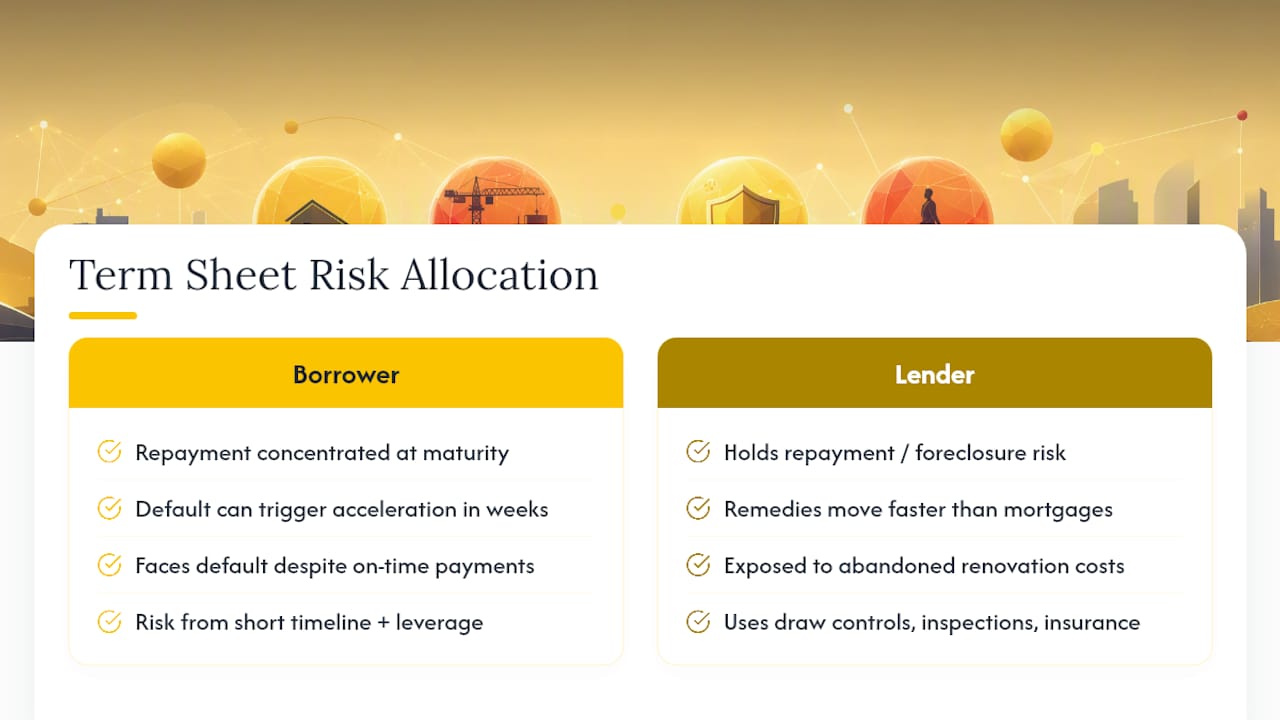
Every clause on a hard money term sheet allocates risk somewhere, and reading it that way changes how you evaluate the document. Interest-only payments with a balloon maturity concentrate repayment risk at the back end of the loan, meaning a borrower who can't refinance or sell by maturity faces default even after months of on-time payments.
Default remedies on hard money loans tend to move faster than on conventional mortgages, since these are business-purpose loans generally outside the consumer protections that slow foreclosure timelines on owner-occupied homes. A missed payment or covenant breach can trigger acceleration and foreclosure proceedings in a matter of weeks in some states, not months.
Lenders carry risk too, which is why the term sheet leans so heavily in their favor. A borrower who abandons a renovation midway leaves the lender holding a partially finished, harder-to-sell asset, which is exactly why draw controls, inspections, and insurance requirements exist in the first place.
For borrowers, the practical risk isn't any single clause; it's the combination of a short timeline, aggressive default remedies, and a leverage basis that might not match project reality if renovation costs run over budget. Reading the term sheet as a full risk map, not just a pricing sheet, is what separates investors who negotiate well from those who sign and hope.
When Speed Justifies Paying More
Speed is worth a rate premium when you're facing a time-limited acquisition, a thin inventory market, or a rescue closing where the alternative is losing the deal entirely. In those situations, a point or two of extra cost is cheap insurance.
Repeat borrowers and larger loan sizes are a different story. There, pushing for rate or point concessions makes sense, since volume and track record are exactly what give you leverage to ask.
— Jason Taken
Jaken Finance Group: Programs Built Around These Term Sheet Realities
Jaken Finance Group is the direct-lending option for investors who'd rather compare a real term sheet than keep reading about hypothetical ones. Its fix-and-flip, DSCR rental, and bridge loan programs are underwritten on an asset-based basis with no minimum credit score, which addresses the leverage-basis clarity and draw-management concerns covered throughout this guide directly.
Investors chasing high leverage on a rehab deal can review the 100% LTC fix-and-flip program details to see how loan-to-cost structuring works in practice, while those needing fast acquisition capital ahead of a refinance can look at the bridge loan program for its rapid-close timing. Some lenders state closings can occur in as few as 7 to 10 days once conditions to close are satisfied. Request a quote through a loan officer to get an actual term sheet in hand and start comparing real numbers instead of estimates.
Sources
Readers wanting deeper legal grounding before signing should review primary commentary rather than secondhand summaries.
- When term-sheet provisions survive the execution of definitive agreements
- Hard Money Loan Agreement: Terms, Fees, and Clauses - LegalClarity
This article is general information, not a substitute for advice from a qualified financial advisor. Consult a qualified financial professional about your own circumstances before acting on anything here.
FAQ
Is hard money lending a good idea?
Hard money lending fits investors who need speed or flexible underwriting more than they need the lowest possible rate. It works well for time-sensitive acquisitions and value-add projects, and less well as a long-term holding strategy given the interest-only, balloon-maturity structure most agreements carry.
What are typical terms for a hard money loan?
Rates commonly range from roughly 9.5% to 15%, with origination points typically running 1% to 4%. Most loans carry a 6 to 24 month term, interest-only payments, and a balloon payoff at maturity, with leverage measured against LTV, ARV, or LTC depending on the lender and program.
Is hard money lending illegal?
Hard money lending is a legal, regulated form of asset-based financing used across the United States for business-purpose real estate loans. It operates under different disclosure and licensing rules than consumer mortgage lending, which is why terms and remedies can differ from a conventional home loan.
How hard is it to get approved for a hard money loan?
Approval leans on the property's value and the project's economics rather than personal credit score, which is why lenders like Jaken Finance Group can approve deals that conventional underwriting would decline. Having a clear exit strategy, adequate cash-to-close, and accurate rehab budget speeds up approval considerably.
What's the difference between a hard money term sheet and a commitment letter?
A term sheet is a non-binding outline of proposed terms issued early in the process, before full underwriting. A commitment letter is issued after underwriting approval and is legally binding, often requiring expense reimbursement if the borrower withdraws.