
Real estate investors flipping houses have seven viable exit strategies, and the right one depends on three numbers: how much cash you need now, your ARV margin, and how liquid your local market is. Quick sale works when comps sell fast and your margin exceeds 20%. Wholetail or wholesale fits investors who need speed over maximum profit. Rent/hold and refinance (BRRRR) suit deals where the after-repair value doesn't clear the 70% rule with enough room to spare. Lease-option and seller financing extend your buyer pool when conventional financing is scarce. A 1031 exchange defers capital gains tax when you're rolling proceeds into another investment property rather than pocketing cash.
Every one of these exits lives or dies on the math you lock in at acquisition, not the story you tell yourself at closing.
- Quick sale/flip: best for speed and maximum immediate cash
- Wholetail/wholesale: best when time or capital is tight
- Rent/hold: best for long-term cash flow over quick profit
- Refinance/BRRRR: best for recycling capital into the next deal
- Lease-option/seller financing: best for widening your buyer pool
- 1031 exchange: best for deferring capital gains tax on a hold
Statistic to remember: Maximum Allowable Offer = ARV × 70% − rehab costs. Get this number wrong upfront, and no exit strategy downstream will fix it.
Key Takeaways
| Point | Details |
|---|---|
| Lock profit at acquisition | Use the 70% rule and conservative ARV comps before you make an offer, not after. |
| Match exit to deal metrics | Favor a flip when ARV margin exceeds 20% and comps sell fast; favor hold or refinance when costs are high. |
| Build in contingency | Budget 15% rehab contingency and a 30-day holding buffer to absorb surprises. |
| Structure financing for flexibility | Choose loans with extension options and milestone-based draws to preserve your ability to pivot exits. |
| Loop in a CPA early | Short-term versus long-term capital gains treatment, and 1031 eligibility, can change which exit nets more. |
Table of Contents
- Exit Strategies Flipping Investors Rely on Most
- How to Choose the Right Exit for Your Deal
- Financing Choices That Determine Which Exits Stay Open
- Tax Considerations That Change Your Net Proceeds
- Pitfalls That Erode Profit and How to Avoid Them
- How the Right Loan Structure Preserves Your Exit Options
- Managing Risk Across Every Exit Path
- Two Flips, Two Different Exits, Both Profitable
- Legal and Contract Details That Protect Each Exit
- Reading the Market Before You Commit to an Exit
- An Editorial Take on Exit-First Investing
- Sources
Exit Strategies Flipping Investors Rely on Most
Each exit strategy carries its own mechanics, costs, and failure points. Here's how the seven break down operationally.
-
Quick sale (traditional flip). Price at or slightly below market to generate multiple offers within the first two weeks. Stage the property, invest in professional photography, and list before your rehab crew fully demobilizes. Every extra month on market chips away at profit, since carrying costs on a typical flip run $1,500 to $3,000 per additional month depending on financing and local taxes. A flip that sits for three extra months can lose $4,500 to $9,000 before you even negotiate a lower price.
-
Wholetail vs. wholesale. Wholesaling means assigning your purchase contract to another investor before you ever close. Wholetailing means you close on the property first, then resell quickly with minimal or no rehab, closing costs and all. The distinction matters because wholetailing exposes the deal to buyer-loan seasoning rules that some loan programs, including FHA, impose on the seller's acquisition date. Verify your buyer's financing before you commit to a wholetail exit, or you may end up making price concessions to a cash buyer instead.
-
Rent/hold. Before you hold, underwrite the rent-to-price ratio and confirm the property stabilizes at a rent that covers debt service with margin to spare. Factor in property management costs, typically 8% to 10% of gross rent, before deciding this exit beats selling.
-
Refinance/BRRRR. Lenders will generally require you to hit a DSCR target, and some require a seasoning period before they'll refinance based on the new appraised value rather than your purchase price. BRRRR trades a lower immediate return for long-term equity and cash flow, and it only works if your post-rehab rent estimate is accurate and your lender is willing to refinance at a favorable loan-to-value ratio.
-
Lease-option and seller financing. Both widen your buyer pool to tenants or buyers who can't qualify for conventional financing today. Document everything: option consideration, purchase price lock-in period, and default terms need to be airtight, since these arrangements tend to attract disputes if the paperwork is loose.
-
1031 exchange. If you're holding rather than flipping, a 1031 exchange lets you defer capital gains tax by rolling sale proceeds into a replacement property within IRS-mandated identification and closing windows.
Pro Tip: Staging and professional photography commonly cost $1,000 to $5,000, but a property that sells two weeks faster often saves more than that in carrying costs alone.
How to Choose the Right Exit for Your Deal
Run every deal through the same three filters before you commit to an exit strategy. First, calculate your all-in cost as a percentage of ARV. If your ARV margin sits at 20% or higher and comps in your area are selling within 30 days, a straight flip is usually your highest-return option.
Second, assess market liquidity. A neighborhood with fast absorption and low inventory supports a quick sale. A slower market with rising days-on-market stats favors wholetailing to a cash buyer or holding until conditions improve.
Third, be honest about your capacity to manage a rental. BRRRR only works if you, or a property manager you trust, can handle tenant turnover, maintenance calls, and vacancy risk.
Before closing or listing, run this checklist:
- Does the deal clear the 70% rule with your contingency built in?
- What's your all-in cost as a percentage of ARV?
- Are comps selling in under 30 days, or sitting for 60-plus?
- Do you have the bandwidth or management team to hold this property if it doesn't sell fast?
- Does your loan structure allow you to pivot exits without penalty?
Financing Choices That Determine Which Exits Stay Open
The loan you choose at acquisition shapes which exits remain available six months later. Hard money loans typically close in 7 to 14 days and fund a high percentage of purchase and rehab costs, but they carry interest rates around 10% to 14%, points of 2% to 5%, and terms of 6 to 18 months. Private money, HELOCs, and cash each carry different cost and speed trade-offs.
- Draw schedules tied to rehab milestones keep cash flowing without forcing you to front the entire rehab budget.
- Extension options on a short-term loan buy you time if the market softens before you're ready to sell.
- Prepayment terms matter if you plan to sell or refinance early. Some lenders penalize early payoff; others don't.
A typical flip runs 4 to 6 months from purchase to sale. Every month beyond that window erodes profit through interest, taxes, insurance, and utilities, which is exactly why loan flexibility matters as much as the interest rate itself.
Tax Considerations That Change Your Net Proceeds
Flips held under a year are taxed as short-term gains at ordinary income rates, while properties held longer than a year qualify for lower long-term capital gains rates. That gap alone sometimes makes holding a property for 13 months, instead of selling at month 11, the more profitable move.
- A 1031 exchange defers capital gains tax entirely if you roll proceeds into a replacement investment property within IRS timing rules.
- An installment sale can spread gain recognition, and tax liability, across multiple years.
- Get a CPA involved before you close, not after. Deal-specific structuring often changes which exit makes the most financial sense.
Pitfalls That Erode Profit and How to Avoid Them
The costliest mistake in flipping isn't a bad contractor. It's a hope-based exit, where an investor buys a property assuming the market or the numbers will work out, rather than confirming it upfront.
- Run every acquisition through the 70% rule and use conservative ARV comps, not optimistic ones.
- Build a 15% rehab contingency into your budget before you make an offer.
- Choose contractors on reliability and speed, not the lowest bid. A slow contractor who drags a rehab three extra months can cost more in carrying costs than a slightly pricier one who finishes on time.
Pro Tip: Successful flippers lock profit at the purchase contract, not at the listing. If the acquisition math doesn't work, no amount of staging will save the deal.
How the Right Loan Structure Preserves Your Exit Options
Loan features determine whether you can pivot exits mid-project or you're locked into a single path by month four. Short-term loans with extension options give you breathing room if the market shifts before you're ready to sell. Draw schedules tied to rehab milestones, rather than lump-sum disbursement, keep your carrying costs aligned with actual progress. Underwriting based on ARV, rather than solely on your credit profile, is what lets asset-based lenders fund deals that conventional banks won't touch.
Jaken Finance Group structures fix-and-flip loans around this exact principle: funding tied to the property's value and rehab plan, not a borrower's FICO score, with closings possible in as few as five days.
The single biggest lending mistake flippers make is choosing the cheapest rate over the most flexible terms. A loan with no extension option forces a sale even when the market says wait.
Before signing with any lender, ask these questions:
- What are your prepayment terms if I sell or refinance early?
- Do you require a seasoning period before I can refinance based on the new appraised value?
- What happens if my rehab runs long? Are extensions available, and at what cost?
- Is underwriting based on ARV, purchase price, or both?
Managing Risk Across Every Exit Path
Every exit strategy carries its own failure mode, and the mitigation looks different depending on which one you've chosen.
A quick flip is most exposed to market downturns between your purchase date and your listing date. That's why conservative ARV estimates matter more than optimistic ones.
A wholetail or wholesale exit carries financing risk on the buyer's side. If your end buyer's loan program requires seasoning from your acquisition date, you may be forced into a price concession or a cash-only sale at closing.
A rent/hold or BRRRR exit is exposed to unexpected repairs after you've stabilized the tenant.
Lease-option and seller financing deals carry counterparty risk if the buyer defaults or stops paying. Strong documentation and a clear default clause protect you here.
Across every path, the common thread is the same: build in a buffer before you need it, not after.
Two Flips, Two Different Exits, Both Profitable
Consider a duplex purchased for $180,000 with an ARV of $310,000. The investor completed rehab in 10 weeks, staged the property, and sold within 18 days on market.

Rather than force a flip on thin margin, the investor refinanced into a DSCR loan after stabilizing a tenant at market rent, pulling out most of the original capital while retaining the asset. The property now cash flows modestly, and the investor redeployed the recovered capital into the next acquisition. Same market, same investor, two entirely different exits, both defensible once you run the numbers instead of guessing.
Legal and Contract Details That Protect Each Exit
Every exit strategy carries its own contract risk. A quick sale needs a clean title, accurate seller disclosures, and contingency clauses that protect you if the buyer's financing falls through. A wholesale assignment requires an assignable purchase contract; not every seller or listing agent allows assignment clauses, so confirm this before you sign. A wholetail exit means you're the seller of record, so standard seller disclosure obligations apply even though you may have owned the property only weeks.
Lease-option agreements need option consideration spelled out clearly, along with the purchase price lock-in period and what happens to the deposit if the tenant-buyer walks away. Seller financing requires a promissory note and deed of trust or mortgage recorded properly, plus clear default and foreclosure procedures. A 1031 exchange requires a qualified intermediary and strict adherence to IRS identification and closing deadlines. Missing a deadline by even one day disqualifies the entire exchange. In every case, a real estate attorney familiar with investor transactions, not just standard residential closings, is worth the fee.
Reading the Market Before You Commit to an Exit
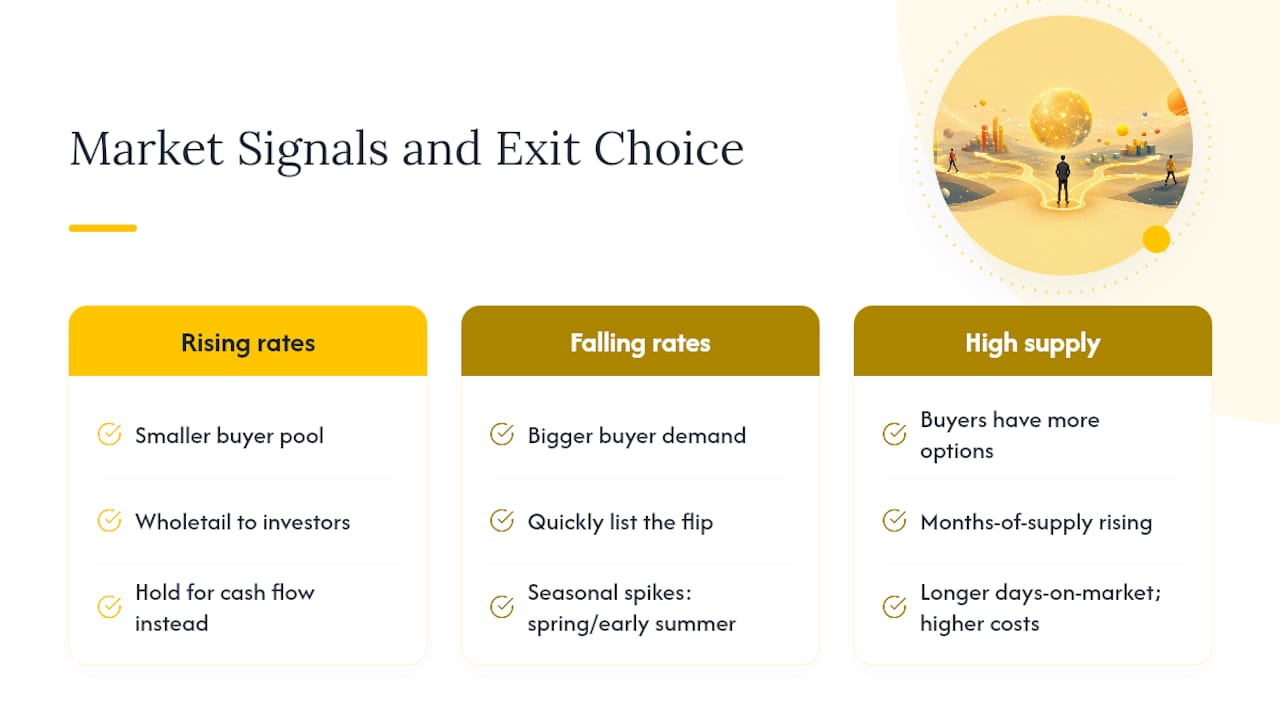
Timing your exit against market conditions can matter as much as the exit strategy itself. Track absorption rates and days-on-market trends in your specific submarket, not citywide averages, since flip-relevant neighborhoods often move independently of broader metro trends.
Rising interest rates tend to shrink your buyer pool for a quick sale, which is exactly when wholetailing to another investor or holding for cash flow becomes more attractive. Falling rates or seasonal demand spikes, typically spring and early summer in most markets, tend to favor listing quickly rather than waiting. Watch local inventory levels too: a market with rising months-of-supply is signaling that buyers have more options and less urgency, which stretches your days-on-market and erodes profit through extra carrying costs.
The investors who time exits well aren't predicting the market. They're building flexibility into their financing so they can pivot from flip to hold, or hold to refinance, without being forced by a maturing loan into a fire sale.
An Editorial Take on Exit-First Investing
Most flipping advice treats the exit as an afterthought, something you figure out once the rehab is finished and the property is ready to list. That sequencing is backward, and it's why so many flips underperform.
The conventional wisdom oversells the flip-or-hold binary. In practice, the more useful question isn't "sell or hold," it's "what loan structure keeps both options alive as long as possible." A loan with extension flexibility and milestone-based draws costs a little more upfront but buys you the ability to wait out a soft market or refinance instead of dumping a property at a loss.
Prioritize the acquisition discipline first. Everything downstream, staging, financing, timing, is secondary to whether the numbers worked on day one.
— Jason Taken
Sources
Before committing to an exit strategy, verify your assumptions with independent tools rather than relying on gut feel. The 70% rule and MAO calculator methodology is a good starting point for stress-testing any acquisition price against realistic rehab and holding costs.
If you're evaluating a lender for financing, NMLS Consumer Access is the public regulatory lookup for confirming a mortgage originator or lending entity is properly licensed. It takes five minutes and can save you from a costly mistake with an unlicensed or unreliable lender. For a deeper look at how the 70% rule applies to your own deals, Jaken Finance Group's 70% Rule / MAO Calculator walks through the math with worked examples specific to fix-and-flip underwriting.
- How to Flip a House: Essential Beginner Guide (2026)