
For most buy-and-hold rental investors scaling across markets, a DSCR loan is the stronger default choice. It underwrites on property cash flow rather than personal income, closes faster, and scales without requiring a banking relationship or personal financial disclosure. Portfolio loans win in specific situations: blanket financing across multiple properties under one note, unusual collateral that DSCR programs reject, or borrowers whose income documentation disqualifies them from programmatic underwriting.
Key trade-offs that change this recommendation:
- Blanket loans and cross-collateralization: Portfolio lenders can wrap multiple properties into a single note, simplifying payments but introducing cross-default risk. DSCR programs typically underwrite each property individually.
- Out-of-state investing: Programmatic DSCR underwriting scales across state lines without a local banking relationship. Portfolio lenders often concentrate in specific geographies.
- Balloon risk: Many portfolio loans carry 3–7 year balloon terms. DSCR products frequently offer 30-year amortization with no balloon, which materially reduces refinance risk.
Portfolio loans are usually superior when you need commercial or mixed-use collateral, when your personal income is irregular but your assets are substantial, or when a single blanket note across multiple properties is operationally preferable to managing separate DSCR notes.
Key Takeaways
For most rental investors, DSCR loans offer the most scalable and predictable financing path, while portfolio loans remain the better tool for blanket consolidation, unusual collateral, and relationship-driven approvals.
| Point | Details |
|---|---|
| DSCR scales across markets | Each property is underwritten independently on cash flow, with no personal income docs required. |
| Portfolio loans carry balloon risk | Most portfolio loans mature in 3–10 years; plan a documented exit strategy before signing. |
| Rate premiums apply to both | Portfolio loans often price 0.5–2 points above conventional; DSCR tracks a similar spread. |
| Cross-default risk is real | Blanket portfolio loans can trigger action on all pledged properties if one defaults. |
| Jaken Finance Group | Offers DSCR rental programs and asset-based hard money loans nationwide for investors at any stage. |
Table of Contents
- What is a DSCR loan vs a portfolio loan?
- How do DSCR and portfolio loans compare side by side?
- How do lenders actually underwrite each loan type?
- What do DSCR and portfolio loans actually cost?
- Which investors should use DSCR vs portfolio loans?
- What the research says about lender incentives and program design
- An editorial perspective on the DSCR vs portfolio loan decision
- Jaken Finance Group offers DSCR and asset-based lending for rental investors
- Sources
What is a DSCR loan vs a portfolio loan?
These two products solve different problems, and conflating them is one of the most common mistakes investors make when shopping for rental financing.
DSCR loan (Debt Service Coverage Ratio loan): A non-QM mortgage that qualifies the borrower based entirely on the subject property's cash flow. The lender divides gross monthly rent by the monthly PITIA (principal, interest, taxes, insurance, and association dues). A ratio at or above 1.0 means the property covers its own debt service; most programs require 1.0–1.25 as a minimum. No W-2s, no tax returns, no personal income verification. A single-family rental producing monthly rent exceeding its monthly PITIA payment by a sufficient margin typically meets program thresholds. DSCR programs underwrite on property cash flow and commonly remove personal income documentation, enabling faster, repeatable approvals for buy-and-hold investors.
Portfolio loan: A mortgage the lender keeps on its own balance sheet rather than selling to Fannie Mae, Freddie Mac, or the secondary market. Because the lender retains the credit risk, it sets its own underwriting rules. A portfolio loan held on the lender's balance sheet can be underwritten with flexible rules, but that flexibility often comes with higher rates and fees. A local bank financing a 6-unit mixed-use building for an investor with two years of self-employment income is a typical portfolio loan scenario.
Principal structural differences investors should track:
- Recourse: DSCR loans are often non-recourse (property is the collateral); portfolio loans frequently carry personal guarantees.
- Balloon risk: Portfolio loans commonly mature in 3–10 years with a balloon payoff; DSCR products often offer 30-year fixed terms.
- Documentation: DSCR requires a rent schedule, lease comps, and appraisal. Portfolio loans typically require tax returns, P&Ls, and bank statements.
- Lender type: DSCR programs are offered by non-bank lenders and mortgage companies with published guidelines. Portfolio loans come from banks, credit unions, and community lenders who hold notes in-house.
- Secondary market: DSCR loans are structured to be sold or securitized; portfolio loans are not, which is why the lender's own appetite and concentration limits matter.
How do DSCR and portfolio loans compare side by side?
The table below maps both products across the decision dimensions that most directly affect investor returns and scalability.
| Dimension | DSCR Loan | Portfolio Loan |
|---|---|---|
| Definition | Property cash-flow underwriting; no personal income docs | On-balance-sheet loan; lender sets own rules |
| Income documentation | Rent schedule, lease comps, appraisal | Tax returns, P&Ls, bank statements, personal financials |
| Credit score | Typically 620–680 minimum; published guidelines | Lender discretion; can approve below conventional minimums |
| DSCR threshold | Usually 1.0–1.25 minimum | Not always required; lender may substitute other metrics |
| Collateral structure | Single-property per note | Single or blanket (multiple properties, one note) |
| Cross-collateralization | Rare | Common with blanket loans; cross-default risk applies |
| Typical rate range | Varies with market; often 1–2 points above 30-year conventional | Varies; often 0.5–2 percentage points above conventional |
| Prepayment penalty | Common (step-down or fixed period) | Common; negotiable with relationship lenders |
| Balloon / term | 30-year fixed common; some 5/1 or 7/1 ARMs | 3–10 year balloon typical |
| Speed to close | Often 15–35 days through experienced lenders | 30–60+ days; committee approval adds time |
| Scalability | High; each property underwritten independently | Moderate; lender concentration limits apply |
| Non-recourse availability | More common | Less common; personal guarantees frequent |
| Availability | Non-bank lenders, mortgage companies nationwide | Banks, credit unions, community lenders; geography-dependent |
DSCR loan pros for investors:
- No personal income documentation required
- Faster, programmatic closings with published guidelines
- 30-year fixed terms available, eliminating balloon risk
- Scales across markets without a local banking relationship
- Non-recourse structures more accessible
DSCR loan cons:
- Typically limited to 1–8 unit residential properties
- Rate premiums above conventional benchmarks; use the FRED 30-year mortgage series as a market reference point
- Prepayment penalties can constrain early exit or refinance
Portfolio loan pros for investors:
- Blanket loans consolidate multiple properties under one payment
- Flexible underwriting for unusual collateral, mixed-use, or non-warrantable projects
- Relationship lenders can approve nonstandard borrowers
- Negotiable terms when the banking relationship is strong
Portfolio loan cons:
- Balloon maturities create refinance risk at maturity
- Cross-default clauses mean one underperforming property can trigger action on all pledged collateral
- Higher rates and fees reflect the lender's retained risk
- Lender discretion cuts both ways: approvals are less predictable
How do lenders actually underwrite each loan type?
Understanding the underwriting process helps investors prepare the right documents and set realistic timeline expectations before submitting an application.
DSCR loan underwriting checklist
- Rent schedule or executed lease: Current lease or market rent appraisal (Form 1007 or 1025 for multi-unit).
- Full appraisal: Confirms property value and supports LTV calculation; most programs cap at 75–80% LTV for purchases.
- Credit report: Minimum FICO typically 620–680 depending on the program; some lenders allow lower scores with compensating factors.
- Entity vesting documents: LLC operating agreement, articles of organization, EIN confirmation if vesting in an entity.
- Reserves verification: Most programs require 3–6 months of PITIA in liquid reserves post-closing.
- Insurance binder: Landlord or investment property policy, not homeowner's policy.
- No tax returns or W-2s required in most programmatic DSCR channels.
Worked DSCR calculation example:
- Gross monthly rent: $2,800
- Monthly principal and interest: $1,600
- Monthly taxes: $350
- Monthly insurance: $120
- Monthly HOA dues: $0
- Total PITIA: $2,070
- DSCR = $2,800 ÷ $2,070 = 1.35
A 1.35 DSCR clears the 1.25 threshold most programs require and would qualify at standard LTV. A ratio below 1.0 means the property does not cover its debt service, which disqualifies most DSCR programs outright. Some lenders offer "DSCR below 1.0" products at higher rates and lower LTV, but those are niche programs. Use a DSCR calculator to run these numbers before approaching any lender.
Typical DSCR timeline: 15–35 business days from application to close when the property meets published guidelines and the borrower delivers documents promptly.
Portfolio loan underwriting checklist
- Two years of personal and business tax returns
- Year-to-date P&L statement (for self-employed borrowers)
- 12–24 months of bank statements
- Personal financial statement (assets, liabilities, net worth)
- Existing property schedule with current rents and debt service
- Larger reserves: many portfolio lenders require 6–12 months of PITIA across all pledged properties
- Personal guarantee documentation
- Relationship history with the lender (deposit accounts, prior loans)
Portfolio lenders set their own underwriting standards and may approve borrowers who fail conventional criteria, but the lender's risk retention often leads to higher pricing and tighter reserve requirements. The committee-based approval process at most banks adds 2–4 weeks compared with programmatic DSCR channels. Providing a complete package upfront, including a property schedule and personal financial statement, is the single most effective way to compress that timeline.
What do DSCR and portfolio loans actually cost?
Rate and fee differences between these products are material over a 5–10 year hold period, and the structure of fees often matters as much as the rate itself.
Interest rates: Both products price above the conventional 30-year benchmark. Portfolio loans typically carry a premium of roughly 0.5–2 percentage points above conventional rates, depending on the lender's balance sheet appetite and the borrower's relationship strength. DSCR rates track a similar spread above conventional benchmarks, with the exact premium driven by LTV, DSCR ratio, credit score, and property type.
Origination fees: DSCR programs commonly charge 1–3 origination points. Portfolio lenders may charge lower points when a strong banking relationship exists, but this is negotiable rather than published.
Prepayment penalties: Both products frequently include prepayment penalties. DSCR loans often use a step-down structure (e.g., 5-4-3-2-1 over five years). Portfolio loans may use yield maintenance or a flat percentage. Investors planning to sell or refinance within 3–5 years should negotiate prepayment language before signing.
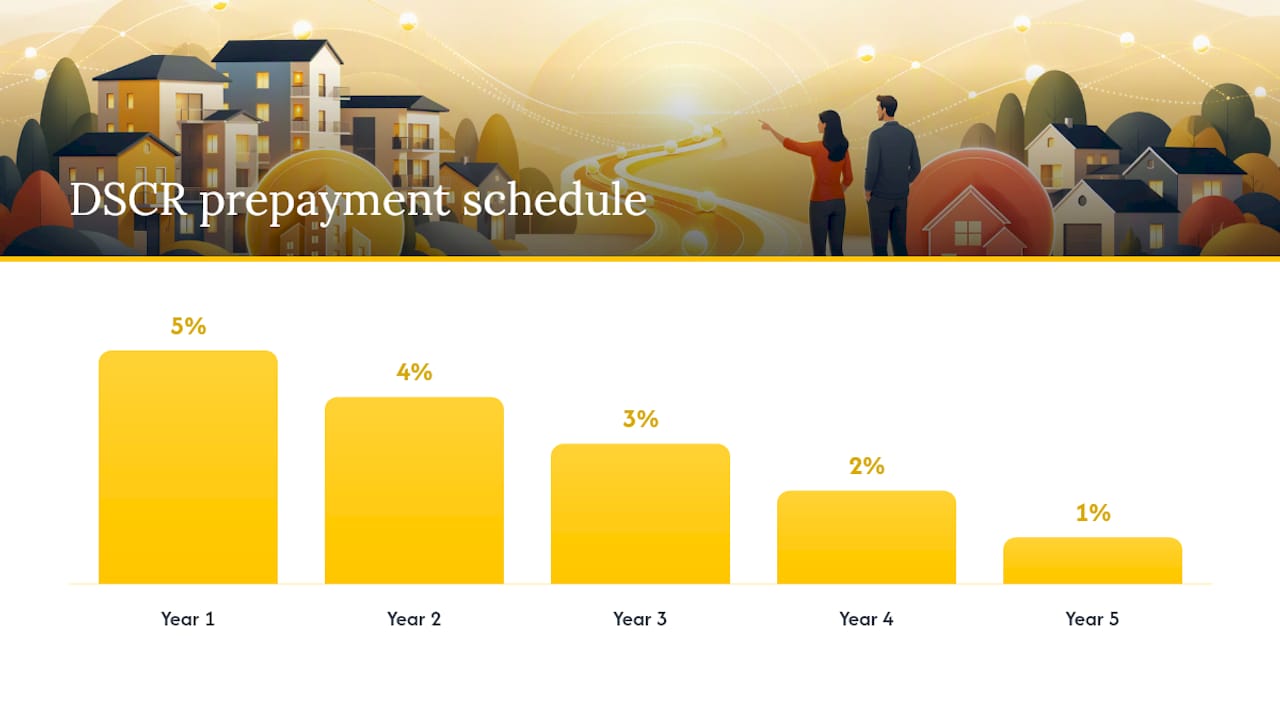
Balloon risk: This is the most underappreciated cost of portfolio loans. A 5-year balloon on a portfolio loan means the full principal balance is due at maturity. If rates have risen or the property's DSCR has declined, refinancing into a DSCR or conventional product may not be available at favorable terms. When refinancing a ballooned portfolio loan, seasoning requirements and DSCR thresholds can be gating factors for qualifying into a new program.
Negotiation checklist for both products:
- Ask whether the lender will sell or transfer the loan after closing (affects servicing and future modifications).
- Request the prepayment schedule in writing before signing the term sheet.
- Confirm whether the balloon term is extendable and under what conditions.
- For portfolio blanket loans, get the cross-default clause language in writing and understand which properties are pledged.
- Compare total cost of ownership (rate + points + prepayment exposure) across at least two lenders before committing.
Which investors should use DSCR vs portfolio loans?
Three investor profiles illustrate where each product fits and where the math changes the decision.
Scenario 1: Scaling buy-and-hold across multiple states
An investor with 12 single-family rentals across Texas, Florida, and Colorado, all held in LLCs, wants to add 3 more properties. Personal income is irregular because the investor is self-employed. A DSCR loan is the clear fit: each property is underwritten independently on its own cash flow, no tax returns are required, and the program is available in all three states. DSCR loans are generally better for investors scaling across markets because each deal is evaluated independently on property cash flow, while portfolio lenders can hit concentration limits as a borrower's portfolio grows.
Scenario 2: Local investor consolidating 6 properties into a blanket loan

An investor owns 6 single-family rentals in one metro area, all with separate notes at different lenders. Servicing 6 payments and 6 insurance policies is operationally burdensome. A portfolio lender offering a blanket loan can consolidate all 6 under one note, one payment, and one lender relationship. Portfolio lenders may offer blanket loans covering multiple properties, which simplifies payments and reporting for multi-property landlords but raises cross-collateralization and cross-default risk. The investor must weigh operational simplicity against the risk that one underperforming property could trigger action on all six.
Scenario 3: High-asset investor with irregular income documentation
An investor with $2.4 million in real estate equity and $800,000 in liquid assets has two years of losses on personal tax returns because of accelerated depreciation. Conventional and DSCR programs that review tax returns will see negative adjusted gross income. A portfolio lender reviewing the full financial picture, including assets, equity, and property-level cash flow, can make a discretionary approval that programmatic underwriting cannot. Portfolio lending is relationship-driven and allows lender discretion to approve nonstandard borrowers and properties, but it lacks the standardized speed of institutional DSCR programs.
Scenario checklist: matching investor priorities to loan type
- Scaling quickly across markets → DSCR
- No personal income documentation → DSCR
- Mixed-use or commercial collateral → Portfolio
- Blanket loan for 4+ properties → Portfolio
- 30-year fixed term, no balloon → DSCR
- Relationship with a local bank → Portfolio
- Out-of-state investing → DSCR
- Irregular income, high assets → Portfolio
What the research says about lender incentives and program design
The structural difference between these two products reflects fundamentally different lender incentives, and understanding those incentives helps investors negotiate more effectively.
DSCR programs are designed for repeatability. Published guidelines, standardized appraisal forms, and property-level underwriting allow lenders to process volume efficiently and sell loans into the secondary market. This programmatic structure benefits investors: predictable outcomes, faster timelines, and no dependence on a single lender's appetite. Programmatic DSCR channels reduce friction for active investors because published thresholds and property-focused underwriting let repeatable underwriting scale across markets.
Portfolio lending operates on a different logic. The lender retains the loan and the credit risk, which creates both the flexibility and the variability investors experience. Relationship-based portfolio lending offers discretion and potential exceptions but lacks the standardization and speed of institutional programs. A portfolio lender who knows the borrower's deposit history and track record can approve a deal that no algorithm would touch. The same lender can also decline without explanation, change terms at the last minute, or impose conditions that a programmatic lender would never require.
Practical guidance for working with each lender type:
- With DSCR lenders: submit a complete package on day one. Missing documents are the primary cause of delays in programmatic channels. Confirm the lender's minimum DSCR, LTV cap, and credit score floor before ordering an appraisal.
- With portfolio lenders: lead with the relationship. Deposit accounts, prior loan history, and referrals from existing clients carry weight that a cold application cannot replicate. Present a full property schedule and personal financial statement proactively.
- Ask any portfolio lender about their concentration policy: how many loans to one borrower, or in one zip code, will they hold? Hitting that ceiling mid-portfolio is a common and avoidable problem.
Pro Tip: When evaluating a portfolio lender's blanket loan offer, request the cross-default clause language in writing before the term sheet is signed. Some clauses trigger on a single missed payment across any pledged property; others require a cure period. The difference in language can determine whether one vacancy event becomes a portfolio-wide crisis.
An editorial perspective on the DSCR vs portfolio loan decision
The conventional framing of this comparison treats DSCR loans as the modern, scalable option and portfolio loans as the legacy fallback for borrowers who can't qualify elsewhere. That framing misses something important.
Portfolio loans are not a consolation prize. For investors building a concentrated local portfolio, a blanket portfolio loan from a community bank that knows the market can outperform a stack of individual DSCR notes on total cost, operational simplicity, and lender flexibility when a property underperforms. The cross-default risk is real, but so is the operational drag of managing 8 separate servicers, 8 insurance renewals, and 8 escrow accounts.
The more useful frame is this: DSCR loans are a repeatable tool for investors who prioritize speed, scale, and geographic diversification. Portfolio loans are a relationship tool for investors who prioritize consolidation, unusual collateral, or lender discretion. Most investors building a serious rental portfolio will use both at different stages.
Three tactical observations from the lender's perspective:
- Entity vesting matters from day one. Vesting properties in an LLC before the first DSCR loan closes protects personal assets and simplifies future portfolio transfers. Changing vesting after closing is expensive and sometimes triggers due-on-sale clauses.
- Plan the balloon exit before you sign. Any portfolio loan with a balloon term should have a documented exit strategy: refinance into DSCR if the property qualifies, sell, or negotiate an extension. Investors who discover at year 5 that their DSCR is 0.92 and rates have risen 200 basis points have no good options.
- Run the DSCR number before the appraisal. A property that pencils at 1.05 DSCR leaves almost no margin for vacancy, insurance increases, or tax reassessments. Target 1.20 or above as a working minimum for a property you intend to hold long-term.
Jaken Finance Group offers DSCR and asset-based lending for rental investors
Investors who want to act on this comparison without spending weeks shopping lenders have a direct path through Jaken Finance Group. Jaken's DSCR rental loan program underwrites on property cash flow, requires no personal income documentation, and is available across the United States, including active investor markets in Colorado, Florida, and Texas. For investors whose deals fall outside standard DSCR parameters, Jaken's asset-based hard money programs close on property value with no minimum credit score requirement, giving investors a direct alternative when programmatic underwriting declines the deal.
Jaken also offers commercial property loan programs for mixed-use and commercial collateral that standard DSCR channels exclude. Investors with funded deal questions or scenario-specific questions can review case studies at Jaken's website or submit a loan inquiry directly. To evaluate a specific property before applying, use Jaken's DSCR calculator to confirm the ratio clears program thresholds. Contact Jaken Finance Group to request a term sheet or prequalification review for your next acquisition.
Sources
- MORTGAGE30US series | FRED
- Portfolio Loans Guide: How They Work | Bankrate
- Portfolio lender explanation | Investopedia
- DSCR vs portfolio loan | HonestCasa
This article is general information, not a substitute for advice from a qualified financial advisor. Consult a qualified financial professional about your own circumstances before acting on anything here.