
DSCR underwriting qualifies a loan by the property's cash flow, not the borrower's paycheck: net operating income divided by the required debt payment. If the rent covers PITIA, the file can close without personal income documentation. Three numbers drive the decision: the debt service coverage ratio itself (usually 1.00 to 1.25 minimum), the reserve months in the bank, and the appraised market rent that anchors the whole calculation.
TL;DR:
- Most lenders require a minimum DSCR of 1.00, with better pricing available at 1.25 or higher, and smaller loans may have higher DSCR floors.
- Appraisals and rent schedules usually take the longest to process, with local appraiser availability often causing delays of several weeks.
- Running DSCR calculations on interest-only payments can often meet or exceed the required ratio, even if fully amortized payments fall short.
- Proper pre-application preparation, including gathering documents and running your own numbers, can significantly reduce closing times.
- Lenders may require higher reserves and tighter credit overlays than advertised, especially for smaller or lower-rated deals.
Table of Contents
- How DSCR Underwriting Calculates the Ratio
- The Underwriting Workflow From Credit Pull to Clear-to-Close
- Appraisal Forms, Market Rent, and Short-Term Rental Rules
- What DSCR Loan Programs Actually Require in 2026
- The Line Items That Swing a DSCR Calculation
- Common Deal-Breakers and How to Fix Them Before Underwriting Sees Them
- Your Pre-Application Checklist for Faster DSCR Approval
- Jaken Finance Group and Jason Taken: Practical DSCR Expertise
- An Underwriter's Three Tactical Tips From the Desk
- Fast, Flexible DSCR-Style Financing From Jaken Finance Group
- Sources
How DSCR Underwriting Calculates the Ratio
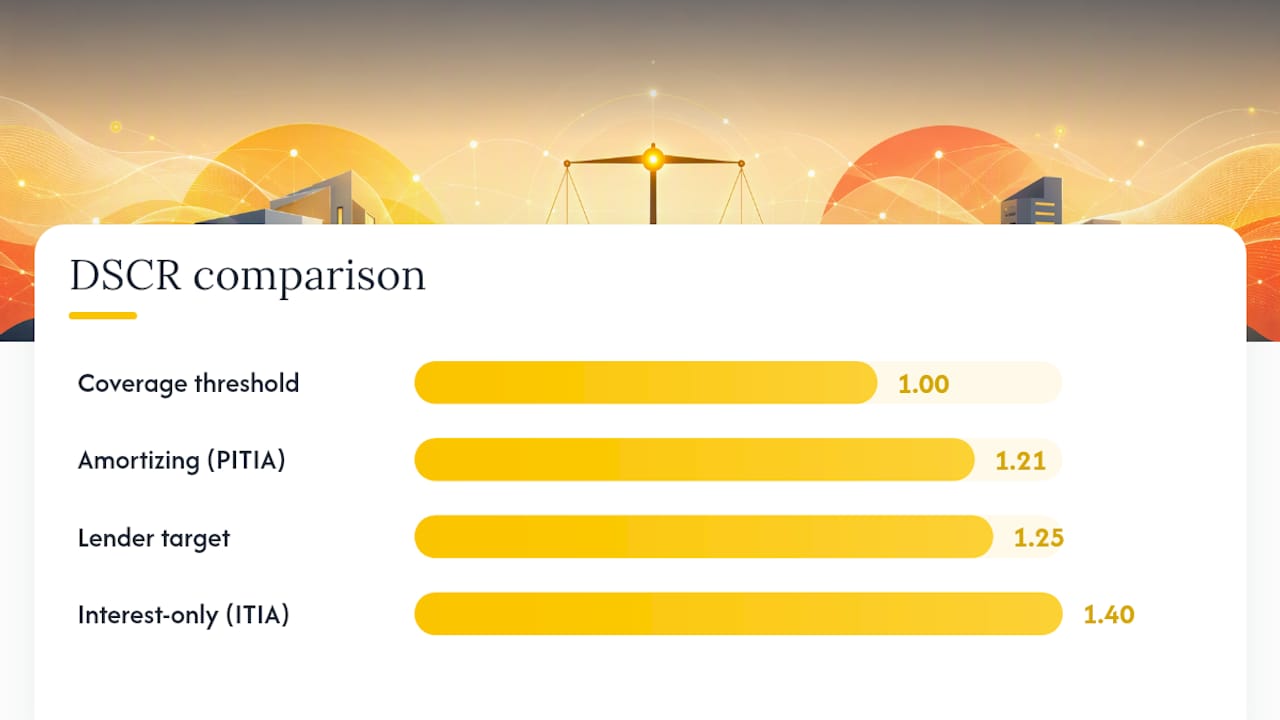
The formula is simple: DSCR equals net operating income (NOI) divided by total debt service. A ratio of 1.0 means the property's income covers its payment exactly. Most lenders treat 1.25 as the target for their best pricing, while a ratio below 1.0 signals the property loses money every month before accounting for the owner's own pocket.
NOI starts with gross rental income, minus vacancy allowance, property taxes, insurance, HOA dues, and operating expenses. It excludes the mortgage payment itself, along with depreciation and other non-cash accounting entries. Debt service, on the other hand, is calculated as PITIA for a fully amortizing loan: principal, interest, taxes, insurance, and association dues.
Interest-only loans swap that for ITIA (interest, taxes, insurance, association dues), stripping out the principal component entirely.
Amortizing example: A duplex generates $2,800 in monthly rent, with $2,240 NOI after expenses. A 30-year amortizing PITIA payment of $1,850 produces a DSCR of 1.21.
Interest-only example: Same property, same NOI, but an interest-only ITIA payment of $1,600 pushes the DSCR to 1.40, a meaningfully stronger number purely from a structuring choice.
The Underwriting Workflow From Credit Pull to Clear-to-Close
DSCR files move through a defined sequence, and knowing the order helps investors anticipate where delays happen. The process typically runs credit tiering, then appraisal and rent schedule, then the DSCR calculation, then title and entity review, then reserves verification, and finally the decision and conditions.
- Credit tri-merge and tiering. The lender pulls a tri-merge credit report and assigns a tier based in the middle FICO score. This tier immediately affects pricing and maximum LTV, since a borrower at 680 will see different leverage than one at 740, even on an identical property.
- Appraisal ordering and the rent schedule. The lender orders an appraisal that includes a market-rent schedule, typically Form 1007 for single-family and 2-4 unit properties or Form 1025 for larger multifamily assets. This step often takes longest in the file, sometimes running multiple weeks depending on local appraiser availability.
- DSCR calculation. With appraised value and market rent in hand, the underwriter runs the actual ratio, using the lower of the lease amount or the appraised market rent as the income figure.
- Title and entity documentation review. For investors closing in an LLC, the underwriter checks operating agreements, EIN documentation, and authorized signer resolutions. Title work confirms clear ownership and identifies any liens that need payoff at closing.
- Reserves verification. The underwriter confirms liquid reserves in a checking, savings, or brokerage account, sourced and seasoned according to program guidelines. Gift funds and unseasoned large deposits often trigger additional documentation requests.
- Decision and conditions. The file returns with either a clear-to-close or a list of conditions, ranging from updated bank statements to a revised insurance quote.
Two steps consume most of the calendar time: the appraisal turnaround and the borrower's speed in clearing conditions. A file that sits waiting on a signed lease addendum or a corrected insurance binder can lose a week for something that takes ten minutes to fix once flagged. Investors who assemble entity documents and insurance quotes before submitting an application routinely shave several days off the total timeline.
Appraisal Forms, Market Rent, and Short-Term Rental Rules
The appraisal does more than establish value. It generates the rent figure that determines whether the deal qualifies at all.
- Form 1004 provides the standard single-family appraisal but does not include a rent schedule on its own.
- Form 1007 attaches a single-family comparable rent schedule, used for 1-unit investment properties.
- Form 1025 covers 2-4 unit properties, providing both value and a small-income-property analysis.
- The lower-of-lease-or-market rule means an underwriter uses whichever figure is smaller: the actual signed lease or the appraiser's market-rent estimate. An investor holding a tenant at $1,600 when market rent is $1,900 gets underwritten at $1,600, per Fannie Mae's DSCR guidance. That gap matters at renewal, and savvy investors negotiate lease timing around a refinance application.
- Short-term rental income requires trailing revenue statements or platform data such as AirDNA, and lenders typically apply a haircut of 10% to 25% to that gross revenue before running the DSCR math, reflecting the volatility and management cost that long-term leases don't carry.
What DSCR Loan Programs Actually Require in 2026
Program sheets advertise round numbers, but the effective standard in the market usually runs tighter than the published floor. Here is what investors should expect walking into an application today.
- Minimum DSCR: Most programs set 1.00 as the underwriting floor, with 1.25 treated as the pricing sweet spot. Some lenders will underwrite sub-1.0 deals, and a smaller set offer no-ratio programs entirely, though both come with reduced leverage and pricing penalties.
- Loan-size quirks: Loans under certain lower limits often carry higher DSCR floors or different pricing tiers, since fixed underwriting costs weigh more heavily on smaller balances. Investors buying in lower-cost markets should factor this into acquisition math before assuming standard terms apply.
- Credit score tiers: Published floors sit around 620 to 660, but effective overlays push many lenders to 660 to 700 for competitive pricing. Interest-only structures typically demand 680 to 700 as a practical minimum, and the strongest terms, including maximum leverage and the lowest rate add-ons, generally require 720 or above.
- LTV ceilings: Purchase transactions on standard rental properties commonly cap at loan-to-value ratios in the mid to high seventies percentile range. Cash-out refinances run lower, and commercial-leaning or mixed-use properties frequently have tighter limits given the added valuation complexity.
- Reserve requirements: Smaller loans might require 2 to 6 months of PITIA in reserves, while larger balances or weaker DSCR ratios can push that to 9 or even 12 months. Industry commentary through 2026 notes that lenders are quietly requiring higher reserves and higher effective credit cutoffs than their advertised program sheets suggest, so treat published minimums as a starting point rather than a guarantee.
The Line Items That Swing a DSCR Calculation
Small adjustments to income and expense assumptions can move a deal from approved to declined, so it pays to understand exactly what an underwriter touches.
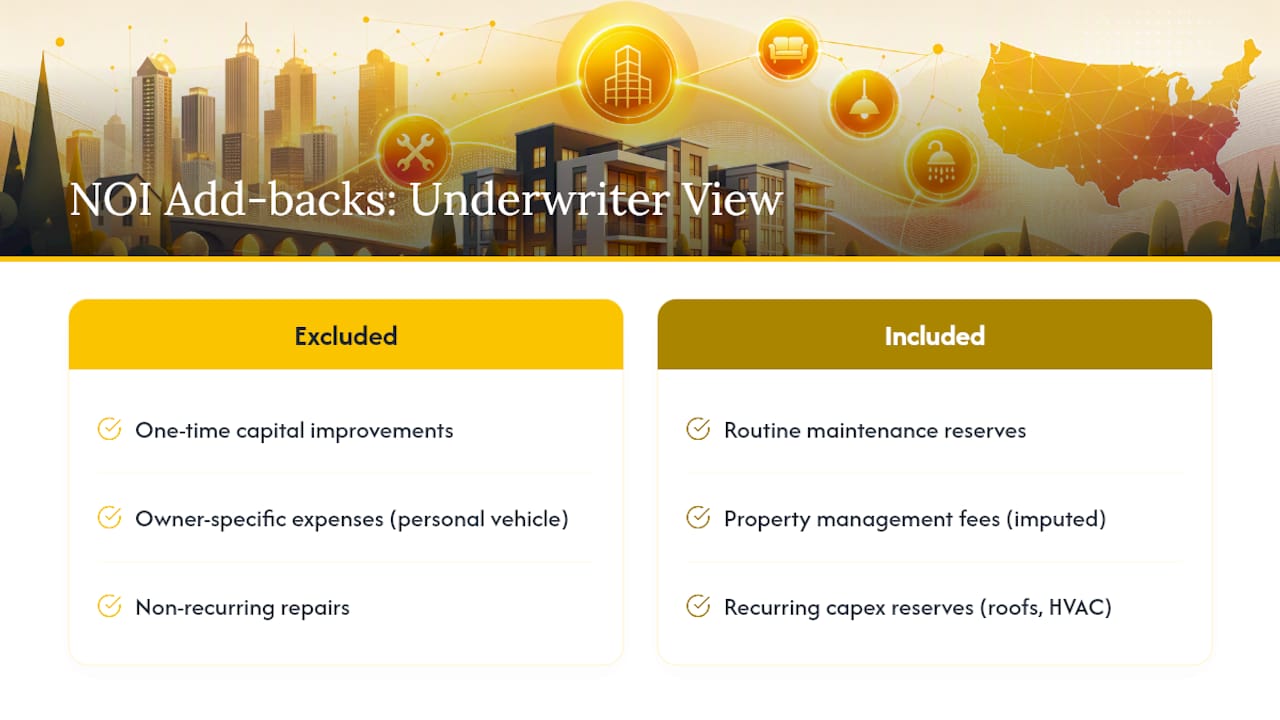
NOI add-backs get scrutinized closely. Underwriters typically exclude one-time capital improvements, owner-specific expenses like a personal vehicle run through the property LLC, and non-recurring repairs from the operating expense line, since these don't reflect ongoing property performance. What they will not exclude: routine maintenance reserves, property management fees even on self-managed properties (many programs impute a management expense regardless), and recurring capital expenditure reserves for items like roofs and HVAC systems.
Vacancy assumptions matter more than most first-time DSCR borrowers expect. Underwriters commonly apply a vacancy and collection loss factor, often 5% to 8% of gross rent, even on a property with a signed lease in place, because the ratio needs to hold up after that tenant eventually moves out.
HOA dues, special assessments, and insurance premium increases all flow directly into the PITIA denominator.
Pro Tip: Run your DSCR math with the interest-only (ITIA) payment before deciding on an amortizing structure. A property that misses the 1.00 threshold on a fully amortizing payment can clear 1.25 or higher on interest-only terms, since the principal component simply drops out of the denominator.
Common Deal-Breakers and How to Fix Them Before Underwriting Sees Them
Certain issues surface repeatedly in DSCR files, and most have known workarounds if addressed early.
- Appraisal shortfall: value comes in below the contract price. Mitigant: renegotiate price, bring additional cash to close, or challenge the appraisal with updated comps.
- Declining or thin comparable sales: appraiser flags a soft submarket. Mitigant: provide your own comp package with rent-roll support for a rebuttal.
- Below-market lease: existing tenant pays under market rent. Mitigant: plan a lease renewal at market rate before closing, or accept the lower qualifying figure and adjust leverage expectations.
- Deferred maintenance: appraiser notes needed repairs. Mitigant: escrow holdback for repairs completed post-closing, satisfying the lender without delaying the deal.
- Title issues: open liens or unclear ownership history. Mitigant: resolve through title company before closing; budget extra time.
Across nearly all of these, additional reserves or a larger down payment strengthen the file and give the underwriter room to approve an exception.
Your Pre-Application Checklist for Faster DSCR Approval
Preparation before submission consistently produces faster closings than reacting to conditions after the fact.
- Gather documents first: credit authorization, two to three months of bank statements, current leases, entity formation documents (operating agreement, EIN letter), an insurance quote, and the signed purchase contract.
- Pre-run your numbers: estimate the appraised market rent using comparable listings, calculate full PITIA at the anticipated rate, and run DSCR under both amortizing and interest-only scenarios so you know your options before the lender does.
- Confirm reserves post-closing: total your liquid reserves after accounting for the down payment and closing costs, then compare against likely program requirements for your loan size.
- Sequence your credit pull carefully: avoid other hard credit inquiries in the weeks before application, since multiple pulls can shift your tier. Order the appraisal as soon as the lender allows rather than waiting on other conditions to clear first.
- Lock strategically: understand your lender's rate-lock window relative to expected appraisal and underwriting timelines so you aren't forced to extend or relock at a worse rate.
A DSCR calculator can help you reproduce these numbers before you ever submit a file.
Jaken Finance Group and Jason Taken: Practical DSCR Expertise
Jason Taken has built educational resources for real estate investors, including loan calculators and underwriting guides, focused on translating agency-style DSCR rules into practical, asset-based lending decisions. These principles can be applied through underwriting models built around property cash flow and collateral value rather than rigid income documentation, potentially allowing files to close more quickly. The firm typically funds fix-and-flip, bridge, new construction, and DSCR rental loans for investors whose deals don't fit conventional agency timelines, often accommodating credit profiles and property conditions that bank programs decline outright.
An Underwriter's Three Tactical Tips From the Desk
Three things separate a smooth DSCR closing from a frustrating one. First, order your appraisal early. It's the longest step in the file, and every day you wait is a day added to your closing date. Second, address conditions in the order the underwriter lists them, not the order that's easiest for you. Reserve documentation and insurance conditions tend to sit at the top for a reason. Third, never assume your lease rent will be your qualifying rent. Run the math against appraised market rent first, so you aren't surprised when the numbers come back lower than expected.
— Jason Taken
Fast, Flexible DSCR-Style Financing From Jaken Finance Group
Some lenders offer closings in as few as five days by underwriting the property's value and cash flow rather than requiring the personal income documentation a bank demands. For investors who've read through the DSCR mechanics above and want a lender that applies asset-based logic without the credit-score gatekeeping, Jaken's programs cover hard money loans with no minimum credit score, bridge financing, and DSCR rental products built for exactly the scenarios this article walks through: below-market leases, short-term rental income, and interest-only structuring.
Investors managing multiple deals often need to move faster than a 45-day agency timeline allows, whether that's a competitive purchase, a refinance ahead of a rate change, or a portfolio acquisition where sellers want proof of funds now. Jaken's funded deal case studies show real funding ratios across property types. If you have a deal that needs DSCR-style underwriting without the wait, start by requesting a quote through Jaken Finance Group's asset-based lending page and get terms based on the property, not your tax returns.
Sources
Verify program details directly before applying. Fannie Mae's DSCR guidance explains appraisal-driven rent schedules in full regulatory detail. Investopedia's DSCR definition offers a clean formula reference. The FRED 30-year mortgage rate series helps with rate-assumption stress testing, and NMLS Consumer Access lets you confirm any lender's licensing before signing an application.
- Debt-Service Coverage Ratio (DSCR) definition — Investopedia
- DSCR Loan Requirements in 2026: Complete Qualification Checklist | DSCR Authority